
What Does a Mid-Market Company's First AI Sales Assistant Deployment Typically Look Like?
A mid-market company's first AI sales assistant deployment typically starts narrow: one or two assistive workflows (email drafting, call summaries, account research) rather than a fully autonomous selling motion. The goal is a measurable productivity win, not headcount reduction. According to Revenue Wizards, mid-market companies (51–200 employees) demonstrate the highest AI adoption in sales at 35%, surpassing early-stage teams — making this segment the leading edge of practical deployment.
Tools like Apollo's AI Sales Assistant are designed exactly for this entry point: an end-to-end GTM assistant that helps revenue teams research accounts, build prospect lists, generate messaging, and launch multi-step workflows from plain-language instructions, without requiring a data science team or a CRM rebuild. For RevOps leaders managing lean teams, that low-friction start matters.

Research Less, Pipeline More With Apollo
Tired of burning hours verifying contact info that goes nowhere? Apollo delivers 97% accurate business emails and mobile numbers so your reps spend time selling, not searching. Join 600K+ companies building pipeline faster.
Start Free with Apollo →Key Takeaways
- First deployments are assistive, not autonomous — email drafting, call notes, and account research are the typical entry points.
- Mid-market companies lead AI sales adoption, making them the most active first-deployers in the market today.
- Governance and human-in-the-loop checkpoints are not optional — they belong in the deployment plan from day one.
- The fastest ROI comes from CRM hygiene wins: meeting summaries flowing into pipeline records and reducing manual data entry.
- A phased approach (pilot, validate, expand) reduces risk and builds the internal proof needed to scale.
What Are the Typical First-Use Cases in a Mid-Market AI Sales Deployment?
The most common first-use cases are meeting summaries, email follow-up drafting, contact and account research, and CRM field updates. These use cases win early because the data already exists (meetings, emails, CRM records) and the ROI is easy to measure in rep time reclaimed.
Research from Insight Mark Research shows AI tools save sales representatives 11 to 12 hours per week by automating repetitive tasks such as call logging, CRM field updates, and follow-up scheduling. For a five-person SDR team, that's a material productivity lift without touching quota structures or headcount.
- Meeting recap to CRM: AI captures call notes and pushes structured data into pipeline fields automatically.
- Email follow-up drafts: AI generates personalized post-meeting emails using conversation context.
- Account and contact research: AI surfaces firmographic signals, funding events, and job changes before outreach.
- ICP-matched list building: AI builds prospect lists from natural-language descriptions of the ideal customer profile.
Spending too much time on manual outreach and research? Automate your sequences with Apollo's multi-channel sales engagement platform and let reps focus on conversations that close.
What Does the Deployment Ladder Look Like Stage by Stage?
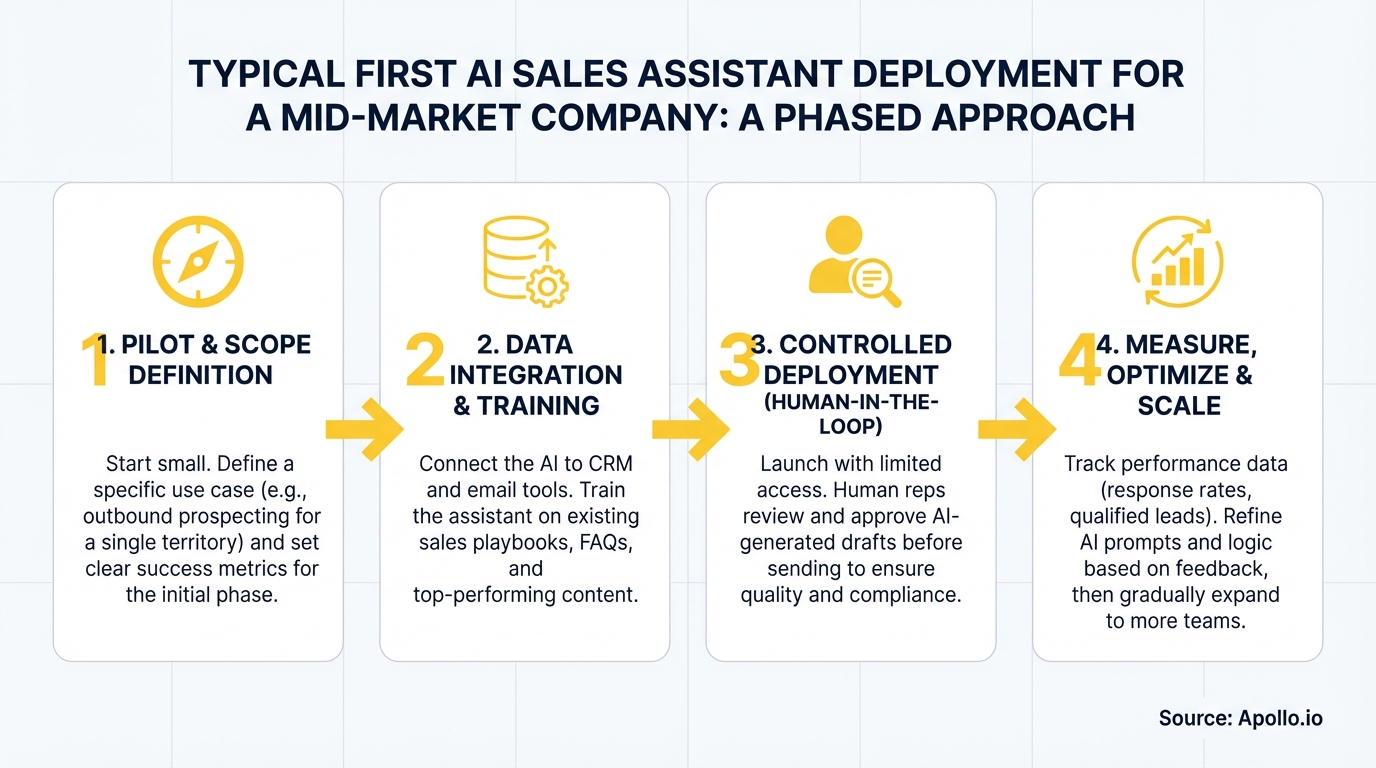
A mid-market first deployment follows a three-stage ladder: Pilot, Validate, and Expand. Each stage has a defined scope, a time horizon, and specific KPIs before advancing.
| Stage | Time Horizon | Scope | Stage-Gate KPI |
|---|---|---|---|
| 1. Pilot | Weeks 1–4 | 1–2 workflows, 3–5 reps, one ICP segment | Adoption rate >70%, output quality score baseline set |
| 2. Validate | Weeks 5–10 | Expand to full SDR/BDR team, add CRM integration | Time-to-first-touch reduced, meetings booked trend positive |
| 3. Expand | Weeks 11–16 | Add AE workflows, scoring, and automated sequences | Pipeline hygiene score, forecast accuracy improvement |
This matches the broader market pattern: most organizations start narrow and scale in stages. Jumping directly to autonomous agent workflows before validating output quality is the most common deployment mistake mid-market teams make.
How Do SDRs and RevOps Teams Use AI Differently in Early Deployments?
SDRs use AI assistants primarily to compress research time and increase outreach volume, while RevOps teams focus on data consistency, pipeline visibility, and workflow governance.
For SDRs, the immediate win is prospect list building and personalized sequence creation. Apollo's Outbound Copilot automatically finds contacts matching ICP filters, adds them to sequences, and generates multi-step outreach with signal-based personalization. Erik Fernando Nieto, BDR at JumpCloud, put it directly: "Apollo's AI Assistant filters and cleans prospect data for me, so I can find the right people faster and run better searches. It saves me about an hour per prospecting session."
RevOps leaders use AI to enforce sales analytics standards: consistent CRM field completion, automated scoring, and territory qualification. Harry Gable-Newkirk, Enterprise Sales Development Manager at YipitData, noted: "Apollo's AI Assistant helped me instantly qualify or disqualify accounts using the right signals — saving me at least a full day's work."
Turn Funnel Gaps Into Closed Deals
Tired of watching marketing leads die before they reach your pipeline? Apollo surfaces in-market buyers the moment they're ready, so your team stops guessing and starts closing. Trusted by 600K+ companies.
Schedule a Demo →What Governance and QA Steps Belong in Every First Deployment?
Governance belongs in the deployment plan from day one, not as an afterthought after something goes wrong. Every first deployment needs human-in-the-loop checkpoints, output sampling, and permissioning controls before AI-generated content reaches prospects.
A lightweight governance checklist for mid-market teams:
- Output sampling: Review a random sample (10–15%) of AI-generated emails and call summaries weekly during the pilot stage.
- Approval gates: Require human approval before AI adds new contacts to active sequences (Apollo's Outbound Copilot supports manual approval mode).
- Permissioning: Limit which reps can trigger autonomous actions vs. review-only outputs during the pilot phase.
- Accuracy logging: Track AI inaccuracy incidents (wrong contact details, hallucinated firmographics) and set a threshold for escalation.
- Message grounding: Configure the AI Content Center with your value proposition, ICP pain points, and differentiators so outputs stay on-brand and factually grounded.
The shift from assistive copilots to agentic workflows (where AI can qualify, route, schedule, and update CRM autonomously) makes governance an ops project, not just a prompt-writing exercise. Teams moving in this direction should define explicit human handoff points before expanding agent permissions.

How Do You Measure ROI from a First AI Sales Assistant Deployment?
ROI from a first deployment is measured through four finance-friendly metrics: rep hours reclaimed, time-to-first-touch, meetings booked per rep, and pipeline data completeness.
Data from Cirrus Insight shows that reps who use AI in their sales workflow are twice as likely to exceed their sales targets compared to non-users. Translate that into a measurement plan:
| Metric | Baseline (Pre-AI) | Target (Post-Pilot) | Data Source |
|---|---|---|---|
| Research time per account | Manual log estimate | Measurable reduction | Rep self-report + activity data |
| Time-to-first-touch | CRM timestamp | Shorter median | CRM sequence reports |
| Meetings booked per rep | Rolling 30-day avg | Positive trend | Calendar + CRM data |
| CRM field completion rate | Current % complete | Meaningful improvement | CRM audit report |
For sales productivity benchmarking, set baselines before the pilot starts. ROI claims without a pre-deployment baseline are difficult to defend to finance stakeholders.
Struggling to get clean pipeline data into your CRM? Build and manage your pipeline with Apollo's unified sales platform and stop losing deals to data gaps.
What Does Change Management Look Like for a Mid-Market Sales Team?
Change management for a first AI sales deployment is primarily an adoption problem, not a technology problem. Reps who see immediate time savings in their daily workflow adopt quickly; reps who feel their judgment is being replaced disengage.
Key enablement steps that reduce resistance:
- Start with a volunteer cohort of 3–5 reps who are curious about AI, not skeptical of it.
- Frame the rollout as a productivity tool, not a monitoring or replacement initiative.
- Share weekly wins publicly: which rep saved the most research time, which sequence had the best reply rate.
- Let reps edit and improve AI outputs so they build trust in the tool through use, not through mandate.
- Involve RevOps in AI assistant configuration so workflows reflect how the team actually sells, not a generic template.
The sales acceleration gains from AI only materialize when reps trust the outputs enough to act on them without second-guessing every line.

Ready to Run Your First AI Sales Deployment Without the Guesswork?
A mid-market company's first AI sales assistant deployment succeeds when it starts with a focused pilot, builds governance in from the start, and measures outcomes against a clear baseline. The pattern is consistent: assistive workflows first, CRM integration second, agentic automation third.
Apollo consolidates the tools this playbook requires into one platform: a 230M+ contact database, AI-powered research and sequence building, conversation intelligence, and an end-to-end GTM assistant that runs from a plain-language prompt. As Tory Kindlick, Head of Revenue Ops at RapidSOS, described it: "Work that would've taken me hours was done before I even got off the train."
For teams ready to move from spreadsheets and stitched-together point tools to a unified AI-powered GTM motion, the first step is a free account. Start your free trial of Apollo and run your first AI-assisted prospecting workflow today.
Prove Pipeline ROI With Apollo
ROI pressure killing your tool budget? Apollo delivers measurable pipeline impact from day one — so you can walk into any budget review with real numbers. Leadium 3x'd their revenue. You're next.
Start Free with Apollo →Don't miss these
Sales
Inbound vs Outbound Marketing: Which Strategy Wins?
Sales
What Is a Sales Funnel? The Non-Linear Revenue Framework for 2026
Sales
What Is a Go-to-Market Strategy? The 2026 GTM Playbook
See Apollo in action
We'd love to show how Apollo can help you sell better.
By submitting this form, you will receive information, tips, and promotions from Apollo. To learn more, see our Privacy Statement.
4.7/5 based on 9,690 reviews
