
What Does a Fair and Rigorous Sales Platform Evaluation Look Like for a 20-Person Team in 2026?
Most 20-person sales teams pick platforms the wrong way: they watch a demo, get dazzled by features, and sign a two-year contract they regret six months later. According to Destination CRM, 40% of CRM buyers prioritize features over usability, yet two-thirds of sales professionals use less than half of what's available. A fair and rigorous evaluation flips that: you set a measurable baseline, assign pre-committed weights, run a structured pilot, and score vendors against your actual workflows—not their best slide deck. If you're also thinking about how sales transformation fits into your growth strategy, this evaluation framework is the right starting point.

Scale Your Team Without the Chaos
Tired of inconsistent outreach and reps burning hours on manual research? Apollo standardizes your playbooks and surfaces verified contacts instantly. Join 600K+ companies building predictable pipeline at scale.
Start Free with Apollo →Key Takeaways
- Set a productivity baseline before talking to any vendor—your control metric anchors every scoring decision.
- Weighted scorecards with pre-committed categories prevent bias and "demo magic" from driving the final decision.
- Integration readiness is a gating criterion, not an afterthought—require a sandbox proof-of-concept before advancing a vendor.
- RevOps leaders and sales leaders should co-own the evaluation; SDRs and AEs should validate usability in the pilot.
- Multi-year TCO, renewal caps, and roadmap alignment matter as much as day-one features in a fast-moving market.
Why Does a Structured Evaluation Process Matter for a 20-Person Team?
A structured evaluation matters because small teams feel bad platform decisions immediately and with little buffer. Research from Forecastio shows companies with a formal sales process achieve 18% more revenue growth than those without—and the platform you choose either reinforces or undermines that process. At 20 seats, there is no IT department to absorb a failed rollout and no budget cushion to absorb a redundant contract.
The other risk is tool sprawl. Inaccord reports that on average, a sales representative uses at least six different tools to perform effectively. For a 20-person team, that fragmentation multiplies admin overhead, data inconsistency, and training burden. A rigorous evaluation explicitly scores for consolidation potential, not just feature depth. See our full breakdown of how to build a sales tech stack that scales revenue for additional context.
How Do You Set a Baseline Before Evaluating Any Vendor?
Establish your baseline by measuring current selling time, pipeline coverage, and conversion rates before contacting a single vendor. Use these numbers as your control group throughout the evaluation.
Without a baseline, every vendor's ROI claim is unverifiable.
For a 20-person team, track these four metrics for 30 days before starting outreach to vendors:
- Selling time ratio: Hours per rep per week spent on actual prospect or customer conversations vs. admin
- Pipeline coverage: Total pipeline value vs. quarterly quota
- Sequence reply rate: Average reply rate across current outreach channels
- Tool count per rep: How many platforms each rep logs into daily
Your pilot success criteria should target measurable improvement on at least two of these metrics. This gives you an objective standard to apply equally across every vendor you evaluate.
What Should a Weighted Scoring Framework Look Like?
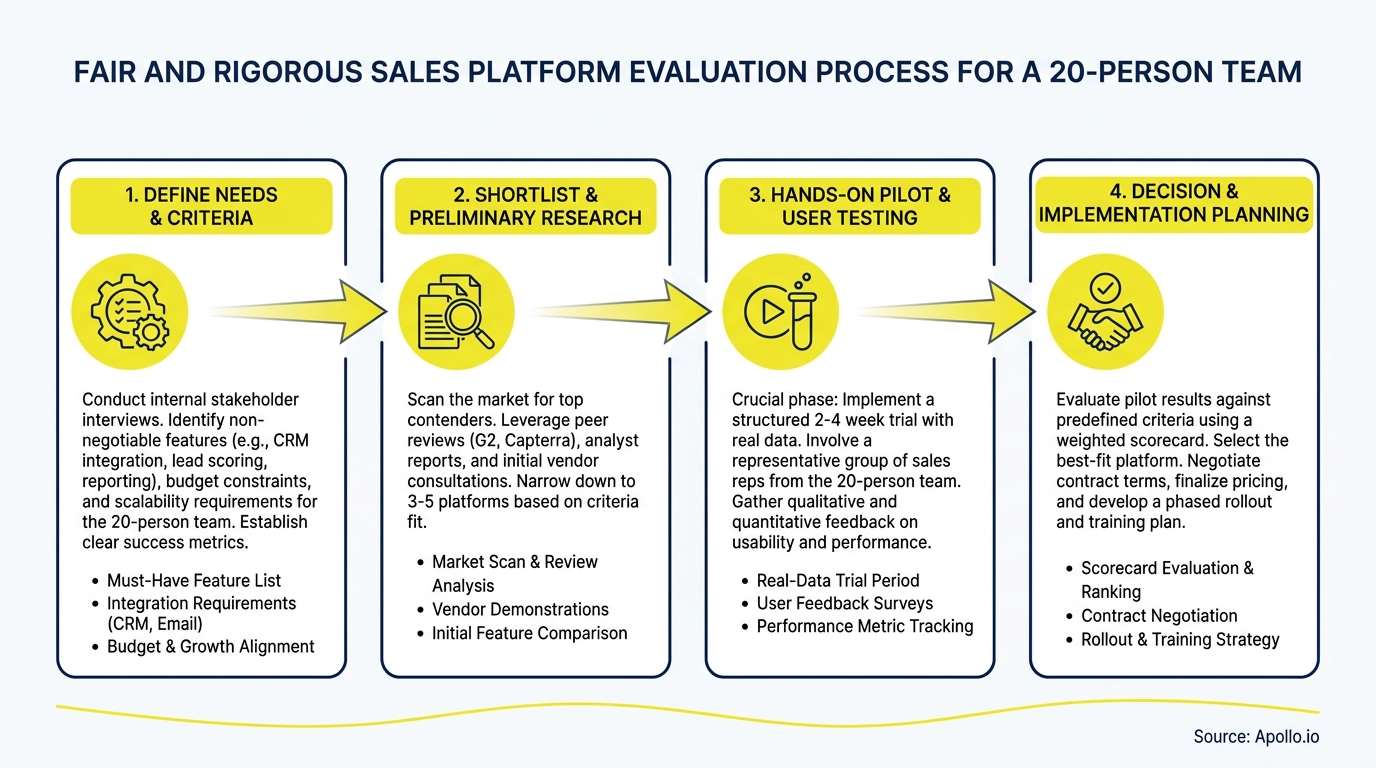
A weighted scoring framework for a 20-person team should include five categories with pre-committed weights agreed upon before any demos begin. Locking weights in advance prevents the team from unconsciously adjusting priorities to favor a vendor they already like.
| Evaluation Category | Suggested Weight | What to Measure |
|---|---|---|
| Workflow fit & usability | 30% | Reps complete real tasks without help in sandbox |
| Integration & data readiness | 25% | Bidirectional CRM sync, identity management, POC pass/fail |
| Multi-year TCO | 20% | Seat costs, AI add-ons, renewal caps, overage fees |
| Automation & AI capability | 15% | Sequence automation, AI-assisted messaging, workflow engine |
| Vendor viability & roadmap | 10% | Funding, customer base, product roadmap transparency |
Workflow fit earns the highest weight because sales performance management research consistently shows adoption drives outcomes, not feature count. Each evaluator scores independently before any group discussion to prevent anchoring bias.
How Should RevOps Leaders and Sales Leaders Structure Evaluation Governance?
Evaluation governance should assign a decision owner (typically a RevOps leader or VP of Sales), a technical validator, and at least two frontline reps—one SDR and one AE—as usability testers. Each role has defined tasks and a separate scorecard to prevent one voice from dominating.
- RevOps leader: Owns integration POC, data model review, and TCO model
- Sales leader: Owns workflow alignment, coaching features, and reporting accuracy
- SDR: Tests prospecting speed, sequence creation, and contact data quality in sandbox
- AE: Tests deal management, meeting scheduling, and pipeline visibility
- Finance/Ops: Reviews contract terms, renewal triggers, and multi-year cost model
Before the first vendor demo, hold a 60-minute cross-functional workshop to align on your ICP definition and lead qualification rules. Research from Gartner (survey of 243 CSOs, Nov–Dec 2024) found 49% of CSOs report that sales and marketing define qualified leads very differently. Resolving that disagreement before platform selection prevents you from buying a workflow that embeds the misalignment. Learn more about clarifying your ICP definition in sales before finalizing evaluation criteria.
Turn Funnel Gaps Into Qualified Pipeline
Tired of watching marketing leads stall before they ever reach sales? Apollo surfaces high-fit prospects with verified contact data and real-time buying signals. 600K+ companies trust Apollo to build pipeline that actually converts.
Start Free with Apollo →What Does a Structured Demo Script and Sandbox Task Pack Include?
A structured demo script replaces open-ended vendor presentations with specific scenario tasks your team scores in real time. Every vendor gets identical tasks in a sandbox environment populated with your data model, so comparisons are apples-to-apples.
Required sandbox tasks for a 20-person team evaluation:
- Build a 5-step multi-channel sequence targeting your primary ICP from scratch
- Import a 50-record CSV and verify field mapping to your CRM object structure
- Pull a pipeline report filtered by stage, owner, and close date without admin help
- Trigger an automated workflow when a deal stage changes
- Book a meeting from within the platform and confirm it syncs to the rep's calendar
- Demonstrate an AI-generated draft email using a specific prospect context
Score each task on a 1–5 rubric: 1 = could not complete, 3 = completed with significant friction, 5 = completed in under two minutes without guidance. Struggling to evaluate outreach platforms side by side? The Apollo vs. Outreach vs. Salesloft comparison is a useful reference for understanding how leading platforms handle these exact workflows.

How Do RevOps Teams Run a Rigorous Integration Proof-of-Concept?
RevOps teams should treat integration as a gating criterion: a vendor that fails the POC does not advance to commercial negotiation, regardless of other scores. Bain & Company research (April 2025) found 70% of companies struggle to integrate sales plays into CRM and revenue technologies—making this the highest-risk step for most evaluations.
Integration POC checklist (minimum requirements):
- Bidirectional sync verified: changes in the platform reflect in CRM within 5 minutes
- Custom fields mapped correctly to your existing CRM object schema
- Role-based permissions validated for at least three permission levels
- Activity logging confirmed: calls, emails, and meetings appear as CRM activities
- No professional services required to complete the above steps
Vendors that require a paid implementation engagement to complete basic bidirectional sync should receive a penalty in the integration scoring category. For teams evaluating consolidated platforms, sales analytics capabilities tied to CRM data are only as reliable as the sync quality beneath them.
Spending too much time managing disconnected tools? See how Apollo's sales engagement platform connects prospecting, sequences, and CRM in one workspace—eliminating the integration complexity that derails most evaluations.
How Should a 20-Person Team Evaluate Multi-Year TCO and Commercial Terms?
Multi-year TCO evaluation should model costs across three scenarios: current headcount, 30% team growth, and a platform expansion (adding AI features or a new use case). Build this model before entering any pricing negotiation so you have a number to anchor against vendor proposals.
Key commercial terms to negotiate and score:
- Annual renewal cap (target: no more than 5–7% increase without renegotiation rights)
- Seat flexibility: ability to add or remove seats without penalty mid-term
- AI and data feature gates: confirm which capabilities require separate add-on purchase
- Data portability: export rights for contacts, sequences, and activity history at contract end
- Security certifications: SOC 2 Type II or equivalent, provided before pilot begins
The CRM software market grew 12.2% in 2024 (Gartner), which means vendors have pricing leverage and packaging changes happen frequently. Build a renegotiation trigger into the contract at the 18-month mark.
Also score platforms on self-serve buyer support features: Gartner's 2024 buyer survey found 61% of B2B buyers prefer a rep-free buying experience, so platforms that only support rep-centric workflows create friction on both sides of your deals.
What Is the Right Pilot Structure for a 20-Person Sales Team?
The right pilot runs 30 days with four to six volunteer reps (including at least two SDRs and one AE), uses live accounts, and measures pre-committed success metrics against your baseline. A pilot with no pre-defined success criteria is not a pilot—it is an extended demo.
Pilot scorecard structure:
| Metric | Baseline (Pre-Pilot) | Target Threshold | Result |
|---|---|---|---|
| Selling time ratio | Measured in Week 0 | Measurable improvement | Record at Day 30 |
| Sequence reply rate | Current average | Improvement vs. baseline | Record at Day 30 |
| CRM data completeness | % of records with full fields | Improvement vs. baseline | Record at Day 30 |
| Onboarding time | N/A | Reps productive within 5 days | Record at Day 5 |
Collect qualitative feedback from pilot reps via a structured survey on Day 15 and Day 30. Ask specifically: "Would you voluntarily use this platform if the choice were yours?" Adoption intent is a leading indicator that feature scores alone cannot capture. Teams that need deeper guidance on connecting platform selection to revenue outcomes should also review how revenue operations drives growth.
Evaluating pipeline visibility as part of your pilot? See how Apollo's pipeline tools give sales leaders real-time deal visibility without switching tabs.

What Does a Complete and Fair Evaluation Deliver?
A complete and fair evaluation delivers a defensible, documented decision that the entire team understands and supports. It eliminates regret purchases, accelerates adoption, and sets a performance benchmark you can measure against in 90 days.
The process described above takes roughly six to eight weeks from baseline measurement to contract signature. That timeline is appropriate for a 20-person team: fast enough to maintain momentum, structured enough to avoid costly mistakes. For sales leaders managing team performance, the evaluation itself becomes a forcing function for aligning the team on process, ICP, and pipeline standards.
Apollo is built for exactly this moment. Trusted by nearly 100,000 paying customers including Anthropic, Redis, and Smartling, Apollo consolidates prospecting, multi-channel engagement, data enrichment, and pipeline management in one platform. "Having everything in one system was a game changer," noted the team at Cyera. When your evaluation is complete, Try Apollo Free and run your own sandbox tasks against a platform built to consolidate your tech stack, not add to it.
Prove Pipeline ROI From Day One
ROI pressure killing your tool approval? Apollo delivers measurable pipeline impact fast — with automation and verified data your leadership can actually see. Leadium 3x'd annual revenue. Your turn.
Start Free with Apollo →Don't miss these
Sales
Inbound vs Outbound Marketing: Which Strategy Wins?
Sales
What Is a Sales Funnel? The Non-Linear Revenue Framework for 2026
Sales
What Is a Go-to-Market Strategy? The 2026 GTM Playbook
See Apollo in action
We'd love to show how Apollo can help you sell better.
By submitting this form, you will receive information, tips, and promotions from Apollo. To learn more, see our Privacy Statement.
4.7/5 based on 9,690 reviews
