
What Causes Poor Email Deliverability and How Does It Hurt Outbound Sales?
Your outbound sequences may look perfect on paper, yet pipeline stays flat. The culprit is often invisible: emails that are accepted by mail servers but never seen by prospects. Poor email deliverability silently kills reply rates, meeting bookings, and revenue before your copy even gets a chance. If you want to fix this problem at the root, start with these five steps to improve email deliverability.

Apollo Turns Hours of Research Into Seconds
Tired of burning your best selling hours on manual lead research and dead-end contact data? Apollo surfaces verified contacts instantly so your team spends time closing, not digging. Nearly 100K paying customers already made the switch.
Start Free with Apollo →Key Takeaways
- "Delivered" does not mean "seen" — inbox placement is the metric that actually drives pipeline.
- Missing authentication (SPF, DKIM, DMARC) is one of the most preventable causes of poor deliverability, yet most domains remain exposed.
- Google now enforces a spam complaint rate threshold that outbound teams can breach without realizing it, with serious consequences at scale.
- SDRs and RevOps leaders who treat deliverability as a revenue KPI recover pipeline faster than those who focus only on copy or volume.
- Verified, accurate contact data directly reduces bounce rates and complaint rates — protecting sender reputation at the source.
What Is Poor Email Deliverability and Why Does It Matter?
Poor email deliverability occurs when outbound emails fail to reach a prospect's primary inbox, ending up in spam, promotions, or going missing entirely. The critical distinction is between delivery rate (accepted by the mail server) and inbox placement rate (landed in the inbox). A message can register as "delivered" while the prospect never sees it.
Data from Landbase shows the global average email deliverability sits at 83.1%, meaning approximately 16.9% of legitimate emails fail to reach intended inboxes. For outbound sales teams running high-volume sequences, that gap compounds rapidly across every campaign.
What Are the Main Causes of Poor Email Deliverability?
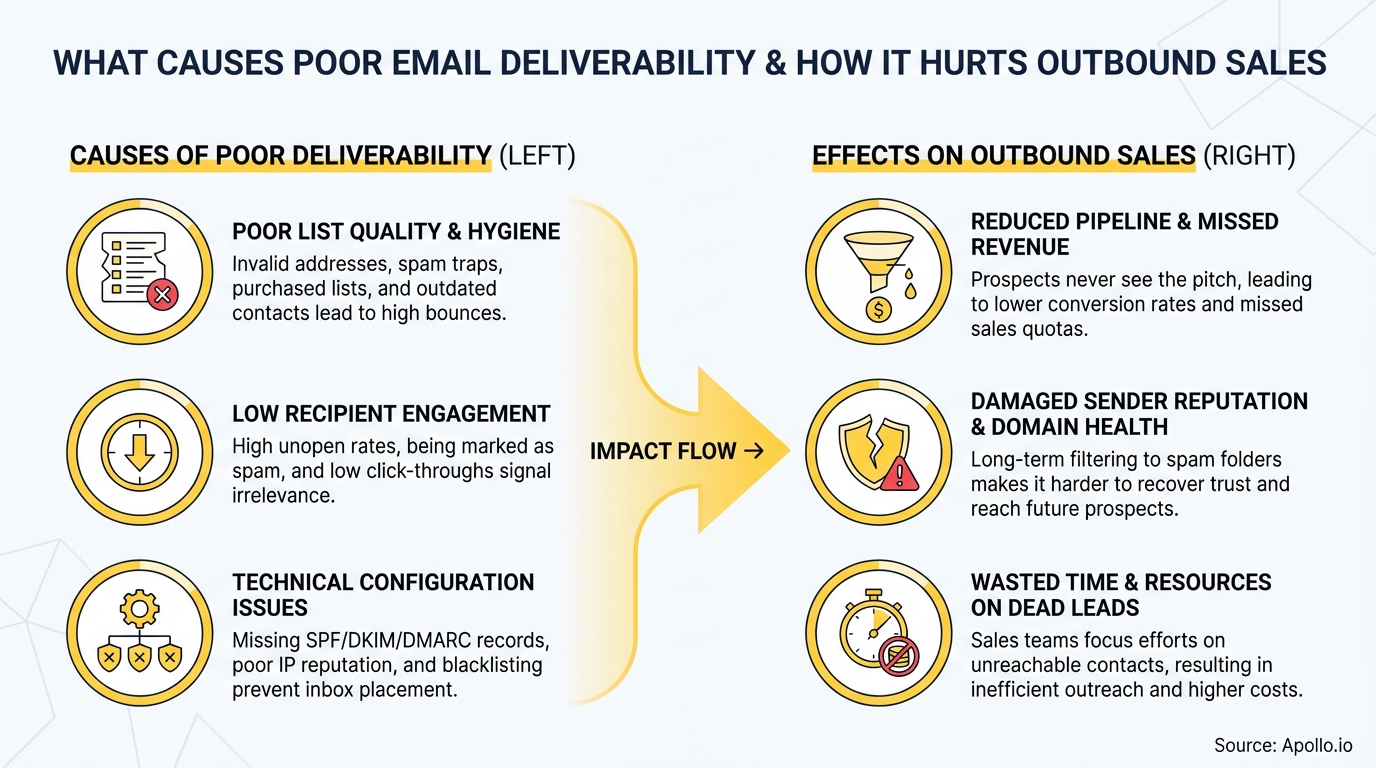
Poor deliverability has four primary causes: missing authentication, unverified contact data, high complaint rates, and sending behavior that triggers filters.
| Cause | What It Means | Pipeline Impact |
|---|---|---|
| No SPF/DKIM/DMARC | Mailbox providers can't verify sender identity | Emails routed to spam or blocked outright |
| High bounce rates | Invalid or outdated contact emails | Damages domain reputation permanently |
| Spam complaints | Prospects mark emails as spam | Triggers provider throttling and blacklisting |
| Low engagement | Low open/reply rates signal irrelevant sends | Algorithms deprioritize future sends |
| Sending spikes | Sudden volume jumps on cold domains | Flagged as suspicious, filtered at scale |
According to research from The Digital Bloom, only 7.6% of domains enforce DMARC, leaving 92.4% vulnerable to spoofing and aggressive ISP filtering. Authentication is no longer optional — Google and Yahoo mandated it for bulk senders starting in early 2024, and Microsoft followed with Outlook enforcement in 2025.
Struggling to send outbound at scale without killing your domain reputation? Apollo's multi-channel sales engagement platform includes built-in deliverability guardrails so your sequences stay compliant and visible.
How Does Poor Deliverability Hurt Outbound Sales Pipeline?
Poor deliverability shrinks your effective reach, which directly reduces meetings booked, opportunities created, and revenue generated. The damage is compounding: every email that lands in spam also harms future sends by lowering your sender score.
For SDRs running cold outreach, the numbers are already tight. Research from Martal shows the average cold email response rate is only about 1-5%. If deliverability problems cut your effective inbox placement, your real response rate drops to a fraction of that already-thin benchmark. SDRs then increase volume to compensate, which worsens complaint rates and accelerates the problem.
RevOps leaders find that deliverability failures also create attribution blind spots. If emails aren't reaching inboxes, open and click data is meaningless, making it impossible to accurately diagnose whether sequences need better copy or simply better reach. For a deeper look at how sales analytics should drive these decisions, see how sales analytics drives revenue growth.

How Do SDRs and RevOps Teams Diagnose Deliverability Problems?
SDRs and RevOps teams diagnose deliverability problems by monitoring three core signals: spam complaint rate, bounce rate, and inbox placement rate (not just delivery rate).
- Spam complaint rate: Google's sender guidelines require keeping this below 0.1% and avoiding 0.3% or higher, which triggers severe delivery penalties. At 1,000 emails per day, that means no more than 1 complaint before you're in a danger zone.
- Bounce rate: Hard bounces above 2% signal list quality issues and damage domain reputation quickly.
- Inbox placement rate: Use seed testing tools to see where emails actually land, not just whether servers accepted them.
- Engagement patterns: Declining open rates over a campaign period often indicate spam folder placement, not prospect disinterest.
According to SQ Magazine, fully authenticated domains are 2.7 times more likely to achieve inbox placement compared to unauthenticated ones. Fixing authentication is the highest-leverage single action most outbound teams can take. Pair that with verifying email addresses before sending to eliminate hard bounces before they accumulate.
Turn Funnel Guesswork Into Pipeline Confidence
Pipeline forecasting a guessing game because leads stall before they ever reach your AEs? Apollo surfaces high-intent prospects and keeps your funnel moving with verified contacts that convert. Nearly 100K paying customers stopped guessing and started closing.
Start Free with Apollo →What Sending Behaviors Trigger Spam Filters at Scale?
Certain outbound behaviors consistently trigger spam filters, even when authentication is correct and the message content is legitimate.
- Over-sequencing: Research from Belkins shows that sending 4+ emails in a sequence can more than triple unsubscribe and spam complaint rates.
- Spam-trigger language: Words like "free," "guaranteed," or excessive punctuation in subject lines increase filter scores.
- Cold domain warming skipped: Sending high volume immediately from a new domain triggers provider suspicion.
- No unsubscribe option: Required for bulk senders under Google's 2024 guidelines and Microsoft's 2025 enforcement.
- Mismatched sending patterns: Irregular volume spikes damage IP and domain reputation with behavioral filters.
For outbound prospecting at scale, this means sequencing discipline matters as much as copy quality. Fewer, better-targeted sends to a verified list outperform high-volume spray campaigns every time.
How Do SDRs Protect Sender Reputation While Hitting Volume Targets?
SDRs protect sender reputation by combining tighter ICP targeting, verified contact data, and controlled sending cadences — rather than increasing raw volume when pipeline lags.
- Use verified, frequently refreshed contact data to keep bounce rates under control.
- Limit sequences to 3 or fewer touchpoints before pausing and re-evaluating engagement.
- Spread sends across multiple sending domains to reduce per-domain complaint exposure.
- Monitor Google Postmaster Tools weekly for domain reputation scores and spam rate signals.
- Personalize at the account level, not just the first name, to drive genuine engagement over complaint risk.
Dirty contact data is one of the fastest ways to blow up a sender domain. If your list contains stale or invalid emails, your bounce rate climbs, your reputation drops, and your entire outbound program pays the price. Apollo's data enrichment keeps your contact records accurate with 97% email accuracy across 230M+ verified business contacts, so you're not burning your domain on bad data.
For a complete guide on writing messages that earn replies without triggering filters, see how to write sales emails that get responses.
How Does Poor Deliverability Connect to Broader Revenue Operations?
Poor deliverability is a revenue operations problem, not just a technical one. When email reach degrades, every downstream metric suffers: pipeline coverage, forecast accuracy, and sales cycle length all worsen without an obvious cause.
For AEs and revenue leaders, the risk is invisible: sequences appear to be running, activity metrics look normal, but meetings aren't booking because prospects never saw the emails. This is why revenue operations teams are increasingly treating inbox placement as a core KPI alongside pipeline and conversion rate. Deliverability ops, like RevOps, requires cross-functional ownership between sales, marketing, and IT.
How Do You Fix Poor Email Deliverability and Recover Outbound Pipeline?
Fixing poor deliverability requires addressing authentication, list quality, and sending behavior in sequence. Start with the highest-impact actions first.
- Authenticate your sending domain: Set up SPF, DKIM, and DMARC records. This single step is the foundation for all deliverability improvements.
- Verify and clean your contact list: Remove invalid emails before sending. Maintain bounce rates below 2%.
- Monitor complaint rates actively: Stay below 0.1% on Google. Any spike above that threshold requires immediate list review.
- Warm new domains gradually: Start with low daily volumes and ramp up over 4-6 weeks.
- Reduce sequence length: Keep cadences to 3 steps or fewer for cold outreach until engagement benchmarks improve.
- Use inbox placement testing: Confirm where your emails are actually landing, not just that servers accepted them.
For a step-by-step diagnostic process, see how to reach inboxes and dodge spam filters.

Start Fixing Deliverability Before Your Next Sequence
Poor email deliverability is a silent pipeline killer. Authentication gaps, bad contact data, and aggressive sending patterns combine to strip your outbound program of its reach — even when your copy, targeting, and process look solid on paper.
The fix starts with clean data, proper authentication, and smarter sending cadences. Apollo gives SDRs, AEs, and RevOps teams the verified contact data, built-in engagement tools, and sequencing controls to run outbound that actually reaches inboxes. "Having everything in one system was a game changer" — Cyera.
Try Apollo Free and start sending outbound that lands where it's supposed to.
Prove Pipeline ROI From Day One
ROI pressure killing your next budget approval? Apollo delivers measurable pipeline impact fast — so you walk into every review with hard numbers. Nearly 100K paying customers made the business case stick.
Start Free with Apollo →Don't miss these
Sales
Inbound vs Outbound Marketing: Which Strategy Wins?
Sales
What Is a Sales Funnel? The Non-Linear Revenue Framework for 2026
Sales
What Is a Go-to-Market Strategy? The 2026 GTM Playbook
See Apollo in action
We'd love to show how Apollo can help you sell better.
By submitting this form, you will receive information, tips, and promotions from Apollo. To learn more, see our Privacy Statement.
4.7/5 based on 9,690 reviews
