
What Are the Most Important Components of a Successful Outbound Sales Sequence in 2026?
Most outbound sequences fail before the first reply arrives. The problem isn't effort—it's architecture. A successful outbound sales sequence in 2026 requires more than a drip of emails: it needs a buyer-enablement structure, role-based messaging, deliverability-first setup, and proof assets that work even when no rep is involved. If you're building or rebuilding your sequence, start with what makes a sales sequence actually work—then use the blueprint below.

Research Less, Close More With Apollo
Tired of burning hours verifying emails and chasing dead-end contact info? Apollo delivers 97% email accuracy across 230M+ contacts so your team spends time selling, not searching. Start building real pipeline today.
Start Free with Apollo →Key Takeaways
- A verified ICP and clean, enriched contact data are the non-negotiable foundation of every sequence.
- Modern buyers prefer self-serve paths—your sequence must include assets that enable decisions without a rep present.
- Deliverability (SPF/DKIM/DMARC, list hygiene) is now a structural sequence requirement, not an IT afterthought.
- Multi-stakeholder, role-based messaging significantly outperforms one-size-fits-all outreach in complex B2B deals.
- Third-party proof integrated directly into sequence steps accelerates trust and buying confidence.
What Is an Outbound Sales Sequence and Why Does Structure Matter?
An outbound sales sequence is a coordinated series of multi-channel touches—email, phone, and social—designed to move a prospect from cold awareness to qualified conversation. Structure matters because uncoordinated outreach wastes rep time and erodes sender reputation. According to MarketingProfs, B2B decision-makers cite high-quality leads and precise targeting as their top expectations from outbound strategy. Without a deliberate structure, even large volumes of outreach fail to deliver those outcomes.
The most effective sequences function as buyer-enablement workflows: each step moves the prospect closer to a confident decision, not just closer to a calendar invite. For a deeper look at sequence design, see how to build winning outbound cadences.
What Are the Core Components Every Sequence Needs?
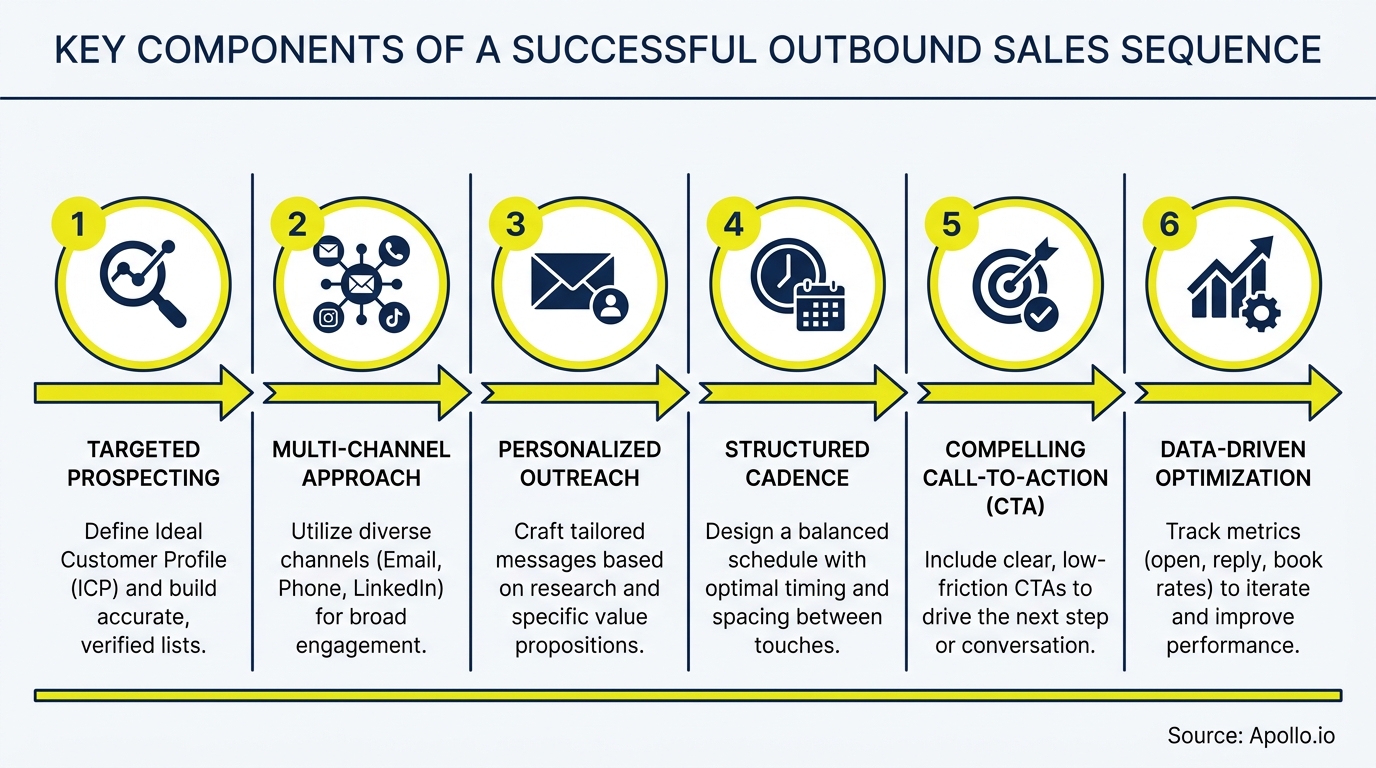
The most important components of a successful outbound sales sequence are: a verified ICP, clean contact data, a deliverability-ready sending infrastructure, multi-channel touches with role-based messaging, proof assets, and self-serve conversion paths. Each component addresses a specific failure point.
| Component | What It Does | Common Failure Without It |
|---|---|---|
| Verified ICP + Clean Data | Ensures outreach reaches real decision-makers | High bounce rates, wasted rep time |
| Deliverability Infrastructure | Gets emails into the inbox | Spam folder, domain blacklisting |
| Multi-Channel Cadence | Reaches buyers on their preferred channels | Low response rates, single-touch fatigue |
| Role-Based Messaging | Speaks to each stakeholder's specific concerns | Generic messaging that gets ignored |
| Proof Assets | Builds trust without a rep present | Stalled deals, unresolved buyer objections |
| Self-Serve Conversion Path | Enables rep-free evaluation and decision-making | Prospects disengage before booking a meeting |
Why Does Deliverability Come Before Copywriting?
Deliverability is the prerequisite that determines whether any other sequence component gets a chance to perform. Since February 2024, bulk senders (5,000+ emails per day) must have SPF, DKIM, and DMARC authentication in place to meet Google and Yahoo inbox requirements—and enforcement has only tightened since.
A great email that lands in spam has zero reply rate.
Your deliverability preflight checklist before launching any sequence:
- Domain authentication: SPF, DKIM, and DMARC records configured and verified
- Sender reputation: Warm new domains gradually (start at 20–30 emails/day)
- List hygiene: Remove invalid, duplicate, and unengaged contacts before import
- Unsubscribe compliance: One-click unsubscribe link in every email
- Bounce monitoring: Pause sequences if hard bounce rate exceeds 2%
Struggling to keep your contact data clean enough to protect deliverability? Start free with Apollo's 230M+ verified business contacts and reduce bounce risk at the source.

How Do SDRs and AEs Build Role-Based Multi-Stakeholder Sequences?
SDRs and AEs need separate messaging tracks for each buying role because a single sequence message rarely resonates across the full decision-making group. Complex B2B purchases involve multiple departments and stakeholders, each evaluating the decision through a different lens: business value, technical fit, or day-to-day usability.
Research from Martal shows that 63% of buyers are more likely to engage with personalized outreach that directly addresses their industry or role. Build three parallel tracks:
- Economic Buyer (VP/C-Suite): Lead with ROI, TCO, and risk reduction. Include an ROI model or executive summary as a self-serve asset in step 2 or 3.
- Technical Evaluator: Lead with integration details, security posture, and implementation plan. Link to a technical spec sheet or security brief.
- End User (Practitioner): Lead with workflow impact and time savings. Include an interactive demo or trial link as the primary CTA.
AEs managing mid-market or enterprise accounts should coordinate these tracks simultaneously rather than sequentially. Multi-threading from the first touchpoint shortens sales cycles and prevents single-threaded deals from stalling when one contact goes dark. For real sequence examples, see the top 3 sales sequences in Apollo.
Turn Funnel Guesswork Into Pipeline Confidence
Tired of watching marketing leads die before they ever reach your pipeline? Apollo surfaces in-market buyers at the exact moment they're ready, so your team stops chasing cold contacts and starts closing. 600K+ companies already know.
Start Free with Apollo →What Role Do Proof Assets Play in a Modern Sequence?
Proof assets—third-party reviews, case studies, comparison pages, and implementation previews—are core sequence components, not optional attachments. A 2024 Gartner Digital Markets survey of 2,400+ business decision-makers found that 98% say reading reviews prior to purchase is important and 66% prefer reviews verified by a third party.
Sequences that embed proof at the right step remove the buyer's need to go hunting for validation elsewhere.
Place proof assets strategically:
- Step 2 or 3: Link to a relevant G2 review page or verified case study that matches the prospect's industry
- Step 4–5: Share a competitor comparison page or implementation timeline to reduce risk perception
- Final step: Include a customer story from a similar company as a breakup email alternative
As The Playbook Agency notes, personalization is shifting from a manual task to a structured, repeatable process—and proof selection is part of that structure.
How Should Sequences Connect to Self-Serve Conversion Points?
Sequences should connect to self-serve conversion points because a growing share of B2B buyers prefer to evaluate and decide without synchronous rep involvement. A 2025 Gartner survey found that 61% of B2B buyers prefer a rep-free buying experience overall.
Outbound sequences that only push for a meeting call lose the majority of buyers who want to self-evaluate first.
Build self-serve pathways directly into your sequence steps:
- Step 1: Link to a relevant blog post or use-case page (low commitment)
- Step 3: Offer an interactive demo or product tour (medium commitment)
- Step 5: Share a free trial link or self-serve pricing page (high commitment)
- All steps: Include a one-click meeting link as an option, not the only CTA
Spending too much time building sequences manually across disconnected tools? Automate your multi-channel sequences with Apollo's sales engagement platform—email, phone, and social in one workspace. As Cyera's team put it: "Having everything in one system was a game changer."
For a complete look at the B2B sales techniques that complement strong sequence design, including social selling and cold calling best practices, that resource covers the full picture. And if you're optimizing the email component specifically, data-backed email subject lines are one of the highest-leverage refinements you can make.
How Do You Measure Whether Your Sequence Components Are Working?
Measure sequence performance by tracking pipeline-connected metrics, not vanity engagement metrics. Opens and clicks tell you about deliverability and curiosity.
Meetings held, pipeline created, and cost per qualified meeting tell you whether the sequence is working as a revenue engine.
| Metric | What It Measures | Action Trigger |
|---|---|---|
| Reply Rate | Messaging relevance | Below 2%: rewrite step 1 subject line and opener |
| Meetings Held Rate | ICP quality + CTA clarity | Below benchmark: tighten ICP filters or soften first CTA |
| Pipeline Created per Sequence | Full-sequence revenue impact | Flat or declining: test proof asset placement or add a channel |
| Hard Bounce Rate | List hygiene + deliverability | Above 2%: pause and re-enrich contact list |
| Unsubscribe Rate | Messaging fatigue or ICP mismatch | Spiking: reduce touch frequency or narrow targeting |
Data from Marketing Eye confirms that leveraging comprehensive data in outbound campaigns leads to increased conversion rates and reduced wasted effort. RevOps leaders should set baseline benchmarks per sequence variant and run structured tests—channel mix, persona variant, proof asset placement—before making broad changes.

How Do You Build This Into a Repeatable Outbound System?
The most important components of a successful outbound sales sequence—ICP clarity, deliverability infrastructure, role-based multi-channel messaging, embedded proof, and self-serve pathways—work best when they live in a single, unified system rather than scattered across multiple tools.
Teams that consolidate prospecting, sequencing, and data enrichment into one platform eliminate the handoff failures that break sequences at the seams. Predictable Revenue's team described the shift directly: "We reduced the complexity of three tools into one." That consolidation is what turns a sequence from a one-time campaign into a repeatable revenue engine.
Apollo gives SDRs, AEs, and RevOps teams one workspace for contact discovery, enrichment, multi-channel sequencing, and pipeline tracking. No more switching between a data tool, an engagement platform, and a CRM to run a single sequence. Start free with Apollo and build your next sequence with every component in one place.
Prove Pipeline ROI With Apollo
ROI pressure killing your next budget approval? Apollo delivers measurable pipeline impact from day one — no guesswork, no slow ramp. Leadium 3x'd annual revenue. Your CFO wants proof. delivers it.
Start Free with Apollo →Don't miss these
Sales
Inbound vs Outbound Marketing: Which Strategy Wins?
Sales
What Is a Sales Funnel? The Non-Linear Revenue Framework for 2026
Sales
What Is a Go-to-Market Strategy? The 2026 GTM Playbook
See Apollo in action
We'd love to show how Apollo can help you sell better.
By submitting this form, you will receive information, tips, and promotions from Apollo. To learn more, see our Privacy Statement.
4.7/5 based on 9,690 reviews
