
What Is a Sales Workshop and How Does It Drive Revenue in 2026?
Most sales workshops teach tactics. The best ones rewire how your team thinks about buyers. With the average B2B win rate sitting at just 21%, according to TryKondo, the gap between winning and losing often comes down to how well reps understand the buying network they're navigating. A well-designed sales workshop closes that gap. For teams looking to improve outcomes, pairing workshop insights with strong sales analytics is the fastest path to measurable change.

Research Less, Pipeline More With Apollo
Tired of your reps burning hours verifying contact info instead of selling? Apollo delivers 96% email accuracy across 224M contacts so your team hits the phones faster. Start building real pipeline today.
Start Free with Apollo →Key Takeaways
- A sales workshop is a structured training session that builds specific skills, aligns team behavior, and connects learning to pipeline outcomes.
- Modern B2B buying involves an average of 13 internal stakeholders, so workshops must cover multi-threaded selling, not just individual deal tactics.
- Training investment pays off: for every dollar spent on sales training, companies see a $4.53 return.
- SDRs, AEs, and RevOps leaders each need different workshop formats tailored to their daily workflows and quota targets.
- Workshops that include GenAI enablement and digital-first selling skills are becoming table stakes for high-performing teams in 2026.
What Is a Sales Workshop?
A sales workshop is a focused, interactive training session designed to build specific skills, align team behavior, and produce measurable improvements in pipeline or quota performance. It differs from a sales training seminar in one key way: workshops are hands-on.
Participants practice, role-play, and solve real deal challenges during the session itself.
Common formats include half-day intensives, full-day offsites, or virtual cohort sessions spread across multiple weeks. The best workshops connect directly to sales KPIs your team is already tracking, so outcomes are measurable from day one.

Why Do Sales Teams Need Workshops in 2026?
The B2B buying environment has fundamentally shifted. According to Hyperbound, for every dollar spent on sales training, companies see a $4.53 return. Yet most teams still train reactively, only when performance drops.
Three forces make structured workshops essential right now:
- Larger buying committees: An average of 13 people are involved in a B2B purchase decision (Forrester, 2024). Reps who only know how to sell to one champion consistently lose to teams that map the full network.
- Digital-first buyers: Gartner projects 80% of B2B sales interactions will occur in digital channels. Reps need digital selling skills, not just phone and email scripts.
- GenAI adoption: Nearly 95% of buyers anticipate using GenAI to support their purchase decisions (Forrester, 2024). Sellers who don't understand AI-assisted buying are already behind.
Struggling to keep your pipeline healthy after workshop insights? Build a stronger pipeline with Apollo's AI-powered pipeline tools.
What Should a High-Impact Sales Workshop Cover?
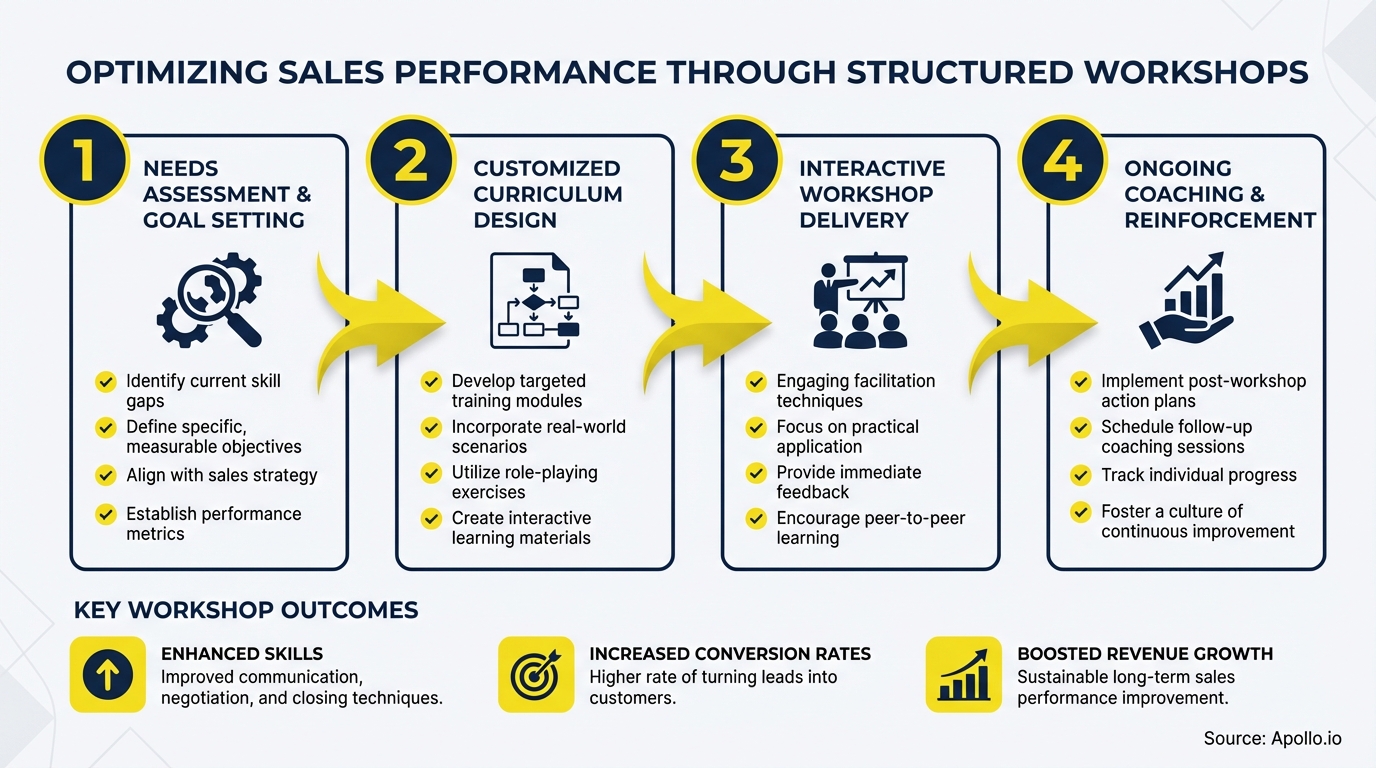
The most effective workshops address the specific failure points in your current deals. Here is a framework built around the four modules that move the needle most:
| Module | What It Covers | Who Benefits Most |
|---|---|---|
| Buying Network Mapping | Stakeholder roles, decision criteria, risk owners, influencer paths | AEs, Enterprise reps |
| Deal Stall Diagnosis | Stall triggers, next-best-content playbooks, ROI verifiers | AEs, Sales Leaders |
| Digital-First Selling | Self-serve journey design, async demos, social outreach | SDRs, BDRs, AEs |
| GenAI Enablement | Prompt libraries, content QA, AI-assisted personalization | All roles |
| Objection Handling | Frameworks for price, timing, and competitor objections | SDRs, BDRs, AEs |
For teams closing complex deals, the enterprise sales playbook is a strong companion resource to any buying network mapping module.
Turn Funnel Guesswork Into Real Pipeline
Tired of watching marketing leads stall before they ever reach your team? Apollo surfaces high-intent prospects and accelerates top-of-funnel conversion. Over 550K companies now forecast with confidence.
Start Free with Apollo →How Do SDRs and AEs Get Different Value from Sales Workshops?
A one-size-fits-all workshop wastes time. SDRs and AEs face different challenges and need different skill-building focuses.
For SDRs and BDRs:
- Prospecting precision: identifying the right contact in a multi-stakeholder account
- Multi-channel sequencing: combining email, phone, and social outreach effectively
- Objection handling at the top of funnel, where most conversations die early
- Using AI tools to personalize outreach at scale without losing authenticity
For Account Executives managing active deals:
- Mapping all buying stakeholders before the deal stalls
- Running multi-threaded conversations across finance, legal, and end users simultaneously
- Building ROI calculators and business case assets to accelerate committee approval
- Mastering late-stage objection handling when deals go quiet
For RevOps leaders, the workshop deliverable is different: a measurement framework that ties workshop content usage to win rate and deal velocity, tracked through a unified platform rather than disconnected spreadsheets.
How Do You Build a Deal-Stall Reduction Framework in a Workshop?
Deal stalls are the single biggest killer of forecast accuracy. A focused workshop module can diagnose why deals stall and build playbooks to unblock them. Use this five-step approach:
- Identify the stall signal: Define what "stalled" means in your CRM (days without activity, stage age, engagement drop).
- Map the missing stakeholder: Most stalls happen because a blocker or risk owner was never engaged. Cross-reference your stakeholder map.
- Select the next-best asset: Match a content asset (ROI calculator, security one-pager, case study) to the specific objection causing the stall.
- Re-engage with a digital-first touchpoint: Send an async video, interactive demo, or personalized email sequence rather than another generic follow-up call.
- Track and attribute: Log what worked in your deal management platform so the playbook improves over time.
Need better visibility into which deals are at risk? Get complete pipeline visibility with Apollo's deal management tools.

How Do You Measure the ROI of a Sales Workshop?
A workshop without measurement is a retreat. Tie every workshop to at least three pipeline metrics tracked before and after the session.
| Metric | What It Measures | Tracking Tool |
|---|---|---|
| Win Rate Change | Overall deal close rate shift post-workshop | CRM / RevOps dashboard |
| Deal Velocity | Average days to close before vs. after | Pipeline analytics |
| Stall Rate | Percentage of deals stuck in a stage 14+ days | Deal management platform |
| Quota Attainment | Percentage of reps hitting or exceeding quota | Sales performance tool |
| Content Usage | How often workshop assets are used in live deals | Enablement platform |
Research from Forecastio shows that organizations implementing a structured sales enablement process experience a 15% increase in win rates compared to those without one. A structured workshop is the fastest way to build that process. For a broader view of what to track, the sales productivity blueprint covers the full measurement stack.
How Do You Run a Sales Workshop That Actually Sticks?
Most workshop learning fades within weeks. These design principles prevent that:
- Anchor to real deals: Use live pipeline examples, not hypothetical scenarios. Reps engage when their actual quota is on the table.
- Build assets during the session: Participants should leave with a completed stakeholder map, a stall-diagnosis checklist, or a personalized outreach sequence.
- Assign a 30-day reinforcement plan: Weekly micro-practices, manager coaching check-ins, and a shared Slack channel for wins and questions.
- Integrate tools, not just concepts: If the workshop covers a new sales pitch framework, reps should practice it inside the tools they use daily. See how to build a sales tech stack that supports ongoing learning.
- Include a skilled sales trainer who can facilitate role-play, give real-time feedback, and adapt the agenda to what the room actually needs.
Start Turning Workshop Insights into Pipeline
A sales workshop is only as valuable as the system that supports it after the session ends. The best teams combine structured training with tools that reinforce new behaviors daily: verified contact data for prospecting practice, engagement automation for multi-channel sequencing drills, and deal management visibility to track stall reduction in real time.
Apollo consolidates all of that into one platform. As Cyera's team put it: "Having everything in one system was a game changer." Whether you're an SDR sharpening your outreach or a sales leader building a cross-functional enablement program, Apollo gives your team the infrastructure to turn workshop skills into quota attainment. Schedule a Demo and see how Apollo supports every stage of your sales workshop outcomes.
Prove Pipeline ROI With Apollo
ROI pressure killing budget approvals? Apollo delivers measurable pipeline impact your leadership can't argue with. Leadium 3x'd their annual revenue — see your own numbers fast.
Start Free with Apollo →Don't miss these
Sales
Inbound vs Outbound Marketing: Which Strategy Wins?
Sales
What Is a Sales Funnel? The Non-Linear Revenue Framework for 2026
Sales
What Is a Go-to-Market Strategy? The 2026 GTM Playbook
See Apollo in action
We'd love to show how Apollo can help you sell better.
By submitting this form, you will receive information, tips, and promotions from Apollo. To learn more, see our Privacy Statement.
4.7/5 based on 9,690 reviews
