
Sales Tracking Software for Small Business: Definition, Benefits, and Best Practices
Small business owners face a common challenge: sales reps spend just 28% of their week actually selling, with the rest consumed by admin work, data entry, and pipeline management. Yet according to Freshworks, 71% of small businesses (500 or fewer employees) now use CRM software to regain control of their sales process. The difference between thriving teams and struggling ones often comes down to how well they track deals, automate repetitive tasks, and turn data into actionable insights.
The right sales tracking software doesn't just organize your pipeline. It eliminates tool sprawl, cuts manual data entry, and gives founders and sales leaders real-time visibility into what's working. For teams choosing small business sales software that actually scales, the goal is simple: more time selling, less time tracking.

Apollo Finds Contacts While You Focus On Selling
Tired of spending 4+ hours daily hunting for contact info? Apollo delivers 224M verified contacts with 96% email accuracy. Join 550K+ companies who replaced research time with revenue time.
Start Free with Apollo →Key Takeaways
- Sales tracking software reduces admin burden and gives small business teams 70%+ more time for revenue-generating activities
- Implementing CRM can increase company sales by up to 29% and improve forecast accuracy by 42%
- All-in-one platforms consolidate 3-5 separate tools, cutting costs in half while providing unified contact data, engagement automation, and pipeline visibility
- Poor data quality blocks 44% of analytics initiatives, making data governance and enrichment critical for ROI
- AI-powered workflow automation is now accessible to SMBs, enabling 24/7 lead follow-up and intelligent deal prioritization
What Is Sales Tracking Software for Small Business?
Sales tracking software for small business is a platform that centralizes contact management, deal tracking, activity logging, and pipeline reporting in one workspace. It replaces spreadsheets, disconnected tools, and manual processes with automated workflows that capture every customer interaction across email, phone, and social channels.
Modern sales tracking platforms integrate three core capabilities: a B2B contact database for prospecting, engagement tools for multi-channel outreach, and deal management for pipeline visibility. For small businesses, this means one unified system instead of juggling separate tools for data enrichment, email sequencing, and CRM.
Research from WPForms shows implementing a CRM can increase company sales by up to 29%. The ROI comes from better lead qualification, faster follow-up, and data-driven forecasting that helps teams focus on deals most likely to close.
Why Do Small Business Sales Teams Need Tracking Software?
Small business sales teams need tracking software because manual processes don't scale. When SDRs and AEs spend hours logging calls, updating spreadsheets, and searching for contact information, they lose time that should go toward conversations and deal progression.
According to LinkPoint360, sales forecasts can increase by up to 42% after implementing a CRM system. For founders and sales leaders, accurate forecasting means better hiring decisions, smarter budget allocation, and predictable revenue growth.
Key benefits for small business teams:
- Time savings: Automated activity logging and data capture eliminate 60-90 minutes of daily admin work
- Pipeline visibility: Real-time dashboards show exactly where deals stand and which reps need coaching
- Tool consolidation: One platform replaces separate contact databases, email tools, and spreadsheet trackers
- Data accuracy: Enrichment and validation prevent the dirty data that blocks 44% of analytics initiatives
Can't see which deals are about to close? Get complete pipeline visibility with Apollo's deal management platform.
How Does Sales Tracking Software Work?
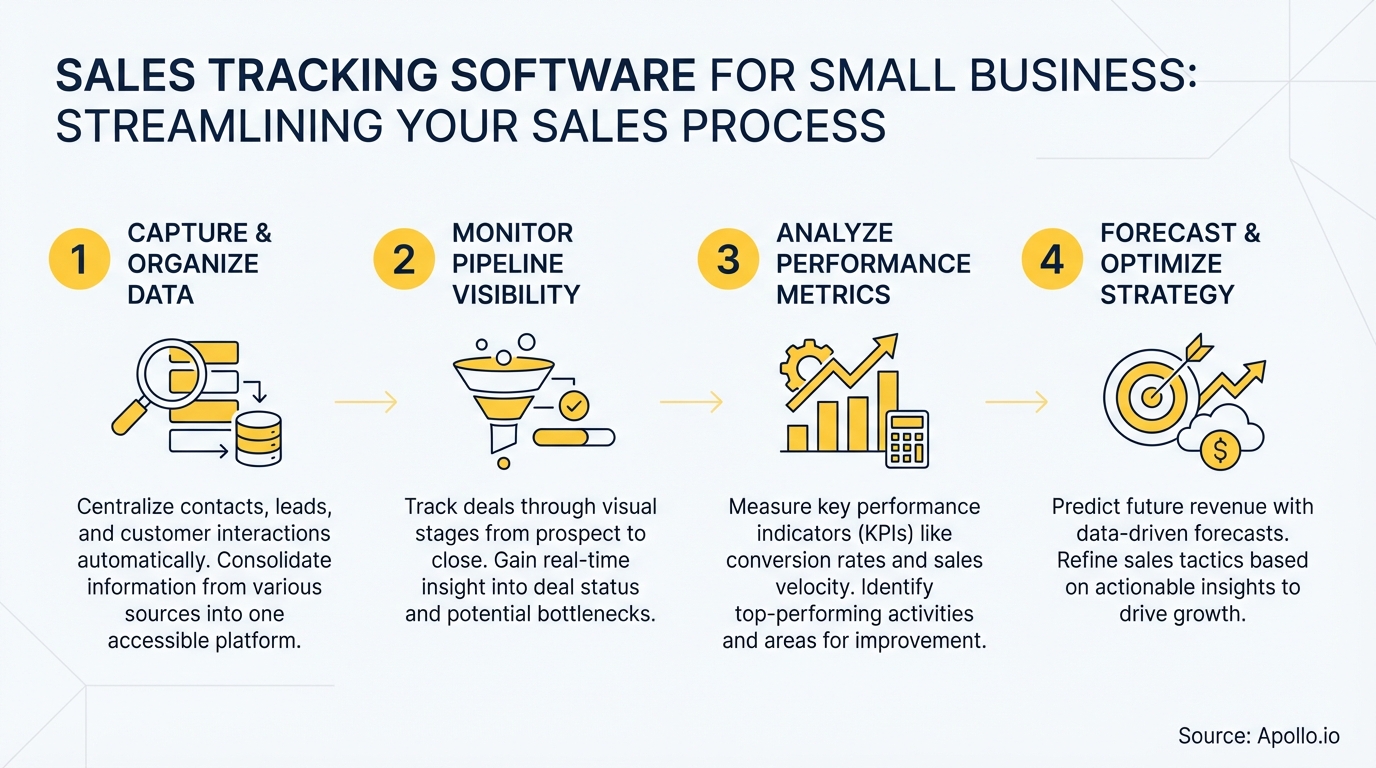
Sales tracking software works by automating data capture across every customer touchpoint. When a rep sends an email, makes a call, or schedules a meeting, the platform logs the activity, updates the contact record, and moves the deal to the appropriate pipeline stage.
Core workflow components:
- Contact management: Centralized profiles with enriched business data, verified emails, and phone numbers
- Activity tracking: Automatic logging of emails, calls, meetings, and social touches across channels
- Deal stages: Visual pipeline with customizable stages matching your sales process
- Task automation: Triggered follow-ups, reminders, and next-step assignments based on buyer behavior
- Reporting: Real-time dashboards showing conversion rates, cycle length, and rep performance
The best platforms integrate directly with email providers, calendar systems, and communication tools to capture data without requiring manual entry. This gives RevOps leaders and sales managers a single source of truth for coaching, forecasting, and process optimization.
Turn Forecast Chaos Into Revenue Certainty
Pipeline forecasting a guessing game? Apollo tracks every deal stage in real-time so you can predict revenue with confidence. Built-In increased win rates 10% with Apollo's visibility and scoring.
Start Free with Apollo →What Features Should Small Businesses Prioritize?
Small businesses should prioritize features that eliminate tool sprawl and reduce time spent on non-selling activities. The goal is one platform that handles prospecting, engagement, and pipeline management without requiring expensive integrations or separate subscriptions.
| Feature Category | Core Capabilities | Small Business Impact |
|---|---|---|
| B2B Data & Enrichment | Verified contacts, company data, data enrichment, duplicate detection | Eliminates separate data provider costs; ensures clean, actionable records |
| Multi-Channel Engagement | Email sequences, dialer, social outreach, meeting scheduler | One workspace for all outreach activities; no context-switching between tools |
| Pipeline Management | Visual deal boards, stage automation, forecasting, reporting | Real-time visibility for leaders; accurate forecasts for planning |
| AI Automation | Lead scoring, next-best-action recommendations, call transcription, email generation | Reduces manual prioritization; scales team capacity without headcount |
| Integration Ecosystem | Native CRM sync, email provider connection, calendar integration | Works with existing stack; no rip-and-replace required |
For teams exploring how sales automation software drives revenue, the key is choosing a platform that combines these capabilities instead of forcing you to stitch together multiple vendors.
How Do Small Business Founders Choose the Right Platform?
Founders choosing sales tracking software should evaluate total cost of ownership, not just subscription price. A platform that costs $99/user/month but consolidates five separate tools delivers better ROI than a $49/user tool that requires expensive add-ons for data, dialing, and automation.
Evaluation checklist:
- Does it include a verified B2B contact database, or will you pay separately for data enrichment?
- Can reps execute multi-channel sequences (email, phone, social) from one workspace?
- Does it provide native CRM integration with your existing system (HubSpot, Salesforce, Pipedrive)?
- Are AI features included in base pricing, or locked behind enterprise tiers?
- Can you start with a free tier and scale as you grow, or is there a minimum seat commitment?
Teams that consolidate their sales tech stack report cutting costs in half while improving team productivity. As one customer put it: "We reduced the complexity of three tools into one" (Predictable Revenue).
How Can Sales Leaders Improve Data Quality and Pipeline Accuracy?
Sales leaders can improve data quality by implementing automated enrichment, validation rules, and duplicate detection from day one. Poor data quality blocks 44% of analytics initiatives, making governance a revenue issue, not just an ops problem.

SMB data quality framework:
- Enrichment at entry: Automatically append missing fields (company size, industry, technology stack) when contacts enter your system
- Validation rules: Require email format verification and phone number structure before records save
- Duplicate prevention: Merge logic that identifies and consolidates duplicate contacts across domains and name variations
- Decay monitoring: Flag contacts with outdated job titles or companies for re-verification
For RevOps teams managing sales performance management strategy, clean data enables accurate attribution, reliable forecasting, and coaching based on real activity patterns instead of guesswork.
Tired of dirty contact data? Start free with Apollo's 224M+ verified business contacts and built-in enrichment.
What AI Automation Should Small Businesses Implement First?
Small businesses should implement AI automation that reduces manual data entry and prioritizes high-intent leads. The goal is practical workflows that fit low-maturity environments, not enterprise-grade complexity that requires dedicated AI teams.
High-impact AI workflows for SMBs:
- Automatic call notes: AI transcribes calls and extracts key points (budget, timeline, decision-makers) into structured CRM fields
- Lead scoring: Machine learning ranks prospects based on engagement signals, firmographic fit, and buying intent
- Next-best-action: System recommends follow-up tasks (send pricing, schedule demo, loop in executive) based on deal stage and buyer behavior
- Email generation: AI drafts personalized follow-up messages using contact context and previous conversation history
- Meeting scheduling: Automated calendar coordination that eliminates back-and-forth email threads
For Account Executives managing complex deals, AI automation means less time on admin and more time building relationships. For founders, it means scaling team capacity without immediate headcount expansion.
How Do SDRs Use Sales Tracking Software to Book More Meetings?
SDRs use sales tracking software to automate prospecting research, execute multi-touch sequences, and prioritize accounts showing buying intent. The platform eliminates manual list-building and provides real-time visibility into which messages drive response rates.
SDR workflow with modern sales tracking:
- Search the contact database using filters (title, company size, industry, technology stack)
- Enroll qualified prospects in multi-channel sequences (email, phone, social)
- Track engagement signals (email opens, link clicks, website visits) to identify hot leads
- Receive AI-powered next-step recommendations based on prospect behavior
- Log all activity automatically without manual CRM data entry
Teams exploring outbound sales software that books more meetings find the biggest ROI comes from eliminating context-switching between prospecting tools, email platforms, and CRM systems.

Start Tracking Smarter in 2026
Sales tracking software transforms small business teams from reactive order-takers to proactive revenue generators. By consolidating prospecting, engagement, and pipeline management into one platform, you eliminate tool sprawl, improve data quality, and give reps more time for actual selling.
The market data is clear: 71% of small businesses now use CRM software, and those who implement it see up to 29% sales increases and 42% forecast accuracy improvements. For founders and sales leaders building scalable go-to-market motions, the question isn't whether to invest in sales tracking software—it's whether you can afford not to.
Ready to cut your sales tech stack and consolidate everything into one workspace? Start a free Apollo trial and get access to 224M+ verified contacts, multi-channel engagement tools, and AI-powered automation that helps small business teams compete with funded competitors.
Show Leadership Real ROI In Days, Not Months
Budget approvals stuck on unclear metrics? Apollo tracks every touchpoint from first contact to closed deal so you can prove pipeline impact instantly. Built-In increased win rates 10% with Apollo's visibility.
Start Free with Apollo →Don't miss these
Sales
Inbound vs Outbound Marketing: Which Strategy Wins?
Sales
What Is a Sales Funnel? The Non-Linear Revenue Framework for 2026
Sales
What Is a Go-to-Market Strategy? The 2026 GTM Playbook
See Apollo in action
We'd love to show how Apollo can help you sell better.
By submitting this form, you will receive information, tips, and promotions from Apollo. To learn more, see our Privacy Statement.
4.7/5 based on 9,690 reviews
