
Who Are Sales Representatives? Roles, Skills, and Success Strategies in 2026
Sales representatives are the revenue engine of every B2B organization, but their role is being redefined. Buyers now self-educate before ever talking to a rep, AI is reshaping daily workflows, and quota attainment has become a persistent challenge across the industry. Understanding what modern sales representatives do, and how the best ones win, is essential for any GTM team in 2026. For a deeper look at how data drives rep performance, see how sales analytics drives revenue growth.

Research Less, Close More With Apollo
Tired of burning hours manually hunting contact info while your pipeline stalls? Apollo surfaces verified leads instantly so your team sells instead of searches. Nearly 100K paying customers have already made the switch.
Start Free with Apollo →Key Takeaways
- Sales representatives are responsible for prospecting, qualifying, and closing deals, but their core value in 2026 is risk reduction and stakeholder alignment, not information delivery.
- Quota attainment is a serious challenge: according to BookYourData, 69% of reps still fell short of quota in 2024.
- Buyers initiate contact late in their journey, making early content presence and shortlist placement critical for sales teams.
- AI adoption is accelerating: revenue leaders and reps alike are integrating AI tools into daily workflows to reclaim selling time.
- The right unified platform lets reps consolidate prospecting, outreach, and pipeline management into one workspace instead of juggling multiple tools.
What Are Sales Representatives?
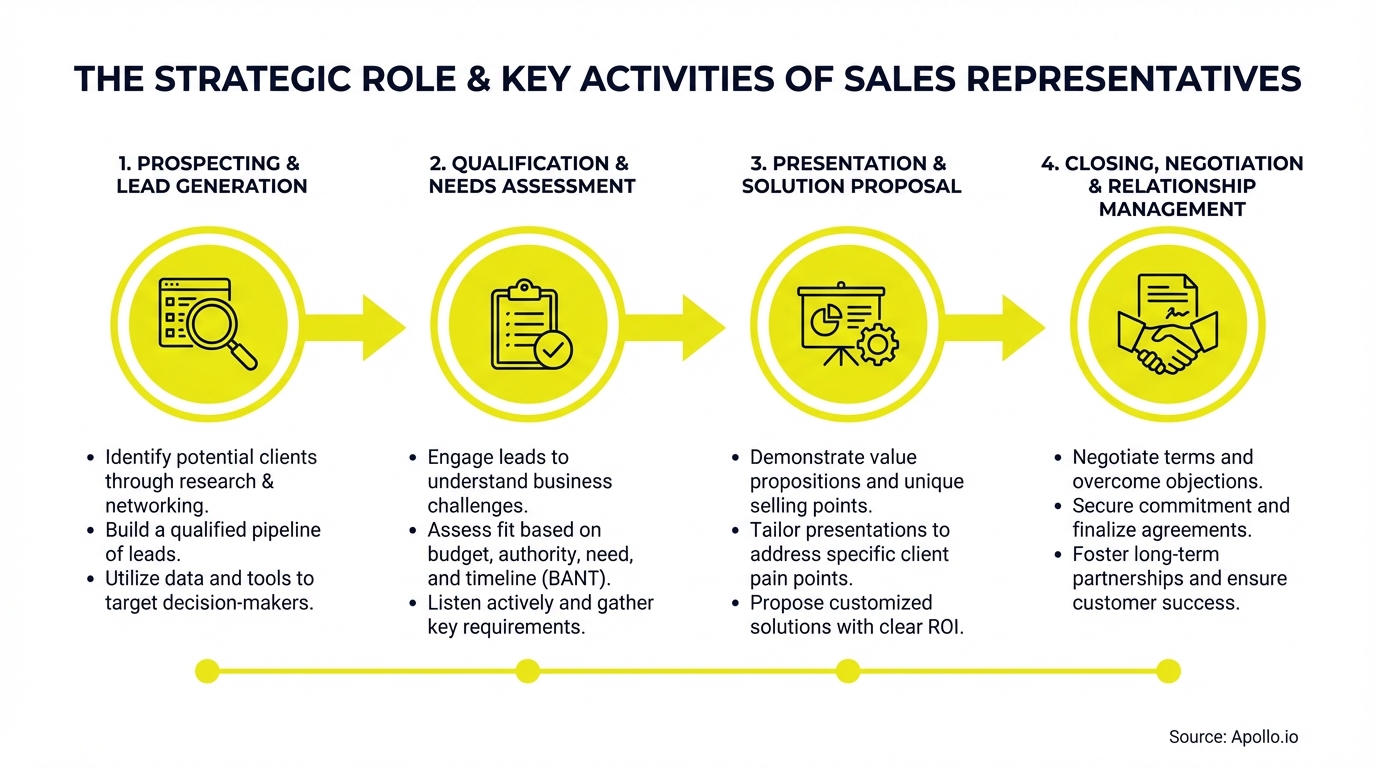
Sales representatives are professionals who identify prospects, build relationships, and guide buyers through a purchase decision. In B2B contexts, they manage complex multi-stakeholder deals, handle objections, and align solutions to buyer outcomes.
The role spans multiple titles: SDRs/BDRs who generate pipeline, Account Executives who close deals, and Account Managers who expand existing accounts.
What separates 2026 reps from those of prior years is the buyer's shift toward self-service. A Gartner survey found 61% of B2B buyers prefer a rep-free buying experience. That means reps now add value primarily by de-risking decisions and building consensus, not just delivering product information.
Why Do Sales Representatives Struggle to Hit Quota?
Quota attainment is a structural problem, not just a skills problem. Research from Everstage shows that as of early 2024, 69% of reps fell short of quota, with only 15% of sales teams having more than half their reps achieve at least 80% of quota. The performance gap is concentrated: data from Ebsta's B2B Sales Benchmarks shows only 17% of reps generate 81% of revenue, an 8.9x performance delta versus average peers.
Key root causes include:
- Too little time selling:Landbase reports sales professionals dedicate only 28-34% of their time to actual selling activities, with the rest consumed by admin work, meetings, and non-revenue tasks.
- Late buyer entry: Buyers delay rep contact until they are already deep in the decision process, reducing the rep's window to influence shortlist formation.
- Fragmented tools: Reps toggling between disconnected prospecting, CRM, and outreach platforms lose momentum and context.
Struggling to fill your pipeline with qualified prospects? Search Apollo's 230M+ contacts with 65+ filters to build targeted prospect lists in minutes.

How Do SDRs and AEs Adapt to Buyer-Led Journeys?
The modern buying journey is buyer-controlled. Research from 6sense indicates buyers initiate outreach themselves over 80% of the time, and the vendor contacted first wins approximately 80% of deals.
For SDRs and Account Executives, this changes the playbook significantly.
| Role | Old Focus | 2026 Focus |
|---|---|---|
| SDR/BDR | Cold outreach volume | Targeted, signal-based outreach to in-market accounts |
| Account Executive | Product demos and feature pitches | Stakeholder alignment, risk reduction, business case building |
| RevOps | CRM hygiene and reporting | Unified data, AI workflow governance, and pipeline visibility |
SDRs need to reach buyers earlier and with more relevant context. AEs need to orchestrate buying groups: Intentsify reports over one in five businesses now have six or more people involved in their buying group. For practical techniques on engaging these stakeholders, see these proven sales pitch techniques that close more deals.
Turn Funnel Guesswork Into Pipeline Wins
Quota missed because marketing leads never convert? Apollo surfaces quality prospects already showing buying intent, so your pipeline reflects reality — not hope. Nearly 100K paying customers stopped guessing and started closing.
Start Free with Apollo →What Skills Do Top-Performing Sales Representatives Need in 2026?
Top reps combine traditional sales competencies with modern, data-driven habits. The performance gap between top and average reps is wide, which means skills development and tooling matter more than ever.
- Prospecting precision: Identifying the right accounts and contacts before outreach, not just reaching the most contacts.
- AI fluency: Using AI tools for research, personalization, and follow-up. According to The Smartekers, 96% of revenue leaders expect their teams to use AI by 2026.
- Objection handling: Navigating complex buying committee concerns with empathy and data. See the full framework for handling sales objections in 2026.
- Multi-channel outreach: Coordinating email, phone, and social touchpoints in a sequenced, relevant way.
- Pipeline discipline: Tracking deal health, forecast accuracy, and sales KPIs consistently to prioritize effort.
How Should Sales Representatives Use AI in Their Daily Workflow?
AI is moving from a content drafting aid to a workflow execution layer. Reps who treat AI as a research and automation partner, not just a writing assistant, reclaim significant selling time.
Practical applications include:
- AI-generated account research summaries before calls
- Automated multi-step outreach sequences with personalized messaging
- CRM auto-updates from call recordings and email activity
- Signal-based alerts when target accounts show buying intent
For teams building or refining their toolset, see which AI sales tools actually close more deals and how to evaluate them. RevOps leaders managing tool sprawl will also find value in understanding how to build a sales tech stack that scales revenue.
Spending too much time on manual outreach and admin work? Automate your sequences with Apollo's multi-channel sales engagement platform and put that time back into selling.

What Metrics Should Sales Representatives Track?
Reps who track the right metrics close more deals. The average B2B deal takes approximately 69 days to close, according to Databox, which means pipeline visibility and deal health signals are critical throughout a long cycle.
| Metric | Why It Matters |
|---|---|
| Quota attainment rate | Benchmarks individual performance against team and industry |
| Pipeline coverage ratio | Ensures enough qualified opportunities to hit quota |
| Average deal cycle length | Identifies bottlenecks in the sales process |
| Win rate by stage | Pinpoints where deals are being lost |
| Activity-to-meeting conversion | Measures outreach efficiency for SDRs and BDRs |
How Do Sales Representatives Succeed with the Right Platform?
The best-performing sales representatives in 2026 work from a unified platform that handles prospecting, outreach, and pipeline management in one place. Tool consolidation reduces context switching, keeps data clean, and gives RevOps a single source of truth.
Apollo brings all of this together for over 2M users and nearly 100K paying customers. Teams use Apollo to find verified contacts, run multi-channel sequences, manage deals, and get AI-powered research assistance without juggling separate tools.
As Cyera's team put it: "Having everything in one system was a game changer." Predictable Revenue reported "We reduced the complexity of three tools into one."
Whether you are an SDR building outbound lists, an AE managing a complex deal, or a RevOps leader trying to consolidate your stack, Apollo is built for how modern sales representatives actually work.
Start a free trial with Apollo and see how your team can prospect smarter, engage faster, and close more deals from one unified platform.
Prove Pipeline ROI From Day One
ROI pressure killing tool adoption before it starts? Apollo delivers measurable pipeline impact fast — so budget approvals become easy wins. Leadium 3x'd annual revenue. Your case starts now.
Start Free with Apollo →Don't miss these
Sales
Inbound vs Outbound Marketing: Which Strategy Wins?
Sales
What Is a Sales Funnel? The Non-Linear Revenue Framework for 2026
Sales
What Is a Go-to-Market Strategy? The 2026 GTM Playbook
See Apollo in action
We'd love to show how Apollo can help you sell better.
By submitting this form, you will receive information, tips, and promotions from Apollo. To learn more, see our Privacy Statement.
4.7/5 based on 9,690 reviews
