
What Is Sales Qualification? Frameworks, Benchmarks, and AI-Ready Workflows for 2026
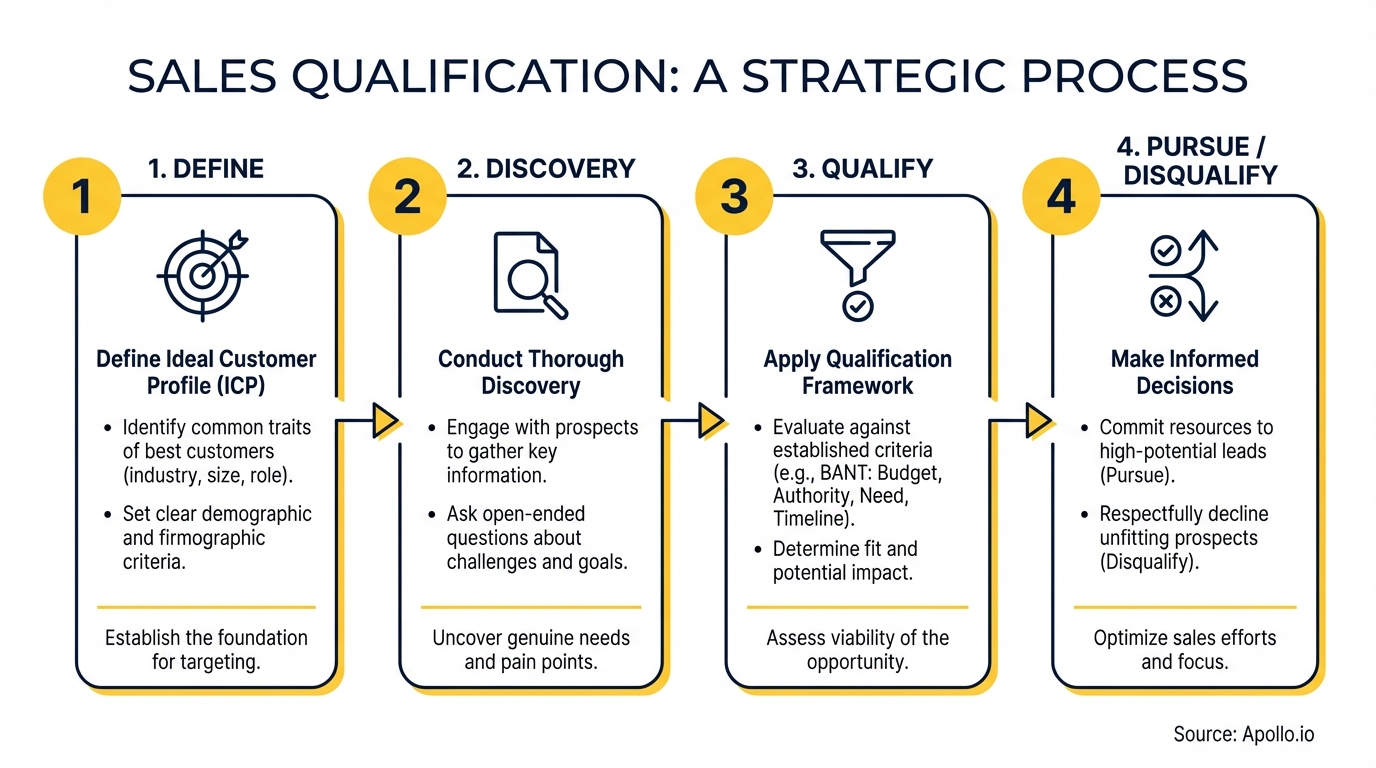
Sales qualification is the process of determining whether a prospect has the need, authority, budget, and timeline to become a paying customer. Done well, it focuses rep time on deals that close. Done poorly, it fills your pipeline with noise that never converts. According to G2, 80% of new leads never translate into sales — a stat that makes strong qualification the single highest-leverage activity in your revenue operation.
In 2026, qualification has evolved well beyond BANT checklists. Buyer committees are larger, channels are more fragmented, and AI is automating triage at scale. Understanding the full picture — frameworks, benchmarks, governance, and AI workflows — is what separates pipeline that closes from pipeline that stalls. For a broader view of how qualification fits your revenue engine, see how sales analytics drives revenue growth.

Research Less, Pipeline More With Apollo
Tired of burning hours verifying contact info instead of selling? Apollo delivers 224M verified contacts with 96% email accuracy — so your team spends time closing, not chasing. Start building real pipeline today.
Start Free with Apollo →Key Takeaways
- Sales qualification determines if a prospect can and will buy — it is not the same as lead generation or lead nurturing.
- MQL-to-SQL conversion benchmarks vary by deal size: Gartner cites 12–26% across industries, but the right target depends on your average selling price.
- Modern qualification must account for buying groups, not just a single champion — Forrester found 73% of B2B purchases involve 3+ departments.
- AI can automate triage and enrichment, but governance matters: ungoverned AI in GTM workflows carries significant risk at the board level.
- Apollo consolidates prospecting, enrichment, and engagement into one platform — eliminating the tool sprawl that slows qualification workflows.
What Is Sales Qualification and Why Does It Matter?
Sales qualification is the structured evaluation of whether a prospect fits your ideal customer profile and is ready to engage in a sales process. It answers two core questions: Should we pursue this account? and Is this the right time? Without a clear answer to both, reps waste cycles on deals that will never close.
The business case is straightforward. Data from Landbase shows qualified opportunity close rates average around 29%, while overall win rates across all pipeline stages typically range from 15–25%. The gap between those two numbers is the ROI of better qualification. For sales development teams running high-volume outbound, sharpening qualification criteria is the fastest way to improve downstream conversion.
What Are the Most Effective Sales Qualification Frameworks?
Different frameworks suit different deal types and team structures. The right choice depends on your average selling price and sales motion.
| Framework | Best For | Core Dimensions |
|---|---|---|
| BANT | High-volume, transactional sales | Budget, Authority, Need, Timeline |
| MEDDIC/MEDDPICC | Complex enterprise deals | Metrics, Economic Buyer, Decision Criteria, Decision Process, Identify Pain, Champion, Competition |
| CHAMP | Mid-market, challenger motion | Challenges, Authority, Money, Prioritization |
| SPIN | Consultative, discovery-heavy deals | Situation, Problem, Implication, Need-Payoff |
For AEs working high-ticket deals, MEDDPICC adds the rigor needed to navigate complex buying committees. For SDRs running early-stage discovery, CHAMP or a simplified BANT keeps calls focused without over-engineering the conversation.
What Do MQL-to-SQL Benchmarks Actually Look Like?
One of the biggest gaps in standard qualification content is deal-size context. Conversion benchmarks vary significantly by average selling price, and applying the wrong benchmark leads to bad decisions about pipeline health.
- Lead to MQL:MarketJoy data from 2024–2025 indicates an average Lead-to-MQL conversion rate of 20–25%, with their benchmark at 22%.
- MQL to SQL:Gartner cites a range of 12–26% across industries for MQL-to-SQL conversion — a wide band that reflects deal complexity and ICP clarity.
- Deal size impact: Higher ASP deals typically require more stakeholders, longer timelines, and stricter SQL criteria — meaning fewer leads qualify, but each qualified deal carries more value.
RevOps leaders should segment their MQL-to-SQL reporting by deal size tier rather than rolling up to a single blended rate. A blended rate hides underperformance in specific segments and makes it impossible to tune qualification criteria accurately. Track these alongside the sales KPIs that matter most in 2026.
Turn Funnel Chaos Into Pipeline Clarity
Tired of watching marketing leads stall before they ever reach your pipeline? Apollo surfaces high-intent prospects and arms your team with the intelligence to act fast. Over 550K companies now forecast with confidence.
Start Free with Apollo →How Do SDRs and RevOps Teams Build a Qualification Governance Model?
Qualification governance is the system that ensures consistent definitions, routing rules, and audit cadence across sales and marketing. It is a RevOps responsibility, not a sales ops afterthought — especially as AI enters scoring and routing workflows.
A Gartner survey of 243 CSOs found that 49% said their sales organization's definition of a qualified lead differs greatly from marketing's definition. That misalignment is the root cause of most MQL rejection rates and pipeline credibility problems.
A governance model fixes this with clear SLAs and shared definitions.
Qualification Governance Checklist:
- Shared MQL and SQL definitions documented and signed off by both sales and marketing leadership
- SLA: Marketing commits to lead volume and quality thresholds; sales commits to follow-up timing
- Routing rules: Clear criteria for when a lead routes to an SDR vs. AE vs. self-serve
- Audit cadence: Monthly review of MQL rejection reasons to recalibrate scoring models
- Data hygiene standards: Required fields at each stage to prevent incomplete records from advancing
SDRs benefit directly from governance — they stop wasting time on leads marketing calls qualified but sales doesn't. For SDR managers, a documented governance model also makes coaching conversations more objective. Pair this with revenue operations best practices to align the full GTM motion.
Struggling to qualify leads at scale? Apollo's AI-powered pipeline builder helps teams qualify and route prospects faster with verified data and intelligent scoring.

How Does Buying-Group Complexity Change Qualification in 2026?
Modern B2B qualification cannot focus on a single contact. Forrester's Buyers' Journey Survey found that 73% of purchases involve 3+ departments, with an average of 13 internal stakeholders and 9 external influencers involved in a purchase decision.
Qualifying the champion without mapping the buying group is one of the most common reasons late-stage deals stall.
Buying-group qualification requires three things:
- Stakeholder mapping: Identify the economic buyer, technical evaluator, champion, and potential blockers early in discovery
- Multi-thread outreach: Engage multiple contacts across the account, not just the initial responder
- Consensus artifacts: Prepare ROI summaries, security questionnaire responses, and business case templates that stakeholders can share internally
For AEs working enterprise accounts, multi-threading is the difference between a champion who can sell internally and one who gets overruled. Build stakeholder maps into your CRM as a required qualification field, not an optional note.
How Does AI Change Sales Qualification Workflows?
AI is reshaping qualification in two ways: automating triage at the top of funnel and enriching contact and account data before reps make first contact. Both capabilities reduce time spent on manual research and improve the accuracy of qualification decisions.
The governance risk is real, however. Forrester's 2026 predictions warned that ungoverned generative AI in GTM workflows carries risks at a scale that has become a board-level issue.
When AI makes qualification decisions, those decisions must be auditable, grounded in verified data, and subject to human review at key inflection points.
AI-ready qualification workflow:
- Automated enrichment: Pull firmographic and technographic data to score ICP fit before any rep touches the record
- Intent signal scoring: Weight inbound behavior (content consumed, pages visited, product trial activity) alongside fit scores
- AI-assisted routing: Route high-fit, high-intent accounts directly to AEs; route mid-tier to SDR sequences; filter low-fit out of the pipeline entirely
- Human-in-the-loop gates: Require rep confirmation before an AI-qualified lead advances to Opportunity stage
The Salesforce State of Sales (2026 edition) reports that 84% of data and analytics leaders say their data strategies need an overhaul to reach their AI goals. Clean, structured data is the prerequisite for any AI qualification model that produces reliable results. Explore how AI sales tools are changing qualification and pipeline management in practice.
Need cleaner data to power your qualification scoring? Apollo's data enrichment keeps your contact records accurate and complete with 96% email accuracy across 224M verified business contacts.
How Should Teams Measure Qualification Quality Over Time?
Qualification is not a one-time setup. It requires ongoing measurement to detect drift in ICP fit, changes in buyer behavior, and shifts in competitive dynamics.
The metrics that matter most are downstream, not top-of-funnel.
- SQL-to-Opportunity rate: Are SQLs actually advancing to active deals?
- Opportunity-to-Close rate: Are qualified opportunities winning at the expected rate?
- Average sales cycle by segment: Deal velocity reveals whether qualification criteria are sharp enough
- MQL rejection rate and reason codes: The most actionable feedback loop between sales and marketing
These metrics connect directly to sales productivity outcomes. Teams that audit qualification quality monthly outperform those that treat it as a quarterly or annual exercise. For deal management, tracking stage conversion rates by lead source and qualification method reveals which criteria actually predict revenue.

How Does Apollo Simplify Sales Qualification at Scale?
Apollo is an all-in-one GTM platform that consolidates the tools qualification workflows typically require: contact data, enrichment, scoring, sequencing, and pipeline tracking. Instead of stitching together a separate data provider, engagement tool, and CRM, teams get one unified workspace.
As Cyera's team put it: "Having everything in one system was a game changer." Predictable Revenue echoed this: "We reduced the complexity of three tools into one." For RevOps leaders managing qualification governance, fewer integrations means fewer data sync failures and cleaner records at every stage.
Apollo's platform supports qualification across the full workflow:
- Prospecting: 65+ filters to identify ICP-fit accounts and contacts from 224M business records
- Enrichment: Auto-fill missing firmographic and contact fields to meet qualification data standards
- Scoring: Apply fit and intent signals to prioritize which leads route to SDRs vs. AEs
- Engagement: Multi-channel sequences (email, phone, and social) triggered by qualification stage
- Pipeline visibility: Track stage conversion rates and identify where qualified leads stall
Sales qualification in 2026 is a system, not a checklist. The teams that win are those who align definitions, govern their AI, map their buying groups, and measure quality downstream. Apollo gives your team the data and workflows to run that system in one place. Request a Demo to see how Apollo helps your team qualify faster and close more.
Prove Pipeline ROI With Apollo
ROI pressure killing your tool budget? Apollo gives sales leaders clear, measurable pipeline impact — fast. Leadium 3x'd their annual revenue after switching. Start your free trial today.
Start Free with Apollo →Don't miss these
Sales
Inbound vs Outbound Marketing: Which Strategy Wins?
Sales
What Is a Sales Funnel? The Non-Linear Revenue Framework for 2026
Sales
What Is a Go-to-Market Strategy? The 2026 GTM Playbook
See Apollo in action
We'd love to show how Apollo can help you sell better.
By submitting this form, you will receive information, tips, and promotions from Apollo. To learn more, see our Privacy Statement.
4.7/5 based on 9,690 reviews
