
Sales Psychology: How to Influence Buyers and Close More Deals
Buyers in 2026 don't respond to generic pitches or pushy tactics. Over 70% of B2B decision-makers prefer digital self-service and expect sellers to understand their specific needs before the first conversation. Sales psychology helps you align with how modern buyers think, decide, and trust, turning cold outreach into meaningful connections that drive measurable revenue growth.

Apollo Finds Contacts While You Focus On Selling
Tired of spending 4+ hours daily hunting for contact info? Apollo delivers 224M verified contacts with 96% email accuracy. Join 550K+ companies who turned research time into revenue.
Start Free with Apollo →Key Takeaways
- Sales psychology helps you align your approach with how buyers naturally think and make decisions
- Reciprocity, social proof, and authority build trust faster than any pitch ever could
- Modern buyers expect digital self-service and evidence-driven content before engaging with reps
- SDRs and AEs who apply psychological principles book more meetings and close deals faster
- Consistency between your content and sales conversations creates trust and accelerates buying cycles
What Is Sales Psychology?
Sales psychology is the study of how buyers think, decide, and respond to influence during the purchasing process. It combines behavioral science, cognitive psychology, and persuasion principles to help sellers understand what drives buyer behavior.
Rather than relying on manipulation, sales psychology focuses on alignment: matching your approach to how prospects naturally evaluate options, build trust, and commit to solutions.
For SDRs and AEs, this means recognizing patterns in how buyers process information, respond to social proof, and justify spending. According to Corporate Visions, 92% of B2B buyers start their journey with at least one vendor already in mind, and 41% begin with a single preferred vendor before any formal evaluation. Understanding the psychology behind these preferences lets you enter conversations with insight, not just a script.
Why Do Sales Teams Need Sales Psychology in 2026?
Buyer behavior has fundamentally shifted. 73% of B2B buyers now purchase through digital channels, conducting extensive research before engaging with sales reps. They expect personalized, relevant interactions backed by evidence, not generic pitches. Sales psychology gives you the framework to meet buyers where they are: self-educated, skeptical, and overwhelmed by options.

Sales Leaders managing teams see faster ramp times when reps understand cognitive biases like anchoring, loss aversion, and confirmation bias. RevOps teams benefit from aligned messaging that reduces friction between marketing content and sales conversations.
When your entire go-to-market motion reflects how buyers actually think, you shorten sales cycles and improve win rates without adding headcount.
See Every Deal In Real-Time With Apollo
Forecasting feels like guesswork without live pipeline visibility. Apollo gives you accurate, real-time deal tracking and intent signals that turn unreliable forecasts into predictable revenue. Built-In increased win rates 10% with Apollo's intelligence.
Start Free with Apollo →How Do Core Psychological Principles Drive Sales Results?
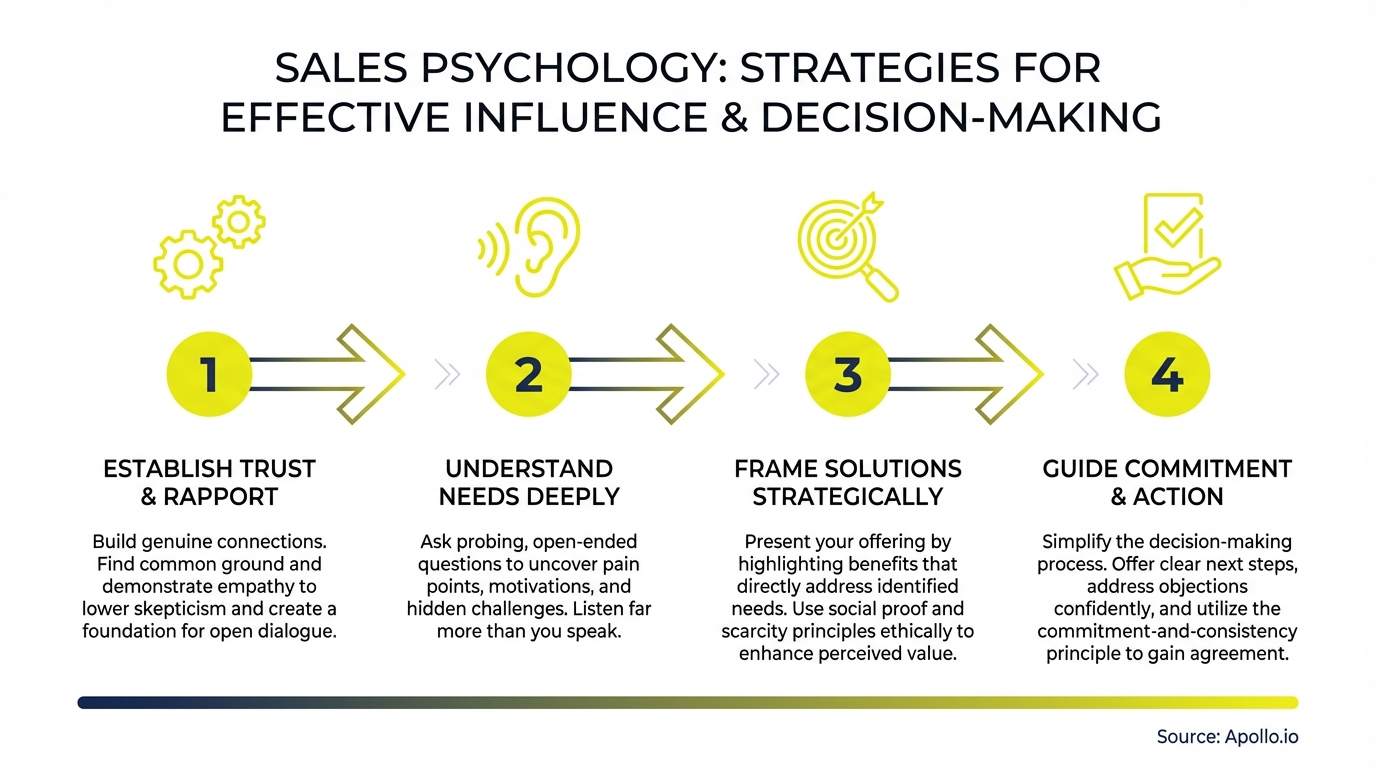
Six principles form the foundation of effective sales psychology. Master these, and you'll influence decisions without feeling manipulative.
What Is Reciprocity and How Does It Work?
Reciprocity means people feel obligated to return value when they receive something first. In sales, this translates to providing useful insights, tools, or research before asking for a meeting.
When you share an industry benchmark report or diagnostic tool, prospects feel more inclined to engage. Founders building outbound motions use reciprocity by offering ROI calculators or implementation playbooks that solve immediate problems, creating goodwill that converts to pipeline.
How Does Social Proof Influence Buying Decisions?
Buyers look to peers before making decisions. Social proof includes customer testimonials, case studies, usage statistics, and third-party validation.
When prospects see that companies like theirs trust your solution, perceived risk drops. AEs managing enterprise deals use social proof by sharing case studies from similar industries, buyer personas, and company sizes.
A simple mention like "We reduced the complexity of three tools into one" from Predictable Revenue carries more weight than any feature list.
Why Does Authority Build Trust Faster?
Authority signals expertise and reduces uncertainty. Buyers pay premiums to work with recognized experts who demonstrate deep knowledge. This applies to both personal authority (your expertise) and organizational authority (your company's thought leadership). Sales Trainers coaching teams emphasize building authority through content, certifications, and industry contributions. When you share insights on social channels, you position yourself as an advisor, not just a seller.
What Is Scarcity and When Should You Use It?
Scarcity triggers urgency by highlighting limited availability or time-bound opportunities. This principle works when genuine: limited beta access, seasonal pricing, or capacity constraints. Misused, it feels manipulative. For high-ticket sales, scarcity might mean showing that your implementation team only onboards three clients per quarter, making prospects who see fit act faster.
How Does Consistency Shape Buyer Behavior?
Once people commit to a position, they're more likely to follow through. This is why discovery questions that get prospects to articulate their pain points work so well.
When a buyer says, "Our current process wastes 10 hours per week," they've committed to the problem. Your solution becomes the logical next step.
SDRs booking meetings use consistency by getting prospects to agree to small commitments ("Would it make sense to explore this?") before asking for calendar time.
What Is the Liking Principle?
People buy from those they like. Liking comes from similarity, compliments, cooperation, and familiarity. This doesn't mean being fake; it means finding genuine common ground. When you research a prospect's background and reference a shared interest or mutual connection, you build rapport. Using appropriate humor can also increase likability, making conversations more memorable and enjoyable.
How Do SDRs Apply Sales Psychology to Book More Meetings?
SDRs face the toughest challenge: getting busy prospects to respond. Applying sales psychology turns cold outreach into warm conversations.
Start with reciprocity by leading with value. Instead of "Can we chat about our product?" try "I noticed your team is hiring SDRs.
Here's a prospecting framework we use to ramp new reps in 30 days." You've given something useful before asking for anything.
Use social proof in subject lines and opening sentences: "Autodesk's SDR team cut research time using this approach." Authority builds when you reference specific insights from industry reports or sales metrics that matter. Struggling to find prospects who actually engage? Search Apollo's 224M+ contacts with 65+ filters to identify buyers showing intent signals.
How Do Account Executives Use Psychology to Close Deals?
AEs managing complex sales cycles apply psychology at every stage. During discovery, use consistency by asking questions that get prospects to articulate pain points in their own words.
This creates ownership of the problem. In demos, leverage authority by showing how your solution addresses industry-specific challenges, backed by data and case studies.
When presenting pricing, use anchoring by showing the most comprehensive option first, making mid-tier packages feel more reasonable. Address loss aversion by framing the cost of inaction: "Your team loses 60 hours monthly to manual prospecting. That's $180K annually in wasted productivity." During objection handling, use social proof to show how similar companies overcame the same concerns. Spending hours prepping for calls without the right context? Let Apollo's AI Call Assistant handle summaries and surface key talking points automatically.
What Role Does Message Consistency Play in Sales Psychology?
Inconsistency kills trust. When your website promises one thing and your sales rep says another, buyers disengage.
This isn't just a messaging problem; it's a psychological barrier. Buyers use consistency as a trust signal.
When everything aligns (marketing content, sales conversations, product experience), confidence builds.

RevOps leaders solve this by creating shared claim libraries and evidence packs that both marketing and sales teams use. When an AE references the same customer success story that appeared in a prospect's nurture email, it reinforces credibility. Revenue operations frameworks that align content, messaging, and seller behavior create the consistency modern buyers expect.
Start Applying Sales Psychology to Your Outbound Motion
Sales psychology works because it aligns with how buyers naturally think and decide. By applying reciprocity, social proof, authority, and consistency, you build trust faster and close deals more predictably.
For teams in 2026, this means moving beyond scripts to understand the cognitive and emotional drivers behind every buying decision.
Modern sellers need tools that support psychology-informed selling: verified contact data for relevant targeting, engagement platforms for consistent multi-channel outreach, and conversation intelligence to identify what resonates. Apollo consolidates these capabilities into one workspace, eliminating the complexity of managing separate tools. "We reduced the complexity of three tools into one," reports Collin Stewart from Predictable Revenue.
Ready to build an outbound motion aligned with buyer psychology? Try Apollo Free and access 224M+ verified contacts, AI-powered sequences, and conversation intelligence in one unified platform.
Show Clear Pipeline ROI In Your First 30 Days
Budget approval stuck on unclear metrics? Apollo delivers measurable pipeline impact from day one—quantifiable meetings booked, deals created, and revenue generated. Built-In increased win rates 10% and ACV 10% with Apollo's intelligence.
Start Free with Apollo →Don't miss these
Sales
Inbound vs Outbound Marketing: Which Strategy Wins?
Sales
What Is a Sales Funnel? The Non-Linear Revenue Framework for 2026
Sales
What Is a Go-to-Market Strategy? The 2026 GTM Playbook
See Apollo in action
We'd love to show how Apollo can help you sell better.
By submitting this form, you will receive information, tips, and promotions from Apollo. To learn more, see our Privacy Statement.
4.7/5 based on 9,690 reviews
