
What Is Sales Price Optimization? Strategies, Tools, ROI (2026)
Sales price optimization is the strategic process of setting prices that maximize revenue and profitability while maintaining competitive positioning and customer value perception. In 2026, this discipline has evolved from quarterly price book updates to dynamic, AI-driven systems that respond to market conditions in real time. For Sales Leaders and RevOps teams managing complex B2B pricing across multiple segments, getting price optimization right can be the difference between hitting targets and missing them by millions. According to Virtue Market Research, the Pricing Optimization Software Market was valued at USD 856.39 million in 2023 and is projected to reach USD 2449.71 million by the end of 2030, growing at a CAGR of 16.2% from 2024-2030. This rapid growth reflects how critical sales analytics and data-driven pricing have become to modern revenue strategies.

Scale Your Team Without the Chaos
Tired of watching reps burn hours on manual research instead of selling? Apollo standardizes your outreach, automates lead generation, and gives every rep a repeatable playbook. Join 550K+ companies building predictable pipeline.
Start Free with Apollo →Key Takeaways
- Sales price optimization uses data and algorithms to set prices that maximize both revenue and profit margins across customer segments
- B2B buyers now prefer self-service pricing discovery, making transparent pricing pages and calculators essential for conversion
- Strategic pricing changes deliver outsized ROI compared to other revenue levers, with measurable impact on operating profit
- Modern pricing systems integrate directly with CRM and deal management platforms to guide reps during negotiations
- RevOps leaders using unified platforms report significant time savings and better pricing governance across teams
What Is Sales Price Optimization?
Sales price optimization is a data-driven approach to setting and adjusting prices based on market demand, competitor positioning, customer willingness to pay, and business objectives. Unlike traditional cost-plus pricing, optimization uses statistical models and machine learning to identify the price points that maximize specific outcomes like revenue, profit margin, or market share.
The process involves analyzing historical sales data, customer behavior patterns, competitive intelligence, and external market factors to determine optimal pricing for different customer segments, products, and scenarios. For Account Executives managing enterprise deals, this means having real-time guidance on discount thresholds and competitive positioning during negotiations.
Modern sales price optimization encompasses several key dimensions:
- Segment-based pricing: Different prices for distinct customer groups based on value perception and willingness to pay
- Dynamic pricing: Real-time price adjustments responding to demand, inventory, or competitive changes
- Promotional optimization: Strategic discounting that drives volume without eroding margin
- Negotiation guidance: Data-backed recommendations for sales reps during deal discussions
Turn Funnel Gaps Into Pipeline Gold
Tired of watching marketing leads stall before they ever reach your reps? Apollo surfaces in-market buyers the moment they're ready, so your team stops chasing cold leads and starts closing warm ones. 550K+ companies trust Apollo to fill the funnel with quality.
Start Free with Apollo →Why Is Sales Price Optimization Critical in 2026?
The business case for price optimization has never been stronger. Research from EY found that 95% of companies that raised prices by over 5% in 2022 enjoyed growth rates over 5% in the same period, and one-third of those had growth rates over 15%. This demonstrates the direct correlation between strategic pricing decisions and revenue performance.
Three market forces make price optimization essential for 2026:
Self-service buying dominance: B2B buyers increasingly research and evaluate solutions without engaging sales reps early. Your pricing presentation must work independently on your website, in comparison tools, and across digital channels.
Pricing transparency expectations: Buyers expect clear, consistent pricing information across all touchpoints. Inconsistencies between your website, sales conversations, and contracts damage trust and stall deals.
Margin pressure from volatility: Supply chain disruptions, tariff changes, and input cost fluctuations require more frequent repricing with clear justification. Static price books can't respond fast enough to protect margins.
For Founders and CEOs building scalable revenue engines, revenue operations excellence starts with pricing that adapts to market realities while maintaining governance and consistency.
How Do Sales Leaders Implement Price Optimization?
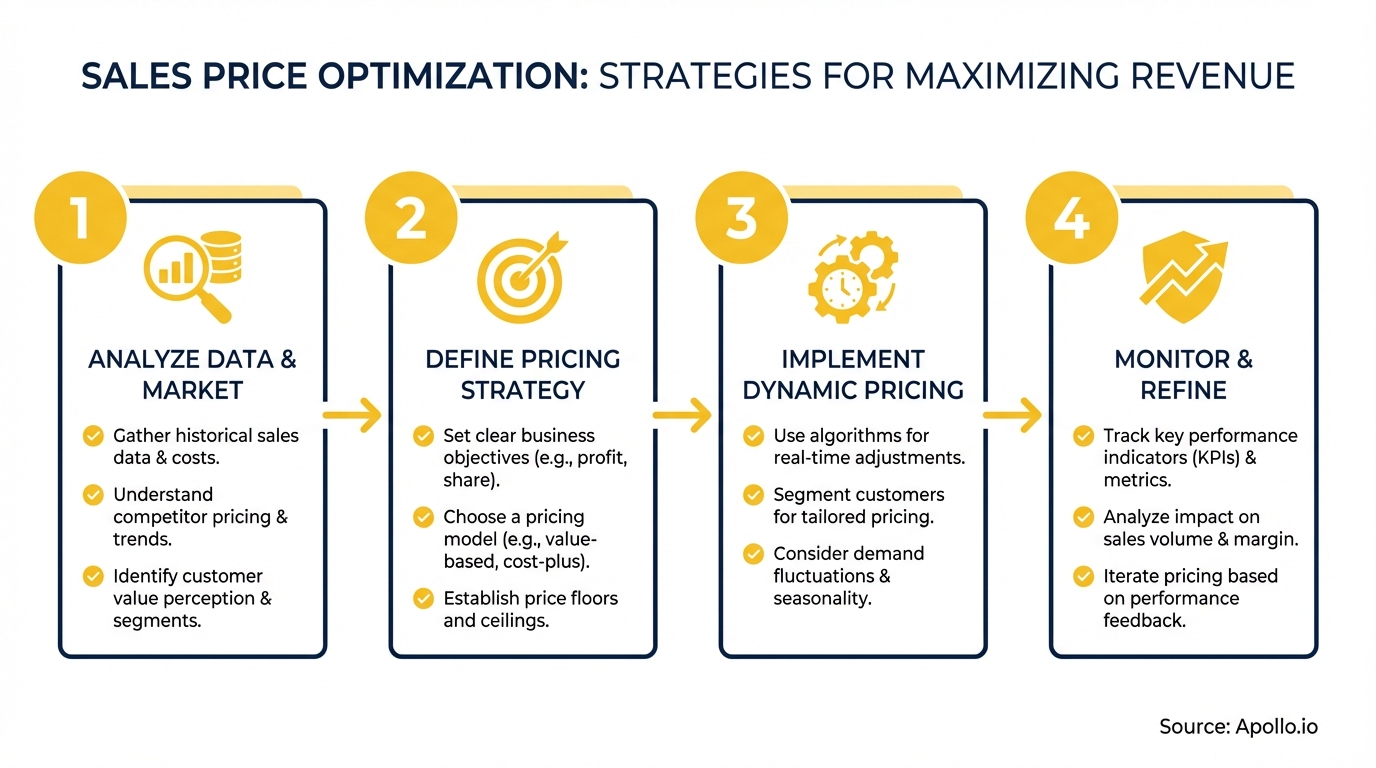
Implementing effective price optimization requires a systematic approach that balances analytical rigor with practical execution. Sales Leaders managing teams across multiple territories need frameworks that work at scale without creating bottlenecks.
The implementation process typically follows these phases:
| Phase | Key Activities | Timeline |
|---|---|---|
| Data Foundation | Consolidate pricing history, win/loss data, competitor intelligence, cost structures | 2-4 weeks |
| Segmentation | Define customer segments by value drivers, purchase patterns, price sensitivity | 2-3 weeks |
| Model Development | Build pricing algorithms, test scenarios, validate against historical performance | 4-6 weeks |
| Integration | Connect pricing engine to CRM, CPQ, and deal management systems | 3-4 weeks |
| Training & Rollout | Enable sales teams, establish governance, monitor early results | 2-3 weeks |
According to The Pricing Society, high-performing companies are more proactive with pricing, with 80% engaging in annual repricing reviews, compared to 56% of low-performing companies. This discipline separates market leaders from laggards.
Struggling to track which deals are winning and losing at different price points? Get complete pipeline visibility with Apollo's deal management platform.

What Are the Core Components of Price Optimization Systems?
Modern price optimization platforms combine several integrated capabilities that work together to guide pricing decisions across your organization. Understanding these components helps RevOps teams evaluate solutions and design effective implementations.
Data aggregation and enrichment: The foundation is comprehensive data about your products, customers, competitors, and market conditions. This includes transaction history, customer firmographics, competitive pricing intelligence, and external market signals. Research from Mordor Intelligence shows that in 2024, cloud deployment captured 61.43% of the price optimization software market share and is predicted to post an 18.43% CAGR to 2030, driven largely by cloud platforms' superior data integration capabilities.
Analytical engines: Statistical models and machine learning algorithms analyze patterns in your data to identify optimal price points. These range from regression analysis and elasticity modeling to neural networks that detect complex interactions between variables.
Scenario testing: Before implementing price changes, teams need to model potential outcomes. Simulation tools let you test different pricing strategies against historical data and projected market conditions to understand likely impacts on revenue and volume.
Workflow automation: The system should trigger appropriate actions based on pricing rules. This includes automatic price updates in your product catalog, alerts when deals exceed discount thresholds, and recommendations pushed directly to reps in CRM.
Governance controls: Pricing authority matrices, approval workflows, and audit trails ensure pricing decisions follow company policy. This prevents margin erosion from unauthorized discounting while maintaining flexibility for strategic deals.
How Do Account Executives Use Price Optimization During Deals?
For Account Executives managing complex B2B sales cycles, price optimization tools provide real-time guidance during negotiations. The best systems integrate directly into sales tech stacks, surfacing recommendations within the CRM during deal progression.
AEs benefit from several specific use cases:
Competitive positioning intelligence: When a prospect mentions a competitor, the system surfaces that vendor's typical pricing for similar deals, helping you position value effectively without racing to the bottom on price.
Discount authorization guidance: Instead of submitting every discount request for manual approval, AEs get instant feedback on whether their proposed pricing falls within approved parameters. Requests outside guidelines trigger streamlined approval workflows.
Configuration optimization: For products with multiple SKUs or modules, the system recommends bundles and configurations that maximize both customer value and company margin.
Win probability scoring: Based on historical patterns, the platform estimates likelihood of closing at different price points, helping AEs make informed tradeoffs between win rate and deal size.
Sales teams using integrated platforms report consolidating tools and cutting costs. As one customer shared, "We reduced the complexity of three tools into one" (Predictable Revenue).
This consolidation eliminates context-switching and ensures pricing guidance appears exactly when reps need it.

What Metrics Should RevOps Teams Track for Price Optimization?
RevOps leaders implementing price optimization need clear metrics to demonstrate value and identify improvement opportunities. The most effective measurement frameworks track both leading indicators (what's changing) and lagging indicators (business impact).
Key performance indicators include:
- Average selling price (ASP): Track by segment, product line, and sales rep to identify pricing consistency and opportunities
- Discount rate distribution: Monitor what percentage of deals fall into different discount bands; concentration in high-discount tiers signals margin risk
- Price realization: Measure actual transaction prices as a percentage of list price to quantify discounting impact
- Win rate by price band: Understand the relationship between pricing and close rates across segments
- Quote-to-close time: Optimized pricing with clear guidelines should reduce negotiation cycles
- Margin by customer segment: Identify which segments deliver healthy margins and which require pricing strategy adjustment
Leading RevOps teams establish pricing dashboards that update daily, giving leadership visibility into pricing performance without manual reporting cycles. When integrated with sales performance management systems, these metrics drive accountability and continuous improvement.
Spending too much time consolidating pricing data across disconnected systems? Unify your go-to-market data with Apollo's integrated platform.
Conclusion
Sales price optimization in 2026 is no longer optional for B2B organizations competing in dynamic markets. The combination of self-service buyer preferences, market volatility, and competitive pressure makes strategic pricing a critical revenue lever.
Companies implementing systematic price optimization report measurable improvements in both revenue growth and profit margins.
The most successful implementations share common characteristics: comprehensive data integration, clear governance frameworks, seamless CRM connectivity, and continuous measurement. Sales Leaders and RevOps teams should focus on building pricing capabilities that scale across segments and geographies while maintaining consistency and control.
For organizations still relying on spreadsheet-based pricing or disconnected point solutions, the opportunity cost grows daily. Modern buyers expect transparent, consistent pricing information across all touchpoints, and sales teams need real-time guidance to compete effectively.
Platforms that consolidate pricing intelligence with broader go-to-market capabilities deliver the fastest time-to-value and highest adoption rates.
Ready to optimize your pricing strategy with better data and unified workflows? Get Leads Now.
Prove Pipeline ROI With Apollo
Budget approval stuck on unclear metrics? Apollo delivers measurable pipeline impact your leadership can see — fast. Teams like Leadium 3x'd revenue after making the switch. Start your free trial today.
Start Free with Apollo →Don't miss these
Sales
Inbound vs Outbound Marketing: Which Strategy Wins?
Sales
What Is a Sales Funnel? The Non-Linear Revenue Framework for 2026
Sales
What Is a Go-to-Market Strategy? The 2026 GTM Playbook
See Apollo in action
We'd love to show how Apollo can help you sell better.
By submitting this form, you will receive information, tips, and promotions from Apollo. To learn more, see our Privacy Statement.
4.7/5 based on 9,690 reviews
