
Sales Plays: Definition, Types, and Best Practices
Sales plays are structured, repeatable approaches that guide sales teams through specific scenarios to close deals faster. Yet according to Bain & Company, 70% of companies fail to effectively integrate these sales plays into their revenue technology tools, leaving massive value on the table. In 2026, the gap between having sales plays and actually executing them has become the critical differentiator between teams that hit quota and those that fall short. Modern sales leaders need AI-powered, CRM-integrated playbooks that deliver contextual guidance exactly when reps need it. This guide shows you how to build, implement, and scale sales plays that drive measurable revenue growth.

Research Less, Pipeline More With Apollo
Tired of your reps burning hours verifying contacts instead of closing deals? Apollo surfaces accurate, ready-to-engage prospects so your team sells from minute one. Join 550K+ companies building pipeline without the manual grind.
Start Free with Apollo →Key Takeaways
- Sales plays are structured frameworks that guide reps through specific scenarios, from cold outreach to enterprise contract negotiations
- Companies that effectively implement sales plays are 2.2 times more likely to achieve revenue targets than those without structured approaches
- 70% of sales plays fail because they aren't integrated into CRM and revenue technology, creating execution gaps
- Modern sales plays require AI-powered guidance, real-time coaching, and seamless workflow integration to drive adoption
- RevOps leaders must build governance frameworks that ensure play consistency across every buyer touchpoint
What Are Sales Plays?
Sales plays are documented, repeatable strategies that guide sales teams through specific selling scenarios. They define the exact steps, messaging, resources, and tactics needed to move prospects from one stage to the next.
A well-designed play answers three questions: when to use it, how to execute it, and what success looks like.
Think of sales plays as the playbook a football team uses. Each play has a specific purpose, clear roles for every team member, and measurable outcomes. Common sales plays include new market entry, competitive displacement, upsell/cross-sell, renewal defense, and executive engagement. Sales analytics help teams identify which plays work and which need refinement.
The challenge? Research from Bain & Company shows that companies that effectively implement a Sales Play System were 2.2 times more likely to achieve their revenue targets in 2024 compared to those that did not. The difference comes down to execution, not just documentation.
Why Do Sales Plays Fail in 2026?
Most sales plays live in slide decks, Google Docs, or buried in learning management systems where reps never see them. The execution gap happens because plays aren't embedded into the tools reps use daily.
When SDRs open their CRM to log a call, they don't see the competitive battlecard. When AEs prep for a demo, they don't get the industry-specific value props.
According to Trinity42, 80% of all B2B sales interactions between suppliers and buyers are expected to occur through digital channels. This shift demands plays that work across email, phone, social outreach, and digital sales rooms. Static PDFs can't adapt to these environments.
The second failure point is relevance. Generic plays create the exact problem they're meant to solve. Buyers are sophisticated, and proven playbooks from top sales organizations show that context matters more than volume. Reps need plays triggered by specific signals: industry, company size, tech stack, buyer role, and deal stage.
How Do Sales Leaders Build Effective Sales Plays?
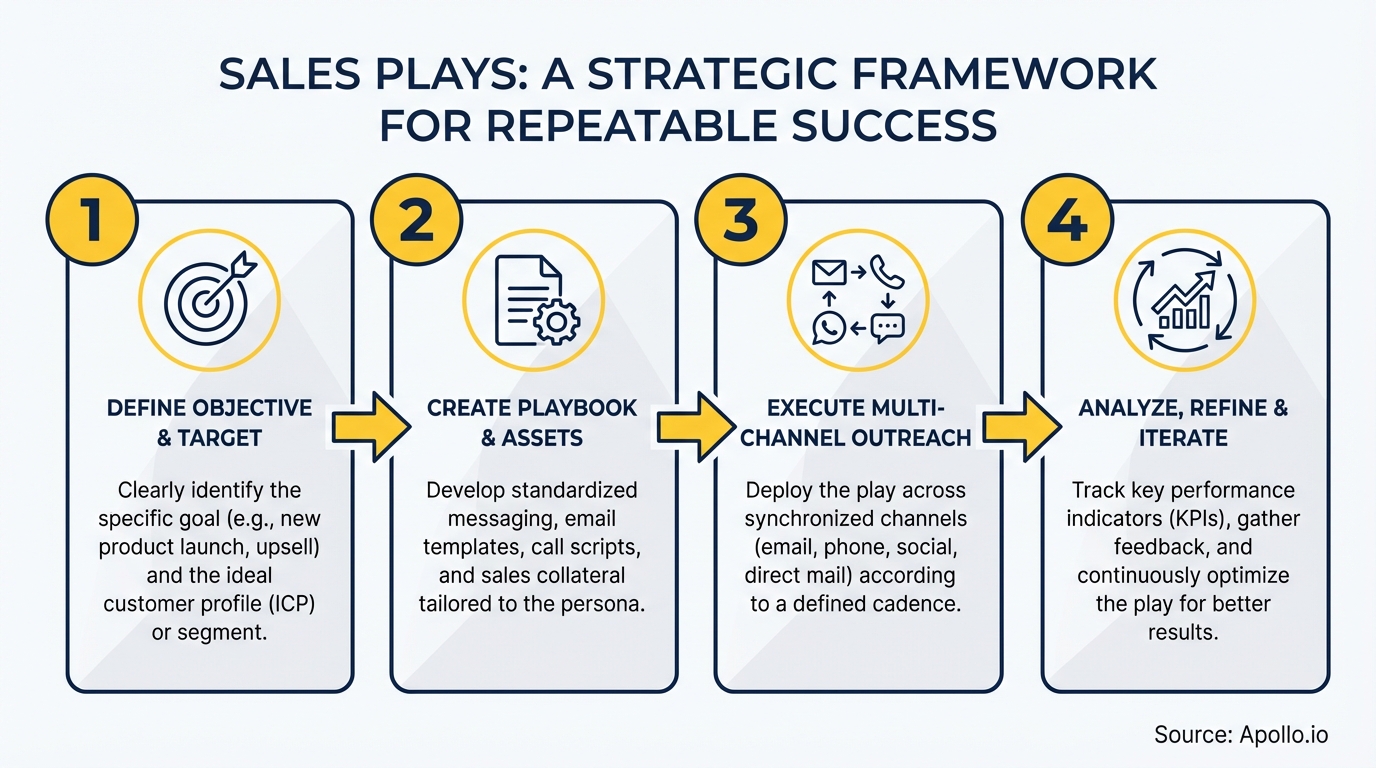
Building sales plays starts with mapping the buyer journey and identifying high-stakes moments where guidance drives outcomes. Sales leaders should analyze win/loss data, interview top performers, and identify patterns in successful deals.
Each play needs a clear trigger (when to use it), structured steps (how to execute), required assets (what you need), and success metrics (how to measure it).
Here's the framework top RevOps teams use in 2026:
- Trigger Definition: Specify the exact scenario (competitive eval, budget concerns, executive involvement, renewal at-risk)
- Stakeholder Mapping: Identify who's involved and what each person cares about (champions, economic buyers, technical evaluators)
- Messaging Architecture: Create value props, objection handling, proof points, and differentiation for each stakeholder
- Asset Library: Build ROI calculators, case studies, battle cards, demo scripts, and email templates
- Workflow Integration: Embed plays into CRM stages, sequence steps, and meeting prep workflows
- Measurement Framework: Track play usage, conversion rates, and velocity impact
Struggling to align your plays with pipeline data? Track every deal stage and play execution in one unified platform.

How Do SDRs Execute Sales Plays That Book Meetings?
SDRs need plays that work at the top of funnel where speed and personalization determine success. The best SDR plays focus on three elements: targeted account selection, multi-channel sequencing, and trigger-based messaging.
Instead of generic outreach, plays should guide SDRs to specific accounts showing buying signals.
A strong SDR play includes account research shortcuts (tech stack, recent funding, hiring patterns), personalized email templates with variable fields, phone scripts with discovery questions, and social engagement tactics.
The play should specify exactly when to call, what to say in the first 10 seconds, and how to handle common objections. Social selling strategies amplify these plays by building credibility before the first call.
Modern SDR plays integrate with sales engagement platforms to automate sequencing while maintaining personalization. When an SDR selects the "new market entry" play, the system auto-populates relevant case studies, industry stats, and messaging frameworks.
This reduces research time and increases message quality.
Turn Funnel Guesswork Into Pipeline Wins
Tired of watching quality leads stall before they ever reach your pipeline? Apollo surfaces in-market buyers and keeps your funnel moving with precision. Join 550K+ companies that forecast with confidence, not guesswork.
Start Free with Apollo →What Sales Plays Do Account Executives Need for Complex Deals?
Account Executives managing complex B2B deals need plays that navigate multiple stakeholders and long sales cycles. According to Monday.com, the average B2B buying group has expanded to include 6 to 10 stakeholders. AEs need plays that address each persona's priorities and build consensus across the buying committee.
Critical AE plays include:
| Play Type | When to Use | Key Components |
|---|---|---|
| Executive Engagement | C-level involvement required | Business case template, executive briefing deck, ROI calculator |
| Competitive Displacement | Prospect evaluating incumbent | Comparison matrix, migration plan, risk mitigation guide |
| Consensus Building | Multiple stakeholders stalling | Champion enablement kit, stakeholder mapping, mutual action plan |
| Procurement Navigation | Legal/security review stage | Security questionnaire, contract redlines, compliance documentation |
Each play needs assets that AEs can share directly with buyers. Modern plays live in digital sales rooms where prospects access content, collaborate with internal teams, and track mutual commitments. Enterprise sales strategies show how top AEs use plays to compress sales cycles by 30-40%.
How Do RevOps Leaders Integrate Sales Plays Into Revenue Technology?
RevOps leaders face a critical challenge: 70% of companies fail to integrate sales plays into CRM and revenue tools. The solution requires three integration layers: workflow triggers, content delivery, and performance measurement.
Plays must activate automatically based on CRM data (deal stage, industry, competitor mentioned) and surface the right guidance without reps leaving their workflow.
Integration best practices include:
- CRM Field Mapping: Tag opportunities with play type to trigger relevant content and next steps
- Sequence Automation: Embed plays into email/call sequences with conditional logic based on responses
- Content Governance: Maintain single source of truth for all play assets with version control and approval workflows
- Analytics Dashboards: Track play usage, conversion rates by play type, and time-to-close impact
- AI Recommendations: Use historical data to suggest which play fits each opportunity
Need to consolidate your sales tech stack and execute plays in one workspace? Build your entire go-to-market motion in Apollo's unified platform. RevOps teams using consolidated platforms report measurable improvements in play adoption because reps don't need to switch between tools.
What Metrics Should Sales Leaders Track for Sales Plays?
Sales play effectiveness requires measurement at three levels: adoption, execution, and outcomes. Adoption metrics show whether reps use plays (play selection rate, asset download rate).
Execution metrics reveal how well plays are followed (steps completed, required assets used). Outcome metrics prove business impact (conversion rate by play, average deal size, sales cycle length).
Top-performing sales organizations track:
- Play Adoption Rate: Percentage of eligible opportunities tagged with a play
- Win Rate by Play: Conversion percentage for each play type vs. no-play baseline
- Velocity Impact: Days to close for deals using plays vs. without
- Asset Utilization: Which play components get used most (identifies what works)
- Rep Proficiency: Performance variance between top and bottom quartile play execution
The most important metric is revenue influenced by plays. Sales KPIs in 2026 show that organizations tracking play-to-revenue attribution make better decisions about which plays to scale and which to retire. This closed-loop measurement separates high-performing sales organizations from those still guessing.

Start Building Sales Plays That Drive Revenue
Sales plays transform from static documents into revenue engines when they're integrated into your CRM, triggered by real-time signals, and measured against business outcomes. The companies winning in 2026 have moved beyond playbook PDFs to AI-powered systems that guide reps through every high-stakes moment.
Start by auditing your current plays. Which scenarios drive the most revenue?
Where do deals stall? What do your top performers do differently?
Build plays around these insights, embed them into your tech stack, and measure adoption ruthlessly. Remember: a play that isn't used is just expensive documentation.
Ready to consolidate your sales tech stack and execute plays where your team actually works? Start a free trial and see how Apollo brings prospecting, engagement, and analytics into one unified platform.
Prove Pipeline ROI With Apollo
Budget approval stuck on unclear metrics? Apollo surfaces the pipeline impact and time savings your leadership needs to see. Leadium 3x'd their annual revenue — your ROI case starts here.
Start Free with Apollo →Don't miss these
Sales
Inbound vs Outbound Marketing: Which Strategy Wins?
Sales
What Is a Sales Funnel? The Non-Linear Revenue Framework for 2026
Sales
What Is a Go-to-Market Strategy? The 2026 GTM Playbook
See Apollo in action
We'd love to show how Apollo can help you sell better.
By submitting this form, you will receive information, tips, and promotions from Apollo. To learn more, see our Privacy Statement.
4.7/5 based on 9,690 reviews
