
Sales Mapping: How to Identify and Influence B2B Buying Committees
Your reps are losing deals to competitors who map buying groups better. B2B buyers spend only 17% of their total purchase journey talking to sales reps, which means the other 83% happens without you. Sales mapping helps you understand who's involved, what they care about, and how to reach them before competitors do. In 2026, mapping isn't about territories anymore. It's about buying committees, stakeholder influence, and coordinated outreach across every channel.
This approach helps RevOps teams align messaging, helps AEs build consensus, and helps SDRs prioritize accounts that will actually close. According to Revenue.io, companies investing in data-driven sales operations see 15% higher quota attainment and 20% faster sales cycles.

Scale Your Team Without Scaling Headcount
Tired of inconsistent processes slowing down your growing sales team? Apollo standardizes outreach and automates workflows so every rep performs like your best. Built-In boosted win rates 10% with Apollo's proven playbooks.
Start Free with Apollo →Key Takeaways
- Sales mapping identifies buying committee members, their roles, influence levels, and decision criteria across target accounts
- Mapping prevents pipeline leaks by ensuring every stakeholder receives relevant, consistent messaging throughout the buyer journey
- Territory mapping reduces customer acquisition costs while buying-group mapping increases deal size and win rates
- RevOps leaders use mapping to align sales, marketing, and customer success around shared account intelligence
- Modern mapping tools automate stakeholder discovery and track engagement signals across email, calls, and digital channels
What Is Sales Mapping in 2026?
Sales mapping is the strategic process of identifying, organizing, and tracking accounts, territories, and buying committees to optimize coverage and increase revenue. It combines geographic territory assignment with stakeholder-level intelligence about who influences purchasing decisions.
Modern sales mapping addresses three core dimensions:
- Territory Mapping: Assigning accounts to reps based on geography, industry, company size, or revenue potential
- Account Mapping: Identifying high-value target accounts and understanding their organizational structure, needs, and budget cycles
- Buying Group Mapping: Tracking individual stakeholders within accounts, including their roles, influence, pain points, and relationships
The shift toward buying-group mapping reflects how B2B purchasing has evolved. Committees now average 8-13 people across multiple departments, each with veto power.
Missing even one stakeholder can stall deals for months.
Why Is Sales Mapping Critical for Revenue Teams?
Sales mapping directly impacts quota attainment, pipeline efficiency, and customer retention. Without systematic mapping, teams waste time on low-fit accounts, miss key decision-makers, and send inconsistent messages that erode trust.
The business impact is measurable. Research from SalesTechScout shows that strategic territory design can help reduce customer acquisition costs by 20%. Organizations that align territory design with performance consistently outperform competitors, according to Varicent.
Beyond cost reduction, mapping prevents revenue leaks:
- Eliminates territory overlap and account confusion that frustrate prospects
- Ensures every buying committee member receives role-appropriate messaging
- Surfaces hidden influencers and blockers before they derail deals
- Enables ABM programs that coordinate marketing and sales around shared targets
For Sales Leaders managing distributed teams, mapping creates visibility into coverage gaps, rep capacity, and pipeline health across regions and segments.
How Do RevOps Teams Build Effective Sales Maps?
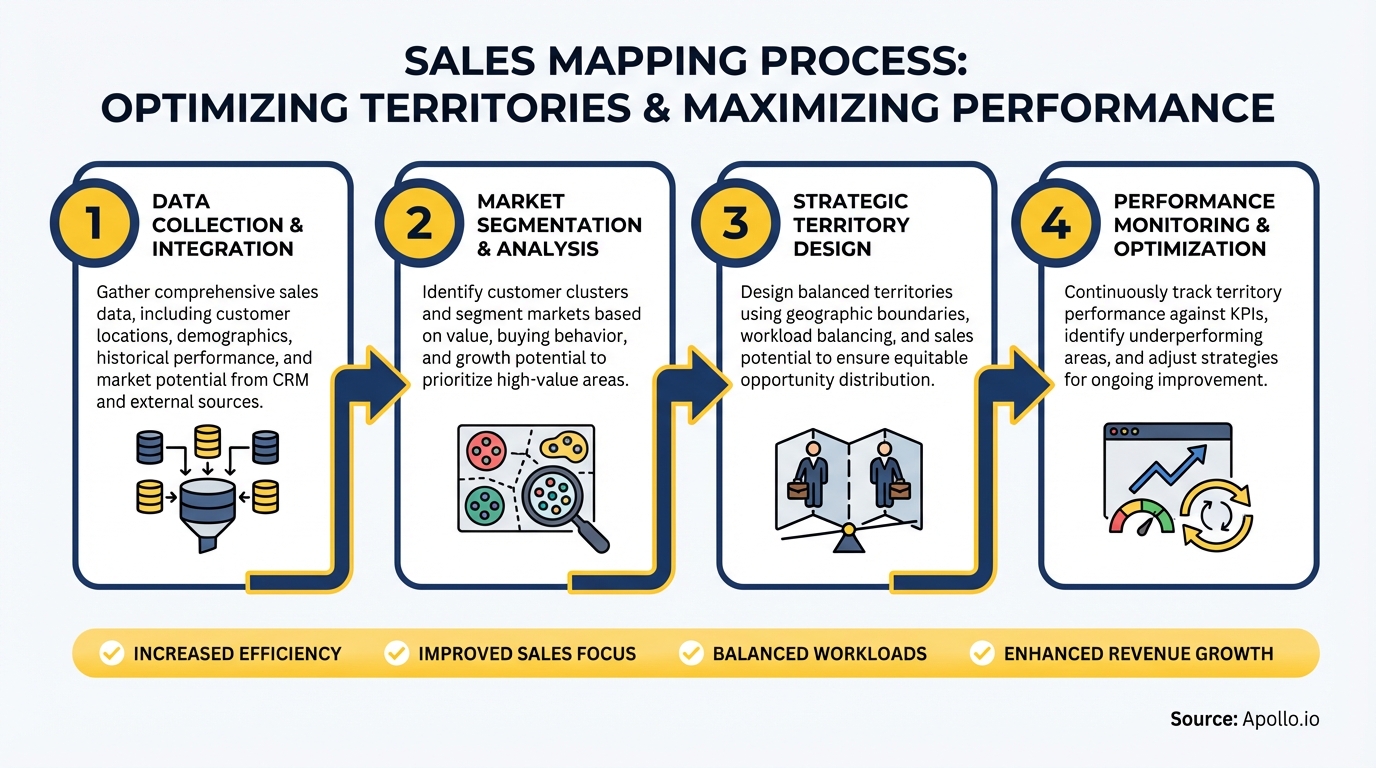
RevOps teams build sales maps by combining CRM data, intent signals, technographic intelligence, and org chart information into a unified view of target accounts and buying groups.
The process follows four stages:
What Data Sources Power Sales Mapping?
Effective mapping requires clean, enriched contact and company data. Start with firmographic attributes (industry, revenue, employee count), technographic signals (current tech stack), and intent data (content consumption, website visits).
Struggling to enrich incomplete account records? Apollo's 224M+ verified contacts help you map buying groups with accurate titles, departments, and reporting structures.
How Do You Identify Buying Committee Members?
Modern buying committees include economic buyers (budget holders), technical buyers (evaluate solutions), end users (daily adopters), and influencers (shape requirements). Map each role by department and seniority.
Use these signals to identify stakeholders:
- Job titles containing "Director," "VP," "Head of," or "Chief" in relevant departments
- Engagement with your content (webinar attendance, email opens, website visits)
- professional networks activity showing project involvement or initiative leadership
- Calendar invites and meeting participants from past discovery calls
How Should You Segment and Prioritize Accounts?
Segment accounts using ICP fit scores, intent signals, and revenue potential. Tier 1 accounts get full buying-group mapping and multi-threaded outreach.
Tier 2 accounts get lighter touch with key stakeholder coverage. Tier 3 accounts enter scaled sequences.
Account Executives prioritizing enterprise deals need deeper maps showing reporting relationships, budget cycles, and cross-functional dependencies. SDRs prospecting into mid-market accounts focus on identifying champions and economic buyers quickly.
How Do You Maintain Map Accuracy Over Time?
Buying groups change constantly through promotions, departures, reorganizations, and new hires. Set quarterly review cadences for Tier 1 accounts and automated alerts for job changes at target accounts.
Track engagement signals to validate map accuracy. If a mapped stakeholder stops responding while a new contact engages heavily, update your map and adjust messaging accordingly.

What Are the Different Types of Sales Mapping?
Sales teams use five distinct mapping approaches, often in combination, depending on their go-to-market strategy and deal complexity.
| Mapping Type | Primary Use Case | Key Benefit |
|---|---|---|
| Territory Mapping | Geographic or vertical coverage assignment | Prevents account overlap and ensures balanced workload |
| Account Mapping | Target account identification and prioritization | Focuses resources on high-value opportunities |
| Buying Group Mapping | Multi-stakeholder deal orchestration | Builds consensus across decision-makers |
| Relationship Mapping | Influence and champion identification | Surfaces hidden advocates and blockers |
| Journey Mapping | Stage-based content and touchpoint planning | Delivers relevant messages at each buying stage |
ABM programs combine all five types. Territory mapping defines the universe of target accounts.
Account mapping selects specific companies. Buying-group mapping identifies stakeholders.
Relationship mapping reveals influence patterns. Journey mapping sequences touchpoints across channels.
Turn Forecast Guesswork Into Revenue Certainty
Unreliable forecasts killing your credibility. Apollo delivers real-time pipeline visibility and lead scoring so you predict revenue with confidence. Built-In boosted win rates 10% with Apollo's intelligence.
Start Free with Apollo →How Do Sales Leaders Implement Sales Mapping at Scale?
Scaling sales mapping requires standardized processes, clear ownership, and technology that automates data collection and updates.
Start with these implementation steps:
- Define Territory Rules: Establish clear criteria for account assignment (geography, industry, deal size, strategic value)
- Build Stakeholder Frameworks: Create role taxonomies that categorize buying committee members by function, seniority, and influence
- Set Mapping Cadences: Require reps to map buying groups during discovery, update maps after each stakeholder interaction, and review maps in weekly deal inspections
- Create Governance Standards: Document how teams should track stakeholder status, relationship strength, and engagement history
- Integrate with Workflows: Embed mapping steps into CRM opportunity stages, deal management processes, and forecast reviews
Sales Trainers often find that mapping adoption fails when it's treated as a one-time exercise. Make it part of daily workflows by requiring updated stakeholder maps before moving deals to next stages.
Need to track buying groups across multiple accounts? Apollo's go-to-market platform consolidates account intelligence, engagement tracking, and pipeline management in one system.
What Mistakes Do Teams Make with Sales Mapping?
The most common mapping failures stem from treating it as a static planning exercise rather than a dynamic revenue discipline.
Avoid these critical errors:
- Mapping Only Economic Buyers: Missing technical evaluators, end users, and influencers who can block deals
- Creating Maps in Spreadsheets: Keeping maps outside your CRM means reps won't maintain them and managers can't inspect them
- Ignoring Relationship Strength: Knowing stakeholder names isn't enough. Track relationship quality, responsiveness, and advocacy level
- Inconsistent Messaging: When different reps contact the same account with conflicting messages, it erodes trust and stalls deals
- Neglecting Map Maintenance: Stale maps with outdated contacts waste time and damage credibility when reps reference departed stakeholders
According to SimplyDepo, poor territory mapping leads to customer dissatisfaction, with inconsistent service eroding trust.
Founders and CEOs building early sales motions should resist the urge to skip mapping until the team scales. Establishing mapping discipline early prevents the chaos of overlapping territories and conflicting outreach as you grow.
How Does Sales Mapping Support ABM and Multi-Threading?
Account-based marketing and multi-threading both depend on accurate buying-group maps to coordinate messaging and build consensus across stakeholders.
ABM programs use sales maps to:
- Identify target accounts that match ICP criteria and show buying intent
- Map complete buying committees including hidden influencers
- Personalize content and campaigns for specific stakeholder roles
- Measure engagement across the buying group, not just individual leads
- Align sales and marketing around shared account priorities
Multi-threading applies mapping insights to deal execution. Instead of relying on a single champion, AEs build relationships with multiple stakeholders simultaneously.
This prevents deals from stalling when champions leave, get promoted, or lose internal political battles.
The data supports this approach. Organizations implementing strategic territory mapping and account focus consistently outperform competitors in new markets and deal velocity. Combining sales analytics with buying-group intelligence helps teams identify which stakeholder patterns predict closed-won outcomes.

Start Mapping Buying Groups to Close More Deals in 2026
Sales mapping has evolved from territory planning into buying-group orchestration. Teams that map stakeholders, track influence, and coordinate messaging across committees win more deals at higher values.
The implementation path is clear. Start with ICP-fit account selection.
Enrich records with complete org chart data. Map buying committees with role-specific intelligence.
Maintain maps through systematic reviews and automated alerts. Integrate mapping into deal stages and forecast processes.
RevOps teams driving this transformation consolidate mapping, engagement tracking, and pipeline management into unified platforms that give reps actionable intelligence without switching tools.
Ready to map buying groups and accelerate pipeline? Request a Demo to see how Apollo helps teams discover stakeholders, track engagement, and coordinate outreach across your entire revenue motion.
Prove ROI Fast With Apollo's Pipeline Impact
Budget approval stuck on unclear metrics? Apollo delivers measurable pipeline impact from day one—track time saved, meetings booked, and deals closed. Built-In increased win rates 10% and ACV 10% with Apollo's intelligence.
Start Free with Apollo →Don't miss these
Sales
Inbound vs Outbound Marketing: Which Strategy Wins?
Sales
What Is a Sales Funnel? The Non-Linear Revenue Framework for 2026
Sales
What Is a Go-to-Market Strategy? The 2026 GTM Playbook
See Apollo in action
We'd love to show how Apollo can help you sell better.
By submitting this form, you will receive information, tips, and promotions from Apollo. To learn more, see our Privacy Statement.
4.7/5 based on 9,690 reviews
