
Sales Goals Examples: 15 Proven Targets That Drive Revenue Growth
Sales goals drive revenue, but outdated metrics like "100 calls per day" no longer reflect how B2B buyers make decisions in 2026. According to CloudApps, only one in three sales reps consistently meet their quotas, and 70% of B2B reps fell short of quota in 2024. Modern sales teams need outcome-focused goals tied to pipeline coverage, win rates, and efficiency metrics that align with compressed buying cycles and digital-first buyer behavior. This article provides copy-ready sales goal examples designed for SDRs, Account Executives, RevOps leaders, and sales managers navigating the rep-free buying era.

Apollo Eliminates 4+ Hours Of Daily Research
Tired of spending 4+ hours daily hunting for contact info? Apollo delivers 224M verified contacts with 96% email accuracy instantly. Join 550K+ companies who replaced manual research with predictable pipeline.
Start Free with Apollo →Key Takeaways
- Effective sales goals in 2026 prioritize outcome metrics (pipeline coverage, win rate) over activity volume (calls, emails sent)
- Modern goal frameworks must address omnichannel buyer behavior and pre-contact influence, not just post-discovery activities
- AI governance, CRM accuracy, and forecast hygiene are now core goal categories as automation adoption reaches 81% in sales
- RevOps-aligned goals improve quota attainment: B2B organizations leveraging RevOps are 1.4 times more likely to exceed revenue targets by 10% or more
- Copy-ready goal templates with specific metrics and timeframes accelerate OKR planning and cross-functional alignment
What Are Sales Goals and Why Do They Matter in 2026?
Sales goals are measurable objectives that define what sales teams must achieve within a specific timeframe to drive revenue growth. They translate business strategy into actionable targets for individual contributors, managers, and entire go-to-market organizations.
In 2026, goal-setting has shifted from pure activity tracking to outcome measurement. Research from TryKondo confirms that 80% of B2B sales interactions occur in digital channels, forcing teams to set goals around digital engagement quality, pipeline velocity, and pre-contact influence rather than meeting volume alone. Sales leaders now balance efficiency goals (cost per opportunity, pipeline per rep) with quality metrics (win rate by stage, deal velocity) to address tighter budgets and compressed sales cycles.
For SDRs and Account Executives, clear goals provide direction and accountability. For RevOps teams and sales leaders, well-structured goals enable forecasting accuracy, resource allocation, and performance coaching at scale. Struggling to track pipeline health across your team? Get complete visibility with Apollo's deal management platform.
What Are the Main Types of Sales Goals?
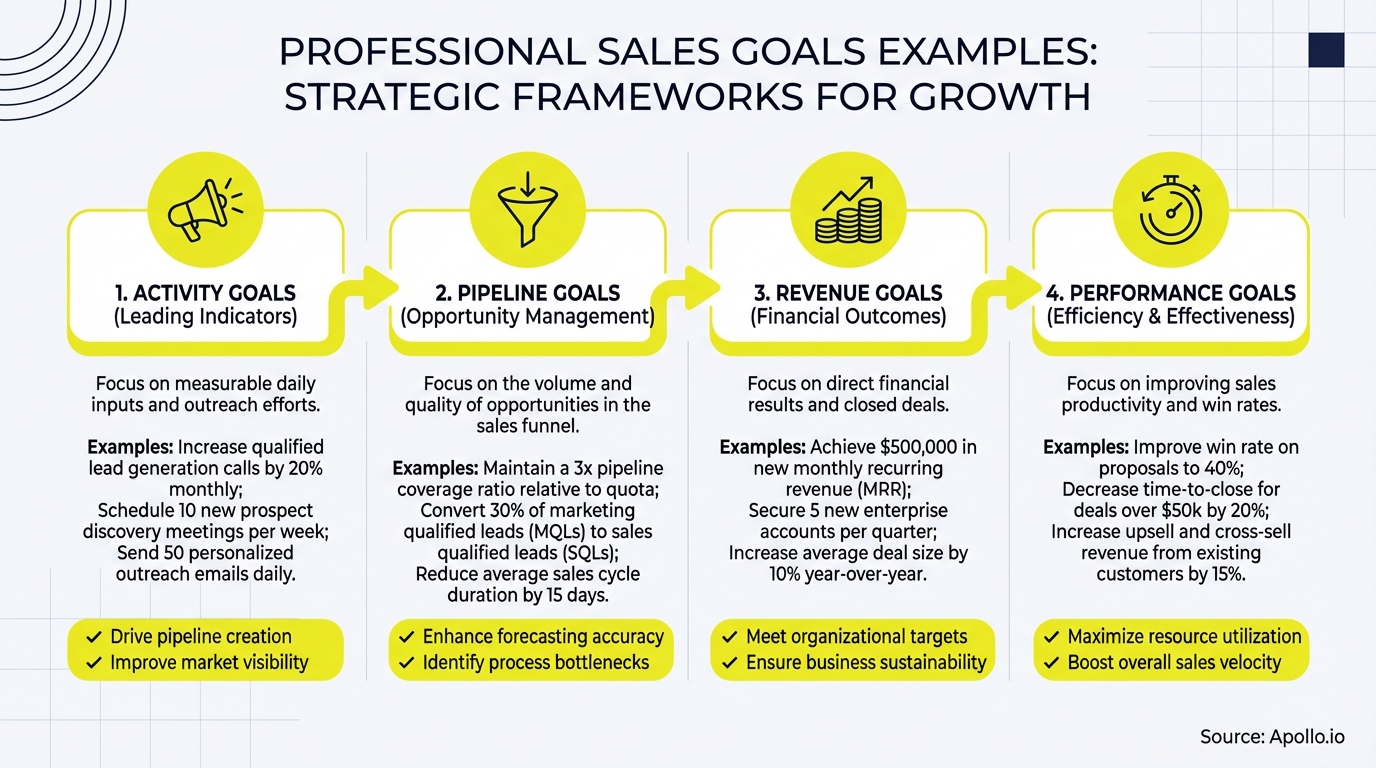
Sales goals fall into four primary categories: revenue goals, activity goals, efficiency goals, and capability goals. Each category serves a distinct purpose in driving team performance and business outcomes.

| Goal Type | Focus Area | Example Metric | Best For |
|---|---|---|---|
| Revenue Goals | Bookings, pipeline, quota attainment | Close $500K in new ARR this quarter | AEs, Sales Leaders |
| Activity Goals | Outreach volume, meetings booked | Book 20 qualified meetings per month | SDRs, BDRs |
| Efficiency Goals | Conversion rates, cycle time, cost metrics | Reduce sales cycle from 90 to 75 days | RevOps, Sales Ops |
| Capability Goals | Skills development, tool adoption, process compliance | Achieve 95% CRM data accuracy by Q2 | All roles |
Revenue goals remain the ultimate measure of sales success, but efficiency and capability goals have become equally critical. According to Vena Solutions, AI adoption in sales surged from 39% in 2023 to 81% in 2025, making AI governance and tool proficiency essential goal categories. RevOps teams increasingly set goals around data completeness and automation coverage because accurate forecasting depends on clean, structured CRM data.
How Do SDRs and BDRs Set Effective Prospecting Goals?
SDRs and BDRs should set goals that balance outreach volume with meeting quality and pipeline contribution. Effective prospecting goals measure both top-of-funnel activity and downstream impact on revenue.
Copy-Ready SDR Goal Examples:
- Book 25 qualified discovery meetings per month with target accounts in ICP segments
- Generate $150K in qualified pipeline per quarter (measured at SQL stage)
- Achieve 15% email reply rate on cold outreach campaigns
- Convert 30% of booked meetings to Sales Qualified Opportunities
- Maintain 95% contact data accuracy in CRM for all new prospects
- Complete 100% of sequences within 48 hours of lead assignment
Modern SDR goals prioritize pipeline contribution over call volume. Instead of "make 80 calls per day," leading teams set goals like "generate $100K pipeline from Q1 outbound efforts." This shift aligns SDR work with revenue outcomes and provides clearer ROI visibility for sales leadership. Need better prospecting data to hit your targets? Search Apollo's 224M+ contacts with 65+ filters for precise targeting.
BDRs focused on inbound leads should set conversion-rate goals (MQL-to-SQL, SQL-to-Opportunity) and response-time SLAs. For outbound-focused SDRs, personalization quality and account penetration (contacts engaged per target account) matter more than raw activity counts. Learn how top teams structure their outreach in our guide to sales cadence examples and best practices.
Turn Forecast Guesswork Into Revenue Certainty
Missing quota because your pipeline data is always outdated? Apollo gives you real-time deal visibility and verified contacts that actually convert. Built-In increased win rates 10% with Apollo's intelligence.
Start Free with Apollo →What Sales Goals Should Account Executives Prioritize?
Account Executives should set goals that optimize deal velocity, win rates, and revenue per opportunity. AE goals bridge pipeline generation and closed revenue while maintaining forecast accuracy.
Copy-Ready AE Goal Examples:
- Close $600K in new ARR per quarter at 25% win rate
- Reduce average sales cycle to 60 days for mid-market deals
- Maintain 3:1 pipeline coverage ratio across all open quarters
- Achieve 90% forecast accuracy (commit vs. closed) each month
- Expand 15% of existing accounts with upsell or cross-sell revenue
- Complete discovery calls within 3 business days of opportunity creation
- Maintain 100% next-step clarity on all Stage 3+ opportunities
Win rate and deal velocity goals directly impact quota attainment. Research from Deloitte Digital shows that B2B organizations leveraging RevOps are 1.4 times more likely to surpass their revenue targets by 10% or more compared to those with siloed teams. AEs working in RevOps-aligned environments should collaborate on shared goals around pipeline quality, stage progression velocity, and forecast discipline.
Account Executives managing complex enterprise deals should add goals for stakeholder engagement (contacts engaged per account, executive meetings secured) and competitive win rates. For transactional sales motions, focus on deal count, average contract value, and time-to-close metrics. Discover enterprise selling strategies in our guide to breaking into enterprise accounts and closing mega deals.
How Should Sales Leaders Set Team and Pipeline Goals?
Sales leaders should set goals that drive predictable revenue, optimize team efficiency, and improve forecast accuracy. Leadership goals cascade from company OKRs to individual contributor targets while addressing capability gaps and process improvements.
Copy-Ready Sales Leadership Goal Examples:
- Achieve 95% of team quota attainment each quarter
- Maintain 4:1 pipeline coverage across all reps and segments
- Improve overall win rate from 22% to 28% by Q3 2026
- Reduce average sales cycle by 15 days through process optimization
- Increase net revenue retention (NRR) to 115% through expansion focus
- Achieve 85% forecast accuracy at commit stage (weekly snapshots)
- Onboard new reps to full productivity within 60 days
- Implement AI-assisted workflows for 100% of outbound sequences by Q2
Forecast accuracy has become a critical leadership goal as market volatility increases. Sales leaders now set explicit targets for pipeline hygiene (stage exit criteria compliance, next-step documentation) and forecast change discipline (limits on late-stage slippage without documented justification).
These governance goals improve predictability and enable more confident resource allocation.
Leaders should also set capability development goals tied to tool adoption and process compliance. With AI adoption reaching 81% in sales, goals around AI governance (compliant usage, auditable workflows) and CRM accuracy (automated activity capture, data completeness) have become standard. RevOps alignment goals are particularly valuable: teams can set shared targets for data quality, lead response times, and cross-functional process adherence. Explore how unified platforms support these goals in our sales tech stack playbook.
What Are the Best Efficiency and Productivity Goals for 2026?
Efficiency goals measure how effectively teams convert inputs (time, budget, activities) into outputs (pipeline, revenue). In 2026, efficiency metrics have moved from nice-to-have to board-level KPIs as sales and marketing budgets face increased scrutiny.
Copy-Ready Efficiency Goal Examples:
- Reduce cost per qualified opportunity by 20% through better targeting
- Increase pipeline-per-rep from $800K to $1M per quarter
- Improve meeting-to-opportunity conversion from 35% to 45%
- Decrease time spent on non-selling activities from 35% to 25%
- Achieve 90% email deliverability across all outbound campaigns
- Reduce stuck deals (no activity >14 days) to less than 10% of pipeline
- Increase automation coverage to 75% of routine follow-up tasks
- Maintain average response time under 2 hours for inbound leads
Productivity goals focus on maximizing selling time and reducing administrative friction. With sales reps spending significant time on manual data entry, research, and follow-up coordination, automation adoption has become a competitive advantage.
Teams should set specific goals around CRM automation coverage, AI-assisted content generation, and automated activity logging to free up time for high-value prospect interactions.
Pipeline velocity metrics (days in stage, stage-to-stage conversion rates) help identify bottlenecks and inform process improvements. RevOps leaders can set goals to reduce friction points: streamline contract review, accelerate security questionnaire responses, or implement faster approval workflows for non-standard deals. Learn how automation supports these goals in our guide to sales automation software.
How Do You Measure and Track Sales Goal Progress?
Effective goal tracking requires clear metric definitions, reliable data sources, and regular review cadences. Sales teams should establish measurement frameworks before setting goals to ensure alignment on what success looks like and how progress will be monitored.
Goal Tracking Best Practices:
- Define metrics precisely: Specify exactly what counts (e.g., "qualified meeting" means discovery call with decision-maker from target account segment)
- Establish data sources: Identify where each metric lives (CRM, engagement platform, analytics tool) and who owns data quality
- Set review cadences: Weekly for activity goals, monthly for pipeline goals, quarterly for strategic objectives
- Create dashboards: Build role-specific views that show real-time progress against targets with drill-down capability
- Document assumptions: Record how metrics are calculated, what's included/excluded, and any known data limitations
- Audit regularly: Validate data accuracy monthly and adjust tracking methods when processes change
CRM data quality directly impacts goal measurement reliability. Teams should set baseline standards for required fields, activity logging, and opportunity stage criteria.
Without clean data, even well-designed goals become difficult to track accurately. Sales operations teams often create "data health" scorecards that measure completeness, accuracy, and timeliness of CRM records as a leading indicator of forecast quality.
Modern sales platforms enable automated goal tracking through native analytics and customizable dashboards. Look for systems that support role-based views (SDR metrics vs. AE metrics), trend analysis (week-over-week progress), and exception reporting (deals at risk, reps below target). For teams using sales analytics platforms, set up automated alerts when key metrics deviate from targets so managers can intervene proactively.
Ready to Achieve Your Sales Goals with Better Data and Automation?
Sales goals in 2026 require outcome-focused metrics, omnichannel measurement, and AI-enabled execution. The shift from activity volume to pipeline quality, forecast accuracy, and efficiency reflects how B2B buying has evolved.
Modern sales teams need goals that address pre-contact influence, digital engagement quality, and governed AI adoption, not just post-discovery activities.
Effective goal-setting starts with clear definitions, reliable data sources, and role-specific targets that ladder up to company revenue objectives. SDRs focus on meeting quality and pipeline contribution.
Account Executives optimize win rates and deal velocity. Sales leaders drive forecast accuracy and team productivity.
RevOps professionals ensure data quality and process compliance that make all other goals measurable.
The examples in this guide provide copy-ready templates for OKR planning, performance reviews, and cross-functional alignment.
Adapt these frameworks to your specific market, sales motion, and organizational priorities.
Remember that the best goals are specific, measurable, achievable, relevant, and time-bound (SMART), with clear ownership and regular review cadences.

Apollo consolidates the sales intelligence, engagement automation, and analytics capabilities needed to track and achieve ambitious sales goals. Teams using Apollo report significant improvements in prospecting efficiency, pipeline visibility, and forecast accuracy. "We reduced the complexity of three tools into one," says Collin Stewart of Predictable Revenue. "Having everything in one system was a game changer," notes a leader at Cyera.
Ready to hit your 2026 sales targets? Request a Demo to see how Apollo helps teams set, track, and exceed their most important sales goals.
Prove Apollo's Value In Your First Week
Budget approval stuck on unclear metrics? Apollo delivers measurable pipeline impact from day one—quantifiable meetings booked, deals created, and time saved. Built-In increased win rates 10% and ACV 10% with Apollo's intelligence.
Start Free with Apollo →Don't miss these
Sales
Inbound vs Outbound Marketing: Which Strategy Wins?
Sales
What Is a Sales Funnel? The Non-Linear Revenue Framework for 2026
Sales
What Is a Go-to-Market Strategy? The 2026 GTM Playbook
See Apollo in action
We'd love to show how Apollo can help you sell better.
By submitting this form, you will receive information, tips, and promotions from Apollo. To learn more, see our Privacy Statement.
4.7/5 based on 9,690 reviews
