
Best Sales Forecasting Tools to Drive Revenue Accuracy in 2026
Sales forecasting tools have evolved from static spreadsheets to AI-powered platforms that adapt to non-linear buyer journeys and self-serve digital channels. According to Gartner, 95% of seller research workflows will begin with AI by 2027, up from less than 20% in 2024. Modern AI sales tools consolidate forecasting, pipeline tracking, and engagement data into unified platforms that eliminate the need for 3-5 separate tools.

Apollo Eliminates Hours Of Daily Research
Tired of spending 4+ hours daily hunting for contact info? Apollo delivers 224M verified contacts with 96% email accuracy instantly. Join 550K+ companies who stopped wasting time and started closing deals.
Start Free with Apollo →Key Takeaways
- AI-powered forecasting tools adapt to non-linear buyer journeys and self-serve channels, improving accuracy in 2026
- RevOps leaders consolidate tech stacks by using platforms that combine forecasting with pipeline management and engagement tracking
- Sales leaders achieve predictable revenue through real-time data integration, scenario planning, and adaptive models
- Implementation roadmaps with quick wins reduce risk while building toward comprehensive AI-enabled forecasting
What Are Sales Forecasting Tools in 2026?
Sales forecasting tools are AI-powered platforms that predict future revenue by analyzing pipeline data, historical win rates, deal velocity, and buyer engagement signals. Unlike traditional spreadsheet models, modern tools integrate with CRM systems, engagement platforms, and conversation intelligence to provide real-time, adaptive forecasts.
These tools serve multiple roles across sales organizations. SDRs use forecasting insights to prioritize high-intent prospects.
Account Executives track deal progression and adjust strategies based on predictive scoring. RevOps leaders monitor forecast accuracy, identify pipeline gaps, and optimize resource allocation.
Sales Leaders rely on forecasting data to set realistic quotas, coach teams, and report to executives with confidence.
The shift from linear to non-linear buyer journeys requires forecasting tools that capture digital self-serve interactions. Forrester research shows that by 2025, more than 50% of large B2B transactions (over $1 million) will be processed through digital self-serve channels. Tools must now integrate website behavior, content engagement, and social signals alongside traditional pipeline metrics.
How Do AI-Powered Sales Forecasting Tools Work?
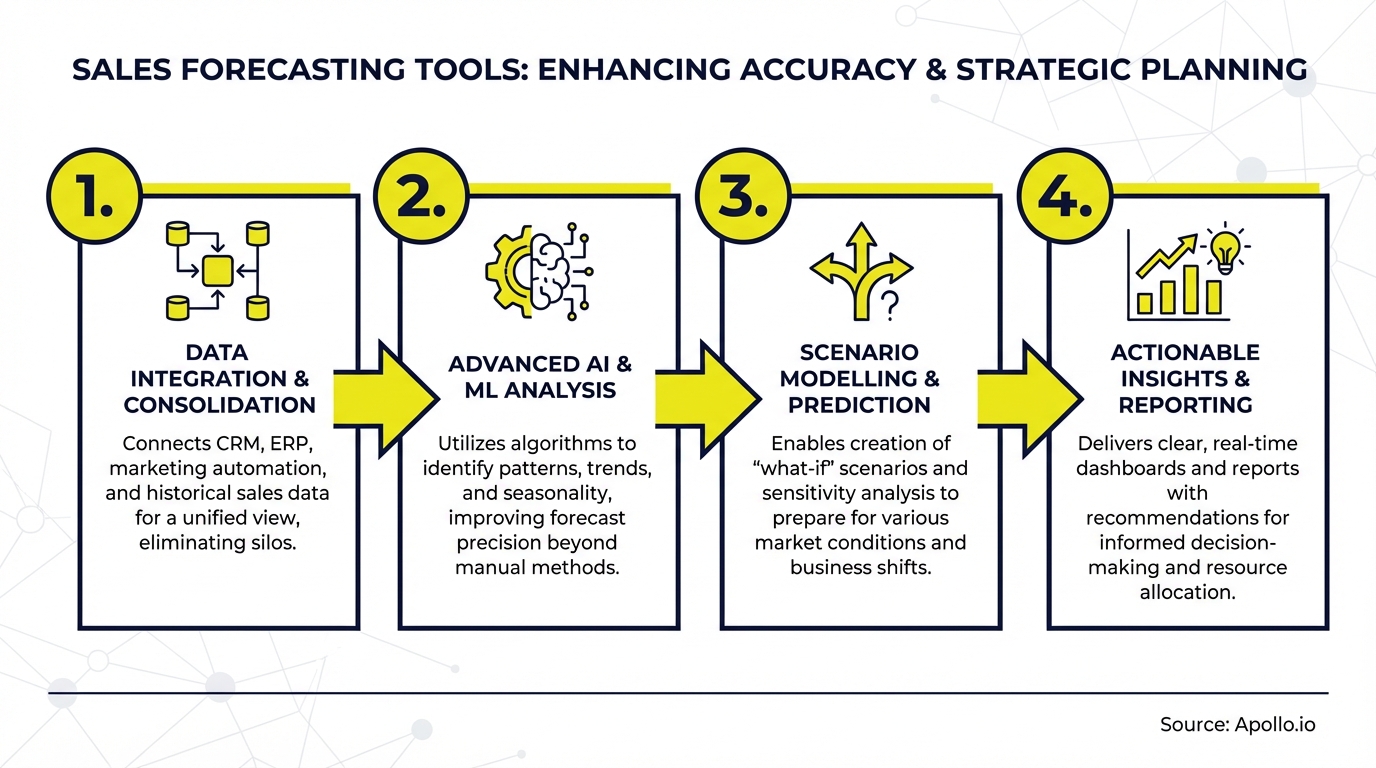
AI-powered sales forecasting tools analyze multiple data inputs to generate predictive models. Core data sources include CRM records (opportunity stages, deal sizes, close dates), engagement metrics (email opens, meeting attendance, content downloads), conversation intelligence (call sentiment, talk-to-listen ratios), and external signals (company growth indicators, funding events).

The AI layer processes this data through machine learning models that identify patterns in historical won/lost deals. These models score each opportunity based on factors like buyer engagement level, deal velocity compared to historical averages, stakeholder involvement, and competitive displacement signals.
The system updates forecasts continuously as new data flows in, rather than waiting for manual updates.
Governance structures ensure forecast reliability. Sales Leaders establish clear stage definitions and exit criteria.
RevOps teams maintain data hygiene by enforcing required fields, removing stale opportunities, and auditing forecast submissions. The platform tracks forecast-to-actual variance, surfaces outliers, and provides coaching insights for managers.
| Data Input | AI Analysis | Forecast Output |
|---|---|---|
| CRM opportunity data | Win probability scoring | Weighted pipeline value |
| Engagement metrics | Buyer intent signals | Deal velocity predictions |
| Conversation intelligence | Sentiment analysis | Risk/opportunity flags |
| Historical win/loss data | Pattern recognition | Accuracy benchmarks |
Why Do Sales Leaders Need Advanced Forecasting Tools?
Sales Leaders managing teams in 2026 face pressure to deliver predictable revenue while navigating economic uncertainty. Traditional forecasting methods based on rep intuition or simple stage-based probabilities produce forecast accuracy below 70%, leading to missed targets, cash flow problems, and lost board confidence.
Advanced forecasting tools improve accuracy through data-driven insights. A McKinsey study found that a global industrials company using AI-enabled forecasting achieved a 40% higher conversion rate and 30% faster lead execution. These tools identify at-risk deals early, surface coaching opportunities, and help leaders allocate resources to high-probability opportunities.
Tech stack consolidation delivers additional value. Instead of paying for separate forecasting software, pipeline management tools, and engagement platforms, leaders use unified systems like sales performance management platforms that combine all capabilities. Customer Census reported cutting costs in half by consolidating tools, while Cyera found that "having everything in one system was a game changer."
Turn Forecast Guesswork Into Revenue Certainty
Forecasting unreliable because your pipeline data isn't real-time. Apollo delivers live deal intelligence and buying signals so you can predict revenue with confidence. Built-In boosted win rates 10% with Apollo's scoring.
Start Free with Apollo →How Do RevOps Teams Implement Forecasting Tools?
RevOps teams own forecasting tool implementation through phased rollouts that balance quick wins with long-term transformation. Phase 1 focuses on data foundation: connecting CRM systems, establishing stage definitions, cleaning historical data, and defining forecast categories (commit, best case, pipeline).
Phase 2 introduces AI capabilities gradually. Start with simple win probability models based on historical data, then layer in engagement scoring and conversation intelligence.
RevOps leaders test model accuracy against actual outcomes, refine scoring algorithms, and train sales teams on interpreting AI recommendations.
Phase 3 expands to advanced features like scenario planning, quota capacity modeling, and territory optimization. The team builds dashboards for different personas: SDRs see pipeline generation metrics, AEs track deal progression, and executives view forecast-to-actual trends. Integration with deal management platforms ensures data flows seamlessly across the revenue tech stack.
- Quick Win 1: Connect CRM and establish baseline forecast accuracy within 30 days
- Quick Win 2: Deploy engagement scoring to identify high-intent deals within 60 days
- Quick Win 3: Launch manager dashboards with variance analysis within 90 days
Can't see which deals are actually moving? Get real-time pipeline visibility with Apollo's unified platform.
What Are the Best Practices for Forecast Accuracy?
Forecast accuracy in 2026 requires discipline across people, process, and technology. Sales teams must commit to weekly forecast reviews, honest pipeline assessments, and timely CRM updates.
Managers hold reps accountable for forecast submissions, conduct deal inspections, and provide coaching on opportunity qualification.
Process standardization eliminates variability. Organizations define clear stage exit criteria: what evidence confirms a deal moved from Discovery to Proposal? Required fields capture essential data like decision criteria, budget authority, and competitive landscape. Best practices for forecasting accuracy emphasize consistent definitions across regions and segments.
Technology enables accuracy at scale. AI models flag deals with unusual patterns: a large opportunity moving quickly with minimal engagement, or a long-cycle deal stalled at the same stage.
Conversation intelligence surfaces risk signals like budget concerns or competitive threats. Workflow automation reminds reps to update opportunities and schedules manager reviews.

Organizations track forecast accuracy metrics weekly: overall accuracy percentage, variance by rep and region, false positive rates (deals forecasted but lost), and false negative rates (deals won that weren't forecasted). Top performers maintain 85%+ accuracy by combining AI insights with rigorous pipeline hygiene.
How Do Forecasting Tools Handle Non-Linear Buyer Journeys?
Non-linear buyer journeys challenge traditional stage-based forecasting because prospects move back and forth between stages, engage through multiple channels, and involve various stakeholders at different times. Gartner reports that the traditional linear sales process no longer exists, requiring adaptive forecasting methodologies.
Modern tools track buyer engagement across all touchpoints: website visits, content downloads, webinar attendance, email responses, and social interactions. Instead of assigning fixed probabilities to stages, AI models calculate dynamic win probabilities based on engagement velocity, stakeholder breadth, and buying signal strength.
A deal in Discovery with high executive engagement may score higher than a Proposal stage deal with low response rates.
Scenario planning accounts for multiple paths to close. Tools model optimistic, realistic, and conservative scenarios based on different assumptions about deal velocity, discount levels, and competitive dynamics.
Sales Leaders use these scenarios to plan hiring, set quotas, and communicate range forecasts to executives rather than single point estimates.
Self-serve channel integration captures digital buying signals that traditional forecasting misses. When prospects explore product documentation, request trials, or engage with pricing calculators, these signals feed into forecast models. RevOps teams using platforms like go-to-market systems consolidate these signals with traditional pipeline data for comprehensive revenue visibility.
Struggling to forecast with buyers who ghost your emails? Track buyer intent across channels with Apollo's unified engagement platform.
What Should Sales Teams Look for in Forecasting Tools?
Sales teams evaluating forecasting tools should prioritize platforms that integrate with existing tech stacks rather than adding another standalone system. Look for native CRM integrations (Salesforce, HubSpot), engagement platform connections, and conversation intelligence compatibility.
Tools that require manual data entry or export/import workflows fail in practice.
AI capabilities should be transparent and explainable. Black-box algorithms that provide win probabilities without showing the underlying factors create distrust.
Best-in-class tools surface the specific signals driving each score: "This deal scores 72% likely to close based on executive engagement (high), deal velocity (fast), and budget confirmation (verified)."
User experience matters for adoption. SDRs and AEs won't use complex tools that require extensive training.
Interfaces should provide role-specific views, mobile access for field reps, and intuitive visualizations. Manager dashboards must highlight exceptions and coaching opportunities rather than overwhelming users with data.
| Capability | Why It Matters | Questions to Ask |
|---|---|---|
| CRM Integration | Eliminates double data entry | Bi-directional sync? Real-time updates? |
| AI Transparency | Builds user trust and adoption | Can reps see scoring factors? |
| Role-Based Views | Increases daily usage | Customized for SDR/AE/Manager/Leader? |
| Historical Analysis | Improves model accuracy over time | Tracks forecast-to-actual variance? |
| Scenario Planning | Enables proactive strategy shifts | Models multiple forecast outcomes? |
Consider total cost of ownership beyond licensing fees. Calculate the cost of separate tools for prospecting, engagement, forecasting, and conversation intelligence versus unified platforms.
Predictable Revenue reduced the complexity of three tools into one with Apollo, significantly lowering their tech spend while improving forecast accuracy.
Start Building Predictable Revenue With Accurate Forecasting
Sales forecasting tools in 2026 have evolved from static models to AI-powered platforms that adapt to non-linear buyer journeys, self-serve digital channels, and complex stakeholder dynamics. Sales Leaders achieve forecast accuracy above 85% by combining rigorous process discipline with intelligent technology that surfaces risks early and identifies coaching opportunities.
RevOps teams drive value through phased implementations that deliver quick wins while building toward comprehensive AI-enabled forecasting. The shift from multiple point solutions to unified platforms reduces costs, eliminates data silos, and provides complete visibility across the revenue cycle. Organizations using enterprise sales solutions consolidate prospecting, engagement, pipeline management, and forecasting into single systems.
Ready to forecast with confidence and cut your tech stack costs? Start prospecting with Apollo's all-in-one platform and join 550K+ companies achieving predictable revenue growth.
Prove ROI In Days, Not Quarters With Apollo
Budget approval stuck on unclear metrics? Apollo delivers measurable pipeline impact from day one—track every touchpoint, attribute revenue, and justify spend with real-time ROI dashboards. Built-In increased win rates 10% and ACV 10%.
Start Free with Apollo →Don't miss these
Sales
Inbound vs Outbound Marketing: Which Strategy Wins?
Sales
What Is a Sales Funnel? The Non-Linear Revenue Framework for 2026
Sales
What Is a Go-to-Market Strategy? The 2026 GTM Playbook
See Apollo in action
We'd love to show how Apollo can help you sell better.
By submitting this form, you will receive information, tips, and promotions from Apollo. To learn more, see our Privacy Statement.
4.7/5 based on 9,690 reviews
