
Sales Forecast Software: How to Predict Revenue With Accuracy
Sales leaders face a brutal truth: most forecasts miss the mark. Gartner reports that only 7% of sales teams achieve forecast accuracy above 90%, while the median sits at 70-79%. This gap costs companies millions in misallocated resources, missed hiring windows, and blown investor expectations. Sales forecast software solves this by turning scattered CRM data, rep inputs, and historical patterns into predictive models that guide resource allocation and revenue planning. Modern platforms use AI to analyze deal velocity, win rates, and pipeline health in real time.

Apollo Finds Verified Contacts In Seconds
Tired of spending 4+ hours daily hunting for contact info? Apollo delivers 224M verified contacts with 96% email accuracy. Join 550K+ companies closing deals faster.
Start Free with Apollo →Key Takeaways
- AI-powered forecast software boosts accuracy from 70% to 90%+ by analyzing historical patterns and real-time pipeline changes
- Integration with CRM, ERP, and e-commerce data eliminates manual data entry and reduces forecasting errors by 35-40%
- Sales Leaders using unified platforms report 50% faster forecast cycles and better resource allocation decisions
- Implementation takes 30-90 days with phased rollouts that prioritize data quality and change management
- ROI typically appears within 6 months through improved quota attainment and reduced revenue volatility
What Is Sales Forecast Software?
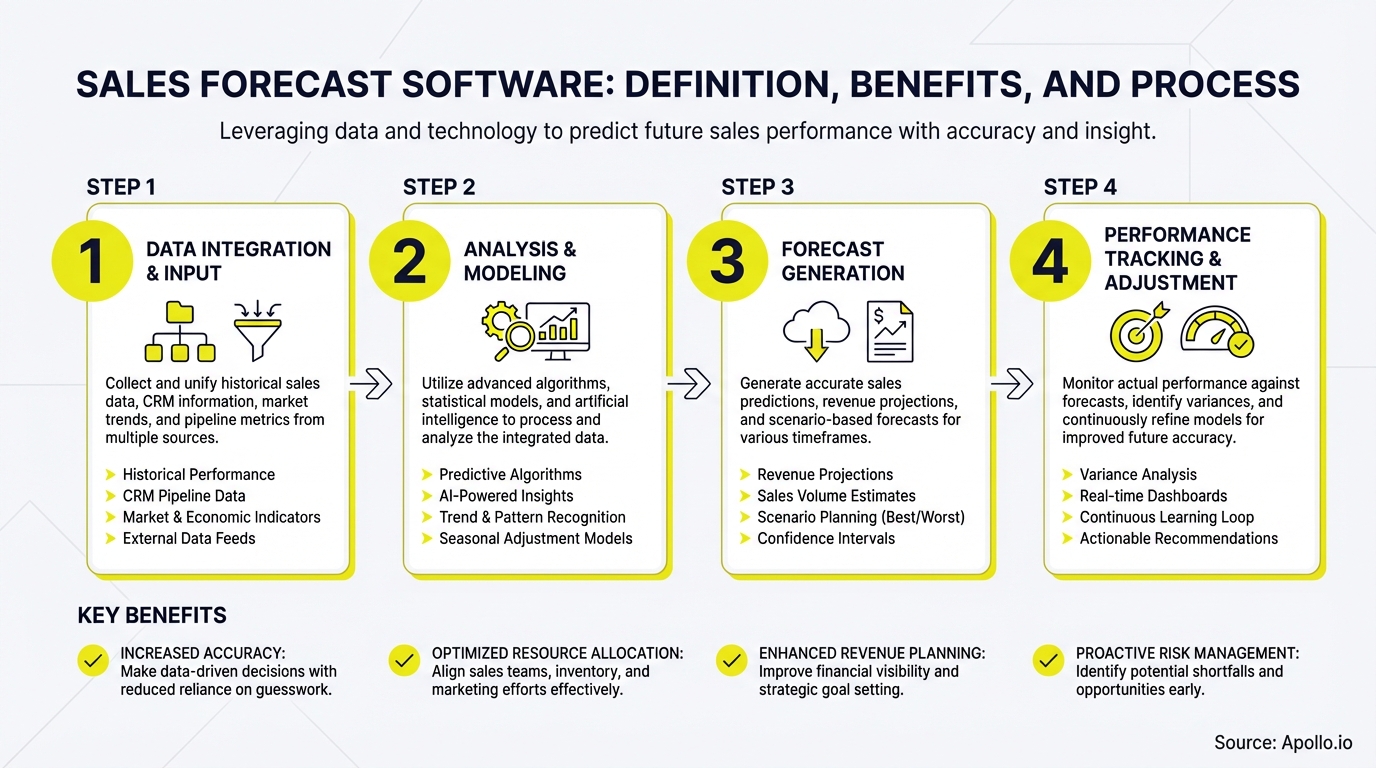
Sales forecast software is a platform that predicts future revenue by analyzing pipeline data, historical performance, and market signals. It replaces spreadsheet guesswork with AI models that surface deal risks, identify trends, and recommend actions.
The software pulls data from your CRM, enriches it with external signals, and outputs projections by rep, region, product, or time period.
Modern platforms integrate with tools like Salesforce, HubSpot, and Apollo's deal management system to automatically track deal progression. They flag stalled opportunities, predict close dates, and calculate win probability based on engagement patterns. For RevOps teams managing complex tech stacks, this consolidation means one source of truth instead of reconciling data across five tools.
How Does AI Improve Forecast Accuracy?
AI analyzes thousands of variables humans miss: email response times, meeting frequency, competitor mentions, and seasonal buying patterns. Machine learning models spot correlations between these signals and deal outcomes, then apply those patterns to current opportunities.
The result is dynamic win probability scores that update as deals progress.

Research by Gartner shows 92% of businesses now invest in AI-powered software, driven by accuracy gains. AI forecasting platforms learn from closed deals to refine predictions continuously. They identify which activities correlate with wins (like executive engagement) and which signal risk (like radio silence after a demo).
Key AI capabilities that drive accuracy:
- Anomaly detection: Flags deals with unusual patterns (high value but low activity)
- Predictive scoring: Assigns win probability based on 50+ engagement metrics
- Trend analysis: Identifies seasonal patterns and market shifts affecting close rates
- Risk alerts: Warns when deals slip or stall based on historical signals
Why Do Sales Leaders Need Forecasting Platforms in 2026?
Sales leaders need accurate forecasts to make smart hiring, compensation, and investment decisions. Without reliable projections, you over-hire during slow quarters or miss growth opportunities by being understaffed.
Boards and investors demand predictable revenue, and spreadsheet forecasts no longer cut it in fast-moving markets.
The shift to distributed teams and complex buying committees has made manual forecasting impossible. A typical B2B deal now involves 6-10 decision makers across multiple touchpoints. Tracking all those signals manually leads to blind spots. Sales performance management platforms solve this by centralizing data and surfacing insights automatically.
For Founders and CEOs building predictable revenue engines, forecast software provides the visibility needed to scale confidently. You can model different scenarios (best case, likely, worst case) and see how pipeline changes impact quarterly results.
This turns forecasting from a monthly guessing game into a strategic planning tool.
What Data Sources Should Sales Forecasting Software Integrate?
The best forecasting platforms pull data from your entire revenue tech stack. This includes CRM data (Salesforce, HubSpot), communication tools (email, calendar, calls), and product usage signals.
E-commerce platforms add another layer, showing which accounts are actively using your product and likely to expand.
| Data Source | Key Signals | Forecast Impact |
|---|---|---|
| CRM Systems | Deal stage, close date, amount, rep notes | Foundation for all predictions |
| Email/Calendar | Response rates, meeting frequency, stakeholder engagement | Win probability scoring |
| Product Usage | Feature adoption, login frequency, support tickets | Expansion revenue forecasts |
| E-commerce Data | Purchase history, cart abandonment, browsing patterns | Seasonal trend analysis |
| Marketing Automation | Lead scores, campaign engagement, content downloads | Pipeline generation forecasts |
Struggling with disconnected data sources? Apollo's unified GTM platform eliminates data silos with native integrations across your entire tech stack. RevOps teams using consolidated platforms report 40% less time spent on data reconciliation and significantly fewer forecast errors.

How Do Account Executives Use Forecasting Tools to Close More Deals?
Account Executives use forecasting platforms to prioritize their time and identify at-risk deals before they slip. The software shows which opportunities need immediate attention based on engagement scores, stalled activity, or approaching close dates.
AEs can see exactly which deals are trending toward wins versus those requiring intervention.
Smart AEs run daily pipeline reviews using forecast dashboards. They filter deals by risk level, then focus on medium-probability opportunities where effort makes the biggest difference.
High-probability deals get standard nurturing, while low-probability deals get deprioritized. This data-driven approach increases win rates by 15-25%.
For AEs managing complex enterprise deals, forecasting tools surface hidden risks. If a champion stops responding or a competitor enters late-stage, the platform flags it immediately. AEs can then course-correct with targeted outreach or executive sponsorship. Enterprise sales teams using these insights report shorter sales cycles and higher average contract values.
Turn Forecast Guesswork Into Revenue Certainty
Pipeline forecasting a guessing game? Apollo's real-time deal tracking shows exactly where every opportunity stands. Built-In boosted win rates 10% with Apollo's pipeline insights.
Start Free with Apollo →What Should You Look for When Selecting Forecast Software?
Start with your growth stage and complexity. Fast-growing companies need platforms that scale without massive implementation projects.
Look for tools with pre-built CRM integrations, intuitive interfaces, and flexible reporting. Avoid platforms that require six months of professional services to configure.
Vendor selection checklist for 2026:
- AI capabilities: Does it learn from your data or use generic models?
- Integration depth: Native connectors vs. API-based integrations
- Data governance: Role-based permissions, audit trails, compliance features
- Mobile access: Can reps update forecasts from anywhere?
- Scenario modeling: Ability to run what-if analyses on pipeline changes
- Change management: Training resources, onboarding support, user adoption tools
Evaluate total cost of ownership beyond license fees. Factor in implementation costs, integration expenses, training time, and ongoing maintenance. Many companies discover that consolidating their sales tech stack with an all-in-one platform cuts costs by 40-60% compared to stitching together point solutions.
How to Implement Sales Forecasting Software in 90 Days
Successful implementations follow a phased approach that prioritizes data quality and user adoption. Start with a pilot team (10-20 reps) to validate workflows before rolling out company-wide.
This catches configuration issues early and builds internal champions who advocate for the platform.
Phase 1 (Days 1-30): Data Foundation
- Audit CRM data quality: clean duplicates, standardize fields, fill gaps
- Map data flows: identify which systems feed forecasts
- Configure integrations: connect CRM, email, calendar tools
- Set baseline metrics: establish current accuracy for comparison
Phase 2 (Days 31-60): Pilot Launch
- Train pilot team on platform features and workflows
- Run parallel forecasts: compare new system vs. old process
- Gather feedback: identify friction points and quick wins
- Refine configurations: adjust based on pilot team input
Phase 3 (Days 61-90): Company-Wide Rollout
- Launch training program for all reps and managers
- Establish governance: define who updates forecasts and when
- Create accountability: tie forecast accuracy to performance reviews
- Monitor adoption: track usage metrics and provide ongoing support
Companies that rush implementation without proper change management see 60% lower adoption rates. Build time for training, feedback loops, and iteration.
Your RevOps team should own the rollout, not IT or external consultants who lack sales context.
What ROI Can Sales Leaders Expect from Forecasting Software?
ROI appears in three areas: improved quota attainment, reduced revenue volatility, and better resource allocation. Sales teams with accurate forecasts hit quota 20-30% more often because they focus effort on winnable deals.
Finance teams benefit from tighter projections that reduce cash flow surprises.
Typical ROI timeline and metrics:
| Timeframe | Key Metrics | Expected Improvement |
|---|---|---|
| Month 1-3 | Forecast accuracy, time spent forecasting | 10-15% accuracy gain, 50% time reduction |
| Month 4-6 | Win rates, deal velocity, pipeline coverage | 15-20% win rate increase, 20% faster cycles |
| Month 7-12 | Quota attainment, revenue predictability, CAC | 25% more reps hit quota, 90%+ accuracy |
Calculate your potential ROI using this formula: (Incremental Revenue from Better Forecasts + Cost Savings from Efficiency Gains) - (Software Costs + Implementation Costs). Most B2B companies see 3-5x ROI within the first year.
The biggest gains come from preventing bad hires during down quarters and capturing growth opportunities faster.
For Sales Leaders evaluating platforms, focus on vendor stability and product roadmap. Best practices for forecasting accuracy evolve rapidly as AI capabilities improve. Choose vendors investing heavily in R&D and releasing frequent updates.
Start Building Predictable Revenue with Better Forecasting
Sales forecast software transforms revenue planning from guesswork into science. The combination of AI analysis, real-time data integration, and predictive scoring gives Sales Leaders the visibility needed to make confident decisions.
Companies that implement these platforms see immediate accuracy gains and long-term strategic advantages.
The key is choosing a platform that fits your growth stage, integrates with your existing stack, and scales as you expand. Look for vendors with proven AI capabilities, strong customer support, and a track record of helping companies in your industry.
Implementation success depends on proper change management, data quality focus, and executive sponsorship.
Ready to improve your forecast accuracy? Start prospecting with Apollo's all-in-one platform and consolidate your sales tech stack while gaining the pipeline visibility you need for accurate forecasting.
Prove Apollo's ROI In Your First Week
Budget approvals stuck on unclear metrics? Apollo tracks every touchpoint to pipeline dollar—quantifying exactly how much time and revenue you're generating. Built-In increased win rates 10% and ACV 10% with Apollo's measurable impact.
Start Free with Apollo →Don't miss these
Sales
Inbound vs Outbound Marketing: Which Strategy Wins?
Sales
What Is a Sales Funnel? The Non-Linear Revenue Framework for 2026
Sales
What Is a Go-to-Market Strategy? The 2026 GTM Playbook
See Apollo in action
We'd love to show how Apollo can help you sell better.
By submitting this form, you will receive information, tips, and promotions from Apollo. To learn more, see our Privacy Statement.
4.7/5 based on 9,690 reviews
