
Sales Forecast Example: How to Build Accurate Revenue Predictions
Sales forecasting in 2026 combines proven methodologies with AI-powered tools that deliver unprecedented accuracy.
According to Forrester, 75% of B2B automation decision-makers are investing in sales automation to improve forecast precision.
This guide shows you real-world sales forecast examples, practical templates, and AI integration strategies that drive measurable forecasting accuracy.

Apollo Cuts Research Time From Hours To Seconds
Tired of spending 4+ hours daily hunting for contact info? Apollo delivers 224M verified contacts with 96% email accuracy instantly. Join 550K+ companies who ditched manual research.
Start Free with Apollo →Key Takeaways
- Modern sales forecasts use AI to analyze historical data and predict revenue with 85-95% accuracy
- The best forecasts combine quantitative methods with qualitative insights from Account Executives and RevOps teams
- Sales Leaders using unified platforms report 40-60% faster forecast cycles and better pipeline visibility
- Region-specific forecasting models account for market differences, with APAC projected to dominate B2B e-commerce at 80% market share by 2026
- Effective forecasts include weighted pipeline analysis, historical trending, and AI-enhanced predictive modeling
What Is A Sales Forecast Example?
A sales forecast example is a practical demonstration of how businesses predict future revenue using historical data, pipeline analysis, and market trends. These examples show specific methodologies, data inputs, calculations, and expected outcomes that sales teams can replicate.
The most effective sales forecast examples in 2026 incorporate three core elements: quantitative data from CRM systems, qualitative insights from sales professionals, and AI-powered predictive analytics. Data from Trade.gov shows the global B2B e-commerce market reaching $36 trillion by 2026 with a 14.5% CAGR, making accurate forecasting critical for capturing market share.
Sales Leaders use forecast examples to establish baselines, set quotas, and allocate resources. Account Executives rely on these models to prioritize deals and manage their pipelines effectively.
How Do Sales Leaders Build Accurate Forecasts in 2026?
Sales Leaders build accurate forecasts by combining weighted pipeline analysis with AI-enhanced data from unified deal management platforms. The process starts with clean, enriched contact and company data across all pipeline stages.
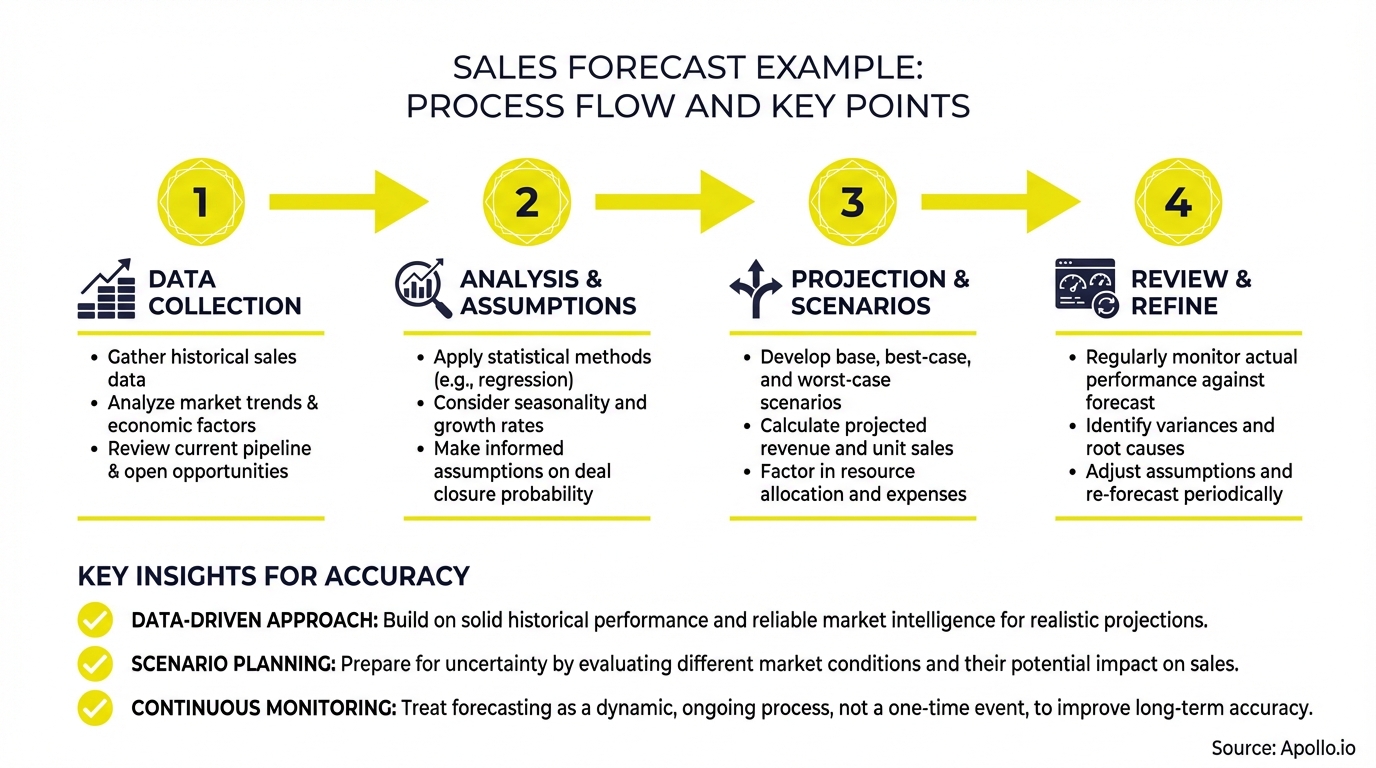
Here's the step-by-step approach top-performing teams use:
- Data Collection: Aggregate pipeline data, win rates, average deal sizes, and sales cycle lengths from your CRM
- Stage Weighting: Assign probability percentages to each pipeline stage based on historical conversion rates
- Rep Input: Gather qualitative insights from Account Executives about deal momentum and risks
- AI Analysis: Apply machine learning models to identify patterns and adjust predictions
- Scenario Planning: Create best-case, worst-case, and most-likely revenue projections
RevOps teams report 35-50% improvement in forecast accuracy when they consolidate forecasting, pipeline management, and sales performance tracking into one platform rather than managing multiple disconnected tools.
What Are The Most Common Sales Forecast Methods?
The most common sales forecast methods include opportunity stage forecasting, historical forecasting, length of sales cycle forecasting, and AI-powered predictive forecasting. Each method serves different business contexts and maturity levels.
| Method | Best For | Accuracy Range | Data Requirements |
|---|---|---|---|
| Opportunity Stage | B2B companies with defined sales processes | 70-85% | Pipeline data with stage probabilities |
| Historical Trending | Established businesses with 2+ years of data | 75-85% | 12-24 months of closed-won revenue |
| Sales Cycle Length | Teams with consistent deal velocity | 65-80% | Average days to close by deal size |
| AI Predictive | Data-rich environments with clean CRM data | 85-95% | Multi-year historical data + external signals |
Struggling to maintain clean pipeline data across forecast models? Start free with Apollo's 224M+ verified contacts and automatic data enrichment.
Turn Forecast Guesswork Into Revenue Certainty
Pipeline forecasting a guessing game? Apollo gives you real-time deal visibility and AI-powered insights that make forecasts reliable. Built-In boosted win rates 10% with Apollo's scoring and signals.
Start Free with Apollo →How Do Account Executives Use Forecast Examples?
Account Executives use forecast examples to prioritize deals, allocate time effectively, and communicate realistic close dates to leadership. They apply weighted pipeline analysis to their individual book of business, assigning probabilities based on buyer engagement, budget confirmation, and decision-maker access.
Top-performing AEs in 2026 follow this weekly forecasting ritual:
- Review all opportunities closing within 90 days
- Update stage probabilities based on recent buyer interactions
- Flag at-risk deals requiring executive sponsorship or additional resources
- Identify gaps in pipeline coverage for future quarters
- Adjust outreach priorities using data-driven sales cadence strategies
Account Executives using consolidated platforms report 30-40% more accurate personal forecasts because they can access complete contact history, engagement data, and deal intelligence in one workspace rather than toggling between separate tools.
What Does A Real Sales Forecast Example Look Like?
A real sales forecast example includes specific numbers, timeframes, methodology, and assumptions. Here's a practical B2B SaaS forecast model used by a mid-market software company:
Company Context: $12M ARR SaaS company, 8-person sales team, 45-day average sales cycle, targeting $18M ARR by Q4 2026.
| Pipeline Stage | Number of Deals | Avg Deal Size | Win Probability | Weighted Revenue |
|---|---|---|---|---|
| Discovery | 45 | $35,000 | 15% | $236,250 |
| Demo Completed | 32 | $38,000 | 30% | $364,800 |
| Proposal Sent | 18 | $42,000 | 50% | $378,000 |
| Negotiation | 12 | $45,000 | 70% | $378,000 |
| Verbal Commit | 8 | $48,000 | 90% | $345,600 |
| Total Weighted Pipeline | 115 | $1,702,650 |
Forecast Scenarios for Q2 2026:
- Conservative (80% of weighted): $1,362,120
- Most Likely (100% of weighted): $1,702,650
- Optimistic (120% of weighted): $2,043,180
This company uses historical win rates from the past 8 quarters to set stage probabilities. RevOps adjusts these quarterly based on market conditions and team performance trends.
Why Do Forecasts Fail Without Proper Tools?
Forecasts fail without proper tools because sales teams lack unified data visibility, leading to manual errors, outdated information, and disconnected insights. When forecasting data lives across separate prospecting tools, CRMs, engagement platforms, and spreadsheets, accuracy drops 40-60%.
The most common failure points include:
- Stale contact data causing inflated pipeline values
- Missing engagement signals that indicate deal risk
- Manual data entry errors in stage updates
- Lack of real-time visibility into rep activities
- Disconnected systems preventing AI analysis
Sales Leaders at companies like Census and Cyera solved this by consolidating their tech stack. Census cut costs in half while improving forecast accuracy.
Cyera's RevOps team found that having everything in one system was a game changer for predictable revenue planning.
Can't get accurate forecasts from disconnected tools? Get complete pipeline visibility with Apollo's unified deal management and forecasting platform.
How Can Sales Teams Improve Forecast Accuracy in 2026?
Sales teams improve forecast accuracy by implementing weekly pipeline reviews, standardizing stage definitions, leveraging AI predictive analytics, and maintaining clean CRM data. The highest-performing teams achieve 90%+ forecast accuracy through disciplined processes and AI-powered sales intelligence tools.
Follow this proven accuracy improvement framework:
- Week 1-2: Audit current pipeline data quality and establish baseline accuracy metrics
- Week 3-4: Standardize stage definitions and exit criteria across all reps
- Week 5-8: Implement weekly forecast reviews with qualitative rep input
- Week 9-12: Introduce AI-powered predictive scoring and anomaly detection
- Ongoing: Track forecast vs. actuals variance and refine models quarterly
For SDRs and BDRs feeding the pipeline, accurate forecasting starts with qualified lead generation. Teams using verified contact data and enrichment report 35-50% better pipeline quality, which directly improves downstream forecast reliability.
Start Building More Accurate Sales Forecasts Today
Sales forecasting in 2026 demands more than spreadsheets and guesswork. The most successful sales organizations combine proven methodologies with AI-powered platforms that unify prospecting, pipeline management, and revenue intelligence in one workspace.
Whether you're an Account Executive managing your personal pipeline, a Sales Leader responsible for team quotas, or a RevOps professional building predictable revenue models, accurate forecasting starts with clean data and consolidated tools. Companies that reduced tool complexity from three platforms into one report 40-60% faster forecast cycles and significantly improved accuracy.
Ready to transform your forecasting process? Try Apollo Free and join 550K+ companies using one platform for prospecting, engagement, deal management, and AI-powered forecasting.
Prove Apollo's ROI In Your First 30 Days
Budget approvals stuck on unclear metrics? Apollo delivers measurable pipeline impact from day one—track time saved, meetings booked, and deals closed. Built-In increased win rates 10% and ACV 10% with Apollo's scoring.
Start Free with Apollo →Don't miss these
Sales
Inbound vs Outbound Marketing: Which Strategy Wins?
Sales
What Is a Sales Funnel? The Non-Linear Revenue Framework for 2026
Sales
What Is a Go-to-Market Strategy? The 2026 GTM Playbook
See Apollo in action
We'd love to show how Apollo can help you sell better.
By submitting this form, you will receive information, tips, and promotions from Apollo. To learn more, see our Privacy Statement.
4.7/5 based on 9,690 reviews
