
What Is Sales Enablement Content? Strategy, Types, and Best Practices for 2026
Sales enablement content is the material that equips sales teams to educate buyers, handle objections, and advance deals.
It includes everything from battle cards and case studies to email templates and onboarding playbooks.
Done well, it's the bridge between what marketing creates and what reps actually need in front of a prospect.
To make it work, you need AI-powered sales enablement built into how your team operates daily, not just stored in a folder no one opens.
The stakes are higher than ever. According to emlen.io, 88% of sales professionals say sales enablement content is moderately vital to making a sale. Yet most teams still lack a structured system for creating, governing, and measuring it.

Research Less, Pipeline More With Apollo
Tired of your reps burning hours verifying contacts instead of closing deals? Apollo delivers 96% email accuracy across 224M contacts so your team sells from minute one. Start building pipeline today.
Start Free with Apollo →Key Takeaways
- Sales enablement content directly influences win rates — organizations with a formal strategy achieve a 49% higher win rate on forecasted deals.
- B2B buyers consume an average of 13 pieces of content before purchasing, making content volume and relevance critical.
- AI is now mainstream in enablement workflows, but most teams haven't operationalized it with governance and measurement.
- Cross-functional taxonomy — shared across Sales, Marketing, RevOps, and Customer Success — prevents content sprawl and duplication.
- Measurement must shift from downloads and views to content influence on deal progression.
What Is Sales Enablement Content?
Sales enablement content is any asset designed to help revenue teams move buyers through the purchase journey. It differs from general marketing content because it's built for rep use: deployed during calls, sent post-meeting, or embedded in outreach sequences.
It spans internal-facing content (playbooks, battlecards, objection handlers) and external-facing content (case studies, ROI calculators, comparison guides).
The key distinction is utility. Marketing content builds awareness. Sales enablement content closes gaps — objections, confusion, competitive pressure, internal champion alignment. Understanding sales performance management strategy helps teams decide which content gaps to close first.
Why Is Sales Enablement Content Important in 2026?
Buyers are self-directing their journeys. They research independently, build shortlists before talking to anyone, and expect relevance when they do engage.
Irrelevant content doesn't just underperform — it actively damages deals.
The numbers make the case clearly:
- Research from G2 shows organizations with a sales enablement strategy achieve a 49% higher win rate on forecasted deals.
- Spekit reports that 90% of organizations now have a dedicated sales enablement team or program, up from 75% in 2022.
- According to Wezeshamarketing, B2B buyers consume an average of 13 pieces of content before finalizing a purchase.
The shift from "content repository" to "content in the flow of work" — where AI surfaces the right asset at the right moment — is accelerating in 2026. Teams without a structured system fall behind fast.
What Are the Core Types of Sales Enablement Content?
Not all content serves the same stage or persona. Effective programs map assets to the buyer journey and the rep's specific use case.
| Content Type | Stage | Primary User |
|---|---|---|
| Battle cards | Evaluation / competitive | AEs, SDRs |
| Case studies | Consideration / decision | AEs, Sales Leaders |
| ROI calculators | Decision / justification | AEs, Economic buyers |
| Email templates | Prospecting / follow-up | SDRs, BDRs |
| Onboarding playbooks | Post-sale | Customer Success |
| Objection handlers | Discovery / negotiation | AEs, SDRs |
| Demo scripts | Demo / evaluation | AEs, SEs |
For SDRs and BDRs doing high-volume outreach, the most-used assets are email templates, objection handlers, and short-form social proof.
Pairing those with personalized email content strategies dramatically improves reply rates.
Struggling to get your outreach in front of the right people? Automate multi-channel sequences with Apollo's sales engagement platform and deploy your best content at scale.

How Do SDRs and AEs Use Sales Enablement Content Differently?
SDRs need content that gets a response. Short, punchy, relevant.
Their arsenal: personalized email snippets, industry-specific one-pagers, and social proof hooks. The goal is to earn a conversation, not explain the full product.
AEs need content that builds confidence and closes gaps. Their toolkit includes competitive battle cards, customer success stories matched to the prospect's vertical, and deal-specific ROI frameworks. For enterprise deals, enterprise sales strategies depend heavily on multi-stakeholder content that helps internal champions sell upward.
RevOps leaders benefit most from content governance infrastructure: taxonomy standards, asset tagging, usage analytics, and lifecycle policies that prevent outdated content from circulating in active deals.
Turn Weak Funnels Into Pipeline Gold
Tired of watching marketing leads stall before they ever reach your pipeline? Apollo surfaces high-fit buyers the moment they're ready to act. Over 550K companies use Apollo to turn top-of-funnel chaos into predictable revenue.
Start Free with Apollo →How Do You Build a Sales Enablement Content System That Works?
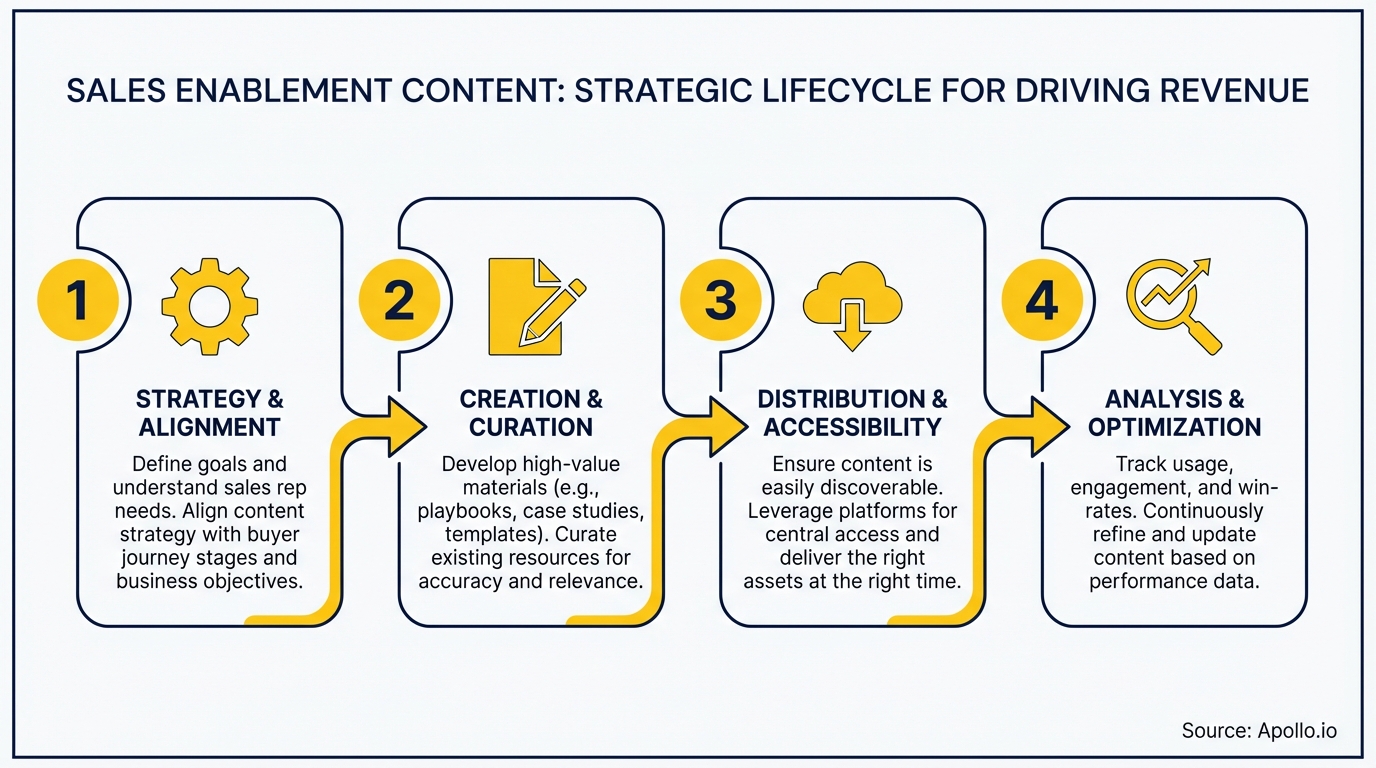
A functional system has five layers: audit, architecture, creation, distribution, and measurement. Most teams invest heavily in creation and skip the rest.
- Audit: Inventory existing content. Tag by stage, persona, format, and freshness. Kill anything outdated.
- Architecture: Build a shared taxonomy across Sales, Marketing, CS, and Partners. Modular naming (e.g., [Stage]-[Persona]-[Format]-[Topic]) prevents duplication.
- Creation: Use a brief template for every new asset. Define audience, stage, key message, proof point, and expiration date before writing a word.
- Distribution: Embed content in CRM, sequences, and deal rooms — not just a shared drive. Content must reach reps in their workflow.
- Measurement: Track content influence on deal progression, not just views. Which assets correlate with closed-won? Which appear in stalled deals?
Tools like Apollo consolidate this workflow. As Collin Stewart from Predictable Revenue put it: "We reduced the complexity of three tools into one." When your sales tech stack is unified, content gets used because it's accessible where reps already work.
Need better pipeline visibility to know where content gaps are costing you deals? Track deal progression and content influence with Apollo's deal management tools.
How Does AI Change Sales Enablement Content Operations?
AI is reshaping how content gets created, reviewed, and surfaced. The Highspot State of Sales Enablement Report 2025 found that 49% of organizations already leverage AI to support go-to-market teams, with 41% planning to.
But adoption and operationalization are different things.
An AI-enabled content workflow looks like this:
- Intake: Sales submits content requests via structured brief (persona, stage, competitive context)
- Creation: AI drafts first versions; subject matter experts review and approve
- Governance: Compliance and legal gates before publishing; version control enforced
- Distribution: AI recommendations surface relevant assets inside CRM or sequence tools
- Measurement: Analytics flag high-performing content and trigger refresh cycles for declining assets
The risk without governance: AI accelerates volume, which accelerates content sprawl and brand inconsistency. Tightening governance as you scale AI is non-negotiable. Explore how AI sales tools fit into this workflow without adding complexity.
How Do You Measure Sales Enablement Content ROI?
Measuring downloads and email opens is a starting point, not a strategy. In 2026, the measurement standard is content influence on revenue outcomes.
Key metrics to track:
- Content-to-close correlation: Which assets appear in won deals vs. lost deals?
- Stage conversion lift: Does sending asset X increase the rate of moving from demo to proposal?
- Time-to-close by content path: Do deals with certain content touchpoints close faster?
- Rep adoption rate: Are reps actually using what's been created?
- Content freshness score: What percentage of your library is current vs. expired?
Connecting these metrics to pipeline data requires clean, integrated systems. Sales analytics platforms that tie content usage to deal outcomes give RevOps the visibility to make informed investment decisions.

Build Smarter Sales Enablement Content in 2026
Sales enablement content isn't a library project. It's a revenue system — one that maps buyer needs to rep workflows, governs quality at scale, and measures influence on closed revenue.
The teams winning in 2026 are those that treat content as infrastructure, not an afterthought.
Apollo gives SDRs, AEs, and RevOps teams a unified platform to prospect, engage, and track outcomes without stitching together five separate tools. As the team at Cyera said: "Having everything in one system was a game changer."
Ready to put your best content in front of the right buyers, faster? Get Leads Now
Prove Pipeline ROI From Day One
Budget approval stuck on unclear metrics? Apollo delivers measurable pipeline impact fast — Leadium 3x'd their annual revenue using Apollo's automation. Start your free trial and show ROI before the next budget review.
Start Your Free Trial →Don't miss these
Sales
Inbound vs Outbound Marketing: Which Strategy Wins?
Sales
What Is a Sales Funnel? The Non-Linear Revenue Framework for 2026
Sales
What Is a Go-to-Market Strategy? The 2026 GTM Playbook
See Apollo in action
We'd love to show how Apollo can help you sell better.
By submitting this form, you will receive information, tips, and promotions from Apollo. To learn more, see our Privacy Statement.
4.7/5 based on 9,690 reviews
