
Sales Department: Structure, Roles, and Best Practices for 2026
Sales departments in 2026 face a unique challenge: reps spend only 34% of their time actually selling, while 66% goes to administrative tasks, research, and internal coordination. The modern sales department must evolve from a team structure into an intelligent operating system that eliminates friction, consolidates tools, and enables measurable productivity gains across every role.

Apollo Eliminates 4+ Hours Of Daily Research
Tired of spending 4+ hours daily hunting for contact info? Apollo delivers 224M verified contacts with 96% email accuracy instantly. Join 550K+ companies who stopped manual prospecting and started closing deals.
Start Free with Apollo →Key Takeaways
- Sales departments are revenue engines responsible for prospecting, qualification, closing, and customer expansion through specialized roles
- Alignment between sales and marketing leads to 38% higher win rates and makes companies 67% better at closing deals
- Modern sales departments consolidate tools to reduce tech sprawl, with unified platforms replacing 3-5 separate systems
- AI agents now handle prospecting, call summaries, and deal risk analysis, freeing reps to focus on high-value conversations
- RevOps serves as the strategic foundation, with 75% of high-growth companies adopting unified revenue operations models
What Is a Sales Department?
A sales department is the revenue-generating division responsible for identifying prospects, building relationships, closing deals, and expanding customer accounts. It operates as a structured system with specialized roles (SDRs, AEs, Sales Leaders, RevOps) working across the full customer lifecycle from initial outreach to renewal and upsell.
Sales departments differ from sales teams in scope and structure. While a sales team may refer to a small group focused on closing, a sales department encompasses the entire GTM motion including prospecting systems, enablement resources, data infrastructure, and revenue operations frameworks that drive predictable growth.
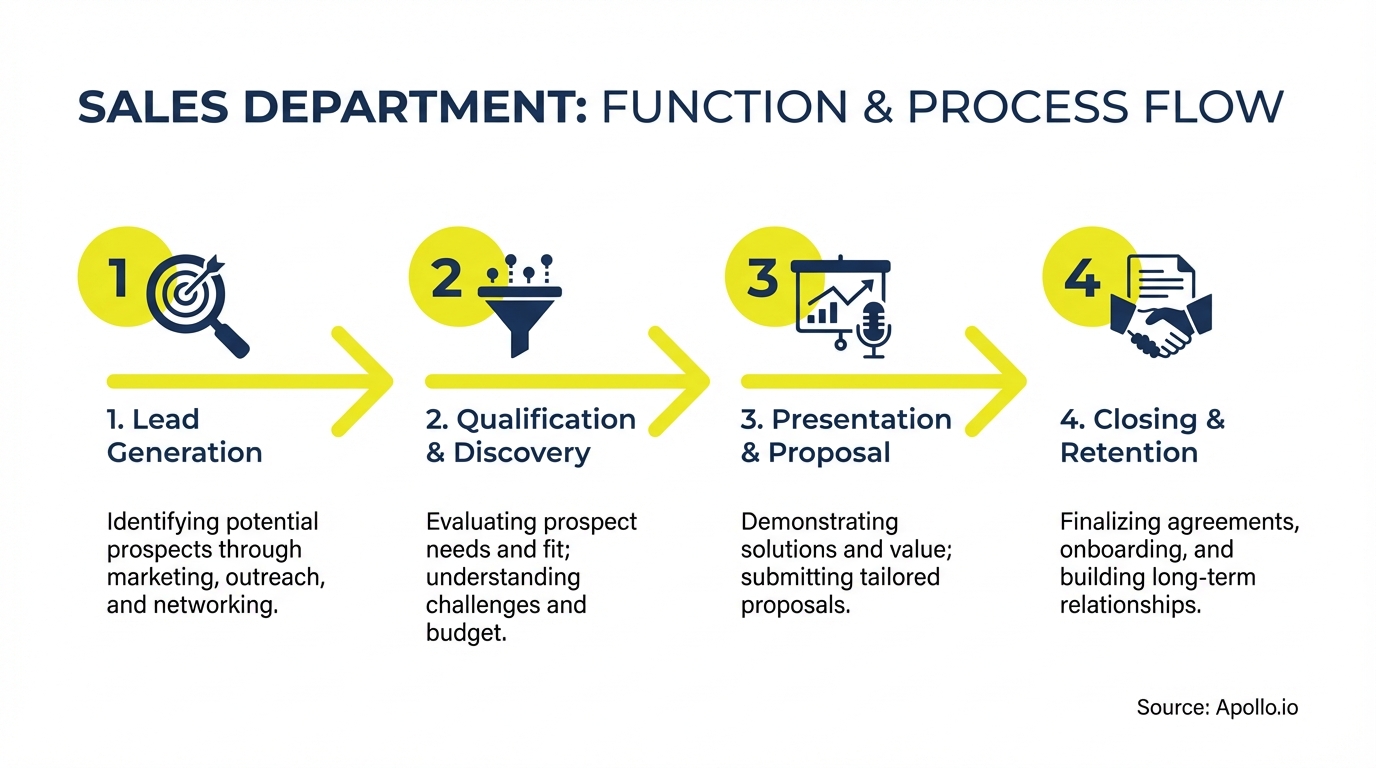
The core functions include:
- Prospecting and Lead Generation: SDRs and BDRs identify and qualify potential buyers using sales intelligence platforms
- Opportunity Management: Account Executives manage deals through discovery, validation, and procurement stages
- Deal Execution: Closers negotiate contracts, address objections, and finalize agreements
- Customer Expansion: Account Managers drive renewals, upsells, and cross-sells to maximize lifetime value
- Sales Operations: RevOps leaders ensure data accuracy, tool efficiency, and process optimization
How Does a Sales Department Drive Revenue in 2026?
Sales departments drive revenue by orchestrating buyer consensus across expanding purchase committees while leveraging AI agents to eliminate non-selling work. The playbook has shifted from individual rep heroics to orchestrated, multi-threaded engagement supported by intelligent automation.
According to Brainstorm Club, alignment between sales and marketing leads to 38% higher sales win rates and makes companies 67% better at closing deals. This integration creates a unified revenue engine where marketing generates qualified demand and sales converts it through structured processes.
Modern revenue generation relies on:
- Unified Data Systems: Single source of truth for contact information, engagement history, and deal intelligence
- Multi-Channel Sequences: Coordinated outreach across email, phone, and social channels with automated follow-up
- AI-Powered Prioritization: Algorithms surface high-intent accounts and recommend next-best actions
- Consensus-Building Assets: Mutual action plans, ROI calculators, and decision frameworks that reduce deal stall
- Real-Time Deal Visibility: Pipeline tracking with forecasting accuracy tied to revenue KPIs
Struggling to find qualified leads? Search Apollo's 224M+ contacts with 65+ filters.
What Are the Core Roles in a Sales Department?
Sales departments organize around specialized roles that handle distinct stages of the buyer journey. Each role requires specific skills, metrics, and tools aligned to their primary function.
| Role | Primary Responsibility | Key Metrics |
|---|---|---|
| Sales Development Rep (SDR) | Generate qualified meetings through outbound prospecting | Meetings booked, connect rate, response rate |
| Business Development Rep (BDR) | Qualify inbound leads and route to appropriate AEs | SQL conversion, lead response time, qualification accuracy |
| Account Executive (AE) | Manage full sales cycle from discovery to close | Quota attainment, win rate, average deal size |
| Account Manager (AM) | Drive renewals, upsells, and customer expansion | Net revenue retention, expansion rate, churn |
| Sales Leader | Coach reps, optimize processes, and forecast revenue | Team quota attainment, pipeline coverage, forecast accuracy |
| Revenue Operations (RevOps) | Maintain data quality, tool efficiency, and process governance | Data accuracy, tool adoption, process compliance |
The B2B Mix reports that Gartner predicts by 2025, 75% of the world's highest-growth companies will have adopted a RevOps model. This shift reflects the strategic importance of unified operations in driving predictable revenue.
How Do SDRs Book More Meetings in Modern Sales Departments?
SDRs book more meetings by leveraging sales intelligence platforms that surface high-intent prospects, automate personalized outreach, and eliminate research time. The modern SDR workflow prioritizes quality over volume, focusing on accounts showing buying signals rather than mass cold outreach.
Effective SDR prospecting in 2026 includes:
- Intent-Based Targeting: Identify accounts researching relevant solutions through technographic and behavioral signals
- Account Research Automation: AI agents compile company background, recent news, and stakeholder profiles
- Multi-Touch Sequences: Coordinated email, phone, and social outreach with contextual messaging
- Real-Time Notifications: Alerts when prospects visit your site, open emails, or change jobs
- Call Intelligence: AI-powered conversation analysis with automatic follow-up recommendations
SDRs using consolidated platforms report measurable time savings. "We reduced the complexity of three tools into one," says Collin Stewart of Predictable Revenue, emphasizing how unified systems eliminate context-switching and duplicate data entry that traditionally consumed 66% of selling time.
Turn Forecast Guesswork Into Revenue Certainty
Pipeline forecasting a guessing game? Apollo delivers real-time deal visibility and intent signals that make revenue predictable. Built-In boosted win rates 10% with Apollo's scoring.
Start Free with Apollo →Why Do Sales Departments Need Tool Consolidation?
Sales departments need tool consolidation to eliminate data silos, reduce subscription costs, and accelerate rep productivity. Research from Salesgenie shows misalignment between sales and marketing costs businesses approximately $1 trillion USD annually in lost productivity and wasted marketing spend.
The average sales tech stack includes 5-7 separate tools for prospecting, enrichment, engagement, dialing, meeting scheduling, and CRM. This fragmentation creates:
- Data Inconsistency: Contact information differs across systems, leading to duplicate outreach and missed opportunities
- Context Loss: Switching between tools breaks workflow and requires reps to rebuild context for each interaction
- Integration Overhead: RevOps teams spend hours maintaining connections between disconnected systems
- Subscription Waste: Overlapping capabilities across tools drive unnecessary costs
- Onboarding Friction: New reps must learn multiple platforms before becoming productive
Companies consolidating to unified GTM platforms report measurable benefits. "We cut our costs in half," reports Census, while Cyera notes "Having everything in one system was a game changer" for team efficiency and sales analytics visibility.
Tired of managing multiple sales tools? Consolidate your tech stack with Apollo's all-in-one GTM platform.
How Should Sales Leaders Structure Their Departments in 2026?
Sales Leaders should structure departments around specialized pods aligned to customer segments, supported by centralized RevOps and shared AI infrastructure. The pod model allows focused expertise while maintaining operational consistency across the organization.
Effective 2026 sales department structures include:

- Segment-Based Pods: Dedicated teams for SMB, mid-market, and enterprise with appropriate sales motions
- Centralized SDR Function: Specialized prospecting team feeding qualified meetings to all pods
- Embedded RevOps: Operations specialists assigned to each pod for real-time support
- Shared AI Agents: Centrally managed automation for research, qualification, and deal risk analysis
- Enablement Resources: Content library, sales training programs, and playbooks accessible across all pods
This structure balances specialization with efficiency. Account Executives in each pod develop deep expertise in their segment's buying process while leveraging shared resources that would be inefficient to duplicate. Sales Leaders gain unified visibility through consistent process frameworks and centralized reporting.
What Technologies Do High-Performing Sales Departments Use?
High-performing sales departments use unified GTM platforms that consolidate prospecting, engagement, intelligence, and analytics in one system. The technology stack in 2026 prioritizes integration over best-of-breed point solutions.
| Capability | Business Impact | Key Features |
|---|---|---|
| Sales Intelligence | Reduce research time, improve targeting accuracy | 224M+ verified contacts, 65+ search filters, intent signals |
| Engagement Platform | Automate outreach, increase response rates | Multi-channel sequences, A/B testing, performance analytics |
| Conversation Intelligence | Coach reps, surface deal risks, automate follow-up | Call recording, AI summaries, next-step recommendations |
| Deal Management | Forecast accurately, prioritize pipeline, prevent slippage | Opportunity tracking, mutual action plans, risk scoring |
| Revenue Operations | Maintain data quality, optimize processes, measure ROI | Data enrichment, workflow automation, unified reporting |
The shift toward unified platforms reflects the productivity crisis in sales. According to Rachel Krug, up to 70% of B2B sales representatives missed their annual quota in 2024. Technology consolidation addresses this by eliminating the tool-switching and data inconsistency that consume non-selling time.
Build a Revenue-Generating Sales Department
Sales departments in 2026 operate as intelligent systems that orchestrate buyer consensus, eliminate administrative friction, and leverage AI agents for repetitive workflows. Success requires specialized roles working from unified data, supported by consolidated technology that replaces 3-5 separate tools.
The highest-performing departments prioritize alignment with marketing (driving 38% higher win rates), adopt RevOps as a strategic foundation (75% of high-growth companies), and structure around customer segments with centralized enablement. They recognize that reps spending only 34% of their time selling represents a solvable productivity crisis, not an acceptable baseline.

For Sales Leaders building modern departments, focus on tool consolidation first. Fragmented tech stacks create the data silos, context loss, and subscription waste that prevent teams from reaching quota.
Unified GTM platforms eliminate these barriers while providing the AI-powered intelligence that separates winning departments from struggling ones.
Ready to transform your sales department? Schedule a Demo to see how Apollo consolidates your entire GTM workflow into one intelligent platform.
Prove Apollo's Value In Your First Week
Budget approval stuck on unclear metrics? Apollo tracks every touch to closed revenue, showing exactly what's working. Customer. io achieved 50% YoY growth with measurable pipeline impact.
Start Free with Apollo →Don't miss these
Sales
Inbound vs Outbound Marketing: Which Strategy Wins?
Sales
What Is a Sales Funnel? The Non-Linear Revenue Framework for 2026
Sales
What Is a Go-to-Market Strategy? The 2026 GTM Playbook
See Apollo in action
We'd love to show how Apollo can help you sell better.
By submitting this form, you will receive information, tips, and promotions from Apollo. To learn more, see our Privacy Statement.
4.7/5 based on 9,690 reviews
