
What Is the Sales Definition in Business? A Modern B2B Framework for 2026
Most definitions of sales describe a rep closing a deal. That picture is incomplete. In 2026, sales in business is a cross-channel revenue system that combines rep-led outreach, digital self-serve, partner channels, and buying-group orchestration to move prospects from awareness to closed revenue. Understanding this broader definition helps SDRs, AEs, RevOps leaders, and founders build processes that match how buyers actually buy today. For a deeper look at building your pipeline, explore small business sales software that actually scales.

Scale Pipeline Without the Manual Grind
Tired of your reps burning hours on research instead of selling? Apollo surfaces verified contacts and automates outreach so your team scales without the chaos. Join 550K+ companies building predictable pipeline.
Start Free with Apollo →Key Takeaways
- Sales in business is a cross-channel revenue system, not just rep-led deal closing.
- B2B buyers are 57% to 70% through their research before they ever contact sales.
- Modern buying groups span multiple departments, requiring orchestrated stakeholder engagement.
- Trust is the biggest barrier for new vendors: 79% of buyers trust vendors they already work with.
- RevOps teams that standardize definitions (MQL, SQL, opportunity) build more predictable pipelines.
What Is the Sales Definition in Business?
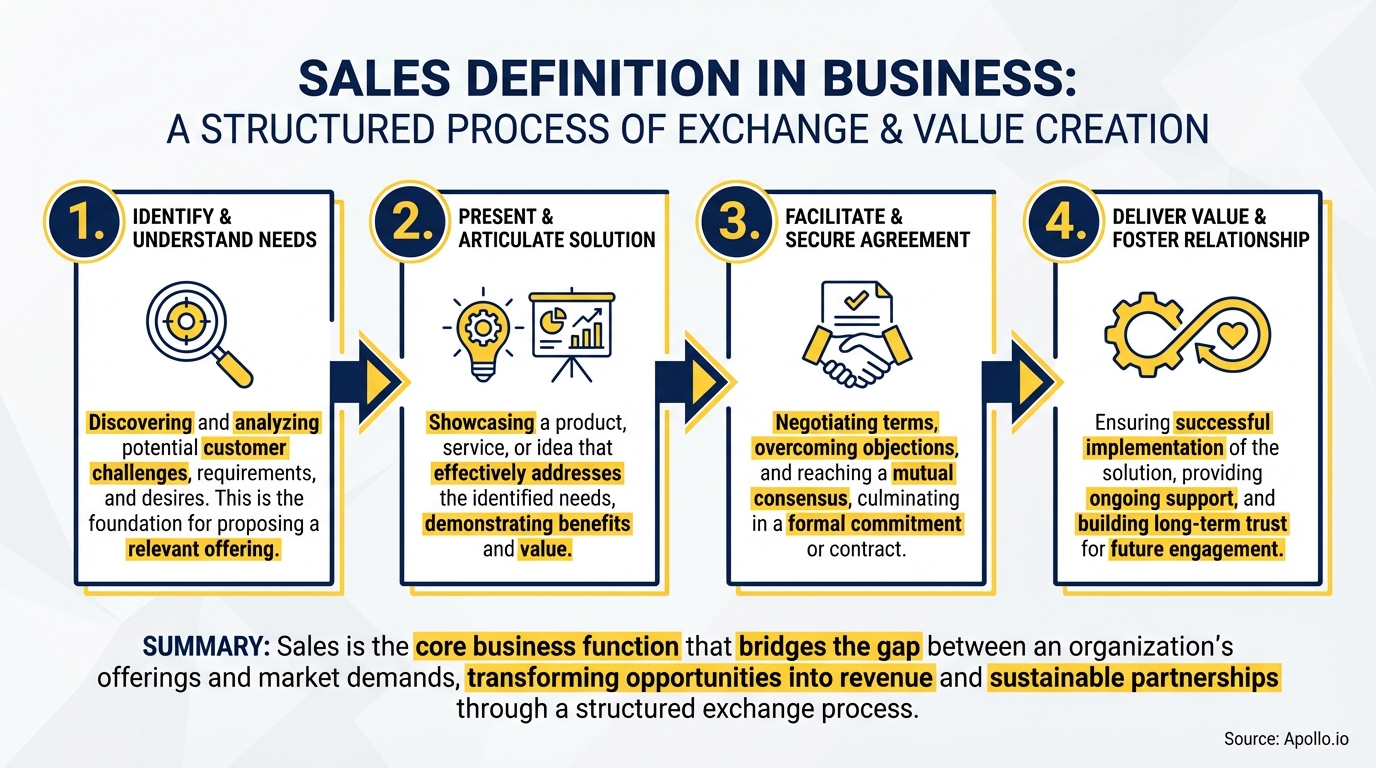
Sales, in a business context, is the process of identifying potential customers, communicating value, managing objections, and facilitating a transaction that generates revenue. Historically treated as a rep-to-buyer activity, the modern definition expands to include every revenue-generating motion across all channels: outbound prospecting, inbound conversion, self-serve purchasing, and partner-referred deals.
Sales is often confused with marketing. Marketing creates awareness and generates demand.
Sales converts that demand into revenue. The handoff point, typically the MQL-to-SQL transition, is where many businesses lose pipeline value due to misaligned definitions.
| Channel | Who Drives It | Primary Motion |
|---|---|---|
| Outbound | SDRs / BDRs | Cold outreach, sequenced follow-up |
| Inbound | AEs / Inside Sales | Demo requests, trial conversions |
| Self-Serve | Product / RevOps | Freemium, marketplace, digital checkout |
| Partner / Channel | Alliances team | Referral, reseller, co-sell motions |
Why Has the Sales Definition Changed for B2B in 2026?
Buyer behavior has fundamentally shifted. According to Sellers Commerce, B2B buyers are 57% to 70% through their buying research before contacting sales. This means reps no longer control the early stages of the sales process. Buyers self-educate, compare vendors, and form preferences before a single conversation occurs.
A Gartner survey found 61% of B2B buyers prefer an overall rep-free buying experience. That does not mean reps are obsolete. It means the definition of sales must expand to include the digital touchpoints buyers use before they ever raise their hand.
Forrester's 2026 B2B predictions also highlight that ungoverned AI in go-to-market creates risks when teams lack consistent definitions of what counts as "qualified" or "pipeline." Standardizing your sales vocabulary is now a strategic requirement, not an administrative task.
Turn Weak Leads Into Real Pipeline
Pipeline forecasting a guessing game because marketing leads never convert? Apollo surfaces verified, in-market contacts so your team stops chasing dead ends. Join 90K paying customers building predictable revenue.
Start Free with Apollo →How Does a Modern B2B Buying Group Change the Sales Process?
A buying group is the full set of internal stakeholders involved in a purchase decision. Deals no longer move through a single champion.
Research shows purchases increasingly involve multiple departments with numerous internal and external participants. This complexity means sales teams must orchestrate consensus, not just persuade one person.
For AEs managing complex deals, this requires stakeholder mapping from day one. Key roles to identify in any buying group include:
- Economic Buyer: Controls budget and final sign-off.
- Champion: Internal advocate who sells on your behalf.
- End Users: Evaluate day-to-day usability.
- Procurement / Legal: Review contracts, compliance, and risk.
- IT / Security: Assess integration and data requirements.
SDRs booking discovery calls should qualify which stakeholders are involved early. AEs should create a mutual action plan that maps each stakeholder's concerns to specific proof points. Learn how top performers approach enterprise sales and mega deals to see stakeholder orchestration in practice.
How Do SDRs and AEs Align Sales Definitions with Pipeline Stages?
Inconsistent definitions of Lead, MQL, SQL, SAL, and Opportunity are the most common source of pipeline leakage. When marketing and sales use different criteria for "qualified," leads stall at handoff and forecasts become unreliable.
RevOps leaders building shared definitions should anchor each stage to observable, measurable criteria.
| Stage | Definition | Owner |
|---|---|---|
| MQL | Meets ICP criteria + engagement threshold | Marketing |
| SAL | Sales accepts the lead for follow-up | SDR |
| SQL | Discovery complete, budget and timeline confirmed | AE |
| Opportunity | Formal proposal stage, stakeholders identified | AE |
| Closed Won | Contract signed, revenue recognized | AE / CS |
Struggling to find qualified prospects to fill the top of this funnel? Search Apollo's 224M+ contacts with 65+ filters to build targeted prospect lists that match your ICP from day one.
Understanding your ideal customer profile is foundational here. See what ICP means in sales and how to build a framework that drives qualified pipeline.

What Role Does Trust Play in the Modern Sales Definition?
Trust is a measurable competitive advantage. Buyers default to vendors they already know. For new vendors entering an account, the sales process must explicitly build credibility at every stage.
Effective trust-building tactics for sales teams include:
- Sharing relevant customer case studies early in discovery.
- Enabling your champion with internal-facing materials (one-pagers, ROI models, FAQ docs).
- Providing transparent pricing and implementation timelines to reduce perceived risk.
- Using social proof from reference customers in the prospect's industry.
According to Sales Odyssey, only 33% of salespeople's time is actually devoted to selling. The rest is consumed by admin, research, and coordination. Automating non-selling tasks frees reps to invest time in the trust-building activities that actually move deals. Explore how sales automation software drives revenue by reclaiming that lost selling time.
How Should RevOps Measure Sales Beyond MQL Volume in 2026?
The 2026 shift in B2B is clear: MQL volume is no longer a primary success metric. RevOps leaders are moving toward pipeline quality, revenue contribution, and cycle velocity as the core indicators of a healthy sales function. This requires revenue operations frameworks that connect marketing, sales, and customer success under shared definitions and shared data.
Key metrics that replace or complement MQL volume:
- MQL-to-SQL conversion rate: Quality signal at the handoff point.
- Pipeline velocity: How fast opportunities move through stages.
- Average deal size by segment: Identifies where to focus sales resources.
- Win rate by source: Reveals which channels produce the best-fit buyers.
- Time-to-close: Measures sales cycle efficiency.
Spending too much time manually tracking these metrics across disconnected tools? Get complete pipeline visibility with Apollo's deal management and run your entire revenue system from one workspace. As Cyera noted, "Having everything in one system was a game changer."
What Are the Core Skills That Define Effective Sales in Business?
Regardless of channel or deal size, effective sales in business requires a consistent skill foundation. These apply equally to SDRs booking first meetings and AEs closing six-figure contracts.
- Discovery: Asking questions that uncover real pain, not assumed pain.
- Value articulation: Translating product features into business outcomes.
- Objection handling: Addressing risk concerns without losing momentum.
- Multi-threading: Building relationships across multiple stakeholders.
- Pipeline discipline: Maintaining accurate stage data and consistent follow-up.
For practical techniques, see 10 proven sales pitch techniques that close more deals and apply them across your team's outreach.

Start Building a Revenue System, Not Just a Sales Team
The sales definition in business has expanded. In 2026, sales is the full system that converts market interest into revenue, spanning outbound prospecting, inbound qualification, self-serve purchasing, and multi-stakeholder deal orchestration.
Teams that align on clear stage definitions, build trust deliberately, and measure beyond MQL volume consistently outperform those still operating with a rep-only mental model.
Apollo gives SDRs, AEs, and RevOps leaders a unified platform to prospect, engage, and close without stitching together five separate tools. "We reduced the complexity of three tools into one," said Collin Stewart at Predictable Revenue. Start free with Apollo and build the revenue system your business needs in 2026.
Prove Pipeline ROI With Apollo
ROI pressure killing your tool budget? Apollo delivers measurable pipeline impact your leadership can actually see. Leadium 3x'd annual revenue — start your free trial and show results fast.
Start Free with Apollo →Don't miss these
Sales
Inbound vs Outbound Marketing: Which Strategy Wins?
Sales
What Is a Sales Funnel? The Non-Linear Revenue Framework for 2026
Sales
What Is a Go-to-Market Strategy? The 2026 GTM Playbook
See Apollo in action
We'd love to show how Apollo can help you sell better.
By submitting this form, you will receive information, tips, and promotions from Apollo. To learn more, see our Privacy Statement.
4.7/5 based on 9,690 reviews
