
Sales CRM: Definition, Key Features, and Why Your Team Needs One
Sales teams lose hours every week to manual data entry, scattered contact information, and disconnected tools. A sales CRM (Customer Relationship Management) system solves this by centralizing customer data, automating workflows, and tracking every interaction in one platform. In 2026, CRM has evolved from a simple contact database into an AI-powered productivity engine that helps reps spend more time selling and less time on admin work. Modern CRM integration strategies connect your entire sales tech stack to eliminate data silos and streamline revenue operations.

Find Verified Contacts In Seconds With Apollo
Tired of spending 4+ hours daily hunting for contact info? Apollo delivers 224M verified contacts with 96% email accuracy. Join 550K+ companies who replaced manual research with instant results.
Start Free with Apollo →Key Takeaways
- Sales CRM centralizes customer data, automates workflows, and tracks interactions to boost productivity and revenue
- According to JISEM research, businesses using CRM see an average 29% increase in sales revenue
- Modern CRMs consolidate your tech stack, replacing separate tools for prospecting, engagement, and pipeline management
- AI-powered features now handle meeting prep, call summaries, and automated outreach to maximize selling time
- The global CRM market is projected to reach $262.74 billion by 2032, reflecting widespread adoption and business impact
What Is Sales CRM Meaning in 2026?
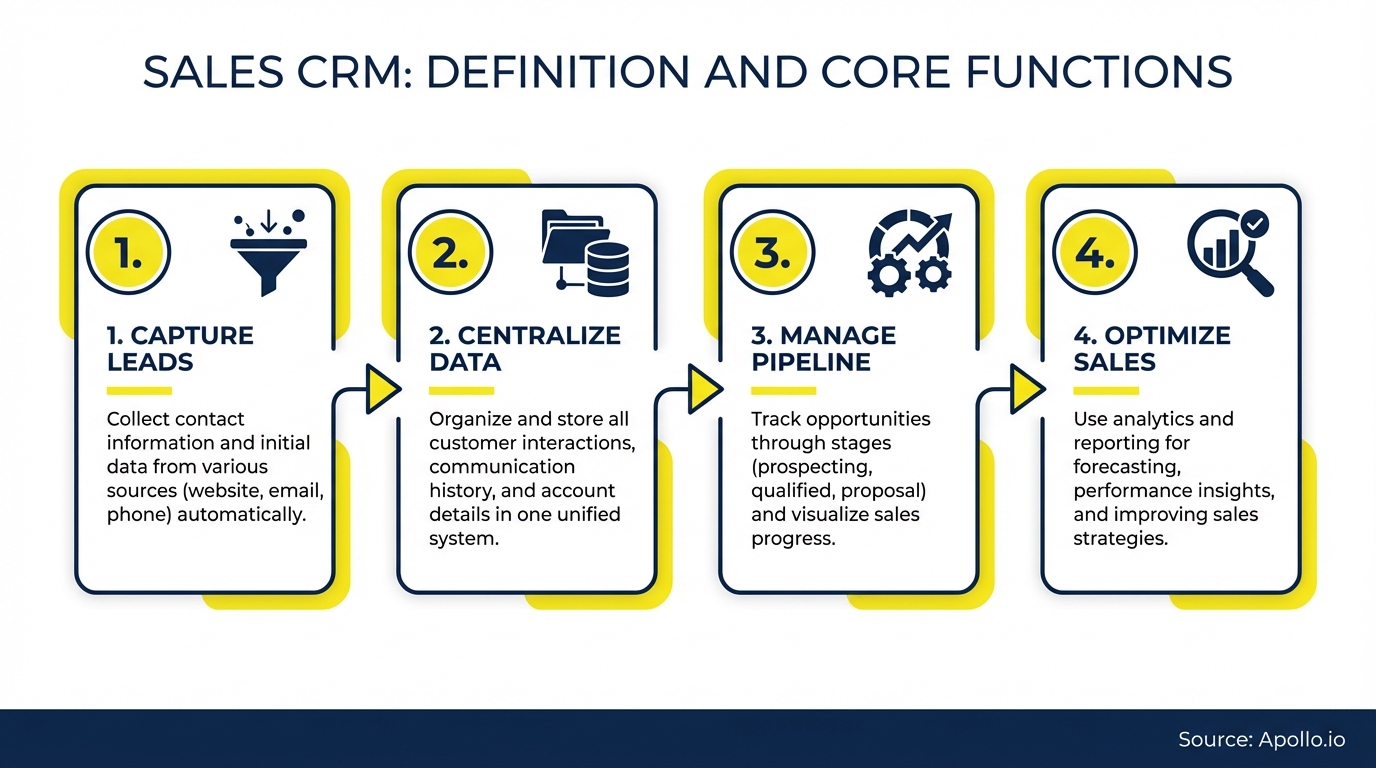
Sales CRM (Customer Relationship Management) is a platform that manages customer interactions, sales activities, and pipeline data in one centralized workspace. It tracks every touchpoint from first contact through closed deal, storing emails, calls, meetings, and notes to give sales teams complete visibility into relationships and revenue opportunities.
The meaning of sales CRM has expanded significantly beyond basic contact management. In 2026, CRM functions as a productivity engine that automates repetitive tasks, enriches prospect data, and uses AI to guide sellers toward the highest-value activities. Research from Sopro shows businesses that use a CRM are almost nine times more likely to exceed their sales goals than those that don't.
Modern sales CRMs integrate with your entire go-to-market stack, from platforms like HubSpot and Salesforce to specialized sales intelligence and engagement tools. This consolidation eliminates the need for reps to toggle between multiple systems, reducing context switching and manual data entry.
How Does Sales CRM Drive Revenue Growth?
Sales CRM drives revenue by converting manual, time-consuming processes into automated workflows that scale. The core mechanism is simple: centralize customer data, eliminate administrative friction, and surface the insights reps need to close deals faster.
According to Digital Socius, 91% of companies with 10 or more employees use a CRM system, reflecting its role as foundational revenue infrastructure. The platform captures every customer interaction automatically, building a complete history that helps AEs personalize outreach and anticipate objections based on past conversations.
Struggling to track deals across your pipeline? Apollo's deal management gives you complete visibility into every opportunity.
Revenue impact comes from three core areas:

- Time savings: Automation handles data entry, follow-up reminders, and activity logging so reps focus on conversations
- Pipeline visibility: Real-time dashboards show deal status, forecast accuracy, and rep performance across the entire funnel
- Data quality: Enrichment tools keep contact information current, reducing bounced emails and wrong numbers
- Workflow consistency: Sequences and playbooks ensure every prospect receives timely, relevant outreach
What Are the Core Features of Sales CRM?
Modern sales CRM platforms combine contact management, pipeline tracking, and automation into unified workflows. The essential features include:
| Feature | Purpose | Impact |
|---|---|---|
| Contact & Account Management | Centralize customer data and interaction history | Single source of truth for customer relationships |
| Pipeline & Deal Tracking | Visualize opportunities across sales stages | Forecast accuracy and revenue predictability |
| Sales Automation | Automate outreach, follow-ups, and task creation | More selling time, less admin work |
| Email & Call Integration | Log communications automatically | Complete activity tracking without manual entry |
| Reporting & Analytics | Track team performance and revenue metrics | Data-driven coaching and strategy adjustments |
| AI & Intelligence | Meeting prep, call summaries, next-best-action recommendations | Guided selling and productivity gains |
For SDRs and BDRs, features like automated sequences and sales analytics eliminate hours of manual prospecting work. Account Executives benefit from deal scoring and pipeline health metrics that highlight which opportunities need attention. RevOps leaders use data sync capabilities to maintain clean, accurate records across integrated systems.
Turn Forecast Guesswork Into Revenue Certainty
Pipeline forecasting a guessing game? Apollo delivers real-time deal visibility and intent signals so you always know which opportunities will close. Built-In boosted win rates 10% with Apollo's scoring.
Start Free with Apollo →How Do Sales Teams Use CRM to Book More Meetings?
Sales teams use CRM to book meetings through targeted prospecting, automated outreach, and intelligent follow-up workflows. The system identifies high-fit prospects, executes multi-channel sequences, and ensures no lead falls through the cracks.
SDRs start by building prospect lists using advanced filters like company size, industry, technology stack, and job title. The CRM enriches these contacts with verified email addresses and direct dial numbers, eliminating hours of manual research.
Automated sequences then deliver personalized emails, call tasks, and touchpoints across multiple channels.
Spending too much time researching prospects? Apollo's 224M+ verified contacts eliminate manual research.
Meeting booking workflows typically include:
- Automated cadences: 7-10 touch sequences combining email, phone, and social outreach
- Personalization at scale: Dynamic fields insert company name, pain points, and relevant case studies
- Follow-up triggers: Automatic tasks when prospects open emails, visit your site, or engage with content
- Calendar integration: One-click scheduling links reduce back-and-forth email exchanges
The most effective teams use CRM data to refine their approach continuously. They analyze which message variants drive responses, which channels generate meetings, and which prospect segments convert best.
This feedback loop turns every interaction into intelligence that improves future campaigns.
Why Is CRM Integration Critical for Sales Success?
CRM integration connects your sales platform with marketing automation, customer support, data providers, and communication tools to create a unified revenue engine. Without integration, teams waste time on duplicate data entry, struggle with version control issues, and miss critical context when engaging prospects.
The business case for integration centers on eliminating tool sprawl. Sales teams often juggle separate platforms for prospecting, enrichment, engagement, dialing, and analytics.
Each disconnected tool creates data silos, forces manual syncing, and increases the risk of outdated information reaching prospects.
According to Folk, 65% of businesses adopt a CRM system within their first five years of operation, indicating its early importance for growth. Modern CRM integration strategies consolidate these workflows into connected systems where data flows automatically.
Integration delivers measurable impact:
- Single source of truth: Customer data updates across all systems simultaneously
- Reduced tech costs: Replace 3-5 point solutions with integrated platforms
- Faster onboarding: New reps learn one system instead of multiple disconnected tools
- Better reporting: Unified dashboards show complete customer journey from first touch to renewal
RevOps teams prioritize integrations that eliminate manual work. Bi-directional syncs between CRM and marketing automation ensure lead status updates instantly.
Calendar integrations automatically log meetings. Call recording tools push conversation summaries directly into contact records.
What ROI Can Sales Leaders Expect from CRM?
Sales leaders should expect CRM to deliver measurable improvements in productivity, revenue, and forecast accuracy. The platform's ROI comes from time savings on administrative work, improved conversion rates through better data, and increased deal velocity from streamlined workflows.
The quantified benefits typically include:
- Revenue growth: Better pipeline visibility and follow-up consistency drive higher close rates
- Productivity gains: Automation reduces time spent on data entry, research, and manual outreach
- Forecast accuracy: Real-time pipeline data improves revenue predictability and planning
- Team scalability: Standardized workflows and playbooks accelerate new rep ramp time
For Founders and CEOs building outbound motion, CRM provides the infrastructure to scale from founder-led sales to a repeatable process that works without you. The system captures what's working, documents best practices, and ensures institutional knowledge doesn't live in one person's head.
Sales Leaders use CRM analytics to identify coaching opportunities, optimize territory assignments, and reallocate resources toward highest-value activities. The platform transforms gut-feel decisions into data-driven strategy backed by actual performance metrics.
Real customer results validate the ROI case. "We reduced the complexity of three tools into one," reports Collin Stewart from Predictable Revenue. "We cut our costs in half," shares the team at Census. "Having everything in one system was a game changer," notes Cyera.
How Is AI Changing Sales CRM in 2026?
AI is transforming CRM from a system of record into an active participant in the sales process. Instead of just storing data, modern CRMs use AI to research prospects, draft personalized messages, summarize calls, and recommend next actions based on deal patterns.
The shift reflects a fundamental change in how sellers work. GenAI handles time-consuming prep work like company research, competitive intelligence gathering, and meeting preparation.
AI call assistants transcribe conversations, extract action items, and update CRM records automatically. Recommendation engines analyze won deals to suggest which prospects to prioritize and which messaging to use.
Key AI capabilities now embedded in sales CRM:
- Intelligent prospecting: AI identifies lookalike accounts based on your best customers
- Message generation: Personalized email drafts tailored to prospect pain points and industry
- Call intelligence: Automatic transcription, sentiment analysis, and coaching recommendations
- Deal scoring: Predictive models highlight which opportunities are most likely to close
- Workflow automation: AI agents execute multi-step processes based on trigger events
The adoption curve shows both promise and friction. Enterprises are evaluating AI CRM features carefully, weighing ROI against implementation complexity and data governance requirements.
The focus has shifted from "does it have AI?" to "is the AI reliable, secure, and auditable?"

Start Building Pipeline with Modern Sales CRM
Sales CRM has evolved from basic contact management into the central operating system for revenue teams. The platform consolidates prospecting, engagement, and pipeline tracking into unified workflows that eliminate tool sprawl and maximize selling time.
The global CRM market's projected growth to $262.74 billion by 2032 reflects its critical role in modern sales operations. Companies adopting CRM early gain competitive advantages through better data, automated workflows, and AI-powered insights that guide teams toward highest-value activities.
For sales teams in 2026, the question isn't whether to use CRM, but which platform best consolidates your tech stack while delivering measurable productivity gains. The right system reduces administrative burden, improves forecast accuracy, and scales your go-to-market motion without adding headcount.
Ready to consolidate your sales tech stack? Start prospecting with Apollo's all-in-one platform and replace 3-5 separate tools with one workspace for prospecting, engagement, and pipeline management.
Prove Apollo's ROI In Your First 30 Days
Budget approvals stuck on unclear metrics? Apollo delivers measurable pipeline impact from day one—track every dollar generated. Built-In increased win rates 10% and ACV 10% with Apollo's scoring.
Start Free with Apollo →Don't miss these
Sales
Inbound vs Outbound Marketing: Which Strategy Wins?
Sales
What Is a Sales Funnel? The Non-Linear Revenue Framework for 2026
Sales
What Is a Go-to-Market Strategy? The 2026 GTM Playbook
See Apollo in action
We'd love to show how Apollo can help you sell better.
By submitting this form, you will receive information, tips, and promotions from Apollo. To learn more, see our Privacy Statement.
4.7/5 based on 9,690 reviews
