
Sales Compensation Plans: Structure, Strategy, and Best Practices
Sales compensation plans drive team performance, yet Xactly reports that 87% of sales teams struggle to meet or exceed quota targets. The problem isn't effort—it's plan design. Sales leaders face mounting pressure to create fair, motivating comp structures while managing administrative complexity and frequent mid-cycle adjustments. In 2026, successful sales organizations are moving toward governance-first frameworks that reduce manual overhead, increase transparency, and tie compensation directly to measurable outcomes.

Reclaim 4+ Hours Daily With Apollo
Tired of spending 4+ hours daily hunting for contact info? Apollo delivers 224M verified contacts instantly so your team can focus on closing. Join 550K+ companies scaling faster.
Start Free with Apollo →Key Takeaways
- Effective sales compensation plans balance base salary and variable pay while aligning with quota-to-OTE ratios between 3:1 and 5:1
- Most companies revise their compensation plans every two years, with increasing focus on mid-cycle adjustments driven by market volatility
- The shift toward performance-based pay prioritizes outcomes like renewals, upsells, and multithreaded deals over pure activity metrics
- Automation reduces administrative burden and improves accuracy, addressing the manual recalculation problem affecting most sales teams
- Sales Leaders using integrated platforms report faster plan implementation and better seller trust through real-time visibility
What Are Sales Compensation Plans?
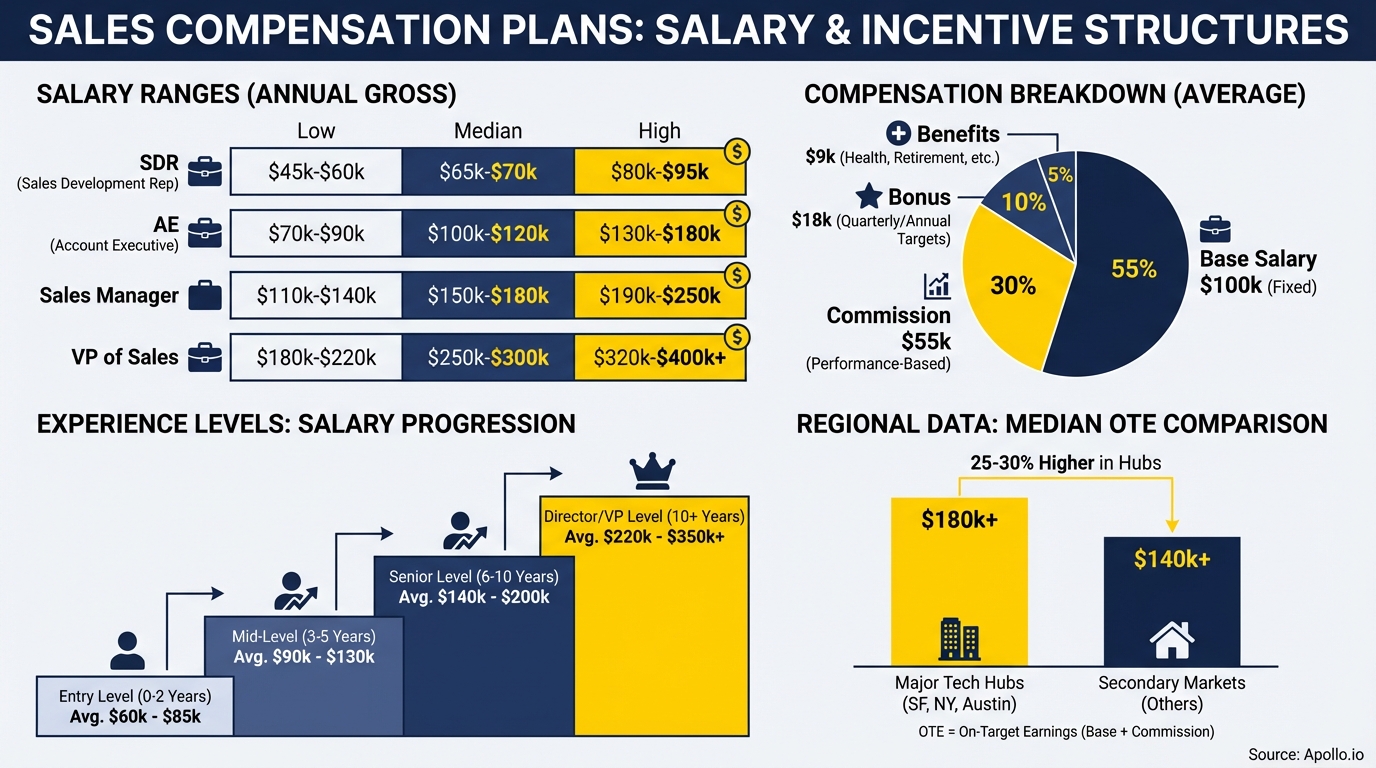
Sales compensation plans are structured frameworks that define how salespeople earn income based on their performance. These plans combine fixed base salary with variable compensation tied to specific metrics like revenue, quota attainment, or deal closure. According to CaptivateIQ's 2025 benchmark report, the classic 50/50 split between base and variable compensation remains the dominant approach for most sales organizations.
A well-designed plan motivates reps while protecting profitability. Research from BrightSales shows an ideal balance between base salary and commission often falls around 60/40 or 70/30, depending on the industry and product complexity. The right structure depends on your sales cycle, deal size, and whether you're optimizing for new business, expansion, or retention.
Need better visibility into your pipeline to set accurate quotas? Track deals and forecast revenue with Apollo's deal management platform.
Why Do Sales Compensation Plans Matter in 2026?
Compensation plans directly impact revenue performance, retention, and team morale. Salesforce reports that 80% of U.S. businesses revise their sales compensation plan every two years or less, reflecting the need for continuous optimization as markets shift.
The stakes are higher in 2026. Sales Leaders managing distributed teams need plans that work across geographies, roles, and product lines. RevOps leaders face pressure to reduce administrative overhead while maintaining accuracy. According to Alexander Group, the top sales compensation plan challenge for 52% of companies is productivity—making every dollar of comp investment drive measurable output.
Poorly designed plans create distrust, disputes, and attrition. AEs and SDRs who can't understand their earnings or feel quotas are unrealistic will disengage or leave.
Effective plans provide transparency, fairness, and clear incentives that align individual behavior with company goals.
What Are the Core Components of Effective Sales Compensation Plans?
Every compensation plan includes several foundational elements that work together to drive performance:
| Component | Description | Typical Range |
|---|---|---|
| Base Salary | Fixed income regardless of performance | 40-70% of OTE |
| Variable Pay | Commission tied to quota attainment | 30-60% of OTE |
| Quota | Revenue or activity target for full variable payout | 3:1 to 5:1 ratio to OTE |
| Accelerators | Higher commission rates above 100% quota | 1.25x-2x base rate |
| Ramp Period | Reduced quota during onboarding | 30-90 days |
| Bonuses/SPIFs | One-time incentives for specific behaviors | Varies by initiative |
Everstage's industry benchmarks show that the quota-to-OTE ratio typically ranges between 3:1 and 5:1 for most B2B sales roles. SDRs booking meetings might have lower ratios, while enterprise AEs closing seven-figure deals operate at the higher end.
The right mix depends on your business model. Transactional sales favor higher variable pay.
Complex enterprise deals with long cycles warrant more base salary to reduce income volatility. Sales Leaders must balance motivating performance with providing financial stability.
Turn Forecast Guesswork Into Revenue Certainty
Pipeline forecasting a guessing game? Apollo's real-time deal tracking and AI-powered insights give you accurate visibility across every stage. Built-In increased win rates 10% with Apollo's signals and scoring.
Start Free with Apollo →How Do Sales Leaders Design Compensation Plans That Drive Results?
Start with clear business objectives. What behaviors do you need to incentivize?
New customer acquisition, expansion revenue, product mix, or margin protection? Your plan mechanics should directly reinforce these priorities.
Follow this framework:
- Define role-specific metrics: SDRs earn on qualified meetings, AEs on closed revenue, Account Managers on net retention
- Set realistic quotas: Use historical data and market conditions—not wishful thinking—to establish achievable targets
- Build in accelerators: Reward over-performance with higher commission rates to motivate top performers
- Create ramp periods: Give new hires reduced quotas during their first 30-90 days while they onboard
- Add transparency mechanisms: Provide real-time visibility into earnings, quota progress, and payout calculations
- Plan for iteration: Build governance processes for mid-cycle adjustments when market conditions shift
According to Everstage, the shift toward performance-based pay is accelerating in 2025, with over 60% of SaaS companies prioritizing outcomes like renewals, upsells, and multithreaded deals as key compensation drivers. This reflects a broader move away from pure activity metrics toward revenue-quality indicators.
The best plans are simple enough for reps to understand but sophisticated enough to drive the right behaviors. Avoid overly complex formulas with multiple modifiers—confusion breeds distrust. For detailed guidance on tracking performance metrics, see our guide on What Sales KPIs Should You Track in 2026.

How Do RevOps Teams Reduce Administrative Burden in Compensation Management?
Manual commission calculations consume time and create errors. RevOps leaders report significant overhead managing spreadsheets, reconciling data across systems, and responding to rep disputes about payout accuracy.
Automation solves these problems:
- Integrate data sources: Pull deal data directly from your CRM instead of manual exports
- Automate calculations: Use comp management platforms that apply plan rules automatically
- Provide self-service visibility: Give reps real-time dashboards showing earnings, pipeline credit, and quota progress
- Create audit trails: Maintain detailed logs of all payout calculations for compliance and dispute resolution
- Streamline approvals: Build workflows for deal exceptions, splits, and manual adjustments
Struggling to keep your sales data clean and current? Enrich your CRM with Apollo's 224M+ verified business contacts to ensure accurate territory assignments and quota calculations.
The goal is shifting RevOps capacity from manual processing to strategic plan design and analysis. Teams using modern comp platforms report faster close cycles, fewer disputes, and better data quality for forecasting. For broader context on revenue operations, see What Is Revenue Operations and How Does It Drive Growth.
What Are the Biggest Mistakes in Sales Compensation Plan Design?
Even experienced Sales Leaders make avoidable errors that undermine plan effectiveness:
| Mistake | Impact | Solution |
|---|---|---|
| Unrealistic quotas | Low attainment rates, high turnover, disengagement | Use historical data and conservative growth assumptions |
| Overly complex plans | Confusion, distrust, inability to forecast earnings | Simplify to 2-3 core metrics with clear payout curves |
| Misaligned incentives | Reps prioritize wrong activities, margin erosion | Test plan mechanics against unintended behavior patterns |
| Poor visibility | Shadow accounting, disputes, delayed plan adjustments | Provide real-time dashboards with self-service access |
| No governance process | Ad-hoc changes, inconsistent application, fairness concerns | Establish RACI models and change-control workflows |
A 2024 compensation report found that in 2023, only 7% of executives reported that all sales team members hit their quota, and 44% stated that at least half of their reps missed their quota. These numbers point to systemic quota-setting problems, not rep performance issues.
The most common mistake is designing plans in isolation without testing against edge cases. What happens when a rep leaves mid-quarter?
How do you handle deal splits across territories? What if a customer churns before the contract goes live?
Address these scenarios upfront in your plan documentation.

How Should Compensation Plans Evolve for Different Sales Roles?
One-size-fits-all compensation doesn't work. Each sales role has distinct activities, sales cycles, and success metrics that require tailored plan structures:
- SDRs/BDRs: Focus on activity and quality metrics—qualified meetings booked, pipeline generated, meeting-to-opportunity conversion rates. Variable pay typically 30-40% of OTE.
- Account Executives: Compensate on closed revenue with accelerators above quota. Variable pay 40-50% of OTE. Consider adding quality gates like win rate or average deal size.
- Account Managers: Incentivize net retention, expansion revenue, and renewal rates. Balance new expansion bookings with customer health metrics.
- Sales Engineers: Often team-based incentives tied to AE performance, technical win rate, or deployment success metrics.
- Sales Leaders: Compensate on team quota attainment, pipeline coverage, and strategic initiatives like new market entry or product adoption.
For SDRs specifically, consider shorter measurement periods (monthly vs quarterly) to maintain motivation. AEs closing enterprise deals need longer measurement windows that align with sales cycle length.
Account Managers benefit from quarterly business reviews that reset retention targets.
The key is matching compensation frequency to the natural rhythm of each role's work. For insights on AE productivity strategies, see What Is Sales Productivity? Blueprint, Strategies, ROI.
Start Building Compensation Plans That Drive Performance
Effective sales compensation plans balance motivation, fairness, and administrative efficiency. In 2026, the best-performing teams use governance frameworks that enable rapid iteration while maintaining trust.
They automate manual calculations, provide real-time visibility, and align incentives with strategic business outcomes.
Start by auditing your current plan against the benchmarks in this guide. Are your quotas realistic?
Do reps understand their earnings? Can your RevOps team process commissions without manual spreadsheet work?
Address gaps systematically using the frameworks above.
Sales Leaders building high-performing teams need integrated platforms that connect prospecting, pipeline management, and deal tracking in one workspace. "Having everything in one system was a game changer," says the team at Cyera. Apollo consolidates your sales tech stack, giving you clean data for accurate quota setting and commission calculations. Start prospecting with Apollo's unified GTM platform.
Prove Apollo's ROI In Your First 30 Days
Budget approval stuck on unclear metrics? Apollo delivers trackable pipeline impact from day one. Built-In increased win rates 10% and ACV 10% with Apollo's signals and scoring.
Start Free with Apollo →Don't miss these
Sales
Inbound vs Outbound Marketing: Which Strategy Wins?
Sales
What Is a Sales Funnel? The Non-Linear Revenue Framework for 2026
Sales
What Is a Go-to-Market Strategy? The 2026 GTM Playbook
See Apollo in action
We'd love to show how Apollo can help you sell better.
By submitting this form, you will receive information, tips, and promotions from Apollo. To learn more, see our Privacy Statement.
4.7/5 based on 9,690 reviews
