
What Is a Sales Aptitude Test? Framework, Components, and Best Practices for 2026
Most sales hiring decisions still rely on gut feel and resume scanning. The result? According to RevOps Coop, only 27% of sales reps hit their quota in H1 of 2023. A sales aptitude test changes that equation by giving hiring teams objective, predictive data before the offer letter goes out. Done right, it identifies candidates who can execute in modern selling environments, not just interview well. For sales leaders pairing assessments with sales personality tests, the result is a hiring process built on evidence, not instinct.

Build Pipeline on Data That Delivers
Tired of hours lost to manual research and bounced emails? Apollo surfaces verified contacts instantly, so your reps spend time selling — not searching. Join 550K+ companies turning accurate data into predictable pipeline.
Start Free with Apollo →Key Takeaways
- A sales aptitude test measures cognitive ability, situational judgment, and role-specific skills, not just personality or charisma.
- Modern tests evaluate AI readiness, written communication, and CRM discipline alongside traditional sales competencies.
- Skills-based hiring is now mainstream: 78% of companies report good results from the approach, according to Sales Assessment Testing.
- Effective tests are short, job-relevant, and legally defensible under EEOC guidelines.
- Sales leaders use aptitude data to reduce ramp time, lower turnover, and build more predictable pipelines.
What Is a Sales Aptitude Test?
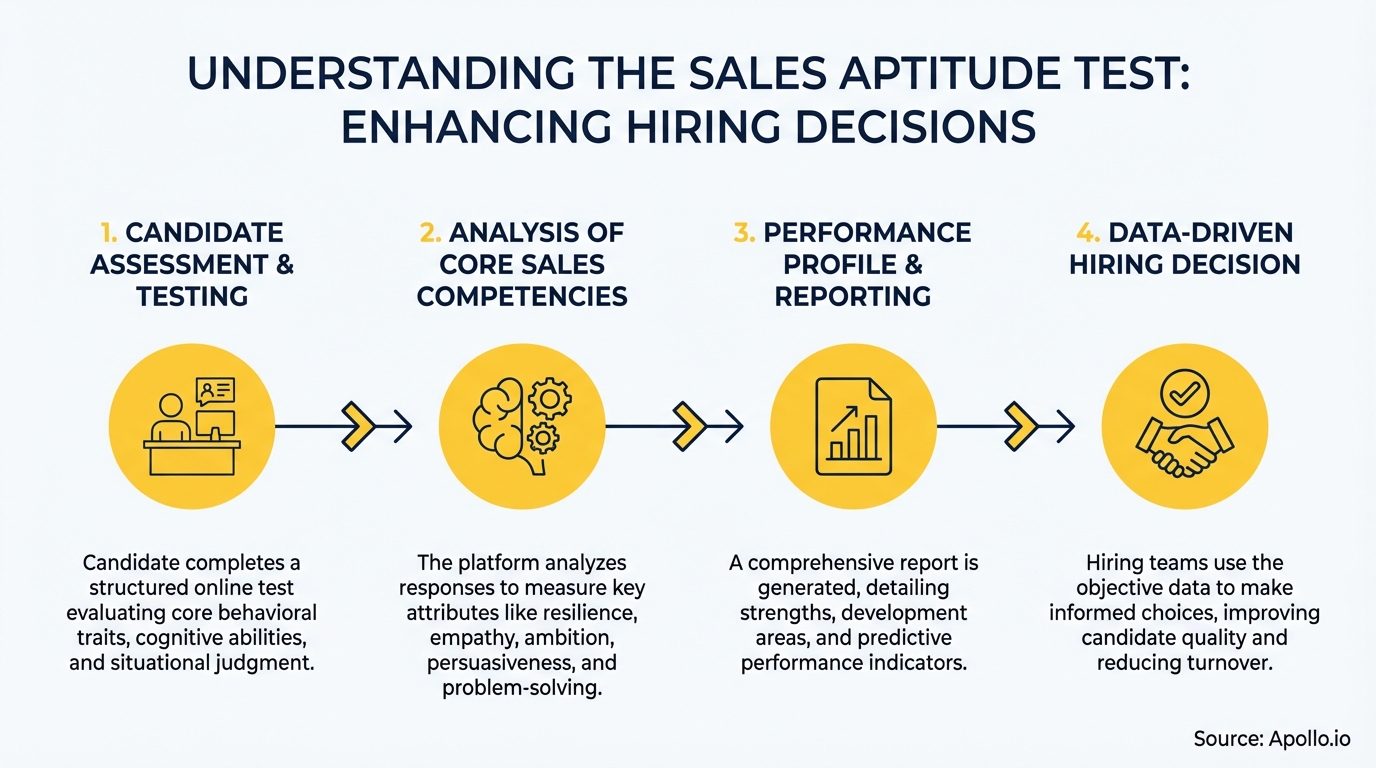
A sales aptitude test is a pre-employment assessment that measures a candidate's potential to succeed in a sales role. It goes beyond resume credentials to evaluate how someone thinks, handles objections, processes information, and navigates real selling scenarios.
Sales aptitude tests are not the same as personality assessments. Personality tests describe behavioral preferences.
Aptitude tests predict performance by measuring job-relevant capabilities directly.
| Assessment Type | What It Measures | Predictive of Performance? |
|---|---|---|
| Cognitive Ability Test | Reasoning, problem-solving, learning speed | High |
| Situational Judgment Test (SJT) | Decision-making in realistic sales scenarios | High |
| Work Sample / Simulation | Mock discovery call, cold email, objection handling | Very High |
| Personality Assessment | Behavioral tendencies, communication style | Moderate |
| AI Readiness Check | Tool fluency, workflow adaptability, data literacy | Emerging |
Why Do Sales Teams Need Aptitude Testing in 2026?
The productivity gap in sales is severe. A Gartner survey of 501 sellers found 77% struggle to complete their assigned tasks efficiently.
That stat alone makes a compelling case for filtering candidates earlier and more rigorously.
The skills gap compounds the problem. According to Selling Power, 29% of companies report major skill gaps across all jobs, a challenge especially acute in B2B sales roles. Meanwhile, MarketSource reports that B2B salesperson turnover increased by 64% in 2024, jumping from 22% to 36%. High turnover combined with unfilled roles creates compounding revenue drag that aptitude screening directly addresses.
Skills-based hiring is the solution gaining traction. Sales Assessment Testing reports that 78% of companies are seeing good results from skills-based hiring, reflecting a clear industry shift toward evaluating practical abilities over credentials alone.

What Do Modern Sales Aptitude Tests Actually Measure?
Effective tests in 2026 go well beyond "gift of gab" and closing instinct. B2B buyers now complete large purchases remotely and through self-serve channels, raising the bar for digital selling competencies.
Modern aptitude frameworks assess:
- Cognitive ability: How quickly candidates learn product knowledge, process information, and adapt to new tools.
- Situational judgment: How candidates respond to realistic scenarios like a stalled deal, an angry prospect, or a competitive objection.
- Written communication: Quality of prospecting emails, follow-up messages, and async selling content.
- CRM and process discipline: Ability to log activities, manage pipeline stages, and follow structured workflows.
- AI readiness: Fluency with AI-assisted research, messaging tools, and call prep workflows. Vendors are now explicitly assessing this as part of sales fit.
- Coachability: Responsiveness to feedback during simulated role-plays or scored work samples.
The shift from static questionnaires to job-simulated formats, such as AI role-plays and scored discovery calls, reflects what hiring managers actually want: proof of performance, not just a favorable score.
Turn Funnel Guesswork Into Pipeline Wins
Tired of watching marketing leads stall before they ever reach your pipeline? Apollo surfaces high-intent prospects at the right moment, so your team acts on real signals — not hunches. 550K+ companies forecast with confidence.
Start Free with Apollo →How Do Sales Leaders and RevOps Teams Use Aptitude Data?
Sales leaders use aptitude test results across the entire talent lifecycle, not just at the point of hire. Here is how different ICP roles apply the data:
- Sales Leaders: Use scores to calibrate interview panels, set ramp expectations, and identify early coaching priorities for new hires.
- RevOps teams: Integrate aptitude benchmarks into hiring scorecards and track whether high-scoring hires actually outperform on key sales KPIs like quota attainment and pipeline velocity.
- Founders and CEOs: Use structured assessments to reduce early mis-hires when building the first sales team, where each bad hire carries outsized cost.
- SDR Managers: Match aptitude profiles to SDR-specific competencies like outbound volume, objection resilience, and email quality, then use scores to personalize onboarding tracks.
Pairing aptitude data with sales analytics creates a closed loop: you can validate whether assessment scores actually predict quota attainment for your specific team and role type.
Once you have hired the right reps, give them a platform that helps them execute. Build and manage your sales pipeline in Apollo, where prospecting, outreach, and deal tracking live in one place.
How Do You Design a Legally Defensible Sales Aptitude Test?
Assessment design carries legal and ethical obligations. The EEOC requires that any test used in hiring decisions be job-relevant and not produce adverse impact against protected groups without business justification.
Practical steps for a compliant process:
- Define the job requirements first. Conduct a job analysis to identify which competencies actually predict success for the specific role (SDR vs. AE vs. enterprise rep).
- Validate the test. Use assessments with documented predictive validity data. Track whether high scorers actually perform better after hire.
- Monitor for adverse impact. Regularly audit results by demographic group. If a test systematically screens out protected groups at a disproportionate rate, revisit the design.
- Keep it job-relevant and transparent. Candidates who understand why a test is relevant complete it at higher rates and with less resentment.
- Maintain audit trails. Document scoring criteria, pass/fail thresholds, and how scores factor into final decisions.
As AI scoring enters assessment platforms, buyers are now asking vendors for explainability documentation and bias audit reports as standard purchase criteria.
What Should an SDR-Specific Sales Aptitude Test Include?
SDR roles demand a distinct aptitude profile compared to AE or enterprise selling roles. A targeted SDR aptitude test should assess:
- Outbound execution: Can the candidate write a compelling, personalized cold email? Score a sample sequence they draft in real time.
- Objection resilience: Use a situational judgment scenario: a prospect says "send me an email" on a cold call. What does the candidate do?
- Learning speed: Present a short product brief, then ask the candidate to explain the value proposition back in their own words.
- Process adherence: Walk through a mock CRM scenario. Does the candidate log correctly, move stages appropriately, and flag stuck deals?
- AI tool comfort: Ask candidates how they would use an AI tool to research a prospect before a call. Assess the quality of their answer.
For SDRs who need to master multi-channel outreach from day one, pairing strong aptitude results with the right tools matters. Apollo's sales engagement platform gives new reps structured sequences across email, phone, and social so they can execute at full speed from week one.
Reps who score well on process discipline and AI readiness also benefit from resources like the best AI sales tools and sales productivity frameworks to accelerate their ramp.

Conclusion: Build a Smarter Sales Hiring Process in 2026
A well-designed sales aptitude test is one of the highest-leverage investments a sales organization can make. It reduces mis-hires, shortens ramp time, and gives managers objective data to coach against from day one.
The best tests in 2026 go beyond personality traits to measure situational judgment, written communication, AI readiness, and process discipline.
Combine strong hiring with the right execution platform. Apollo gives your reps, SDRs, and AEs the prospecting data, engagement tools, and pipeline visibility they need to perform at their peak from the moment they are onboarded.
Start Free with Apollo and give your newly hired sales team the all-in-one GTM platform that replaces the complexity of multiple tools.
Prove Pipeline ROI With Apollo
Budget approval stuck on unclear metrics? Apollo surfaces measurable pipeline impact from day one, so you walk into every review with hard numbers. Leadium 3x'd their revenue — see what Apollo delivers for your team.
Start Free with Apollo →Don't miss these
Sales
Inbound vs Outbound Marketing: Which Strategy Wins?
Sales
What Is a Sales Funnel? The Non-Linear Revenue Framework for 2026
Sales
What Is a Go-to-Market Strategy? The 2026 GTM Playbook
See Apollo in action
We'd love to show how Apollo can help you sell better.
By submitting this form, you will receive information, tips, and promotions from Apollo. To learn more, see our Privacy Statement.
4.7/5 based on 9,690 reviews
