
New Sales Simplified: A Modern Framework for B2B Sales Success
Sales teams face a paradox in 2026. AI tools promise automation, yet buyers increasingly demand human connection. According to Landbase, sales representatives spend only 28-34% of their time actively selling. The rest? Administrative tasks, research, and coordination. This gap between selling time and productivity creates an urgent need for streamlined approaches that put reps back in front of prospects. Modern sales simplification combines smart automation with human-first engagement, helping sales teams drive measurable revenue growth without sacrificing the personal touch that closes deals.

Scale Quality Leads Without Adding Headcount
Struggling with slow lead generation while your team drowns in manual research? Apollo automates prospecting with 224M+ verified contacts and AI-powered targeting. Customer. io grew 50% YoY using Apollo's workflows.
Start Free with Apollo →Key Takeaways
- New sales simplified means automating busywork while prioritizing human connection in 2026's buyer landscape
- SDRs and AEs can reclaim selling time by consolidating prospecting, engagement, and analytics into one platform
- Simplified selling requires sharper ICP targeting, relevant messaging, and data-driven workflows
- Modern buyers expect personalized outreach backed by instant access to self-serve resources
- Tool consolidation cuts costs and complexity while improving team productivity and pipeline visibility
What Is New Sales Simplified in 2026?
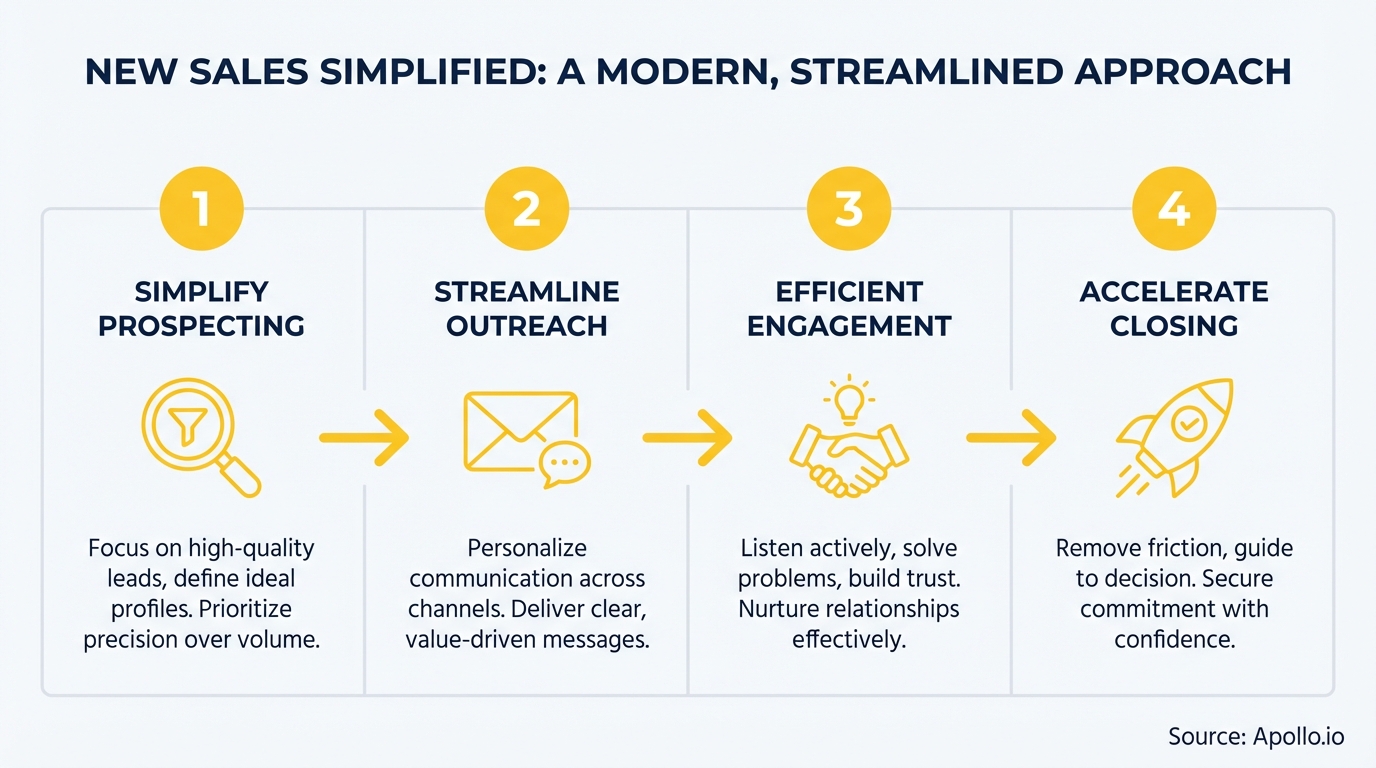
New sales simplified is a methodology that strips away complexity from the sales process through targeted automation and clearer execution. It focuses on three pillars: precise ICP targeting, relevant multi-channel outreach, and streamlined workflows that maximize actual selling time. Research from Semrush shows that 58% of B2B marketers believe content marketing helped increase sales and revenue in 2024, up from 42% in 2023. This growth reflects the shift toward value-driven, simplified approaches.
The core principle remains unchanged from Mike Weinberg's original framework: focus on activities that directly generate pipeline. However, 2026's version integrates AI for research and administrative tasks while keeping human judgment central to relationship building.
For SDRs, this means spending less time on list building and more time crafting personalized messages. For Account Executives, it translates to better pre-meeting intelligence and faster deal cycles.
Why Does Sales Simplification Matter Now?
The B2B buying landscape has fundamentally shifted. According to Coalition Technologies, B2B buyers engage in an average of 62+ touchpoints before finalizing a deal. Each touchpoint demands relevance and value, or buyers disengage entirely. Sales teams juggling multiple tools, inconsistent data, and manual processes cannot keep pace with this complexity.
Three market forces drive the need for simplification:
- Buyer self-service expectations: Prospects research independently and expect instant access to pricing, case studies, and ROI calculators
- Tool sprawl costs: Teams using separate platforms for prospecting, engagement, and analytics face integration headaches and higher subscription costs
- Productivity pressure: Sales leaders need measurable ROI from every investment, not experimental AI features that add complexity
Struggling to find qualified leads? Search Apollo's 224M+ contacts with 65+ filters.
How Do SDRs Book More Meetings Using Simplified Sales?
SDRs using simplified sales frameworks focus on three high-impact activities: targeted prospecting, relevant messaging, and consistent follow-up. The key is eliminating low-value tasks that don't directly contribute to booked meetings. Modern SDRs leverage AI sales tools to automate research while maintaining personalized outreach.
Effective simplified prospecting for SDRs includes:
- ICP-first targeting: Start with firmographic and intent data to build lists of accounts showing buying signals
- Multi-channel sequences: Combine email, phone, and social outreach in coordinated cadences
- Value-based messaging: Lead with prospect pain points and relevant use cases, not product features
- Fast follow-up: Respond to engagement signals within minutes using automated alerts
Teams using consolidated platforms report significant time savings. As Collin Stewart from Predictable Revenue notes: "We reduced the complexity of three tools into one." This consolidation allows SDRs to spend more time on personalization and relationship building instead of switching between systems.
What Tools Simplify Sales Workflows in 2026?
The most effective sales simplification comes from platform consolidation. Instead of stitching together separate tools for data, engagement, and analytics, modern teams use all-in-one platforms that integrate these capabilities.
This approach reduces cost, eliminates data sync issues, and provides unified visibility across the entire sales cycle.

| Traditional Stack | Simplified Approach | Impact |
|---|---|---|
| Data provider + engagement platform + CRM + analytics | Unified GTM platform | Lower costs, faster workflows |
| Manual list building and research | AI-powered prospecting with filters | More selling time for reps |
| Disconnected outreach channels | Multi-channel sequences in one workspace | Higher response rates |
| Spreadsheet-based pipeline tracking | Real-time deal management | Better forecast accuracy |
RevOps leaders prioritizing sales tech stack optimization focus on platforms that combine data quality, engagement automation, and performance analytics. Census, an Apollo customer, cut their costs in half by consolidating tools. Cyera's team found that "having everything in one system was a game changer" for their go-to-market motion.
Turn Forecast Chaos Into Revenue Certainty
Missing deals because your pipeline is a black box? Apollo gives you real-time visibility into every deal stage with AI-powered insights. Built-In increased win rates 10% using Apollo's scoring and signals.
Start Free with Apollo →How Can Sales Leaders Implement Simplified Selling?
Sales leaders implementing new sales simplified start with process audits to identify bottlenecks and low-value activities.
The goal is creating repeatable workflows that scale without adding complexity.
This requires aligning on ICP definitions, standardizing messaging frameworks, and selecting tools that support execution rather than adding administrative burden.
Implementation steps for sales leaders:
- Audit current workflows: Document how reps spend their day and identify time drains
- Define your ICP precisely: Build detailed profiles with firmographics, technographics, and intent signals
- Standardize messaging: Create templates for common scenarios while allowing personalization
- Consolidate your tech stack: Replace fragmented tools with integrated platforms
- Train on execution: Focus enablement on high-impact activities using structured onboarding programs
- Measure what matters: Track activities that correlate with pipeline generation, not vanity metrics
Spending hours on manual outreach? Automate your sequences with Apollo.

What Role Does AI Play in Sales Simplification?
AI simplifies sales by handling repetitive research, data entry, and administrative tasks that consume non-selling time. However, effective AI implementation in 2026 means augmenting human sellers, not replacing them.
The most successful teams use AI for prospect intelligence, message drafting, and call preparation while keeping strategic decisions and relationship building firmly in human hands.
Practical AI applications that simplify selling:
- Prospect research: AI surfaces company news, funding events, and job changes relevant to your ICP
- Message personalization: Tools suggest relevant talking points based on prospect data and intent signals
- Call preparation: Pre-meeting briefs compile account history, stakeholder maps, and suggested questions
- Follow-up automation: AI drafts next-step emails based on meeting outcomes and CRM data
The key is governance. Sales leaders must define clear guardrails for AI usage, ensuring tools enhance rather than complicate workflows. As highlighted in sales automation best practices, the goal is productivity gains with measurable ROI, not experimental features that add complexity.
How Do Founders Build Simplified Sales Processes?
Founders building outbound motions face unique constraints: limited budgets, small teams, and the need to prove ROI quickly. Simplified sales for early-stage companies means starting with manual processes to learn what works, then selectively automating proven activities.
The priority is speed to first revenue, not building perfect systems.
Founder-friendly simplification framework:
- Start narrow: Target one specific ICP segment to validate messaging and process
- Use multi-channel outreach: Combine email, phone, and social in coordinated sequences
- Track leading indicators: Monitor response rates, meeting bookings, and conversion metrics
- Choose unified platforms: Avoid tool sprawl by selecting all-in-one solutions that scale
- Document what works: Capture successful sales pitch techniques and objection responses
Early-stage teams benefit most from platforms that eliminate the need for multiple vendors. Instead of paying for separate data providers, engagement tools, and analytics dashboards, consolidated platforms reduce costs while providing the capabilities needed to compete with better-funded competitors.
Simplify Your Sales Process in 2026
New sales simplified in 2026 means cutting complexity without sacrificing effectiveness. The most successful teams automate administrative tasks, consolidate fragmented tech stacks, and focus selling time on high-value activities that directly generate pipeline.
For SDRs, this translates to more meetings booked. For Account Executives, it means shorter sales cycles.
For sales leaders, it delivers predictable revenue growth with leaner operations.
The path forward combines smart automation with human-first engagement. Tools handle research, data entry, and coordination.
Sellers focus on building relationships, understanding buyer needs, and closing deals. Platform consolidation reduces costs and complexity while improving team productivity and forecast accuracy.
Ready to simplify your sales process? Try Apollo Free and consolidate prospecting, engagement, and analytics into one workspace that helps your team sell more efficiently.
Prove Apollo's ROI In Your First 30 Days
Budget approval stuck on unclear metrics? Apollo tracks every dollar of pipeline generated from first touch. Customer. io achieved 50% YoY growth with measurable automation ROI.
Start Free with Apollo →Don't miss these
Sales
Inbound vs Outbound Marketing: Which Strategy Wins?
Sales
What Is a Sales Funnel? The Non-Linear Revenue Framework for 2026
Sales
What Is a Go-to-Market Strategy? The 2026 GTM Playbook
See Apollo in action
We'd love to show how Apollo can help you sell better.
By submitting this form, you will receive information, tips, and promotions from Apollo. To learn more, see our Privacy Statement.
4.7/5 based on 9,690 reviews
