
Marketing Frameworks That Actually Drive Revenue in 2026
Most B2B marketers are running on frameworks built for a different era. Research by MarTech found that while 74% of B2B enterprise marketers have a content marketing strategy, only 22% rate their efforts as effective. The problem isn't lack of frameworks—it's choosing the right ones and executing them with precision.
This guide cuts through the noise. You'll get actionable marketing frameworks tested by revenue teams in 2026, plus the data infrastructure to make them work.

Skip Manual Research—Apollo Finds Contacts Fast
Tired of spending 4+ hours daily hunting for contact info? Apollo delivers 224M verified contacts with 96% email accuracy instantly. Join 550K+ companies who ditched manual prospecting.
Start Free with Apollo →Key Takeaways
- Modern marketing frameworks must connect content activity to measurable business value, not just vanity metrics
- 85% of B2B marketers fail to tie content to revenue because they lack integrated data and attribution systems
- AI-powered personalization and post-purchase engagement frameworks now deliver 35-46% performance lifts
- The best frameworks in 2026 unify strategy, execution, and measurement in one platform to eliminate tech stack bloat
- Customer retention frameworks deliver 3-5x ROI compared to acquisition-only approaches
What Are Marketing Frameworks and Why They Matter Now
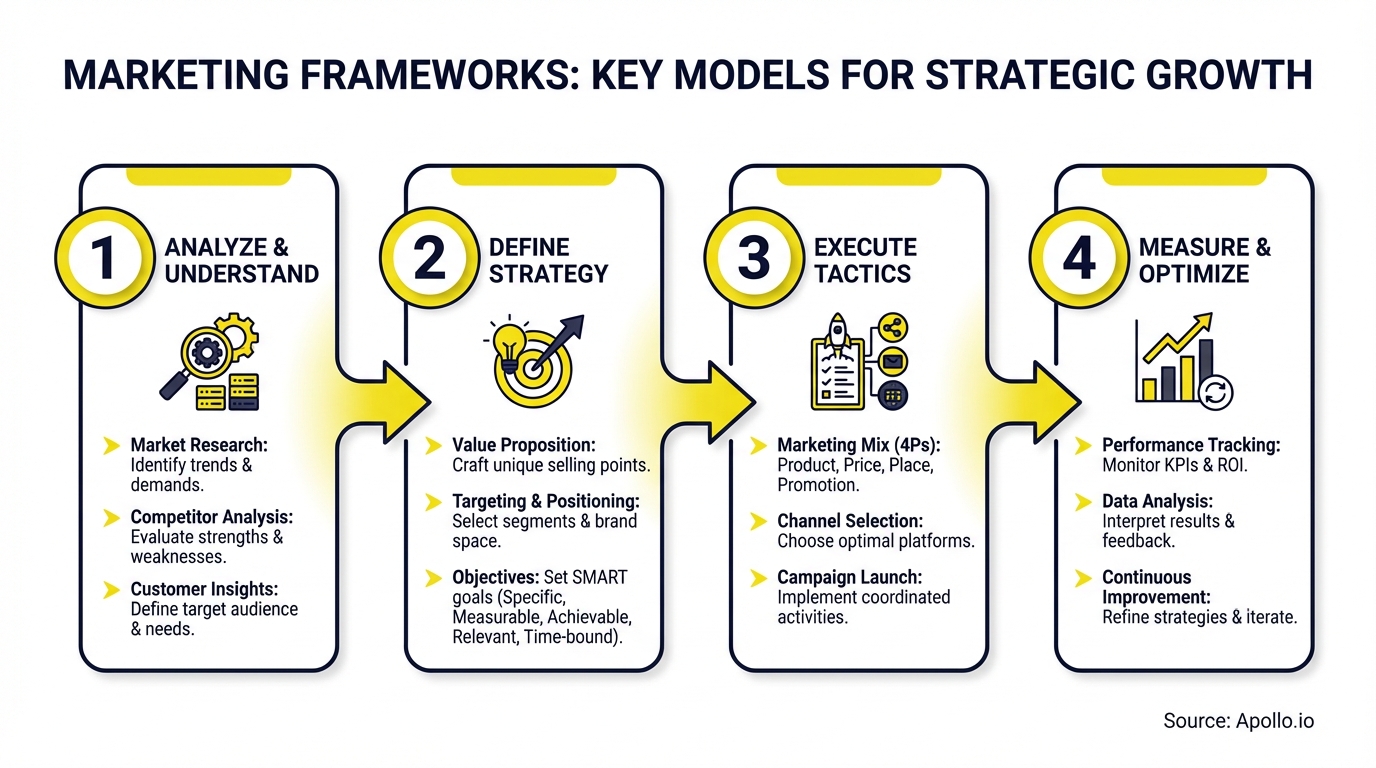
Marketing frameworks are structured approaches that guide strategy, execution, and measurement. They transform vague goals like "increase brand awareness" into actionable steps with clear metrics.
Here's what changed: According to Forrester, 85% of B2B marketers fail to connect content activity to business value. The frameworks that win in 2026 solve this by building measurement and attribution directly into execution.
The best frameworks now answer three questions: Who are we targeting? What value do we deliver? How do we prove ROI?
Essential Marketing Frameworks by Use Case
Different challenges require different frameworks. Here's how to match frameworks to your biggest gaps.
Strategy and Market Positioning Frameworks
| Framework | Best For | Key Output |
|---|---|---|
| Jobs to Be Done (JTBD) | Understanding customer motivations | Outcome-driven messaging that resonates |
| Porter's Five Forces | Competitive market analysis | Strategic positioning decisions |
| Blue Ocean Strategy | Finding uncontested market space | Differentiation beyond features |
| TAM/SAM/SOM | Market sizing and prioritization | Realistic revenue targets |
For go-to-market strategy, combine JTBD with TAM/SAM/SOM to identify which customer problems are worth solving at scale.
Customer Segmentation and Targeting Frameworks
Segmentation separates winners from losers. The frameworks that work:

- ICP (Ideal Customer Profile): Firmographic and behavioral criteria for best-fit accounts
- Persona Development: Role-based decision-maker profiles with pain points and goals
- RFM Analysis: Recency, frequency, monetary value for customer prioritization
- Behavioral Segmentation: Action-based grouping (product usage, content engagement, buying signals)
Struggling to build accurate segments? Apollo's 224M+ verified contacts with 65+ fi lters let you segment by technographics, intent signals, and firmographics in seconds, not weeks.
Turn Forecast Guesswork Into Revenue Certainty
Pipeline forecasting a guessing game? Apollo gives you real-time deal visibility and intent signals that make quota planning predictable. Built-In increased win rates 10% with Apollo's scoring.
Start Free with Apollo →"Apollo enriches everything we have: contacts, leads, accounts... And we don't really have to touch it, it just works."
Content and Campaign Execution Frameworks
| Framework | Purpose | Execution Advantage |
|---|---|---|
| Content Pillar Strategy | Organize content themes | Consistent messaging across channels |
| RACE (Reach, Act, Convert, Engage) | Full-funnel planning | Balanced investment across stages |
| Hub and Spoke Model | Content distribution | Maximize asset ROI through repurposing |
| AI Personalization at Scale | Dynamic content adaptation | 35-46% lift in engagement and conversions |
The 2026 shift: AI personalization frameworks now deliver what manual segmentation couldn't. Apollo customers see a 46% increase in meetings booked using AI-powered research and messaging that adapts to each prospect's context.
Post-Purchase and Retention Frameworks (The Missing Piece)
Here's the gap most frameworks miss: 67% of B2B marketers focus on acquisition while only 10% prioritize retention. Yet retention delivers 3-5x ROI compared to new customer acquisition.
Winning retention frameworks in 2026:
- Customer Journey Mapping: Identify drop-off points and expansion opportunities post-sale
- Product Adoption Scoring: Track feature usage to trigger proactive engagement
- NPS + Action Framework: Turn detractors into promoters through systematic follow-up
- Expansion Revenue Plays: Automate upsell/cross-sell triggers based on usage patterns
Effective retention requires integrated data. When customer success, product analytics, and marketing work from one system, you catch churn signals before they become cancellations. Learn more about B2B marketing strategies that balance acquisition and retention.
Measurement and Attribution Frameworks That Connect to Revenue
The attribution problem is why 85% of marketers can't prove content ROI. These frameworks fix it:
| Framework | What It Measures | Best Use Case |
|---|---|---|
| Multi-Touch Attribution | Credit across all touchpoints | Complex B2B buying journeys |
| Marketing Mix Modeling | Channel contribution to revenue | Budget allocation decisions |
| Cohort Analysis | Customer behavior over time | Retention and LTV optimization |
| Pipeline Velocity Tracking | Speed from MQL to closed-won | Identifying bottlenecks |
For detailed guidance on tracking what matters, see our guide to marketing metrics that actually drive decisions.
"Apollo could be a third of the cost if you look at the full price of what we were spending on ZoomInfo, Outreach, Salesforce, and admins to make it all work."
How to Choose the Right Framework for Your Team
Don't pick frameworks because they're trendy. Use this decision filter:

- Start with your biggest gap: Positioning? Execution? Measurement? Pick frameworks that directly address it.
- Match to team maturity: Early-stage teams need simpler frameworks (ICP, basic attribution). Scaled teams can handle multi-touch attribution and AI personalization.
- Verify data availability: Advanced frameworks require integrated data. If your tech stack is fragmented, start there.
- Test before committing: Run 30-day pilots with one framework before rolling out company-wide.
The most common mistake: choosing frameworks that require data you don't have. If you're running attribution models but contacts aren't enriched with firmographics and intent signals, you're measuring noise.
Operationalizing Frameworks With Unified Data and Automation
Frameworks fail when execution requires juggling 5-10 tools. The solution: platform consolidation that connects data, engagement, and measurement.
What unified execution looks like:
- Segment accounts using real-time intent signals and firmographics
- Launch personalized sequences across email, phone, and LinkedIn from one workspace
- Track every touchpoint from first contact to closed-won
- Measure which frameworks drive pipeline, not just activity
Spending hours stitching together data from multiple platforms? Apollo unifies prospecting, engagement, and analytics so your frameworks run on clean data, not guesswork.
For more on building efficient marketing operations, explore our guide to marketing team structures that actually work.
Start Executing Frameworks That Drive Revenue
The best marketing frameworks in 2026 share three traits: they're built on verified data, they connect activity to revenue, and they run on integrated platforms that eliminate tool bloat.
Stop running frameworks on fragmented data and disconnected tools. Start with the infrastructure that makes execution possible: accurate contact data, automated engagement, and attribution that proves ROI.
Ready to operationalize your frameworks? Get leads now with Apollo's all-in-one platform—224M+ verified contacts, AI-powered personalization, and end-to-end attribution in one workspace.
Prove Apollo's ROI In Your First 30 Days
Budget approval stuck on unclear metrics? Apollo delivers measurable pipeline impact from day one—track time saved, meetings booked, and revenue generated. Built-In increased win rates 10% and ACV 10% with Apollo's scoring.
Start Free with Apollo →Don't miss these
Sales
Inbound vs Outbound Marketing: Which Strategy Wins?
Sales
What Is a Sales Funnel? The Non-Linear Revenue Framework for 2026
Sales
What Is a Go-to-Market Strategy? The 2026 GTM Playbook
See Apollo in action
We'd love to show how Apollo can help you sell better.
By submitting this form, you will receive information, tips, and promotions from Apollo. To learn more, see our Privacy Statement.
4.7/5 based on 9,690 reviews
