InsightsSalesWhat Is a Go-to-Market Strategy in 2026?
What Is a Go-to-Market Strategy in 2026?
February 19, 2026
Written by The Apollo Team
What Is a Go-to-Market Strategy in 2026?
A go-to-market strategy is your blueprint for bringing products to customers efficiently. In 2026, GTM success depends on self-serve buying experiences, internal team alignment, and AI-powered execution. According to RevOps Coop, 75% of B2B buyers prefer a rep-free experience, and only 5% of the buyer's journey is spent with a salesperson. Your GTM must win before sales ever engages.
This guide breaks down the frameworks, tools, and execution strategies that drive revenue in a budget-constrained, buyer-led market. You'll learn how to align cross-functional teams, design decision-enablement content, and leverage unified platforms to consolidate your tech stack.
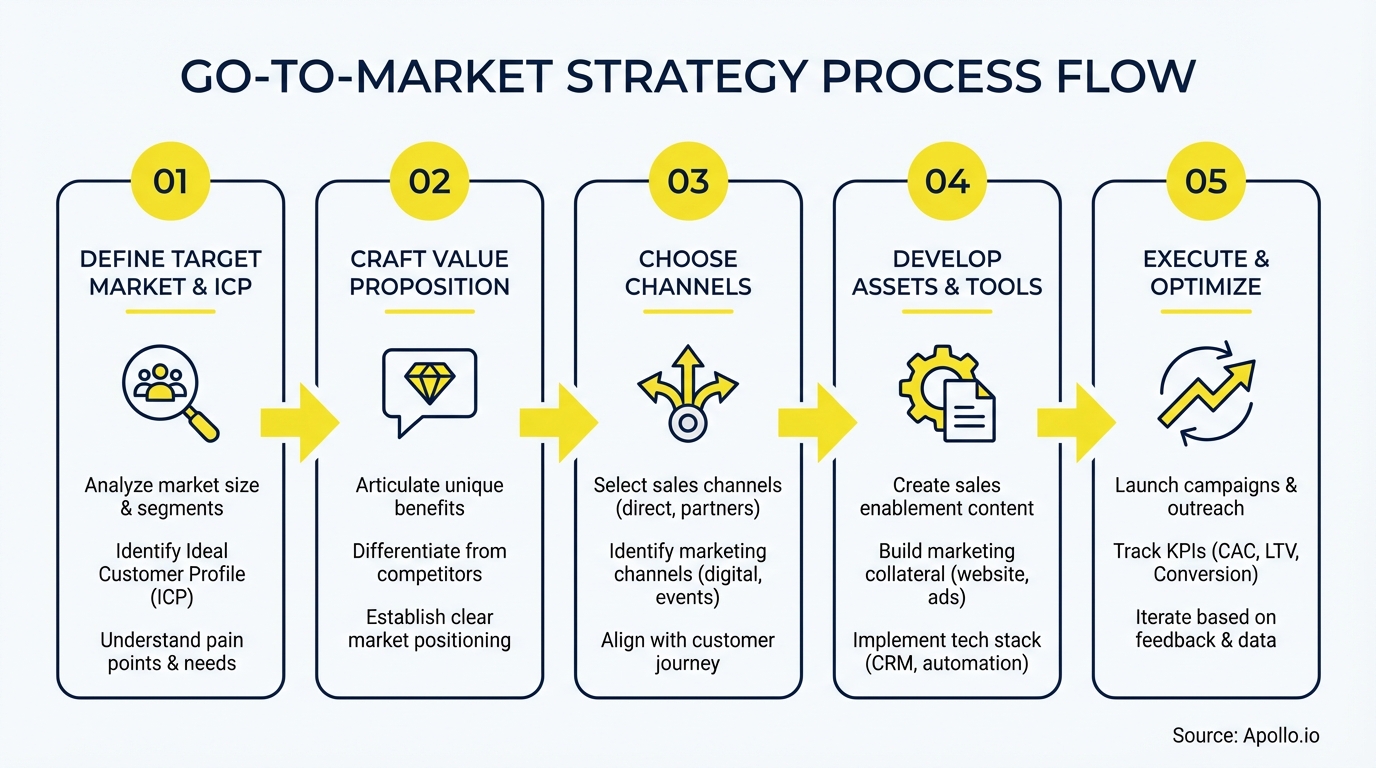
A five-step go-to-market strategy process flow diagram with icons and descriptions.
LEAD RESEARCH EFFICIENCY
Stop Manual Research—Apollo Finds Contacts Fast
Tired of spending 4+ hours daily hunting for contact info? Apollo delivers 224M verified contacts with 96% email accuracy. Join 550K+ companies closing more deals.
GTM strategies must prioritize self-serve buying journeys and decision-enablement content
Internal alignment between Marketing, Sales, and Customer Success is the top GTM priority for 52% of leaders
AI governance and unified platforms reduce tool sprawl and improve efficiency
Budget constraints demand ROI-first planning and lifecycle conversion optimization
Multi-channel execution requires clear handoffs, data hygiene, and revenue attribution
What Is a Go-to-Market Strategy?
A go-to-market strategy is a tactical plan that defines how you reach target customers, deliver value, and convert them into revenue. It answers four questions: Who buys?
Why do they buy? How do they buy?
What channels and resources drive conversion?
GTM strategies differ from marketing plans. Marketing focuses on awareness and demand generation.
GTM encompasses the full revenue motion: positioning, pricing, sales enablement, onboarding, and expansion. It's the operational bridge between product development and revenue realization.
In 2026, GTM strategies must address structural shifts in B2B buying behavior. Research from The B2B House shows 61% of US B2B buyers engage with three to seven pieces of content before interacting with a salesperson. Your content must educate, enable decisions, and build trust autonomously.
"The thing that made me most excited as somebody who's been in sales development a long time was Apollo's integration between sales data and sales engagement and the magic that you can make happen when those two are together on the same platform."
Why GTM Alignment Is the Top Priority in 2026
According to MarketingProfs, strengthening internal alignment among Marketing, Sales, and Customer Success teams is the top priority for 52% of B2B GTM executives and managers. Misalignment creates friction in handoffs, duplicated efforts, and inconsistent messaging.
Alignment failures manifest in three ways: conflicting definitions of qualified leads, disconnected data across systems, and competing incentives between teams. When Marketing optimizes for MQLs but Sales measures pipeline quality, you create a structural conflict that no amount of activity can solve.
Effective alignment requires shared definitions (what qualifies as an opportunity?), unified data infrastructure (single source of truth for accounts and contacts), and cross-functional accountability (revenue targets tied to collaborative metrics). Building a winning GTM plan starts with operational clarity, not channel tactics.
Core Components of a Modern GTM Strategy
Component
Purpose
2026 Best Practice
Target Market Definition
Identify ideal customer profiles and buying personas
Use intent data and firmographic signals to prioritize accounts
Value Proposition
Articulate differentiation and quantifiable outcomes
Lead with ROI proof, not feature lists
Pricing & Packaging
Structure offers that align with customer value realization
Enable self-serve pricing transparency where possible
Channel Strategy
Determine how customers discover, evaluate, and purchase
Design for digital-first, rep-optional journeys
Sales Enablement
Equip teams with content, training, and tools
Automate sequences and provide AI-assisted personalization
Customer Success
Drive retention, expansion, and advocacy
Instrument lifecycle triggers and health scoring
Each component requires operational integration. Your ICP definition should flow into targeting filters in your sales intelligence platform.
Your value proposition should inform email copy, landing page messaging, and sales talk tracks. Your pricing should be procurement-ready with transparent ROI calculators.
PIPELINE FORECASTING
Turn Forecast Guesswork Into Revenue Certainty
Pipeline visibility a black box? Apollo delivers real-time deal intelligence and buyer signals so you forecast with confidence. Built-In increased win rates 10% with Apollo's scoring and insights.
1. Define Your Ideal Customer Profile and Personas
Start with firmographic criteria: industry, company size, revenue, location, technology stack. Layer in behavioral signals: intent data, hiring patterns, funding events.
Personas translate ICP into individual buyer roles with distinct pain points, evaluation criteria, and decision authority.
2. Map the Buyer Journey and Decision Process
Identify stages from awareness to advocacy. For each stage, define: What questions do buyers ask? What content do they consume? Who influences the decision? What triggers forward motion? Lifecycle marketing strategies align messaging to each stage.
3. Develop Decision-Enablement Content
Create assets that help buyers make confident decisions internally: ROI calculators, comparison guides, procurement FAQs, implementation checklists, security documentation, reference architectures. This content accelerates deals by reducing internal friction.
4. Select Channels and Set Budget Allocation
Prioritize channels where your ICP is active and receptive. Research from Dreamdata shows Google Network (Search, Display, YouTube) accounts for over 50% of paid budget. Balance paid, owned, and earned channels based on CAC and conversion data.
5. Build Cross-Functional Workflows and Handoffs
Define lead routing logic, qualification criteria, and SLAs for each handoff. Marketing to SDR: What constitutes an MQL?
SDR to AE: What qualifies as a Sales Qualified Opportunity? AE to CS: What triggers onboarding?
Document workflows and automate where possible.
6. Instrument Measurement and Attribution
Track metrics that connect activity to revenue outcomes: pipeline generated, win rate, average deal size, sales cycle length, CAC payback period. Use multi-touch attribution to understand which channels and content drive conversions. Struggling to connect your GTM data? Unify your go-to-market operations in Apollo's all-in-one platform.
"We reduced the complexity of three tools into one. We're getting higher reply rates, open rates are doubled, meetings are up, and speed to booking a meeting is cut in half."
Four colleagues actively discuss a project at a modern office table with a laptop.
GTM Execution Models: Product-Led vs. Sales-Led
Product-Led Growth (PLG): Customers discover value through self-serve trials or freemium tiers. Marketing drives signups. Product usage triggers sales engagement for expansion. Best for products with low complexity and immediate time-to-value.
Sales-Led Growth (SLG): Sales drives the full journey from awareness to close. Marketing generates qualified leads. AEs run demos, negotiate contracts, and coordinate implementation. Best for complex, high-ACV products requiring customization.
Hybrid Models: Most B2B companies blend both. Marketing generates awareness. Prospects self-serve into trials. High-intent users trigger sales outreach. The key is defining clear triggers and handoff criteria. Inbound and outbound marketing strategies complement each other in hybrid models.
How AI and Automation Transform GTM Execution
AI shifts GTM from manual to scalable. Prospecting automation identifies and enriches target accounts. Sequence automation personalizes outreach at scale. Conversation intelligence surfaces deal risks and coaching opportunities. According to Growth Labs, over 55% of businesses currently utilize AI in some capacity, particularly in marketing and sales.
AI governance is now a GTM differentiator. Buyers ask: How do you ensure data accuracy?
What provenance do your AI outputs have? How do you mitigate bias and hallucinations?
Teams need documented AI guidelines, review SLAs, and quality controls. Forrester's 2026 predictions emphasize trust and governance as central to operational AI adoption.
Platforms that unify data and engagement reduce tool sprawl. Instead of ZoomInfo for data, Outreach for sequences, and Gong for calls, teams consolidate into one workspace. This reduces admin overhead, improves data consistency, and accelerates onboarding. Need to consolidate your tech stack? Search Apollo's 224M+ contacts and automate outreach in one platform.
Common GTM Mistakes and How to Avoid Them
Mistake 1: Launching without customer validation. Build GTM on assumptions rather than customer interviews and pilot feedback.
Solution: Run discovery interviews with 10-15 prospects before finalizing positioning.
Solution: Align on shared pipeline and revenue goals with collaborative accountability.
Mistake 3: Channel sprawl without prioritization. Spreading budget across too many channels dilutes impact. Solution: Focus on 2-3 high-ROI channels and optimize deeply before expanding.
Mistake 4: Ignoring the self-serve buyer journey. Forcing rep engagement on buyers who prefer self-education.
Buyers stall because they can't build internal business cases.
Solution: Create procurement-ready templates, ROI models, and champion kits.
How to Measure GTM Performance
Metric
What It Measures
Target Benchmark
Pipeline Generated
Total qualified pipeline created by GTM motions
3-5x revenue target
Win Rate
Percentage of opportunities that close-won
20-30% for enterprise, 30-40% for mid-market
Sales Cycle Length
Average days from opportunity creation to close
30-90 days depending on ACV
CAC Payback Period
Months to recover customer acquisition cost
12-18 months
Net Revenue Retention
Revenue expansion minus churn from existing customers
110-120%+
Track leading indicators (pipeline coverage, conversion rates by stage) and lagging indicators (revenue, CAC payback). Use cohort analysis to understand how GTM performance evolves over time. B2B marketing metrics that drive revenue growth provide deeper measurement frameworks.
GTM Strategy Examples Across Industries
SaaS (Product-Led): Offer free trial with product-qualified lead (PQL) scoring. Automate onboarding emails. Trigger sales outreach when users hit usage thresholds or invite teammates.
Enterprise Software (Sales-Led): Target accounts with intent data. Run multi-threaded outbound campaigns. Provide custom demos and POCs. Involve technical pre-sales and executive sponsors.
Professional Services: Publish thought leadership content. Build personal brands for senior practitioners. Offer diagnostic assessments. Convert inbound leads through consultative sales.
Marketplace Platforms: Solve chicken-and-egg problem by seeding supply side. Use targeted outreach to onboard early adopters. Leverage network effects and referral incentives.
Three colleagues collaborate around a laptop at a modern office table.
Conclusion: Build Your GTM Strategy for 2026
Go-to-market strategies in 2026 prioritize buyer autonomy, internal alignment, and operational efficiency. Self-serve experiences, decision-enablement content, and AI-powered execution are table stakes.
Budget constraints demand ROI-first planning and tool consolidation.
Start by defining your ICP and mapping the buyer journey. Build decision-enablement assets that reduce internal friction.
Align Marketing, Sales, and Customer Success around shared revenue goals. Instrument multi-touch attribution to connect activity to outcomes.
The teams winning in 2026 consolidate their tech stack into unified platforms, automate repetitive workflows, and govern AI with transparency. They design for digital-first, rep-optional buying journeys while maintaining human engagement at high-value moments.
Ready to unify your go-to-market operations? Request a Demo to see how Apollo consolidates prospecting, engagement, and deal execution in one workspace.
REVENUE GROWTH
Prove ROI Fast With Apollo's Pipeline Impact
Budget approvals stuck on unclear metrics? Apollo delivers measurable pipeline growth and quantifiable time savings from day one. Built-In increased win rates 10% and ACV 10% with Apollo's intelligence.