
Learning Sales in 2026: The Modern Playbook for B2B Revenue Teams
Learning sales has changed fundamentally. Buyers now complete the majority of their research before ever speaking to a rep, and the skills that closed deals five years ago are no longer enough. Whether you're an SDR building your first outbound motion or an AE sharpening your enterprise approach, the frameworks you use to learn sales directly determine your quota attainment. Start with what sales productivity actually looks like before diving into tactics.

Research Less, Close More With Apollo
Tired of burning hours on manual lead research while your pipeline stalls? Apollo surfaces verified contacts instantly so your team sells instead of searches. Join 600K+ companies turning research time into revenue.
Start Free with Apollo →Key Takeaways
- The global sales training market was valued at $10.32 billion in 2024 and is projected to reach nearly $19 billion by 2032, signaling massive investment in structured learning.
- For every dollar spent on sales training, companies see an average return of $4.53, a 353% ROI.
- By 2026, 65% of B2B sales organizations are predicted to rely on technology-driven training to remain competitive.
- Learning sales today means mastering both buyer psychology and the digital tools buyers use to evaluate you before you ever reach them.
- SDRs, AEs, and RevOps teams each need distinct learning paths, not a one-size-fits-all training program.
What Does Learning Sales Actually Mean in 2026?
Learning sales is the ongoing process of developing the skills, frameworks, and toolset to identify buyers, create value, and close revenue. It is not a one-time certification or a single book.
It spans prospecting, discovery, objection handling, negotiation, and post-sale expansion.
The discipline has shifted toward continuous, in-workflow learning. Enablement stacks are increasingly built as productivity hubs that blend coaching with deal execution, so reps learn in the context of live opportunities rather than in isolated training sessions. According to The Learning OS, by 2026, 65% of B2B sales organizations are predicted to rely on technology-driven training to remain competitive.
What learning sales is NOT: passive consumption of content without application. Reading a sales book without role-playing the techniques, or completing a course without changing your call behavior, produces no measurable outcome.
Why Is Learning Sales So High-ROI?
The financial case for investing in sales learning is clear. According to The Sales Collective, for every dollar spent on sales training, companies see an average return of $4.53, representing a 353% ROI. That makes structured learning one of the highest-leverage investments a revenue team can make.
The market reflects this. Hyperbound reports the global sales training market was valued at $10.32 billion in 2024 and is projected to reach nearly $19 billion by 2032. Organizations are not just buying training content; they are building learning systems tied to pipeline outcomes.
The risk of not investing is equally concrete. Irrelevant outreach drives buyers away. Reps who lack discovery skills lose deals to silence, not to competitors.

How Do SDRs and AEs Build a Learning Sales Foundation?
SDRs and AEs need different learning priorities. SDRs focus on top-of-funnel skills: prospecting, cold outreach, and qualifying.
AEs need deeper skills in multi-stakeholder discovery, negotiation, and deal management.
| Role | Core Learning Focus | Key Skills to Develop |
|---|---|---|
| SDR / BDR | Pipeline generation | Cold outreach, objection handling, ICP targeting |
| Account Executive | Deal progression | Discovery, multi-threading, negotiation, closing |
| RevOps | Process and data | CRM hygiene, pipeline analytics, tech stack optimization |
| Sales Leader | Coaching and forecasting | Performance coaching, revenue forecasting, team ramp |
SDRs learning sales should prioritize handling objections effectively and building consistent outreach habits before optimizing for volume. AEs should study enterprise account strategies to understand how complex deals progress through multiple stakeholders.
Struggling to turn learning into booked meetings? Automate your outreach sequences with Apollo's multi-channel engagement platform so you spend more time on skills and less on manual tasks.
Turn Funnel Guesswork Into Pipeline Clarity
Tired of watching marketing leads stall before they ever reach your pipeline? Apollo surfaces high-intent prospects and keeps your funnel moving with verified contacts that actually convert. Nearly 100K paying customers stopped forecasting blind.
Start Free with Apollo →What Are the Most Effective Methods for Learning Sales?
Not all learning formats produce equal results. Research by Federico Presicci found the most engaging sales training methods include scenario-based learning (69%), post-training activities (66%), and video-based learning (66%). Practice-based formats outperform lecture-based ones because they produce skill signals, not just course completions.
The most effective learning sales approach combines:
- Role-play and simulation: AI-powered roleplay tools are now mainstream for objection handling and discovery practice.
- Call review: Reviewing recorded calls with a structured coaching rubric accelerates pattern recognition.
- Peer learning: Weekly deal reviews where AEs share wins and losses build institutional knowledge fast.
- Content application: Reading or watching training content only counts when followed by immediate application in live prospecting or calls.
- Mentorship: A sales trainer or coach provides the feedback loop that self-directed learning cannot replicate.
The shift toward agentic AI is also changing what learning looks like. Teams are moving from AI that summarizes calls to AI that delivers contextual coaching prompts mid-deal, making learning continuous and deal-tied rather than episodic.
How Do You Build a Sales Learning System That Scales?
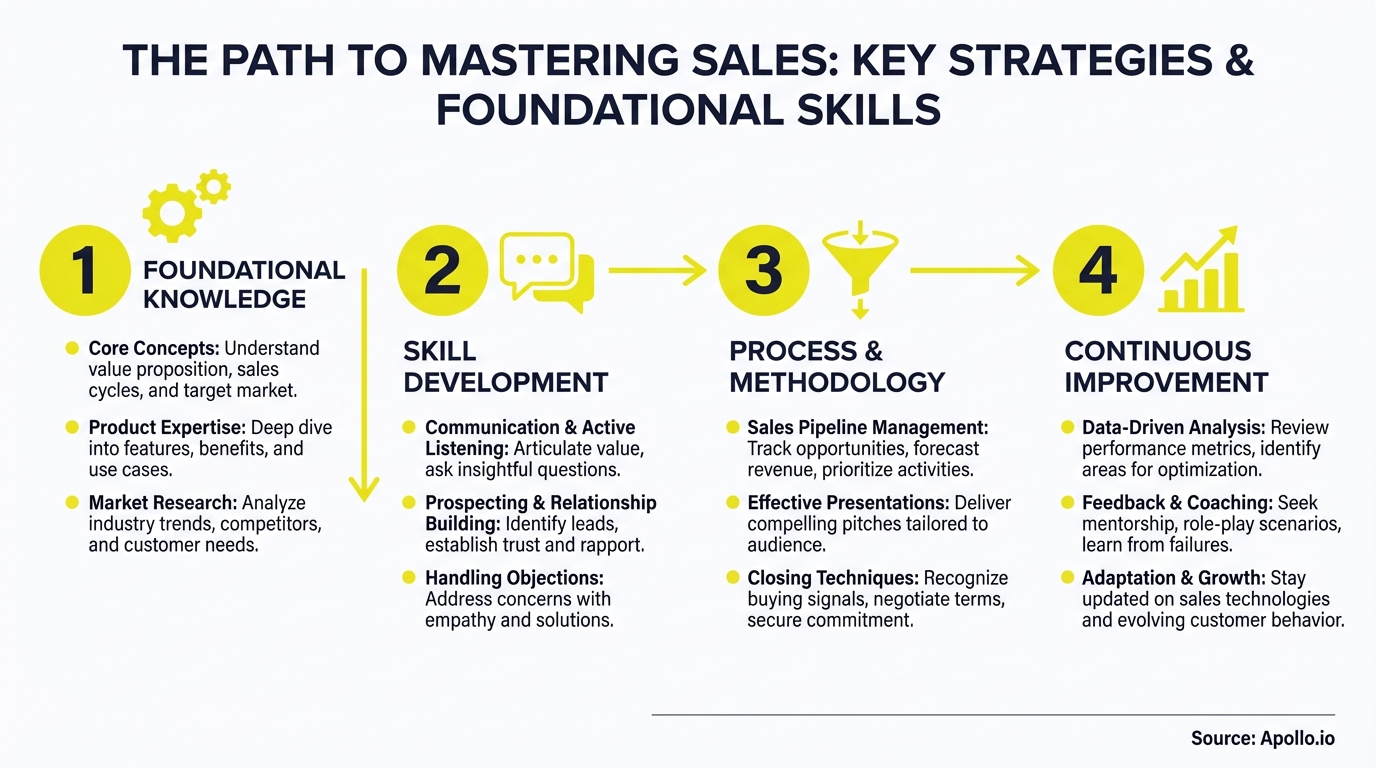
Individual effort gets you to average. A system gets you to consistent top performance. A scalable learning sales system has four components:
- A defined skills framework: Map the specific competencies needed at each role and stage (prospecting, discovery, negotiation, close).
- A content library with governance: Centralize playbooks, call recordings, and training materials in one place. Inconsistent messaging is a real problem: 69% of B2B buyers report inconsistencies between what they see on a company's website and what sellers tell them.
- Measurement tied to pipeline: Track the right sales KPIs to connect learning activity to revenue outcomes, not just course completion rates.
- A tech stack that enables learning in context: Reps learn fastest when coaching is embedded in the tools they use daily.
RevOps leaders building these systems should also explore how to build a sales tech stack that scales without creating fragmentation across too many platforms. As Cyera noted, "Having everything in one system was a game changer."
Want to put your learning into practice immediately? Build a qualified pipeline with Apollo's AI-powered prospecting tools and apply what you're learning in real conversations from day one.

What Sales Skills Matter Most in 2026?
The buyer environment has fundamentally changed. A Gartner summary by HiFuture Consulting notes that 80% of all B2B sales interactions are expected to take place in the digital world. Reps who cannot operate effectively across digital channels are structurally disadvantaged.
The skills with the highest leverage in 2026:
- Relevance and personalization: Generic outreach actively drives buyers away. The ability to craft relevant, persona-specific messaging is now a baseline requirement.
- Digital fluency: Understanding how buyers self-educate before engaging a rep, and meeting them with the right content at the right moment.
- Multi-channel execution: Coordinating email, phone, and social outreach in sequenced, coherent campaigns rather than isolated touches.
- Data interpretation: Using sales analytics to identify what is working and iterate quickly.
- AI tool proficiency: Leveraging AI sales tools for research, messaging, and call prep without losing the human judgment that closes deals.
Start Learning Sales with the Right Foundation
Learning sales is a compounding skill. The reps who invest consistently in structured practice, peer review, and data-driven iteration outperform those who rely on instinct alone.
Start with the fundamentals: master your ICP, sharpen your discovery questions, and build outreach habits that create consistent pipeline.
Apollo gives B2B GTM teams a single platform to prospect, engage, and close without stitching together five separate tools. Over 2 million users rely on Apollo to put their sales learning into practice every day. Start Prospecting with Apollo for free and apply everything you've learned in real pipeline, starting today.
Prove Pipeline ROI Before Next QBR
ROI pressure killing your tool budget? Apollo delivers measurable pipeline impact fast — Leadium 3x'd annual revenue after switching. Start your free trial and show leadership real numbers, not projections.
Start Your Free Trial →Don't miss these
Sales
Inbound vs Outbound Marketing: Which Strategy Wins?
Sales
What Is a Sales Funnel? The Non-Linear Revenue Framework for 2026
Sales
What Is a Go-to-Market Strategy? The 2026 GTM Playbook
See Apollo in action
We'd love to show how Apollo can help you sell better.
By submitting this form, you will receive information, tips, and promotions from Apollo. To learn more, see our Privacy Statement.
4.7/5 based on 9,690 reviews
