
Sales KPIs That Actually Drive Revenue Growth in 2026
Sales leaders tracking the wrong KPIs waste time on vanity metrics while revenue stalls. In 2026, CFOs demand proof that sales activity translates to efficient growth. Modern sales KPIs measure pipeline velocity, win rates, and revenue efficiency instead of call volume or email opens.

Get Verified Contacts Instantly With Apollo
Tired of spending 4+ hours daily hunting for contact info? Apollo delivers 224M verified contacts with 96% email accuracy. Join 550K+ companies closing deals faster.
Start Free with Apollo →Key Takeaways
- Track revenue efficiency KPIs (CAC payback, win rate, pipeline velocity) instead of activity metrics
- Align sales and marketing KPIs to prevent the 10% revenue loss from misalignment
- Monitor buyer-group coverage and deal progression to reduce the 86% of stalled B2B purchases
- Use AI-driven forecasting KPIs to improve accuracy and deal risk visibility
- Consolidate tech stacks to track KPIs in one platform and cut costs by half
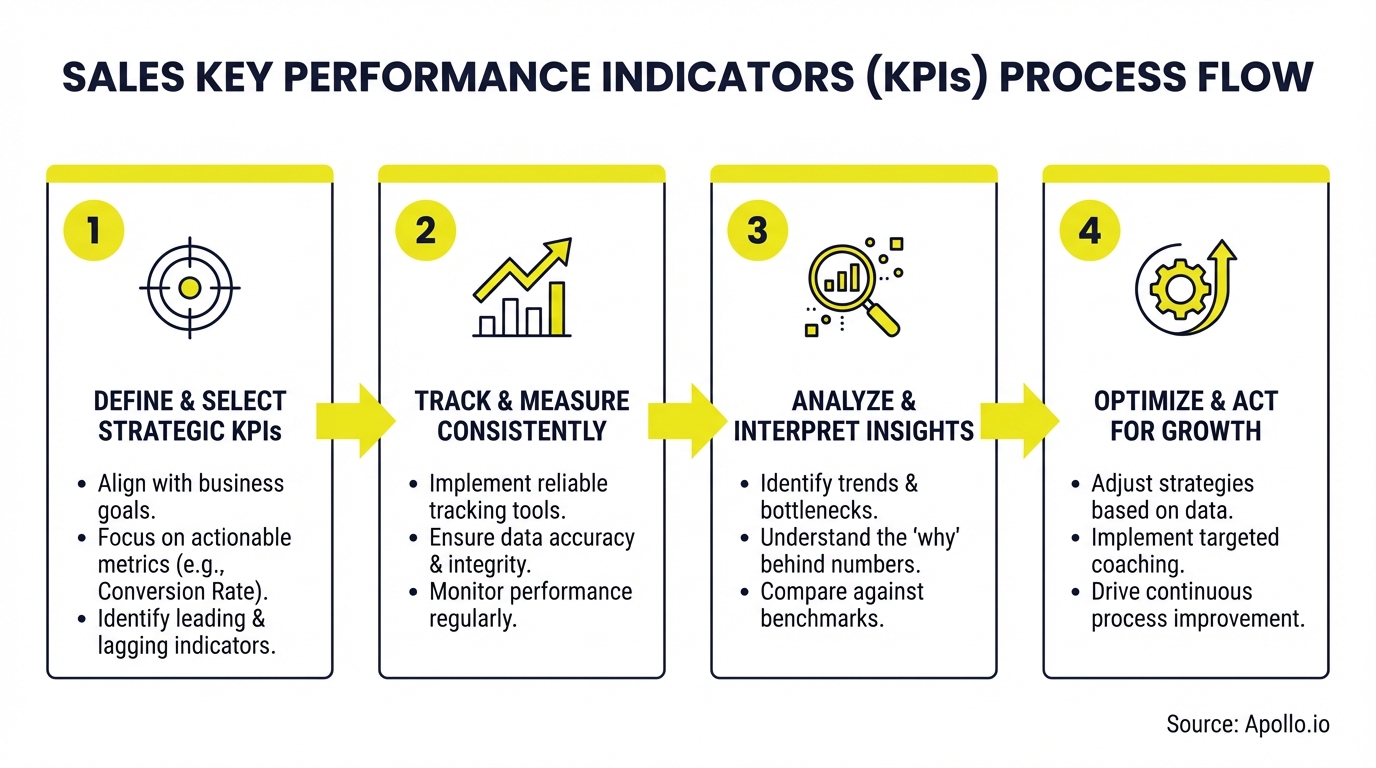
What Are KPIs for Sales?
KPIs for sales are measurable metrics that track performance against revenue goals. They show whether your team generates pipeline efficiently, converts opportunities, and closes deals profitably.
In 2026, effective KPIs connect daily activities to board-level outcomes like CAC payback and ARR growth.
Modern sales KPIs fall into three categories: input metrics (activities), throughput metrics (conversion rates and velocity), and output metrics (revenue and efficiency). Sales performance management frameworks prioritize output and throughput KPIs because they predict revenue, while input KPIs alone create false confidence.
Why Do Sales Teams Need Revenue Efficiency KPIs in 2026?
Finance teams now scrutinize every dollar spent on go-to-market. Flat marketing budgets and rising acquisition costs force sales leaders to prove efficient growth. According to Brightlark, misaligned teams can lead to a 10% loss in sales revenue annually.
Revenue efficiency KPIs answer the CFO's core question: are we spending less to generate more? Key metrics include:
- CAC Payback Period: Months to recover customer acquisition cost
- LTV:CAC Ratio: Customer lifetime value divided by acquisition cost (target 3:1 or higher)
- ARR per Sales Rep: Annual recurring revenue generated per full-time rep
- Pipeline Coverage: Pipeline value divided by quota (target 3-4x for healthy forecasting)
Struggling to track pipeline health across fragmented tools? Apollo's deal management consolidates pipeline visibility in one workspace, eliminating the need for separate CRM plugins and analytics platforms.
What Sales KPIs Should SDRs and AEs Track?
SDRs and AEs require role-specific KPIs that drive accountability without micromanagement. Research from Martal shows the average B2B win rate is approximately 20%, with top performers reaching 30% or more.
SDR Performance KPIs
- Qualified Meetings Booked: Meetings accepted by AEs (not just scheduled)
- Meeting-to-Opportunity Conversion: Percentage of meetings advancing to pipeline
- Target Account Coverage: Percentage of ICP accounts contacted with multi-threading
- Speed to Lead: Time from lead assignment to first meaningful contact
AE Performance KPIs
- Win Rate by Stage: Conversion percentages at each pipeline stage
- Average Deal Size: Revenue per closed deal
- Sales Cycle Length: Days from opportunity creation to close
- Forecast Accuracy: Percentage of forecasted deals that close on time
For Account Executives managing complex deals, tracking buyer-group engagement is critical. Data from Sales Engine reveals the average number of individuals involved in complex B2B purchasing decisions is now 6 to 10 people.
Turn Forecast Guesswork Into Revenue Certainty
Pipeline forecasting a guessing game? Apollo delivers real-time deal visibility and lead scoring so you can predict revenue with confidence. Built-In boosted win rates 10% using Apollo's intelligence.
Start Free with Apollo →How Do Sales Leaders Measure Pipeline Velocity?
Pipeline velocity measures how quickly deals move through your funnel and convert to revenue. The formula: (Number of Opportunities × Average Deal Value × Win Rate) ÷ Sales Cycle Length.
Improving any variable accelerates velocity.
Sales leaders should track velocity by segment, rep, and channel to identify bottlenecks. Sales analytics platforms reveal where deals stall and which activities correlate with faster progression. Key velocity indicators include:
| Velocity Metric | What It Measures | Target Benchmark |
|---|---|---|
| Stage Conversion Time | Days spent in each pipeline stage | Discovery: 7-14 days, Demo: 10-15 days |
| Deal Progression Rate | Percentage of deals advancing weekly | 60-70% of active opps progress monthly |
| Stall Recovery Time | Days to re-engage stalled opportunities | Under 5 days for priority deals |
Can't see which deals are actually progressing? Apollo's go-to-market platform tracks engagement signals and next-step completion rates, giving RevOps leaders real-time visibility into deal health without manual reporting.

Why Is Sales and Marketing Alignment a Critical KPI?
Alignment between sales and marketing directly impacts close rates and revenue efficiency. According to JiffleNow, businesses with aligned sales and marketing teams are 67% more efficient at closing deals.
Track these alignment KPIs monthly:
- MQL-to-SQL Conversion Rate: Percentage of marketing qualified leads accepted by sales
- Lead Response Time: Minutes from MQL assignment to first sales contact
- Content-Influenced Pipeline: Opportunities touched by marketing content before close
- Closed-Loop Feedback Rate: Percentage of leads with sales disposition recorded
Sales leaders should establish SLAs for lead follow-up and feedback. Marketing needs disposition data (not qualified, bad timing, competitor, closed-won) to optimize targeting. Sales performance management systems automate closed-loop reporting and surface which campaigns drive qualified pipeline.
How Should RevOps Leaders Track Multi-Channel Attribution?
Buyers engage across email, phone, social, and self-serve channels before purchasing. RevOps teams must track which channels assist deals and where to invest.
Single-touch attribution (first or last touch) misrepresents the buyer journey.
Implement multi-touch attribution models that credit all meaningful interactions:
- W-Shaped Attribution: Credits first touch (30%), lead conversion (30%), opportunity creation (30%), and mid-touches (10%)
- Time Decay: Credits recent interactions more heavily than early touches
- Custom Algorithmic: Machine learning assigns credit based on historical conversion patterns
Track channel-level KPIs including cost per opportunity, opportunity-to-close rate, average deal size, and sales cycle length by source. This reveals which channels drive efficient pipeline versus vanity traffic. Consolidated sales tech stacks eliminate attribution gaps caused by disconnected tools.
What AI-Driven Sales KPIs Matter in 2026?
AI tools introduce new operational KPIs around forecast accuracy, conversation quality, and automation effectiveness. Sales teams using AI-powered platforms track metrics that were impossible to measure manually.
Critical AI-influenced KPIs include:
- AI Forecast Accuracy: Predicted close rate versus actual outcomes (target 90%+ accuracy)
- Conversation Intelligence Score: Talk-to-listen ratio, objection handling, next-step commitment rates
- AI-Assisted Win Rate: Close rate for deals with AI-generated insights versus baseline
- Automation Coverage: Percentage of outreach and follow-up handled by sequences
For sales leaders managing distributed teams, AI-driven KPIs provide coaching visibility without listening to every call. Apollo for Sales Leaders surfaces performance patterns and recommends interventions based on activity and outcome data.

Start Tracking Revenue-Focused Sales KPIs Today
Sales KPIs in 2026 measure revenue efficiency, pipeline velocity, and buyer-group engagement instead of activity volume. Track metrics that connect to CFO-level outcomes: CAC payback, win rates, and forecast accuracy.
Align sales and marketing KPIs to prevent revenue leakage and improve close rates by up to 67%.
RevOps leaders should consolidate KPI tracking into unified platforms that eliminate manual reporting and attribution gaps. Teams using all-in-one systems report significant time savings and clearer visibility into what drives revenue.
Ready to track pipeline KPIs without juggling three separate tools? Get leads now with Apollo's unified sales platform and start measuring the metrics that matter.
Prove Apollo's ROI In Your First 30 Days
Budget approval stuck on unclear metrics? Apollo tracks every touch to closed revenue so you can justify spend with real pipeline data. Built-In increased win rates 10% and ACV 10% using Apollo's intelligence.
Start Free with Apollo →Don't miss these
Sales
Inbound vs Outbound Marketing: Which Strategy Wins?
Sales
What Is a Sales Funnel? The Non-Linear Revenue Framework for 2026
Sales
What Is a Go-to-Market Strategy? The 2026 GTM Playbook
See Apollo in action
We'd love to show how Apollo can help you sell better.
By submitting this form, you will receive information, tips, and promotions from Apollo. To learn more, see our Privacy Statement.
4.7/5 based on 9,690 reviews
