
What Is Internal Sales? Strategy, Enablement, and Execution in 2026
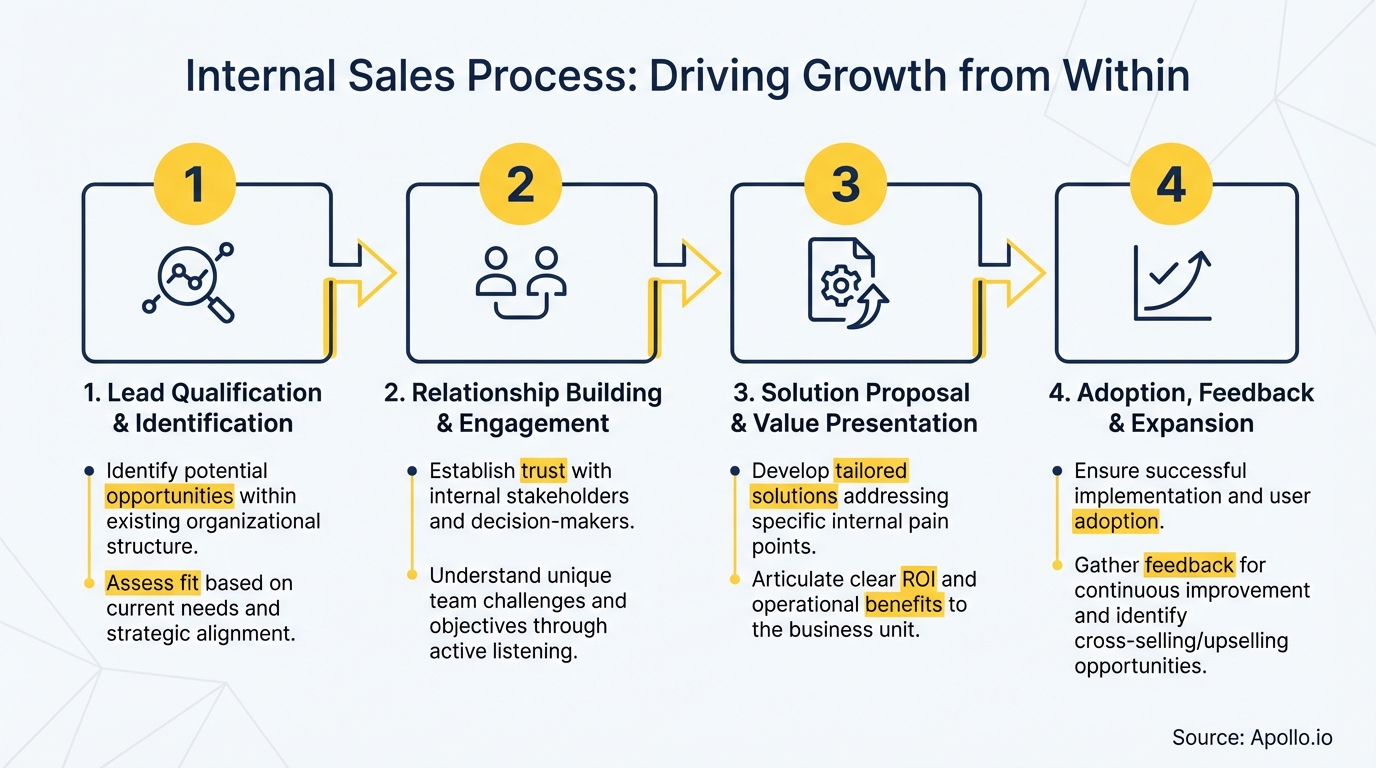
Internal sales refers to the people, processes, content, and tools that power a sales team from the inside out. It covers how reps find and qualify leads, how enablement content gets built and distributed, and how deals move from first touch to close. As buyers increasingly self-educate before ever speaking to a rep, your internal sales system determines whether your team adds value fast enough to win. Learn how sales analytics drives revenue growth when your internal foundation is solid.

Scale Smarter With Apollo's GTM Engine
Tired of manual research eating your selling time? Apollo standardizes your team's outreach with verified contacts and scalable playbooks. Join 550K+ companies building predictable pipeline from day one.
Start Free with Apollo →Key Takeaways
- Internal sales combines your people, processes, content, and tools into a system that closes deals faster.
- Most sales content goes unused because it lacks governance, findability, and channel-ready packaging.
- Deal-stall playbooks mapped to specific objections unblock mid-funnel progression more reliably than top-of-funnel volume.
- Sales and marketing alignment is a revenue multiplier: organizations with strong alignment achieve 208% higher marketing revenue.
- Apollo consolidates prospecting, engagement, and pipeline management into one workspace, cutting tech stack complexity.
What Is Internal Sales and How Does It Differ from Inside Sales?
Internal sales is often confused with inside sales, but they are distinct concepts. Inside sales describes a selling model where reps work remotely rather than in the field. Internal sales describes the operational system supporting those reps: the enablement content, workflows, data, and governance that make selling possible from the inside of an organization.
Internal sales is not just a library of slide decks. It is the end-to-end infrastructure that equips reps with the right message, for the right buyer, at the right stage. According to marketingltb.com, 93% of B2B buying processes begin with online research, meaning buyers arrive informed and reps must add immediate, specific value.
| Concept | What It Describes |
|---|---|
| Inside Sales | A remote-first selling model (vs. field sales) |
| Internal Sales | The enablement system, content, and workflows supporting the team |
| Sales Enablement | A subset of internal sales focused on content and training |
Why Is Internal Sales Alignment So Critical in 2026?
Misalignment between sales and marketing is the single biggest drag on internal sales performance. Brainstorm Club reports that organizations with strong sales and marketing alignment achieve 208% higher marketing revenue than those with poor alignment. Yet most teams still operate in silos where marketing creates content that reps never use.
The fix is not more content. It is governed, packaged content that reps can find and deploy in seconds.
Every asset should include four components: a talk track, a proof point, an email snippet, and a slide version. This packaging standard ensures content is channel-ready from the moment it is published.
Struggling to keep your pipeline moving while reps spend time hunting for the right asset? Apollo's deal management tools give your team complete pipeline visibility in one workspace.
How Do SDRs and AEs Use Internal Sales Content to Close More Deals?
SDRs depend on internal sales content to book meetings faster. When talk tracks, objection-handling frameworks, and email snippets are pre-built and easy to find, SDRs spend less time creating and more time selling. Sales Odyssey reports that only 33% of salespeople's time is actually devoted to selling. Reducing content search time directly converts to more selling hours.
For Account Executives managing complex deals, internal sales content must go deeper.
AEs need stage-specific assets: business case templates for economic buyers, security questionnaire responses for IT stakeholders, and ROI calculators for CFOs.
Explore how to handle sales objections in 2026 with structured internal playbooks.
- SDRs: Pre-written email snippets, cold call scripts, objection responses
- AEs: Business case decks, ROI models, stakeholder-specific proof points
- RevOps: Content attribution dashboards, asset lifecycle governance
- Sales Leaders: Coaching guides, deal-review frameworks, forecast inputs
Turn Weak Leads Into Pipeline That Closes
Tired of marketing leads that never become real opportunities? Apollo surfaces in-market buyers with verified contact data so your team stops guessing and starts closing. Join 90K paying customers building predictable pipeline.
Start Free with Apollo →What Is a Deal-Stall Content Map and Why Does It Matter?
A deal-stall content map assigns specific assets to specific reasons a deal stops moving. Most enablement programs focus on top-of-funnel content, but inside sales teams at high-performing organizations know that mid-funnel is where revenue is lost. Matching the right asset to the right stall reason is what unblocks progression.
| Stall Reason | Asset to Deploy | Channel |
|---|---|---|
| Security concern | Security FAQ + compliance one-pager | Email + call |
| Budget freeze | ROI calculator + CFO executive summary | |
| Implementation fear | Step-by-step onboarding timeline | Slide deck + email |
| Stakeholder disagreement | Consensus-building guide + case study | Email + social |
| Competitor evaluation | Differentiation one-pager + customer reference | Call + email |
Build each kit as a modular account package. For ABM motions, add department-specific versions: a CFO pack, an IT pack, and a champion enablement pack. See how enterprise sales teams build multi-stakeholder access strategies that move complex deals forward.

How Should Sales Teams Measure Internal Sales Content Performance?
Content that cannot be measured cannot be improved. Internal sales programs need three measurement layers: usage (was the asset opened?), influence (did the deal advance after the asset was sent?), and impact (did the deal close at a higher rate with this asset?). Tracking the right sales KPIs in 2026 starts with connecting content activity to pipeline outcomes.
RevOps leaders find that tagging assets with deal stage and buyer persona creates the data needed for attribution modeling. Start with a simple governance checklist:
- Is the asset tagged by stage, persona, and stall reason?
- Does it include a talk track, email snippet, proof point, and slide version?
- Is there a review date assigned to prevent stale content from circulating?
- Is usage tracked in your CRM or sales engagement platform?
For Founders building their first outbound motion, consolidating prospecting, engagement, and tracking into one platform eliminates the attribution gaps that come from stitching together five separate tools. As Cyera put it, "Having everything in one system was a game changer."
Spending too much time stitching together tools instead of selling? Apollo's multi-channel sales engagement platform automates sequences and tracks every touchpoint in one place.
How Does Digital Channel Dominance Change Internal Sales in 2026?
Internal sales content must be built for digital-first delivery. According to BookYourData, 80% of B2B sales interactions between suppliers and buyers now occur through digital channels. Every asset in your internal sales library needs a digital-ready format: a version that works in email, a version that works in a video call, and a version that works asynchronously.
The shift also means reps must enter buyer conversations later and add value faster. Internal sales content is no longer a nice-to-have backup. It is the primary tool that determines whether a rep can compete in a buyer's already-formed consideration set. Pair strong content with sales productivity strategies that maximize the time reps spend on high-value interactions.

How Do You Build an Internal Sales System That Scales?
A scalable internal sales system combines governed content, channel-ready packaging, and a single platform where reps can find, deploy, and track everything. The goal is to reduce the time between "I need an asset" and "the asset is in the buyer's hands" to under two minutes.
Key components of a scalable system:
- Content governance: Taxonomy, ownership, and review cycles for every asset
- Standard packaging: Every asset ships with a talk track, email snippet, proof point, and slide
- Deal-stall playbooks: Pre-mapped asset kits for the five most common stall reasons
- ABM account kits: Persona-specific packages for CFO, IT, champion, and end-user buyers
- Attribution tracking: CRM-tagged distribution with stage and persona metadata
- Unified platform: One workspace for prospecting, engagement, and pipeline tracking
Teams that consolidate their sales tech stack report faster ramp times and fewer attribution blind spots. As Predictable Revenue noted, "We reduced the complexity of three tools into one." Review how to build a sales tech stack that scales revenue without adding complexity.
Start Building a Stronger Internal Sales System Today
Internal sales is the operational foundation that separates teams that consistently hit quota from those that scramble. Governed content, deal-stall playbooks, and channel-ready asset packaging are not advanced tactics reserved for enterprise teams.
They are the baseline for any team that wants to compete in a digital-first, buyer-led market.
Apollo gives SDRs, AEs, RevOps, and Sales Leaders a unified workspace for prospecting, multi-channel engagement, pipeline tracking, and deal management. No more hunting across five tools to find the right contact, send the right message, and log the right activity. Request a Demo and see how Apollo consolidates your internal sales infrastructure into one platform that scales with your team.
Prove Pipeline ROI With Apollo
Budget approval stuck on unclear metrics? Apollo gives sales teams the pipeline visibility and performance data leaders need to justify every dollar. Leadium 3x'd their annual revenue after making the switch.
Start Free with Apollo →Don't miss these
Sales
Inbound vs Outbound Marketing: Which Strategy Wins?
Sales
What Is a Sales Funnel? The Non-Linear Revenue Framework for 2026
Sales
What Is a Go-to-Market Strategy? The 2026 GTM Playbook
See Apollo in action
We'd love to show how Apollo can help you sell better.
By submitting this form, you will receive information, tips, and promotions from Apollo. To learn more, see our Privacy Statement.
4.7/5 based on 9,690 reviews
