
How to Verify Contact Information Before Outreach in 2026
Sending outreach to stale, inaccurate contacts wastes rep time, damages sender reputation, and signals poor intent to prospects. According to ContactInfo.com, email lists decay at 28% per year, meaning more than one in four addresses on an unverified list goes cold every twelve months. Before your first touchpoint lands, you need a systematic process to confirm every contact is real, reachable, and relevant. This guide shows you exactly how to verify email addresses for B2B sales and build a governance-driven verification workflow that protects pipeline.

Get Verified Contacts, Skip the Research
Tired of burning hours verifying emails that bounce and numbers that go nowhere? Apollo delivers 230M+ verified business contacts with 97% email accuracy. Start building pipeline, not spreadsheets.
Start Free with Apollo →Key Takeaways
- B2B contact data decays rapidly, making pre-outreach verification a revenue protection requirement, not optional hygiene.
- Verification covers four layers: email validity, role and company match, sender authentication, and suppression compliance.
- SDRs and RevOps teams who gate sequences behind verification spend less time on dead-end contacts and more time on qualified conversations.
- Poor data quality carries a significant financial cost per organization annually, making a verification stack one of the highest-ROI investments in your GTM motion.
- Platforms that surface verification confidence signals (verified, guessed, unverified) let reps prioritize outreach without manual cross-checks.
Why Is Contact Verification So Critical Before Outreach?
Contact verification is critical because unverified data directly causes bounces, sender score damage, and wasted pipeline capacity. Research from Landbase shows B2B contact data decays at rates between 22.5% and 70.3% annually depending on industry and role churn. High-turnover segments like SDR and BDR roles drift fastest, while VP and C-suite contacts at stable companies drift more slowly.
The financial stakes are concrete. Data from Datamatica indicates poor data quality costs U.S. businesses an estimated $3.1 trillion annually, and individual organizations lose an average of $12.9 million to $15 million per year. For RevOps leaders building pipeline reliability, that number alone justifies a structured verification SLA. Verification also reduces impersonation risk: with fraud losses rising and inbox providers tightening authentication requirements, prospects are increasingly skeptical of outreach from unrecognized senders.
What Are the Four Layers of Contact Verification?
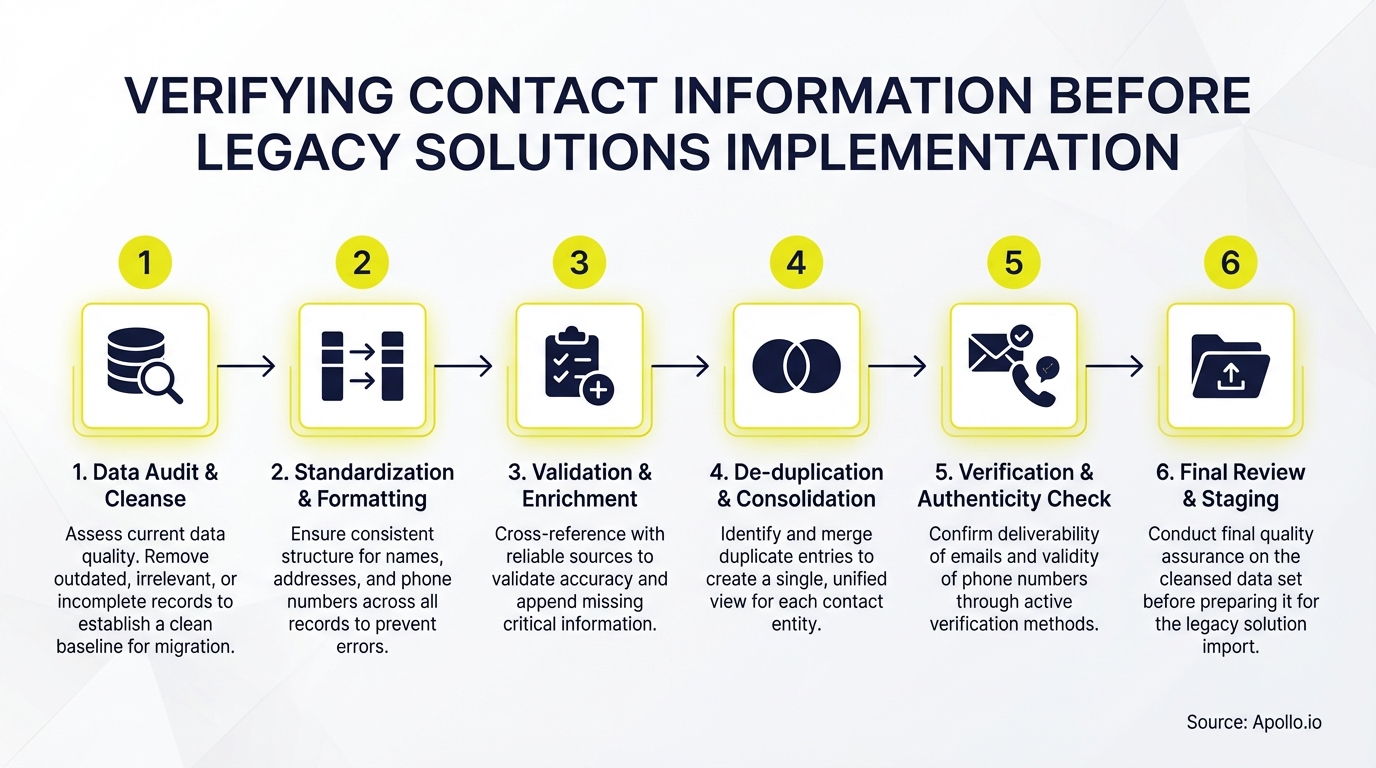
Complete contact verification covers four sequential layers, each filtering a different category of risk before a contact enters your sequence.
| Layer | What It Checks | Risk It Eliminates |
|---|---|---|
| 1. Email Validity | Syntax, domain MX records, SMTP response | Hard bounces, inbox damage |
| 2. Role and Company Match | Current title, active employment, correct domain | Wasted outreach to departed contacts |
| 3. Sender Authentication | SPF, DKIM, DMARC on your sending domain | Deliverability failures, spam folder placement |
| 4. Suppression and Compliance | Opt-out lists, DNC registries, consent records | Regulatory exposure, complaint rates |
Skipping any layer creates a gap. Many teams verify email syntax but miss role changes, then send a well-crafted sequence to someone who left the company three months ago. Microsoft's bulk-sender authentication enforcement (effective May 5, 2025) made Layer 3 non-negotiable for teams reaching Outlook and Hotmail inboxes. Teams that treat all four layers as a unified gate before sequence enrollment see materially lower bounce rates and stronger reply rates. Learn more about how contact data enrichment drives ROI across the full verification stack.
How Do SDRs Verify Contacts Without Slowing Down Prospecting?
SDRs verify contacts efficiently by building verification directly into their prospecting workflow rather than treating it as a separate manual step. The goal is a sequencing gate: a contact must pass validation checks before it can be enrolled, not after bounces accumulate.
Practical SDR verification checklist:
- Use a database with confidence signals. Look for platforms that label contacts as verified, guessed, or unverified so you can filter before you export. Apollo displays email verification status directly in search results, letting SDRs prioritize verified contacts at scale.
- Cross-reference role and company. Confirm the prospect's title and employer match your ICP using a professional network profile or enrichment data before personalizing outreach.
- Check for recent job changes. Contacts who changed roles in the last 90 days often have stale email addresses. Flag these for re-verification or phone-first outreach.
- Run SMTP validation on imported lists. Any list not sourced from a live-verified database should pass through an SMTP validator before entering your CRM.
Struggling to find contacts that are verified before you even search? Search Apollo's 230M+ verified contacts with 65+ filters and skip the manual verification step entirely.

How Often Should RevOps Teams Re-Verify Contact Data?
RevOps teams should re-verify contact data on a cadence matched to the turnover risk of each ICP segment, not on a single annual schedule. Data from RevenueBase shows email decay accelerated to 3.6% in a single month as of November 2024, meaning a 90-day-old list can carry meaningful stale contact volume before you realize it.
| Segment | Turnover Risk | Recommended Re-Verify Cadence |
|---|---|---|
| SDR / BDR roles | Very High | Every 30 days |
| Director / VP | Medium | Every 60–90 days |
| C-Suite at established companies | Lower | Every 90–180 days |
| SMB founders (high churn environments) | High | Every 45 days |
RevOps leaders should set SLAs that require any contact inactive for more than 90 days to be re-enriched before sequence re-enrollment. Automating this via contact enrichment tools prevents CRM drift without requiring manual review cycles. For a deeper look at building a CRM-to-pipeline reliability framework, see what Revenue Operations is and how it drives growth.
Turn Weak Leads Into Pipeline With Apollo
Pipeline forecasting a guessing game because marketing leads never convert? Apollo surfaces in-market buyers with precision targeting so your team stops chasing dead ends. Join 600K+ companies building predictable revenue.
Start Free with Apollo →What Trust Signals Should You Include in Outreach?
Trust signals in outreach are verification artifacts that confirm your identity and legitimacy to a skeptical prospect. With fraud losses rising sharply and recipients increasingly wary of unsolicited messages, accurate details in your first touchpoint are a conversion factor, not just courtesy.
Include these legitimacy markers in every outreach:
- Correct title and company in your signature. Mismatched details are an immediate credibility flag.
- Domain-aligned sending address. Sending from a personal Gmail or mismatched subdomain raises suspicion. Your from-domain should match your company website.
- Accurate prospect details in the body. Reference the prospect's actual current role and company, not outdated information from a stale record.
- Clear unsubscribe path. Required for bulk senders under current provider rules and a signal of legitimate sender behavior.
These signals matter even more in finance and procurement outreach, where stakeholders are trained to spot impersonation attempts. For a practical look at finding verified business contacts before crafting your first message, Apollo's email finder surfaces confidence-rated contacts so your outreach reflects accurate, current information from the start.
How Can AEs and RevOps Build a Verification Stack That Scales?
A scalable verification stack combines a live-verified contact database, enrichment automation, and sequencing gates into a single governance framework. Account Executives and RevOps leaders who rely on point-in-time lists without re-verification automation inevitably see pipeline reliability degrade over time.
Core stack components:
- Primary database: A platform that labels contact verification status and refreshes records continuously (not just at import).
- Enrichment layer: Automated re-enrichment triggered by CRM inactivity thresholds or job-change signals.
- Sequence gate: A workflow rule that blocks enrollment for any contact without a verified email and current role match.
- Suppression sync: Opt-out and DNC lists synced to your CRM and engagement platform in real time.
Apollo consolidates this stack into one platform: prospecting, contact data enrichment, multi-channel engagement, and workflow automation all operate from the same verified contact database. As Cyera put it, "Having everything in one system was a game changer." For teams evaluating how to build this infrastructure, this sales tech stack playbook covers architecture decisions from data to engagement. Tired of managing separate tools for verification, enrichment, and outreach? Start free with Apollo's verified B2B contact database and consolidate your stack.

Start Verifying Before You Prospect, Not After You Bounce
Contact verification is a revenue protection system. The teams winning in 2026 treat it as a sequencing gate, not an afterthought.
Verify email validity, confirm current role and company, authenticate your sending domain, and maintain suppression compliance before any contact enters a sequence.
Apollo brings verification, enrichment, and engagement into one unified platform, so SDRs, AEs, and RevOps teams spend less time chasing stale data and more time running conversations that close. Schedule a Demo and see how Apollo's verification-first approach protects your pipeline from the first search to the final send.
Prove ROI Before Budget Asks You To
ROI pressure killing your tool adoption? Apollo delivers measurable pipeline impact from day one — so you walk into budget reviews with results, not promises. Leadium 3x'd revenue. You're next.
Start Free with Apollo →Don't miss these
Revenue Operations
Top Market Intelligence Tools for B2B Teams in 2026
Revenue Operations
Sales Operations Analyst Salary: 2026 Compensation Guide and Benchmarks
Revenue Operations
Sales Compensation Software: How to Automate Commission Management
See Apollo in action
We'd love to show how Apollo can help you sell better.
By submitting this form, you will receive information, tips, and promotions from Apollo. To learn more, see our Privacy Statement.
4.7/5 based on 9,690 reviews
