
How to Use Sales Automation to Schedule Follow-Up Reminders
Most B2B sales reps know they should follow up. They just don't do it consistently. According to Martal, 80% of B2B deals require five or more follow-ups to close, yet 92% of reps stop after four or fewer attempts. The gap isn't effort — it's the absence of a system. Sales automation closes that gap by converting follow-up intent into scheduled, triggered actions that run without relying on memory or manual discipline.

Build Pipeline, Not Spreadsheets
Tired of burning hours on manual research instead of closing deals? Apollo surfaces verified contacts and scales your outreach automatically. Join 600K+ companies generating predictable pipeline.
Start Free with Apollo →Key Takeaways
- Follow-up reminders should be triggered by buyer signals and SLA deadlines, not fixed "Day 3/Day 7" cadences alone.
- CRM data quality is the foundation: dirty or incomplete fields break reminder triggers before automation even runs.
- Escalation logic matters as much as the initial reminder — unresponsive leads need automatic reassignment, not just another notification.
- SDRs and RevOps teams both benefit from automated reminders, but for different reasons: SDRs gain response speed, RevOps gains SLA compliance visibility.
- The shift from rule-based reminders to AI-powered next-best-action workflows is already underway — teams that adapt now will have a structural advantage.
Why Does Follow-Up Automation Matter in 2026?
Follow-up automation matters because manual follow-up fails at scale, and the cost of inaction is measurable. Kixie reports that 38% of reps fail to follow up after the initial contact at all. Meanwhile, Salesforce's 2026 State of Sales found 54% of sales teams already use AI agents, with follow-up and prospecting among the highest-adoption use cases.
The business case is straightforward: buyers research independently, buying committees average 13 stakeholders, and deals stall constantly. Automated reminders keep deals moving without adding to rep workload. As sales automation software has matured, scheduling follow-up reminders has evolved from a CRM task feature into a full workflow layer with escalation, SLA tracking, and AI-generated next steps.
What Is the Workflow Blueprint for Automated Follow-Up Reminders?
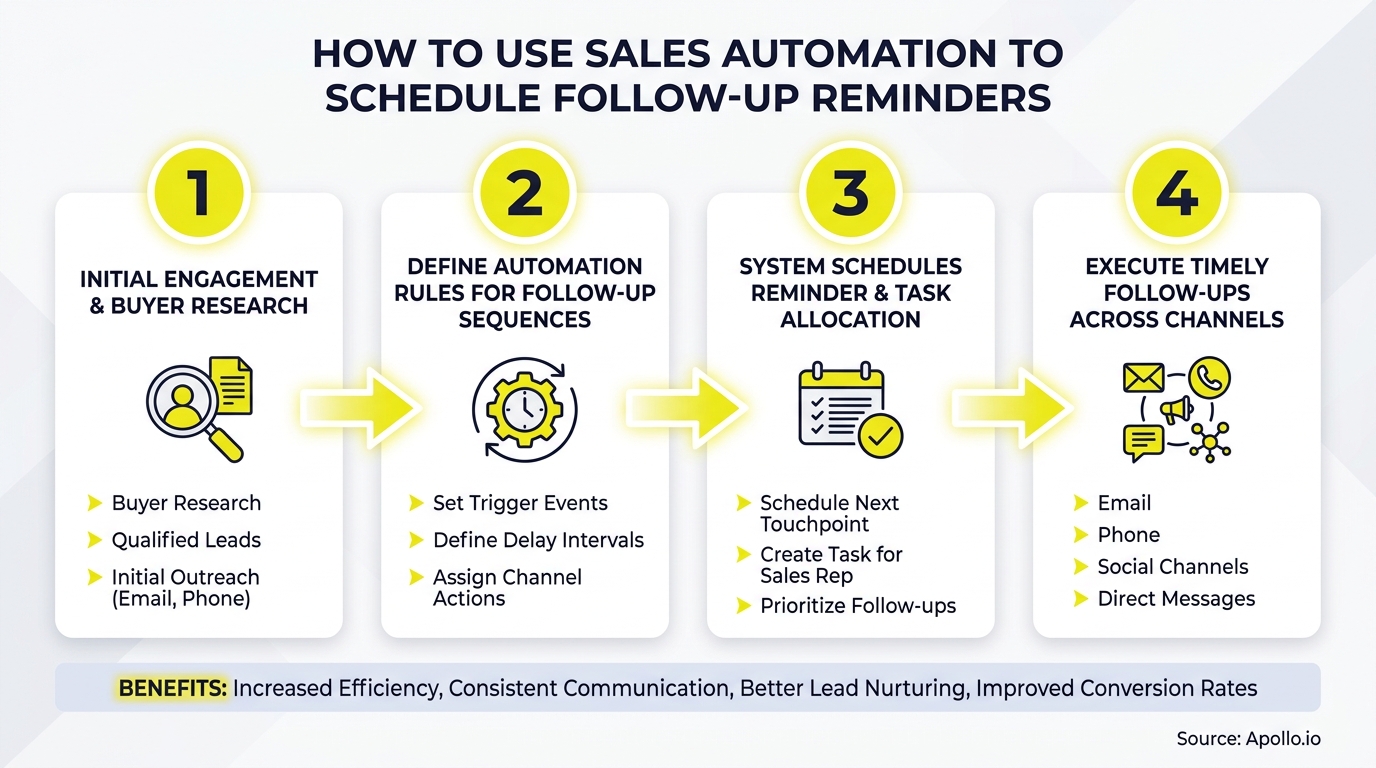
An effective follow-up reminder system has five stages: trigger event, ownership routing, reminder schedule, escalation logic, and measurement.
| Stage | What Happens | Example |
|---|---|---|
| Trigger Event | A buyer action or inactivity threshold fires the workflow | Demo request submitted, pricing page visited, 3-day no-reply |
| Ownership Routing | Lead is assigned to the right rep automatically | Territory-based routing, round-robin, or account owner |
| Reminder Schedule | Tasks and notifications are created with due times | "Call within 1 hour," "Email by EOD," "Check in Day 5" |
| Escalation Logic | Overdue tasks trigger manager alerts or reassignment | No action in 4 hours → Slack alert; 24 hours → reassign |
| Measurement | SLA compliance, response rates, and next-step completion tracked | % of leads touched within SLA, task completion rate |
A sales professional wrote on Reddit that teams handling 50-plus weekly leads saw 40% better conversion when they introduced visual aging indicators (leads turn yellow at 4 hours, red at 24 hours) combined with daily 9am Slack digests showing only actionable items per rep. The lesson: staged rollout beats a complex system built all at once.
Spending hours on manual outreach and task-setting? Apollo's AI sales automation creates follow-up tasks and sequences automatically so reps focus on conversations, not calendar management.
What Should Your CRM Readiness Checklist Include Before Automating?
Reminder automation is only as reliable as the CRM data that triggers it. If fields are missing, stale, or inconsistently populated, your workflows will fire at the wrong time — or not at all.
Before building any reminder workflow, verify these fields are complete and standardized:
- Lead/contact owner: Every record must have an assigned rep. Unowned records can't route reminders.
- Lifecycle stage or lead status: Defines which workflow applies (new lead vs. open opportunity vs. stalled deal).
- Last activity date: The inactivity timer that triggers "no response" follow-up sequences.
- Next step and next step date: Enables task-based reminders tied to committed actions.
- SLA deadline field: A custom field marking when a response is required by.
- Duplicate records: Duplicate contacts create duplicate reminders and split activity history.
The data problem is widespread. A 2024 Validity survey of 631 CRM stakeholders found 68% struggle with incomplete data and 31% say poor data quality costs at least 20% of annual revenue. Fix your data foundation first, then automate on top of it. Apollo's CRM integration syncs contact and activity data in real time, keeping the fields that trigger reminders accurate and current.

How Do SDRs and RevOps Teams Use Follow-Up Reminder Automation Differently?
SDRs use follow-up reminders to hit response SLAs and stay in front of prospects; RevOps uses the same system to enforce accountability and track pipeline health.
For SDRs and BDRs: The priority is speed-to-lead. A reminder to call within the first hour of a demo request dramatically increases connect rates. Research from Peak Sales Recruiting shows a first follow-up email can result in a 220% surge in reply rates compared to the initial outreach. Automating that first follow-up task — and the second and third — removes the cognitive load of tracking every open thread. Building sequences in Apollo lets SDRs set this logic once and apply it across every new lead automatically.
For RevOps leaders: The value is SLA compliance reporting. Which reps are responding within the defined window? Which territories have the highest overdue-task rates? Which deal stages have the longest average inactivity gaps? Sales analytics tied to reminder workflows turns follow-up from a rep behavior into a measurable team metric.
Turn Weak Leads Into Pipeline Wins
Quota stress mounting because marketing leads never convert? Apollo surfaces in-market buyers with verified contact data so your team reaches the right person at right moment. 600K+ companies trust Apollo to fill their funnel with opportunities that close.
Start Free with Apollo →What Should You Automate vs. Keep Human-Owned?
Not every follow-up step should be fully automated. The goal is to automate the logistics so humans can focus on judgment-intensive conversations.
| Automate | Keep Human-Owned |
|---|---|
| Task creation after trigger events | Pricing discussions and contract negotiations |
| Reminder notifications (Slack, email, CRM) | Objection handling and stakeholder relationship-building |
| Lead aging alerts and SLA countdowns | Multi-stakeholder buying committee outreach strategy |
| Initial follow-up email drafts (AI-assisted) | Final message review and personalization for key accounts |
| Escalation routing for overdue tasks | Manager coaching conversations triggered by SLA misses |
A commenter added in a Reddit discussion that their organization uses territory-based routing first, but if a lead isn't touched within a defined window, it automatically opens to the rest of the team on a first-come, first-serve basis — with a 30-minute action timer before a lead goes to the floor. This escalation model keeps ownership clear without sacrificing response speed.
How Do You Handle Multi-Stakeholder Follow-Up Reminders for Stalled Deals?
Multi-stakeholder deals require reminder logic that tracks each contact's last touch date separately, not just the account-level activity.
When an average of 13 people are involved in a B2B purchase decision and 86% of deals stall at some point (per Forrester's 2024 research), a single follow-up task per account misses the complexity of the actual buying process. Build your reminder logic to:
- Create separate next-step tasks per key stakeholder (champion, economic buyer, technical reviewer)
- Trigger a stalled-deal alert when no contact at the account has been touched in 7+ days
- Escalate to the AE or manager when a deal has had no activity for 14+ days and is in a late pipeline stage
- Route a "re-engagement" sequence automatically when an opportunity crosses a defined inactivity threshold
Struggling to keep track of every deal and next step across a complex pipeline? Apollo's deal management tools give AEs complete pipeline visibility with automated next-step tracking so no stakeholder goes uncontacted.
How Should You Measure Follow-Up Reminder Performance?
Measure follow-up automation against SLA compliance rates, task completion rates, and pipeline velocity — not just email open rates.
Key metrics to track:
- SLA compliance rate: % of leads responded to within your defined window (e.g., 1 hour for inbound, 24 hours for outbound)
- Task completion rate by rep: Identifies who is working the system and who isn't
- Average response time: Trending down = the automation is working
- Pipeline stage velocity: Deals moving faster through stages signal effective follow-up cadences
- Escalation rate: High escalation frequency = reminder schedules need tightening or rep coaching is needed
Data from Freshworks shows businesses leveraging CRM systems find it saves employees 5-10 hours per week and shortens the average sales cycle by 8-14 days. Closed-loop reporting on reminder performance is what turns that time savings into a revenue outcome you can point to. Use Apollo's workflow engine to build automated sequences with built-in reporting so you can see exactly where follow-ups are succeeding or stalling.

Conclusion: Build the System, Then Let It Run
Automated follow-up reminders work when they are built on clean CRM data, governed by clear SLAs, and designed with escalation paths that protect response speed without overwhelming reps. The shift happening in 2026 is from static "Day 3/Day 7" task reminders to behavior-triggered, AI-assisted next-best-action workflows that surface the right follow-up at the right moment.
According to Overton Collective, 76% of companies already use some form of sales automation in their go-to-market strategies. The competitive edge now belongs to teams that automate intelligently — with SLA accountability, escalation logic, and measurement built in from the start.
Apollo consolidates prospecting, sequencing, follow-up automation, deal management, and CRM sync into one unified platform. As Cyera put it: "Having everything in one system was a game changer." Start your free trial and build your first automated follow-up workflow today.
Prove Pipeline ROI With Apollo
ROI pressure killing your tool budget approval? Apollo delivers measurable pipeline impact fast — so you walk into every budget review with hard numbers. Leadium 3x'd annual revenue. You're next.
Start Free with Apollo →Don't miss these
Sales
Inbound vs Outbound Marketing: Which Strategy Wins?
Sales
What Is a Sales Funnel? The Non-Linear Revenue Framework for 2026
Sales
What Is a Go-to-Market Strategy? The 2026 GTM Playbook
See Apollo in action
We'd love to show how Apollo can help you sell better.
By submitting this form, you will receive information, tips, and promotions from Apollo. To learn more, see our Privacy Statement.
4.7/5 based on 9,690 reviews
