
How to Use AI to Improve Targeting of High-Value Accounts in 2026
Your best accounts are already ranking vendors before your SDRs know they exist. According to 6sense's 2025 Buyer Experience Report, 94% of buying groups ranked preferred vendors before first contact. If AI-powered account targeting isn't part of your GTM motion, you're already behind. The good news: most teams are still doing this wrong, which means there's real competitive upside for those who get it right. Learning how intent data powers smarter B2B sales is the first step toward closing that gap.

Research Less, Pipeline More With Apollo
Tired of burning hours verifying contact info instead of selling? Apollo delivers 230M+ accurate contacts so your reps spend time closing, not researching. Start building pipeline today.
Start Free with Apollo →Key Takeaways
- High-value account targeting requires revenue-weighted prioritization, not just generic propensity scoring.
- AI personalization without governance guardrails risks irrelevant outreach that actively repels buyers.
- Buying-group mapping is now more important than individual lead scoring for enterprise deals.
- Content format signals purchase intent: playbooks and webinars indicate near-term buying decisions more reliably than eBooks.
- Clean, unified data is the prerequisite — AI scales your targeting strategy, good or bad.
What Makes an Account Truly "High-Value"?
A high-value account is one with measurable revenue upside, not just a good firmographic fit. Most teams conflate "looks like our ICP" with "likely to generate significant incremental revenue" — these are different inputs that require different weighting.
Build your value model around three categories:
- Revenue potential: ACV ceiling, expansion history in similar accounts, multi-product fit
- Conversion probability: Historical win rates by segment, buying stage signals, champion presence
- Strategic value: Reference potential, market influence, network effect within a vertical
Once these inputs are defined, weight them by your actual win data — not sales intuition. According to Outcomes Rocket, 78.7% of companies now incorporate AI into ABM primarily for personalization, predictive analytics, and targeting. The teams generating outsized returns are those using AI to validate and continuously update these weights — not set them once and forget.
How Does Revenue-Weighted AI Account Prioritization Work?
Revenue-weighted AI prioritization ranks accounts by predicted incremental revenue impact, not just fit score. This is the core workflow shift that separates high-performing ABM programs from the rest.
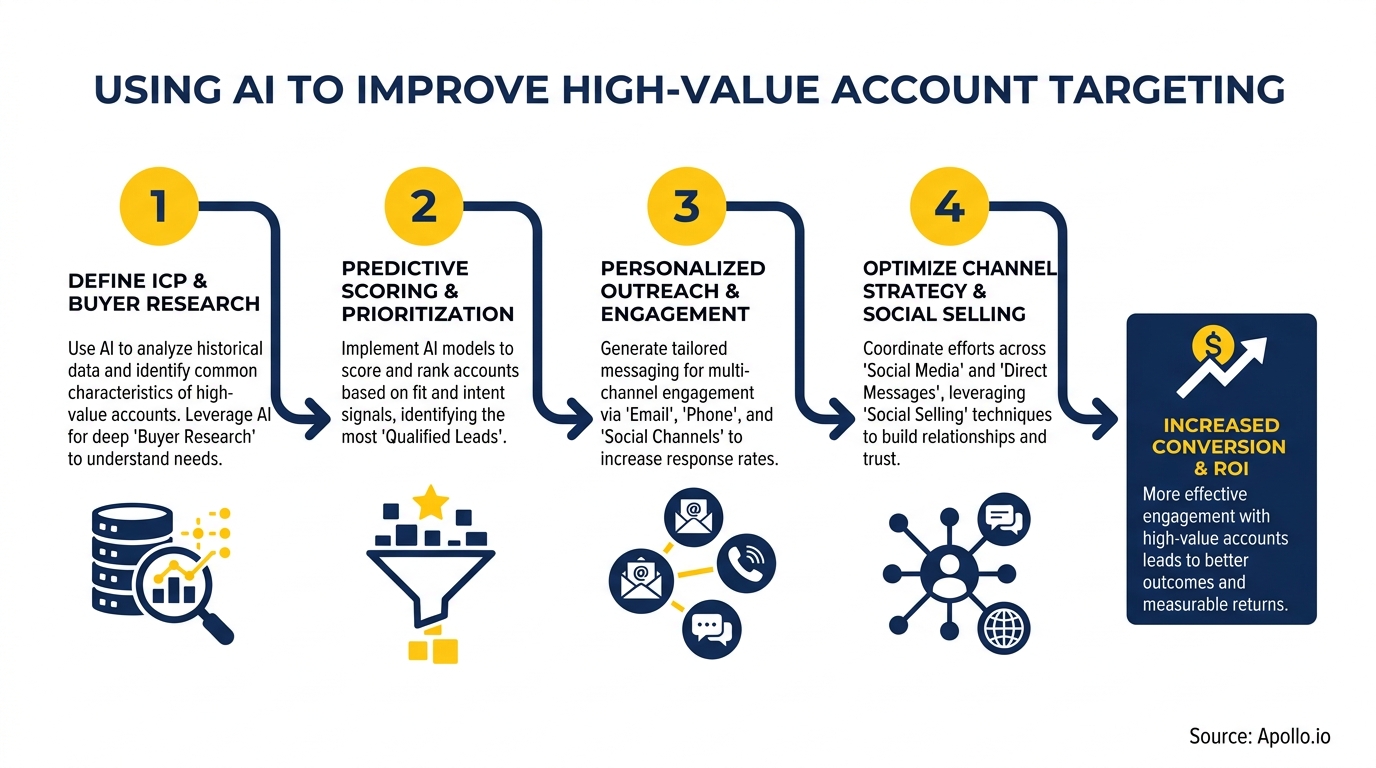
The practical workflow has four steps:
- Ingest first-party signals: CRM history, deal velocity, product usage, past engagement
- Layer third-party intent: Topic spikes, hiring signals, tech stack changes, funding events — see how intent data is collected for a full breakdown
- Score by revenue tier: Separate "high fit" from "high revenue potential" — an SMB with perfect ICP fit may rank below a mid-market account showing active buying signals
- Validate with A/B testing: Run prioritized vs. unprioritized cohorts and measure actual pipeline impact, not just engagement rates
Research from Span Global Services confirms that AI-powered platforms are making B2B intent data collection "smarter, faster, and more actionable," leveraging real-time behavioral signals and predictive analytics to identify high-intent buyers earlier and more accurately. Combine that with your revenue model and you have a continuously updating priority queue — not a static list.
Struggling to find qualified accounts at scale? Search Apollo's 230M+ contacts with 65+ filters to surface high-intent accounts instantly.
How Do SDRs and RevOps Teams Apply Explainable AI Scoring?
Explainable AI scoring gives SDRs and RevOps teams the "why" behind each account's rank, making prioritization actionable instead of opaque. When reps understand what triggered a score, they personalize outreach with context rather than sending generic sequences.
For SDRs, explainability means seeing specific signals: "This account spiked on [topic] content, added two new sales ops headcount, and matches three of your top five closed-won attributes." That's a cold call brief, not just a number. For RevOps leaders, explainability enables governance: you can audit why certain accounts are being prioritized, catch data quality issues, and align scoring models to actual pipeline outcomes.
According to Demand Gen Report, AI can classify prospects as decision-makers, influencers, or executors with remarkable accuracy based on job title, online behavior, content consumption, and engagement patterns. This buying-committee mapping is what moves AI targeting from "account-level" to "deal-level" precision.
To build this into your sales tech stack, ensure your scoring platform exposes feature-level explanations — not just composite scores — and that those explanations sync into your CRM where reps actually work.

What Are the Guardrails for AI Personalization at Scale?
AI personalization guardrails are governance rules that ensure outreach remains relevant, consistent, and on-brand across every touchpoint — preventing the irrelevant outreach that actively damages pipeline. This is the most under-discussed risk in AI-driven ABM.
Gartner's 2025 data found 73% of B2B buyers actively avoid suppliers that send irrelevant outreach. AI amplifies both good and bad personalization at scale.
Without guardrails, you'll scale the wrong message to your best accounts.
Implement these four guardrails:
- Relevance threshold: Only trigger personalized outreach when the AI's confidence in the signal meets a defined minimum — don't auto-send on weak signals
- Web-to-seller consistency: Ensure the messaging a prospect sees in ads matches what the rep says in outreach — misalignment destroys trust
- Human review gates: For Tier 1 accounts, require rep approval before AI-drafted messages send
- Suppression lists: Automatically exclude accounts in active deals, recent churns, or flagged as not ready
For email personalization specifically, test AI-generated variants against a human-written control before scaling. The goal is precision, not volume.
Turn Funnel Guesswork Into Closed Deals
Pipeline forecasting a guessing game because quality leads never make it past the top of the funnel? Apollo surfaces in-market buyers with precision targeting so every rep focuses on opportunities that actually close. Join 600K+ companies forecasting with confidence.
Schedule a Demo →How Does Content Format Map to Buying-Stage Intent?
Content format is itself a buying signal: what a prospect downloads or attends tells you where they are in their decision timeline, not just what topic they care about.
| Content Format | Intent Signal Strength | Recommended Targeting Action |
|---|---|---|
| Playbook / Framework | High (12-month purchase window) | Trigger direct outreach, route to AE |
| On-Demand Webinar | High (3–6 month purchase window) | Add to Tier 1 sequence, personalize by topic |
| Interactive Demo / Tool | High | Immediate SDR follow-up with use-case framing |
| eBook / Long-Form Report | Low-Medium (research phase) | Nurture sequence, wait for stronger signal |
| Blog / Thought Leadership | Low (awareness stage) | Ad retargeting, no direct outreach yet |
The practical implication: don't treat all content engagement equally in your scoring model. An account that downloads a playbook should score differently than one that reads a blog post — even if both consumed content on the same topic. Pair this logic with your B2B marketing funnel stages to build a content-to-action map your GTM team actually uses.
How Can AEs and Sales Leaders Avoid AI Targeting Failures?
AI targeting failures happen when teams automate prioritization before fixing the data and workflow foundations underneath. As Gartner warned, by 2028 AI agents will outnumber sellers by 10x, yet fewer than 40% of sellers will say agents improved their productivity. More automation does not equal better results.
For Account Executives managing deal cycles, the risk is misaligned messaging: an AI system scores an account as high-priority based on intent signals, but the rep's outreach doesn't reflect the account's actual pain points. For sales leaders, the risk is investing in AI tooling before the CRM data is clean enough to trust.
Three failure modes to fix first:
- Stale CRM data: Scores built on outdated contacts and closed opportunities produce wrong priorities. Invest in data sync processes before deploying AI scoring
- Tech silos: Salesforce's 2026 State of Sales report found 51% of sales leaders with AI say tech silos delay or limit AI initiatives — unify your intent, engagement, and CRM data first
- No feedback loop: If reps can't flag bad scores, the model never improves. Build a simple thumbs-up/thumbs-down mechanism into your CRM workflow
Spending too much time on manual research before each outreach? Apollo's AI sales automation surfaces account intelligence and drafts personalized outreach in one workspace — so AEs spend time selling, not researching.

How to Get Started with AI Account Targeting in 2026
The fastest path to AI-powered high-value account targeting is consolidating your data, scoring, and engagement into one platform rather than stitching together five separate tools. "Having everything in one system was a game changer" — Cyera. "We cut our costs in half" — Census.
A practical 30-day starting plan:
- Week 1: Audit your CRM data quality — identify stale contacts, missing fields, and duplicate records
- Week 2: Define your revenue-weighted account tiers using historical win data, not gut feel
- Week 3: Activate intent data and map it to your content-format scoring model
- Week 4:Run a pilot: prioritize 50 accounts using AI scoring vs. 50 using your current method, and measure pipeline created over 60 days
According to Demand Gen Report, the estimated average ROI from ABM programs is 137%, with nearly half of organizations citing ABM as delivering the highest ROI of any marketing investment. The returns are real — but only for teams that target with precision, not volume. Pair this approach with Apollo's sales automation best practices to operationalize every step at scale.
Ready to put AI-powered targeting to work? Try Apollo Free and access 230M+ verified contacts, 65+ search filters, AI-powered scoring, and multi-channel engagement — all in one platform that replaces your fragmented stack.
Prove Pipeline ROI With Apollo
ROI pressure killing your next tool approval? Apollo delivers measurable pipeline impact from day one — 46% more meetings with AI, real results your CFO can't argue with. Start free in minutes.
Start Free with Apollo →Don't miss these
Sales
Inbound vs Outbound Marketing: Which Strategy Wins?
Sales
What Is a Sales Funnel? The Non-Linear Revenue Framework for 2026
Sales
What Is a Go-to-Market Strategy? The 2026 GTM Playbook
See Apollo in action
We'd love to show how Apollo can help you sell better.
By submitting this form, you will receive information, tips, and promotions from Apollo. To learn more, see our Privacy Statement.
4.7/5 based on 9,690 reviews
