
How to Standardize Prospecting Across Sales Teams in 2026
Inconsistent prospecting is a quota killer. When every SDR runs their own playbook, uses different tools, and defines "qualified" differently, your pipeline becomes unpredictable and your coaching becomes guesswork.
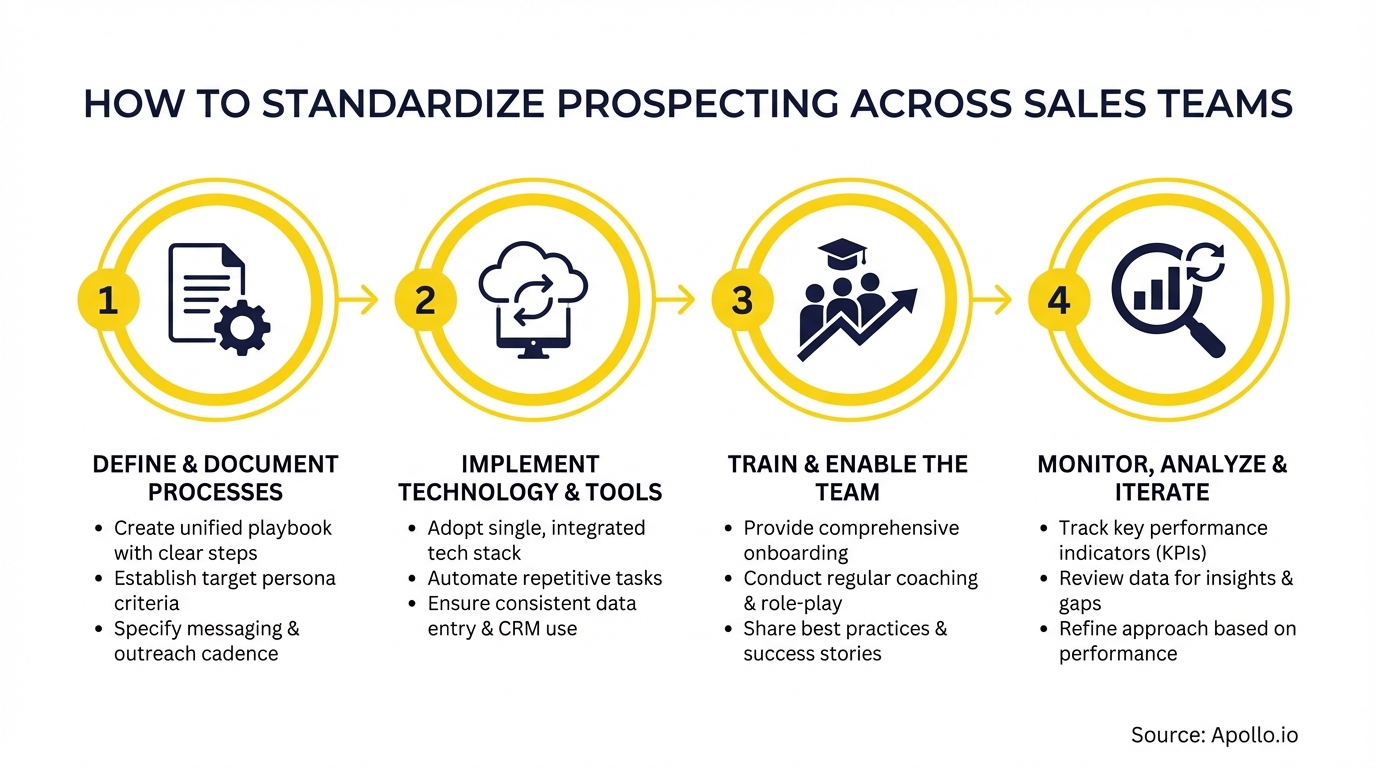
The good news: standardization is a solvable operational problem, not a talent problem. This guide gives you a governance-first framework to align your entire GTM team around one repeatable, measurable prospecting system.
Before building your playbook, read how data-driven prospecting strategies give teams the foundation they need to make standardization stick.

Scale Smarter With Apollo's GTM Engine
Tired of manual research eating your team's selling time? Apollo standardizes your outreach process and surfaces verified contacts instantly. Over 600K companies already run faster, leaner pipelines with Apollo.
Start Free with Apollo →Key Takeaways
- According to Everstage, teams using a standardized follow-up process see a 78% higher conversion rate than those without a systematic approach.
- Standardization requires governance, not just templates: shared ICP definitions, CRM hygiene rules, and adoption tracking all matter.
- AI is accelerating outbound variance. Without a governing policy for AI-generated messaging, inconsistency scales faster than growth.
- SDRs, BDRs, and AEs each need role-specific standards within the same unified framework.
- Measure adoption in bands (low, medium, high) and tie each band to expected quota outcomes to build a business case for standardization.
Why Is Prospecting Standardization a Business Priority in 2026?
Prospecting standardization directly lifts quota attainment by removing the variability that drags down average rep performance. Research from The Sales Collective found that companies with a structured sales process increased win rates by approximately 8% compared to those using informal or ad hoc approaches.
The urgency is sharper in 2026. Salesforce's State of Sales 2026 report found 55% of sales professionals are already using AI for prospecting.
When AI is involved, inconsistency doesn't just slow teams down: it scales faster. Uneven ICP definitions, mismatched messaging guardrails, and rep-by-rep prompt variance amplify errors at speed.
The operational case is clear. Standardize now, or watch AI-assisted outbound create more chaos than pipeline.
What Are the Core Components of a Prospecting Standard?
A prospecting standard is a shared operating system covering four layers: data definitions, workflow rules, messaging guardrails, and measurement criteria.
| Layer | What to Standardize | Who Owns It |
|---|---|---|
| Data Definitions | ICP criteria, persona attributes, lead scoring thresholds | RevOps / Marketing |
| Workflow Rules | Sequence steps, SLA timing, touch limits, handoff triggers | Sales Ops / SDR Manager |
| Messaging Guardrails | Approved templates, AI prompt library, QA review gates | Enablement / Sales Leader |
| Measurement Criteria | Activity KPIs, conversion benchmarks, adoption bands | RevOps / Sales Leadership |
According to Intelligent Demand, Revenue Operations in 2025 prioritized seamless data integration across marketing, sales, and customer success to create a single source of truth for revenue data. That single source of truth is the backbone of any prospecting standard.
Struggling to find qualified leads consistently across your team? Search Apollo's 230M+ contacts with 65+ filters so every rep starts from the same verified, ICP-aligned list.
How Do SDRs and BDRs Operate Within a Standardized Framework?
SDRs and BDRs are the primary executers of prospecting standards, and their day-to-day behavior either validates or undermines the system. For standardization to hold, reps need role-specific clarity, not just a shared doc.
Key standards SDRs and BDRs need defined:
- Touch cadence: Number of attempts, channel sequence (email, phone, social), and spacing between touches
- Qualification criteria: Exactly what makes a prospect worth a call (firmographic fit, intent signal, trigger event)
- Handoff SLA: When and how a prospect moves to an AE, including required CRM fields before handoff
- AI usage policy: Which AI tools are approved, what prompts are pre-vetted, and where human review is required
For Account Executives receiving those handoffs, the standard must include a minimum data threshold so no AE ever enters a discovery call without firmographic context, recent activity, and a clear disqualification reason if the lead is returned. This is where sales operations plays a critical governance role.

How Do You Build a Prospecting Standardization Scorecard?
A prospecting standardization scorecard tracks adoption across four dimensions and ties each level to expected performance outcomes. Use adoption bands to create a measurable business case.
| Adoption Band | Adoption Rate | Expected Outcome |
|---|---|---|
| Low | Under 25% | Below-average quota attainment, high rep variance |
| Developing | 25%–75% | Inconsistent pipeline, some improvement in conversion |
| High | 76%–90% | Measurable quota lift, reduced coaching burden |
| Optimized | 90%+ | Predictable pipeline, top-decile team performance |
Track these KPIs weekly: sequence enrollment rate, step completion rate, connect-to-meeting conversion, and CRM field completion at handoff. RevOps leaders find that leading indicators (step completion, enrollment consistency) predict pipeline outcomes 4–6 weeks earlier than lagging indicators like closed-won rate.
Pair your scorecard with sales analytics to identify which reps are off-standard and where the process is breaking down, not just who is underperforming.
Turn Weak Funnels Into Pipeline Gold
Pipeline forecasting a guessing game because marketing leads never convert? Apollo surfaces high-intent prospects ready to buy — not just names on a list. Nearly 100K paying customers stopped guessing and started closing.
Start Free with Apollo →How Do You Govern AI Use in Outbound Prospecting?
AI governance for outbound prospecting means defining approved use cases, required QA gates, and clear ownership before any AI tool touches a prospect message. Without governance, AI-assisted prospecting accelerates inconsistency, not scale.
Build your AI governance policy around three rules:
- Approved sources only: Reps use pre-vetted data sources and CRM-synced contact records. No ad hoc scraping or unverified enrichment.
- Human-in-the-loop for first sends: Any AI-generated message going to a net-new prospect requires manager or enablement review before the first send in a new sequence.
- Prompt library governance: Maintain a shared, version-controlled library of approved prompts. Reps do not write their own prompts from scratch for outbound.
This matters more in 2026 than ever. Salesforce reports that nearly 9 in 10 sellers plan to use AI agents by 2027. A governance policy today prevents a fragmented, unauditable outbound operation tomorrow. Learn more about how sales automation done right keeps teams aligned without sacrificing personalization.

What Is the Rollout Blueprint for Prospecting Standardization?
A phased rollout prevents the transformation fatigue that causes most standardization efforts to stall after 60 days.
- Phase 1 (Weeks 1–2): Define. Lock ICP criteria, persona definitions, and a shared activity taxonomy. Get sign-off from sales, marketing, and RevOps before moving forward.
- Phase 2 (Weeks 3–4): Build. Configure approved sequences in your sales engagement platform, set CRM field requirements, and publish the AI governance policy.
- Phase 3 (Weeks 5–8): Launch and measure. Enroll all SDRs and BDRs in the standard sequences. Track adoption band weekly. Flag low-adoption reps for coaching, not punishment.
- Phase 4 (Ongoing): Optimize. Run monthly sequence audits. Update templates based on conversion data. Retire underperforming touches and promote winning variants.
Spending too much time on manual outreach coordination? Automate your sequences with Apollo's multi-channel sales engagement platform so standardization runs inside the tool, not just in a shared doc.
As Collin Stewart from Predictable Revenue put it: "We reduced the complexity of three tools into one." Consolidating your engagement, data, and analytics into a single platform removes the tool sprawl that makes standardization nearly impossible to enforce.
How Do You Measure the ROI of Prospecting Standardization?
The ROI of prospecting standardization shows up in three measurable places: conversion rates, quota attainment, and pipeline predictability.
Use these leading indicators to track progress before you see closed-won impact:
- Sequence step completion rate (target: 85%+ across the team)
- CRM field completion at lead handoff (target: 95%+)
- Connect-to-meeting conversion rate (benchmark against pre-standardization baseline)
- Adoption band distribution (target: 75%+ of reps in the High or Optimized band within 90 days)
For a deeper view into how Revenue Operations drives pipeline predictability, align your standardization metrics to the same reporting cadence your CRO reviews each week. That visibility is what turns a sales enablement project into a board-level growth lever.
Start Standardizing Your Prospecting Today
Prospecting standardization is not a one-time project. It is an operating system that compounds over time: better data quality feeds better sequences, which produce better conversion data, which improves your next sequence iteration.
The teams that build this flywheel in 2026 will have a structural advantage that is very hard to replicate.
Apollo gives GTM teams everything they need to standardize in one place: a 230M+ contact database with 65+ filters, multi-channel sequence automation, AI-powered messaging tools, and CRM-native analytics. "Having everything in one system was a game changer," said the team at Cyera. "We cut our costs in half," reported Census after consolidating their stack.
Ready to build your standardized prospecting system? Start Your Free Trial and give every rep on your team the same verified data, approved sequences, and AI tools to hit quota consistently.
Prove Pipeline ROI Before Next QBR
ROI pressure killing your tool budget? Apollo delivers measurable pipeline impact from day one — no lengthy onboarding, no guesswork. Leadium 3x'd annual revenue. Your CFO wants proof. Apollo provides it.
Schedule a Demo →Don't miss these
Sales
Inbound vs Outbound Marketing: Which Strategy Wins?
Sales
What Is a Sales Funnel? The Non-Linear Revenue Framework for 2026
Sales
What Is a Go-to-Market Strategy? The 2026 GTM Playbook
See Apollo in action
We'd love to show how Apollo can help you sell better.
By submitting this form, you will receive information, tips, and promotions from Apollo. To learn more, see our Privacy Statement.
4.7/5 based on 9,690 reviews
