
How to Learn Sales: A Practical Guide for the AI Era
Learning sales in 2026 requires a fundamentally different approach than just five years ago. The modern sales professional must balance AI-powered tools with human connection, data-driven insights with authentic relationship building.
Whether you're an SDR starting your first outbound role or a founder building your sales motion from scratch, this guide provides a practical roadmap for mastering sales in the AI era.
The stakes are high. According to Gartner research, sellers who effectively partner with AI tools are 3.7 times more likely to meet their sales quotas. Yet most sales training programs still teach outdated tactics that ignore how buyers actually research and purchase today.

Apollo Eliminates 4+ Hours Of Daily Research
Tired of spending 4+ hours daily hunting for contact info? Apollo delivers 224M verified contacts with 96% email accuracy instantly. Join 550K+ companies who automated prospecting.
Start Free with Apollo →Key Takeaways
- Modern sales combines AI automation with human-centric engagement, not one or the other
- Data-driven selling with verified contact intelligence dramatically shortens sales cycles
- SDRs using unified platforms book 46% more meetings than those juggling multiple tools
- Buyers prefer human interaction for complex deals but want self-service for research phases
- Sales professionals who master both virtual and in-person selling outperform single-channel reps by 3x
What Is Modern Sales Learning in 2026?
Modern sales learning is the practice of developing skills that combine technology proficiency with human relationship building. It involves mastering data-driven prospecting, AI-assisted outreach, and consultative selling techniques that prioritize buyer needs over product features.
The fundamentals remain unchanged: understand your buyer, communicate value clearly, handle objections professionally, and close deals confidently. However, the execution has transformed dramatically. Research by Gartner shows that 60% of B2B sales organizations transitioned to data-driven selling by 2025, moving away from intuition-based approaches.
Today's sales professionals use platforms that integrate prospecting, engagement, and analytics in one workspace. This consolidation matters because context switching between tools kills productivity and creates data silos. As one customer from Predictable Revenue explained: "We reduced the complexity of three tools into one."
How Do SDRs Learn Sales Fundamentals?
SDRs learn sales fundamentals through a combination of structured training, hands-on practice, and continuous coaching. The most effective learning path includes prospecting mastery, pitch development, objection handling, and meeting qualification skills.
Start with prospecting fundamentals. Learn to identify your ideal customer profile using firmographic and technographic filters.
SDRs who master advanced search capabilities find better-fit prospects and achieve higher connect rates. Practice building targeted lists based on specific criteria like company size, industry, technology stack, and buying signals.
Struggling to find qualified leads? Search Apollo's 224M+ contacts with 65+ filters to build targeted prospect lists in minutes.
Next, develop your outreach skills across multiple channels. Modern SDRs use email sequences, LinkedIn messages, phone calls, and video in coordinated campaigns. The key is personalization at scale. Use intent data to prioritize prospects showing active buying signals, then tailor your messaging to their specific pain points.
What Training Methods Work Best for New SDRs?
The most effective training combines role-playing, real-world practice with feedback, and shadowing top performers.
New SDRs should spend their first two weeks listening to recorded calls, reviewing winning email templates, and understanding the buyer journey before making their first outreach.

Create a practice routine that includes:
- Daily cold call practice sessions with peer feedback
- Weekly email copy reviews with top performers
- Monthly pitch refinement based on actual objections encountered
- Quarterly deep dives into industry trends and buyer challenges
What Sales Skills Should Account Executives Master?
Account Executives must master discovery questioning, solution positioning, stakeholder mapping, and deal orchestration. Unlike SDRs focused on booking meetings, AEs own the full sales cycle from qualification through close.
The foundation is consultative selling. Learn to ask questions that uncover business impact, not just surface-level pain points. Top consultative sellers focus on understanding the prospect's desired future state, quantifying the cost of inaction, and building consensus among multiple stakeholders.
AEs also need proficiency in enterprise account strategy for larger deals. This includes executive relationship building, business case development, and navigating complex procurement processes. The most successful AEs maintain detailed account plans that map decision-makers, identify champions, and anticipate objections.
For Account Executives managing complex deals, having all prospect intelligence, conversation history, and deal tracking in one workspace accelerates cycles. Companies using unified platforms report 35% faster deal velocity because reps spend less time switching between tools and more time selling.
Turn Unreliable Forecasts Into Revenue Clarity
Pipeline forecasting a guessing game? Apollo's real-time deal tracking shows exactly where every opportunity stands. Built-In boosted win rates 10% with Apollo's visibility and scoring.
Start Free with Apollo →How Does AI Change Sales Learning?
AI fundamentally changes sales learning by automating research, personalizing outreach at scale, and providing real-time coaching during conversations. Modern sales professionals must learn to leverage AI as a strategic partner rather than viewing it as a replacement.
The data is compelling. According to Gartner, 75% of B2B sales organizations now augment traditional playbooks with AI-guided selling solutions. These tools handle time-consuming tasks like prospect research, email personalization, and meeting preparation, freeing sellers to focus on relationship building.
Learn to use AI sales tools for specific workflows:
- Pre-call research: AI analyzes prospect websites, news, and social profiles to surface relevant talking points
- Message generation: AI drafts personalized email sequences based on prospect data and campaign goals
- Call analysis: AI transcribes calls, identifies key moments, and suggests follow-up actions
- Deal intelligence: AI predicts deal risk, recommends next steps, and highlights patterns from won opportunities
Spending hours on pre-call research and manual note-taking? Let Apollo's AI handle call summaries, action items, and CRM updates automatically.
However, remember that buyers still value human connection. Research by Gartner predicts that by 2030, 75% of B2B buyers will prefer sales experiences that prioritize human interaction over AI. The winning approach combines AI efficiency with authentic relationship building.
What Sales Resources Accelerate Learning?
The best sales resources combine practical frameworks, real-world examples, and hands-on practice opportunities. Focus on resources that teach transferable skills rather than company-specific tactics.
Essential learning resources include:
| Resource Type | What to Learn | Best Practices |
|---|---|---|
| Sales playbooks | Proven sequences, scripts, objection responses | Adapt frameworks to your buyer, don't copy verbatim |
| Call recordings | Tonality, pacing, question flow, handling pushback | Analyze both wins and losses for patterns |
| Industry research | Buyer challenges, market trends, competitive landscape | Subscribe to buyer-focused publications, not just sales content |
| Sales communities | Peer insights, tool recommendations, career advice | Contribute value before asking for help |
| Certification programs | Structured methodology, credibility signals | Choose programs aligned with your selling motion |
For SDRs and AEs, learning sales automation and social selling techniques dramatically improves productivity. RevOps leaders should focus on understanding how data enrichment, pipeline analytics, and workflow automation drive predictable revenue.
How Do Sales Leaders Build High-Performing Teams?
Sales leaders build high-performing teams by creating a culture of continuous learning, providing real-time coaching, and removing friction from the selling process. The best managers balance accountability with support, setting clear expectations while investing in skill development.
Start with onboarding excellence. New reps should achieve their first meeting booked within two weeks and their first closed deal within 90 days.
Structure onboarding with clear milestones, shadowing opportunities, and gradual responsibility increases. Track leading indicators like call volume, email response rates, and meeting conversion rates.
Implement regular coaching cadences. Weekly one-on-ones should review pipeline health, discuss specific deals, and address skill gaps.
Monthly business reviews should analyze trends, celebrate wins, and adjust strategies. Use call recordings and email analytics to provide specific, actionable feedback.
Most importantly, consolidate your tech stack. Teams using 5+ disconnected tools waste 30% of their time on administrative tasks.
As one customer from Cyera shared: "Having everything in one system was a game changer." Unified platforms give sales leaders complete visibility into team activity, pipeline health, and coaching opportunities without asking reps to update multiple systems.
What Metrics Should Sales Leaders Track?
Sales leaders should track both activity metrics and outcome metrics. Activity metrics include calls made, emails sent, LinkedIn messages, and meetings booked.
Outcome metrics include pipeline generated, win rate, average deal size, and sales cycle length.
The key is connecting activities to outcomes. If your team makes 100 calls per day but books zero meetings, the problem isn't effort but targeting or messaging. Use sales analytics to identify which activities drive the best results, then coach your team to focus on high-impact behaviors.
Conclusion: Your Sales Learning Roadmap for 2026
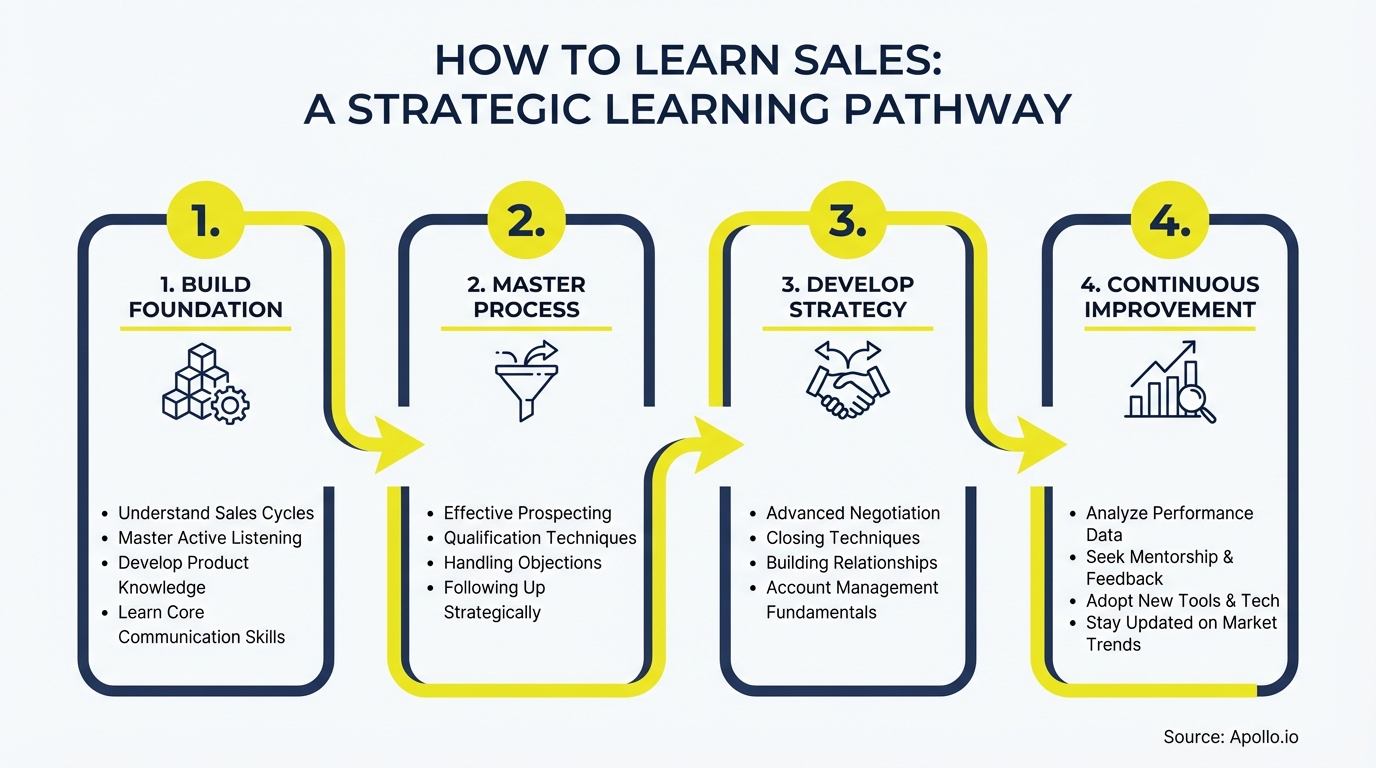
Learning sales in 2026 means embracing both technology and timeless relationship-building principles. Start with the fundamentals: prospecting, pitching, handling objections, and closing.
Then layer on modern capabilities like AI-assisted research, data-driven targeting, and multi-channel engagement.

The most successful sales professionals combine three elements: deep buyer understanding, proficiency with modern tools, and authentic communication skills. They use AI to handle repetitive tasks but lead conversations with empathy and curiosity.
They analyze data to identify patterns but adapt their approach to each unique buyer situation.
Whether you're an SDR booking your first meetings, an AE closing enterprise deals, or a sales leader building a high-performing team, focus on continuous improvement. Learn from every call, refine your messaging based on real feedback, and stay current with evolving buyer expectations.
Ready to accelerate your sales learning with a platform that combines prospecting, engagement, and intelligence in one workspace? Request a Demo to see how Apollo helps sales professionals master modern selling techniques while cutting tech stack costs in half.
Prove Apollo's ROI In Your First 30 Days
Budget approval stuck on unclear metrics? Apollo tracks every dollar to pipeline impact with real-time dashboards. Built-In increased win rates 10% and ACV 10% with Apollo's measurable ROI.
Start Free with Apollo →Don't miss these
Sales
Inbound vs Outbound Marketing: Which Strategy Wins?
Sales
What Is a Sales Funnel? The Non-Linear Revenue Framework for 2026
Sales
What Is a Go-to-Market Strategy? The 2026 GTM Playbook
See Apollo in action
We'd love to show how Apollo can help you sell better.
By submitting this form, you will receive information, tips, and promotions from Apollo. To learn more, see our Privacy Statement.
4.7/5 based on 9,690 reviews
