
How to Implement Follow-Up Reminders Based on Prospect Engagement
Most follow-up reminders are time-based: send on day 3, call on day 7, repeat until response or burnout. In 2026, that approach is obsolete. Buyers now interact across an average of 10 channels, and the most effective reminder systems trigger based on what a prospect actually does, not a calendar. If you want to learn how to build winning sales sequences that respond to real behavior, this guide gives you the blueprint.

Build Pipeline With Verified Data
Tired of burning hours hunting down contacts that bounce or go nowhere? Apollo delivers verified business data so your team spends time selling, not searching. Join 600K+ companies turning research time into revenue.
Start Free with Apollo →Key Takeaways
- Engagement-triggered reminders outperform time-based cadences because they respond to real buyer intent signals, not arbitrary schedules.
- According to Salesgenie, 80% of sales require at least five follow-up attempts, making systematic, signal-driven follow-up essential.
- Cross-channel signal mapping (email opens, web visits, content downloads) tells you which channel to follow up on, not just when.
- Guardrails like frequency caps and opt-down options prevent over-personalization from damaging buyer trust.
- AI-assisted automation reduces manual follow-up burden while keeping reps focused on high-intent accounts.
What Are Engagement-Based Follow-Up Reminders?
Engagement-based follow-up reminders are automated or system-generated tasks that trigger when a prospect takes a specific action, such as opening an email, visiting a pricing page, downloading a case study, or attending a webinar. Unlike time-based sequences that fire on a fixed schedule, these reminders use behavioral signals to determine timing, channel, and message content.
This approach matters because buyer journeys are no longer linear. A prospect might ignore three emails, then visit your pricing page twice in one day.
A time-based cadence misses that signal entirely. An engagement-based system creates a follow-up task the moment it happens.
How Do You Build a Signals-to-Actions Blueprint?
A signals-to-actions blueprint maps each engagement event to a specific follow-up action, owner, timing window, and recommended asset. This turns behavioral data into a decision table your entire GTM team can execute consistently.
| Engagement Signal | Trigger Action | Owner | Timing | Recommended Asset |
|---|---|---|---|---|
| Email opened 3+ times, no reply | SDR call task + personalized follow-up draft | SDR | Within 4 hours | Case study relevant to persona |
| Pricing page visited | AE alert + high-priority task | AE | Same day | ROI calculator or comparison sheet |
| Webinar attended (50%+ watched) | Nurture email + SDR task with talk track | SDR/Marketing | Within 24 hours | Webinar recap + next-step CTA |
| Content downloaded (e.g., whitepaper) | Automated nurture email + SDR notification | Marketing/SDR | Within 1 hour | Related content or demo invite |
| No engagement after 5 touches | Channel switch: move to social or direct mail | SDR | Day 14+ | Short personalized video or note |
For SDRs building outbound sequences, understanding which customer engagement metrics actually matter helps prioritize which signals deserve immediate action versus longer nurture windows.
Spending too much time managing manual follow-up tasks? Automate your engagement-triggered sequences with Apollo's multichannel sales engagement platform.
How Do SDRs and AEs Implement Engagement-Triggered Reminders?
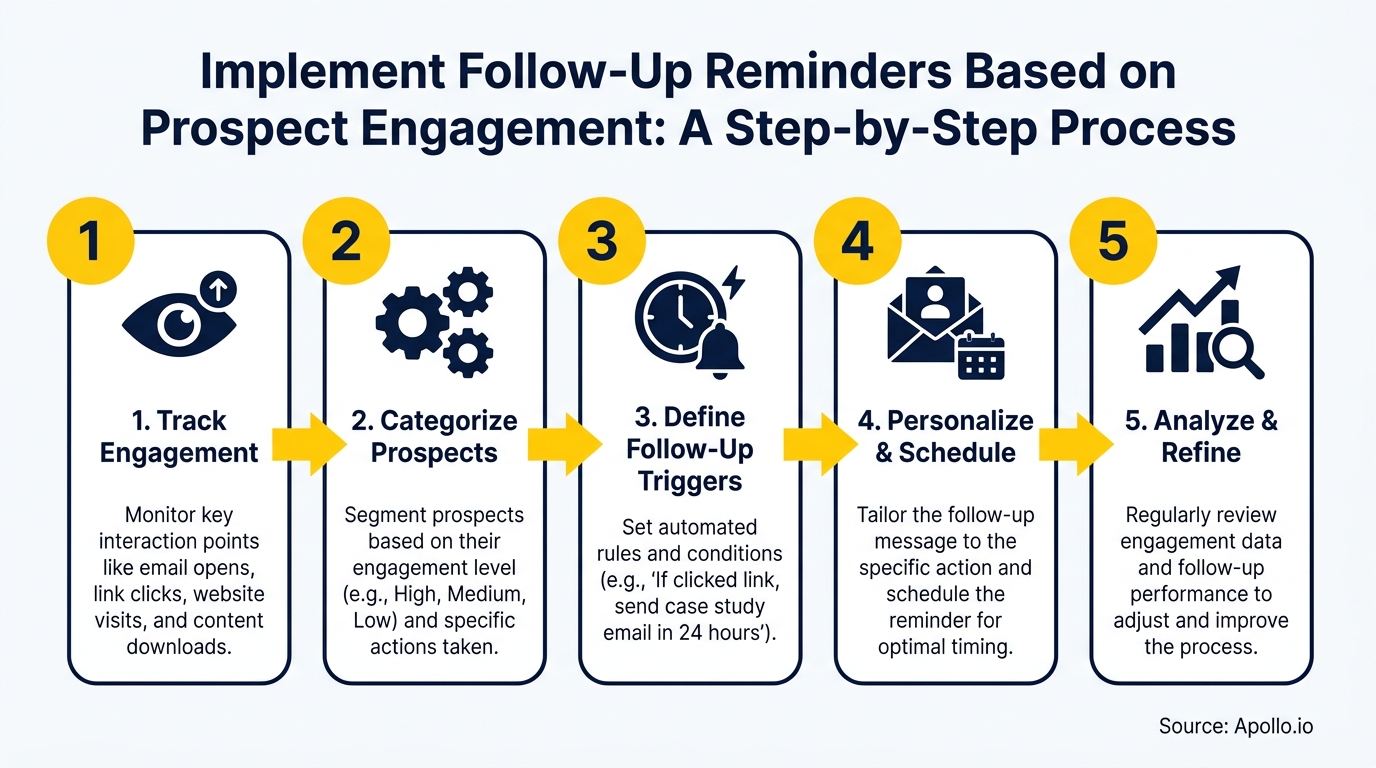
SDRs and AEs implement engagement-triggered reminders by configuring their sales engagement platform to create tasks automatically when defined behavioral thresholds are met, then acting on those tasks within a defined SLA window.
Here is a practical implementation sequence for B2B GTM teams:
- Define your signal library: List every trackable engagement event in your stack (email opens, clicks, web visits, form fills, meeting attendance).
- Set threshold rules: Decide which signals are high-intent (pricing page visit = immediate) versus low-intent (newsletter open = nurture).
- Configure auto-task creation: In your CRM or sales engagement platform, build workflows that create a task, assign an owner, and attach the recommended asset when a threshold is met.
- Establish SLA windows: High-intent signals should trigger action within hours. Lower signals can queue for the next business day.
- Run a weekly signal audit: RevOps leaders should review which triggers are firing, response rates, and whether thresholds need adjustment.
For AEs managing active deals, these top sales sequence examples show how to structure multi-touch follow-up around deal stage and buyer behavior.

What Guardrails Prevent Over-Personalization From Backfiring?
Guardrails for engagement-based reminders include frequency caps, opt-down mechanisms, low-PII trigger rules, and channel suppression logic. These controls prevent the system from feeling intrusive to prospects.
A 2025 Gartner study found that personalization generated negative experiences for 53% of customers, with those customers 3.2x more likely to regret a purchase. The lesson: reminders should signal helpfulness, not surveillance.
Key guardrail rules to implement:
- Frequency cap: No more than one automated reminder per channel per week for any single prospect.
- Opt-down option: Every automated follow-up should include an easy way for prospects to reduce communication frequency.
- Low-PII triggers only: Use behavioral signals (page visits, content downloads) rather than highly personal data points to trigger outreach.
- Channel suppression: If a prospect disengages on email for 14+ days, suppress email and switch to a different channel.
- Human review for high-value accounts: Auto-draft follow-ups for enterprise accounts but require AE approval before sending.
Turn Weak Funnels Into Pipeline Fast
Pipeline forecasting a guessing game? Apollo surfaces in-market buyers with verified data so your team stops chasing cold leads and starts closing real opportunities. Join 600K+ companies building predictable pipeline.
Start Free with Apollo →How Does AI Improve Engagement-Based Reminder Systems?
AI improves engagement-based reminder systems by analyzing engagement history to recommend optimal send times, channels, and message content, reducing manual decision-making for reps. As noted by Leadspicker, AI can determine the optimal time to send messages or the best channel for each prospect based on engagement history.
In February 2026, Gong's "Mission Andromeda" update expanded its Revenue AI platform to turn conversation signals and intent spikes into automated next-step tasks, an example of AI moving from suggestion to conditional execution. This agentic direction means follow-up reminders increasingly fire without rep intervention, within defined governance guardrails.
Practical AI-assisted capabilities for GTM teams:
- Send-time optimization based on individual prospect open history
- Channel recommendation when one channel shows declining engagement
- Auto-drafted follow-up messages tailored to the triggering signal
- Intent spike alerts that elevate a prospect's priority in the queue
Research from Instapage shows that 83% of B2B marketers have seen improved lead generation from personalization, reinforcing why signal-informed messaging outperforms generic cadences.
Want AI to handle the timing and channel decisions for you? Explore Apollo's AI sales automation tools that trigger follow-ups based on real engagement signals.
How Do You Measure Whether Engagement-Based Reminders Are Working?
Measure engagement-based reminder performance using four core metrics: task-to-response rate, speed-to-follow-up, channel conversion rate by signal type, and pipeline influenced by triggered sequences.
| Metric | What It Measures | Target Benchmark |
|---|---|---|
| Task-to-response rate | % of triggered tasks that generate a prospect reply | Improve vs. time-based baseline |
| Speed-to-follow-up | Time from signal to rep action | Under 4 hours for high-intent signals |
| Channel conversion rate | Which signal type drives the most meetings | Benchmark by signal tier |
| Pipeline influenced | Revenue in pipeline sourced from triggered sequences | Track monthly vs. manual sequences |
RevOps leaders should run a monthly review comparing pipeline generated by engagement-triggered sequences versus standard time-based cadences. This comparison makes the ROI case for expanding automation coverage. For a structured approach, these sales cadence frameworks provide solid baselines to measure against.
It is also worth noting that while personalized, timely follow-up improves conversion, follow-up volume still matters. Data from Kixie confirms that most B2B deals need 2-6 follow-ups for conversion, meaning even the best-timed single reminder rarely closes a deal on its own.

How Do You Get Started with Engagement-Based Follow-Up in 2026?
Start by auditing your current follow-up process: identify which signals you already track, which create manual tasks, and which are ignored entirely. Most teams discover significant gaps between available data and actual follow-up execution.
A phased approach works best:
- Phase 1 (Week 1-2): Map your top 5 high-intent signals and configure auto-task creation for each in your CRM or engagement platform.
- Phase 2 (Week 3-4): Add guardrails (frequency caps, opt-down, channel suppression) and train reps on SLA expectations.
- Phase 3 (Month 2+): Layer in AI-assisted send-time optimization and begin measuring task-to-response rates by signal type.
Apollo consolidates prospecting, engagement sequencing, and signal tracking into one workspace, removing the need to stitch together separate tools for data, outreach, and task management. As Cyera's team put it: "Having everything in one system was a game changer." Learn how to use sales automation the right way to build a reminder system that scales with your pipeline.
Ready to replace your time-based cadences with smarter, signal-driven follow-up? Try Apollo free and start turning prospect engagement into automated, actionable next steps today.
Prove Pipeline ROI Before Next QBR
ROI pressure killing your tool adoption? Apollo delivers measurable pipeline impact fast — so budget conversations become easy wins. Leadium 3x'd annual revenue. Your QBR could tell the same story.
Start Free with Apollo →Don't miss these
Sales
Inbound vs Outbound Marketing: Which Strategy Wins?
Sales
What Is a Sales Funnel? The Non-Linear Revenue Framework for 2026
Sales
What Is a Go-to-Market Strategy? The 2026 GTM Playbook
See Apollo in action
We'd love to show how Apollo can help you sell better.
By submitting this form, you will receive information, tips, and promotions from Apollo. To learn more, see our Privacy Statement.
4.7/5 based on 9,690 reviews
