
How to Identify Upsell or Cross-Sell Opportunities in Current Accounts (2026 Framework)
Your best pipeline for 2026 is already in your CRM. According to Teneo's 2026 B2B Software Vendor Survey, 66% of B2B software growth in 2025 came from existing customers, and vendors expect that pattern to continue. Yet most GTM teams still treat expansion as an afterthought, waiting for the QBR to ask about upgrades. That reactive approach leaves real revenue on the table.
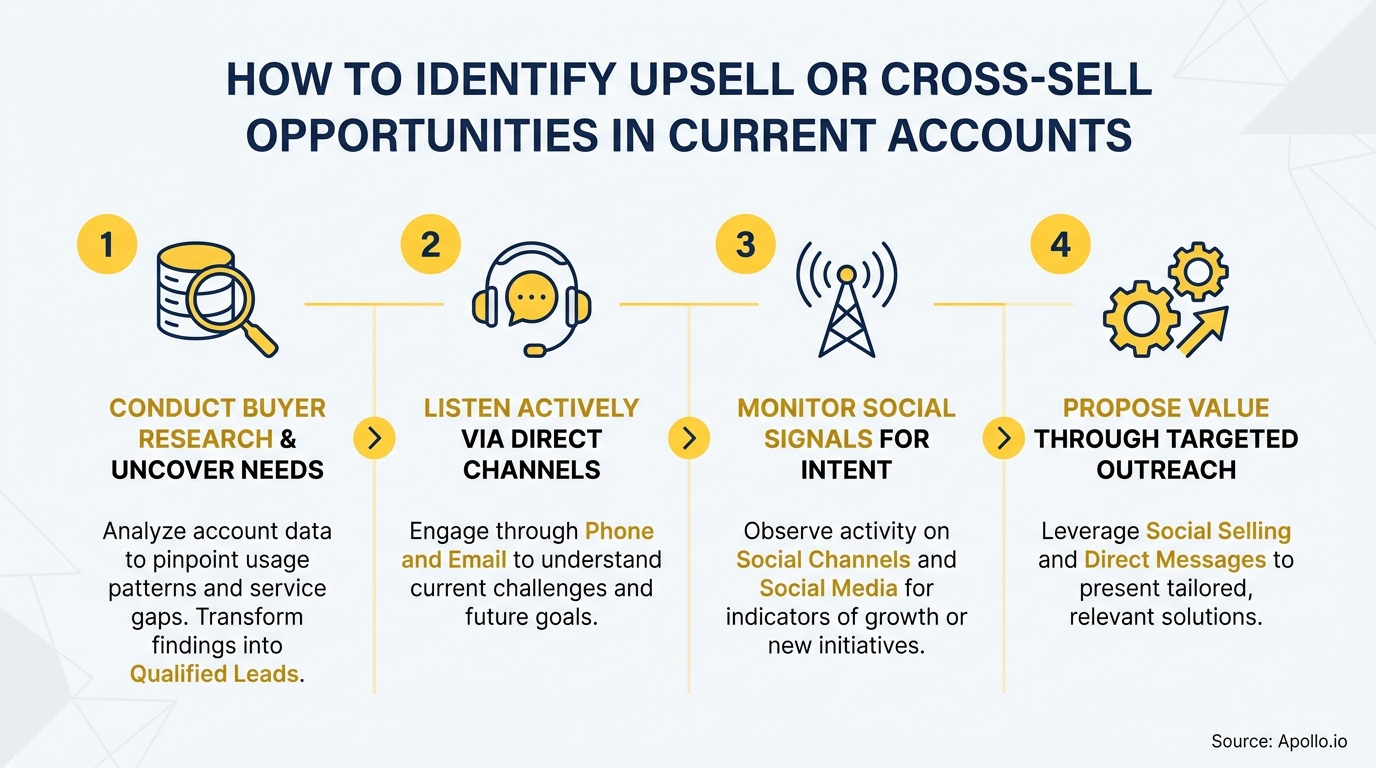
This guide gives AEs, RevOps leaders, and CS managers a practical, signal-based framework for identifying upsell and cross-sell opportunities before customers go looking for alternatives. If you're also building out your intent data strategy, expansion signals belong at the center of it.

Research Less, Pipeline More With Apollo
Tired of your reps burning hours verifying contacts instead of selling? Apollo surfaces accurate, ready-to-work leads so your team scales outreach without scaling headcount. Over 600K companies already made the switch.
Start Free with Apollo →Key Takeaways
- Expansion signals go beyond usage data: buying-pattern, relationship depth, and omnichannel consistency signals matter just as much.
- The probability of selling to an existing customer is significantly higher than converting a new prospect, making expansion the most efficient revenue motion.
- Timing matters: upselling during active onboarding often backfires by adding complexity that reduces retention.
- Most B2B buyers prefer self-service or minimal rep involvement, so expansion outreach must be contextual and triggered by real signals, not calendar dates.
- Unified account data across CRM, product usage, support, and intent sources is the foundation of any reliable expansion scoring model.
Why Is Expansion Revenue So Important in 2026?
Expansion revenue is important because it converts existing trust into incremental revenue at a fraction of the cost of net-new acquisition. Research from Leadfeeder shows the probability of selling to an existing customer is 60–70%, compared to just 5–20% for a new prospect. That math alone justifies a dedicated expansion motion.
According to Cirrus Insight, upsell motions contribute an average of 21% of revenue. For SaaS businesses specifically, the stakes are even higher. McKinsey's B2B NRR research found top-quartile companies carried 113% net dollar retention versus 98% for bottom-quartile peers, translating to a 24x versus 5x EV/revenue multiple. Expansion is now a valuation driver, not just a sales tactic.
What Signals Predict Upsell and Cross-Sell Readiness?
Expansion readiness signals fall into four categories: usage, relationship, buying-pattern, and intent. Relying on usage alone misses the majority of actionable signals.
| Signal Category | What to Track | Expansion Indicator | Score Weight |
|---|---|---|---|
| Product Usage | Feature adoption rate, usage frequency, seat utilization | High adoption near plan limits | High |
| Buying Patterns | Purchase history, frequently co-purchased products | Adjacent product gap identified | High |
| Relationship Depth | Number of active contacts (multi-threading), exec engagement | New stakeholder added, champion promoted | Medium |
| Intent Signals | Research on adjacent topics, competitor content consumption | Active in-market for related category | High |
| Support Patterns | Ticket volume, feature request themes | Repeated requests point to a gap product solves | Medium |
| Firmographic Changes | Headcount growth, new office, funding round, acquisition | Organizational growth creates whitespace | Medium |
As AccountInsight notes, intent-based expansion involves spotting research on adjacent topics as a natural cross-sell opportunity, tracking competitor signals that indicate vulnerability, and identifying departmental expansion within accounts. Pair these signals with your intent data collection process to score accounts continuously rather than at quarterly reviews.
When Is the Right Time to Upsell an Existing Account?
The right time to upsell is after a customer has achieved a clear success milestone, not during active onboarding. Introducing add-on complexity before a customer has realized core value consistently increases churn risk and damages trust.
Use this lifecycle model to time expansion conversations correctly:
- Onboarding (0–90 days): Focus exclusively on adoption. No upsell outreach. Plant seeds by documenting future use cases.
- Early Value (90–180 days): First expansion window opens after the customer hits their primary success metric. Introduce one adjacent capability.
- Mature (180+ days): Full expansion motion is appropriate. Multi-thread to new departments, introduce higher-tier plans, cross-sell complementary products.
- Renewal Approach (60–90 days before renewal): Highest-intent window. Combine renewal protection with targeted upsell tied to proven ROI.
For Account Executives managing named accounts, the renewal window combined with a firmographic trigger (headcount growth, new funding) is the highest-converting expansion scenario. Pair timing with revenue operations visibility so every AE sees renewal dates and account health scores in one place.
Turn Funnel Guesswork Into Pipeline Wins
Pipeline forecasting a guessing game because quality leads never make it past stage one? Apollo surfaces in-market buyers with pinpoint timing so reps engage prospects ready to convert. Nearly 100K paying customers stopped forecasting blind.
Start Free with Apollo →How Do AEs and RevOps Leaders Score and Prioritize Expansion Accounts?
AEs and RevOps leaders should build an Expansion Readiness Score by combining signal categories into a weighted numeric model that surfaces the top 10–20% of accounts ready for outreach now.
A practical scoring approach:
- Assign 1–3 points per signal category based on the table above.
- Set a threshold: accounts scoring 7+ are high-priority; 4–6 are monitor-and-nurture; below 4 are not ready.
- Layer in a whitespace analysis: which products does the account not have that similar accounts of the same size and segment typically buy?
- Sync the score to your CRM so AEs see prioritized expansion queues without manual research.
RevOps leaders find that manual account reviews miss signals sitting in disconnected tools. Consolidating data into a unified GTM platform solves this. As the team at Cyera put it, "Having everything in one system was a game changer." Struggling to keep your expansion pipeline clean and prioritized? Get complete pipeline visibility with Apollo's deal management to track expansion opportunities alongside your new-business deals.

How Should Teams Approach Rep-Free Expansion for Current Accounts?
Rep-free expansion means designing a path for customers to discover, evaluate, and purchase add-ons or upgrades without requiring a sales conversation. This is no longer optional: Gartner found 61% of B2B buyers prefer an overall rep-free buying experience, and 73% actively avoid suppliers that send irrelevant outreach.
Build a hybrid expansion journey with two parallel tracks:
- Self-service track: In-app upgrade prompts triggered by usage thresholds, targeted email sequences triggered by adoption milestones, and self-serve pricing pages for add-ons. Works best for transactional upgrades under a defined ACV threshold.
- Rep-assisted track: AE or CSM outreach triggered by high-value signals (new executive stakeholder, intent spike, competitive research signal). Every message must reference a specific account event, not a generic check-in.
The bar for rep-assisted outreach is high. Generic "just checking in" messages actively damage expansion potential. Use sales automation to trigger personalized sequences only when a qualifying signal fires, not on a fixed calendar cadence.
What Omnichannel Data Do Teams Need to Spot Expansion Opportunities?
Teams need a unified account view that combines CRM data, product usage, support history, web engagement, and intent signals into one record. Without it, expansion signals stay trapped in siloed tools and never surface to the reps or CSMs who can act on them.
McKinsey's B2B Pulse research found buyers now use an average of 10 channels across the buying journey, and inconsistent information across those channels is a leading reason buyers switch suppliers. That same inconsistency is a missed-expansion signal: if a customer is engaging with your pricing page or consuming competitor content, but no one on the account team sees it, the opportunity disappears.
Omnichannel expansion checklist:
- CRM: renewal date, account health score, open support tickets, last AE activity date
- Product: feature adoption %, seat utilization, last login, usage trend (up or down)
- Marketing: email engagement, webinar attendance, content downloads on adjacent topics
- Intent: third-party research signals on adjacent categories or competitive keywords
- Firmographic: headcount changes, job postings in relevant functions, funding events
Spending too much time stitching together account data from multiple tools? Run multi-channel expansion sequences from a single workspace with Apollo and keep every signal in one place.
How to Turn Expansion Signals Into Revenue: A Practical Action Plan
Turning signals into revenue requires a closed-loop process that connects signal detection to outreach execution to pipeline tracking. The goal is to move expansion from a reactive, calendar-driven activity to a continuous, signal-driven motion.
Five-step action plan:
- Audit your current account data. Identify which signals you can already track and which require new integrations or enrichment. According to the Salesforce 2026 State of Sales report, 84% of data and analytics leaders say their data strategies need an overhaul, so this step is rarely trivial.
- Build your scoring model. Use the signal table above as a starting template. Weight intent and usage signals highest.
- Define expansion triggers.Set automated alerts for high-priority signals: seat utilization above 80%, new executive stakeholder added, intent spike on an adjacent topic.
- Map each trigger to a next-best action. Decide in advance whether a given signal routes to a self-service email, an AE outreach task, or a CSM QBR conversation.
- Track expansion pipeline separately. Expansion deals have different sales cycles, personas, and objection patterns than net-new deals. Separate tracking surfaces conversion rates and lets you optimize each motion independently. Learn more about structuring this in your sales tech stack.

Start Expanding Your Best Accounts Today
The revenue you need for 2026 targets is already inside your current customer base. The teams that win will be the ones who replace quarterly guesswork with a systematic, signal-driven expansion readiness process.
That means unified data, clear scoring, lifecycle-aware timing, and outreach that earns attention because it's relevant to what the account is doing right now.
Apollo gives B2B GTM teams, from SDRs to RevOps leaders, a unified platform to track accounts, enrich contact data, automate personalized expansion sequences, and manage expansion pipeline alongside net-new deals. As the team at Census said, "We cut our costs in half" after consolidating their stack. Try Apollo free and put your best expansion opportunities front and center.
Prove Pipeline ROI With Apollo
ROI pressure killing your tool budget? Apollo delivers measurable pipeline impact so you can walk into any budget review with hard numbers. Leadium 3x'd their annual revenue — your CFO will notice.
Start Free with Apollo →Don't miss these
Sales
Inbound vs Outbound Marketing: Which Strategy Wins?
Sales
What Is a Sales Funnel? The Non-Linear Revenue Framework for 2026
Sales
What Is a Go-to-Market Strategy? The 2026 GTM Playbook
See Apollo in action
We'd love to show how Apollo can help you sell better.
By submitting this form, you will receive information, tips, and promotions from Apollo. To learn more, see our Privacy Statement.
4.7/5 based on 9,690 reviews
