
How to Handle Common Objections During Cold Calls in 2026
The new cold-call objection isn't "no" — it's "prove you're relevant in 20 seconds." A Gartner survey found 73% of B2B buyers actively avoid suppliers sending irrelevant outreach. That means most cold-call objections aren't buying decisions — they're permission signals. Reps who learn to earn permission fast will convert. Those who fight through resistance will keep losing. This guide gives you a permission-first playbook for handling sales objections at every stage of the buyer journey.

Research Less. Pipeline More With Apollo.
Tired of your reps burning hours on manual lead research instead of actual selling? Apollo surfaces verified contacts instantly so your team spends time closing, not digging. Join 600K+ companies building pipeline faster.
Start Free with Apollo →Key Takeaways
- Most cold-call objections are early-stage resistance signals, not final buying decisions — treat them as diagnostic opportunities.
- The first 25–60 seconds determine whether you earn permission to continue. Relevance beats rebuttals every time.
- Map your response to the buyer's journey stage: pre-shortlist, shortlisted, or validation. Different stages need different approaches.
- "Send me an email" is a channel stall, not a rejection — follow up with a proof asset within the hour and suggest a specific next step.
- Budget and timing objections require an ROI frame, not generic empathy. Have a business-case script ready.
What Are the Most Common Cold Call Objections?
The most common cold call objections are early-stage resistance signals: "I'm not interested," "I'm too busy," "Send me an email," "We already have a solution," and "No budget right now." According to SkipCall, approximately 80% of cold call objections fall into these categories. These aren't final verdicts — they're reflexive responses from buyers who haven't yet seen a reason to engage.
| Objection | What It Actually Means | Response Type |
|---|---|---|
| "I'm not interested" | You haven't proved relevance yet | Permission script + trigger |
| "I'm too busy" | Uncertain if you're worth their time | 30-second value hook |
| "Send me an email" | Channel stall, not rejection | Call-to-content follow-up |
| "We already have a solution" | Status quo bias | Diagnostic question |
| "No budget / not a priority" | Can't see ROI clearly enough | Business-case framing |
| "Wrong person / department" | May be true — or avoidance | Multithreading ask |
Data from SalesGenie shows the average cold calling success rate sits between 2% and 3%. Closing that gap starts with handling these six objections well.
How Do SDRs Earn Permission in the First 25–60 Seconds?
SDRs earn permission by leading with a specific, relevant reason for calling — not a product pitch. The goal of the opener is to lower the prospect's guard by showing you did homework, not to rush toward a demo request.
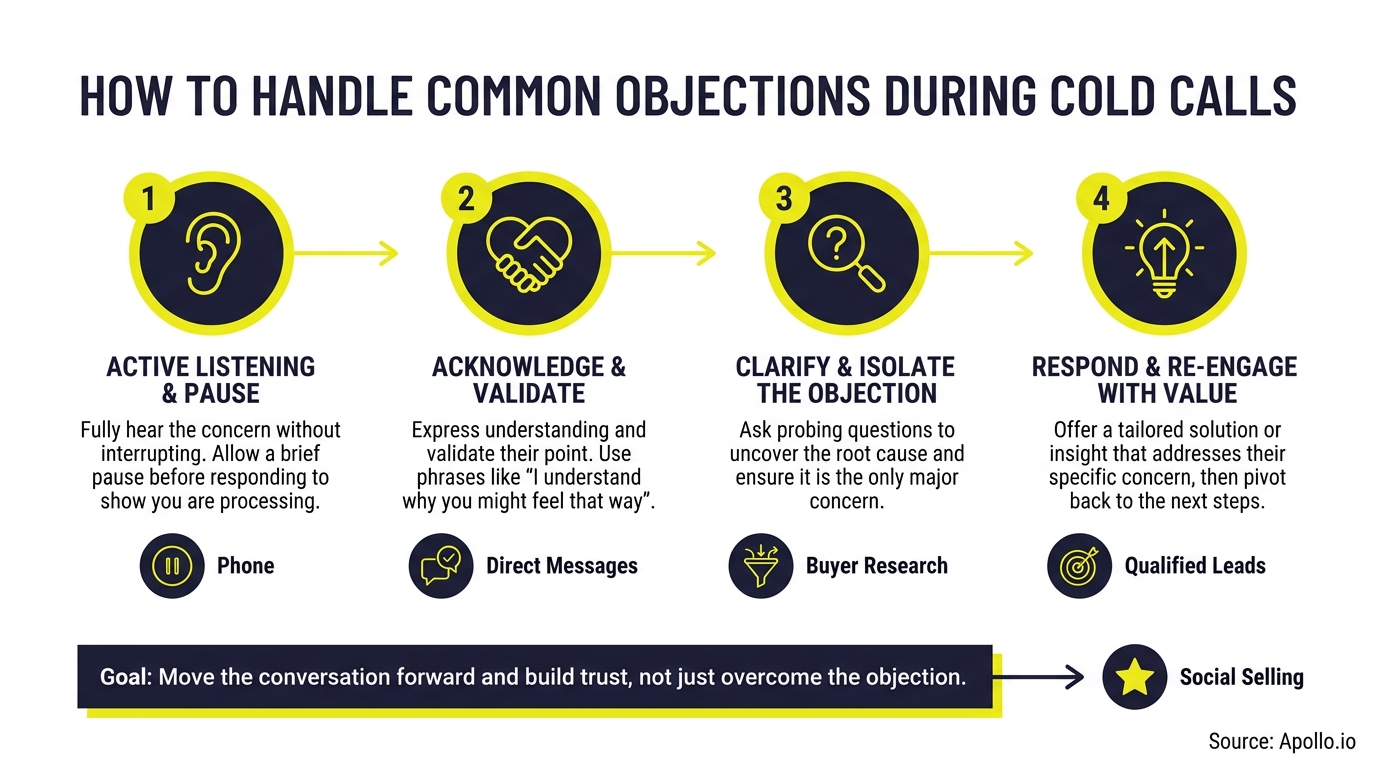
Permission framework for "I'm not interested" or "I'm busy":
- Acknowledge fast: "Totally fair — I'll be quick."
- State a trigger: "I saw [company] just [hired a new VP of Sales / expanded to EMEA / raised a round]."
- Connect to a specific outcome: "We help [similar companies] [specific result] when that happens."
- Ask a micro-question: "Is that on your radar at all?"
For SDRs building outbound prospecting sequences, the opener script should vary by trigger type: hiring signal, funding, tech change, or intent spike. Generic openers produce generic objections. Check out these cold calling tips that actually book meetings for more opener frameworks.

How Should You Map Objection Responses to Buyer Journey Stage?
Objection responses should differ based on where the buyer sits in their journey: pre-shortlist, shortlisted, or in validation. Applying the wrong response type to the wrong stage is a common reason well-intentioned reps still lose the call.
| Stage | Buyer Signal | Best Response Approach |
|---|---|---|
| Pre-shortlist | "Not interested" / "Didn't know this was a problem" | Teach the problem. Use a pattern interrupt + relevant trigger. |
| Shortlisted | "We're evaluating options" / "Already talking to someone" | Differentiate on fit. Ask what's most important in their evaluation. |
| Validation | "Need to talk to my team" / "Need to see ROI" | Enable the champion. Provide a business-case asset they can share internally. |
"I need to talk to my team" is a multithreading opportunity. Treat it as such: ask who else is involved and offer to join a brief call with the full group. For deeper guidance on the full sales objection handling process, including late-stage stakeholder objections, review the complete framework.
Turn Weak Funnels Into Pipeline Gold
Quota pressure mounting while marketing leads stall before they ever reach sales? Apollo surfaces verified, in-market buyers the moment they're ready to engage. Join 600K+ companies converting more leads into real opportunities.
Start Free with Apollo →How Do You Handle "Send Me an Email" Without Losing Momentum?
"Send me an email" is a channel switch, not a close — handle it with a call-to-content follow-up playbook. The goal is to stay in the conversation by sending something specific and timely, not a generic one-pager.
The "Send Me an Email" Follow-Up Playbook:
- On the call:Confirm: "Happy to — what's most relevant to you right now: [option A] or [option B]?" Use their answer to personalize the email.
- Within 60 minutes:Send a short email (3–4 sentences max) with one proof asset: a relevant case study, ROI calculator link, or comparison page.
- Subject line:Reference the call: "Quick follow-up from our call — [their stated priority]"
- Close with a next step: Offer two specific times for a 15-minute call, not an open-ended "let me know."
Pair the follow-up email with smart email personalization to keep the conversation warm. According to Superhuman Prospecting, objections signal that prospects are still engaged — they're opportunities for further conversation, not immediate roadblocks.
Spending too much time manually tracking follow-ups after calls? Automate your post-call sequences with Apollo's multi-channel engagement platform and never lose a warm prospect to a missed follow-up again.
How Do Account Executives Handle Budget and Priority Objections?
Account Executives handle budget and priority objections by reframing the conversation around ROI, not cost. Buyers who say "no budget" or "not a priority" haven't been shown a compelling enough business case — yet.
Business-case script for "No budget right now":
- Validate: "That makes sense — budget cycles are tight."
- Reframe the cost of inaction: "Can I ask — what does [the problem] cost you per quarter if it stays unsolved?"
- Anchor to an outcome: "We helped [similar company] address that and saw [specific result]. I can send you the breakdown."
- Offer a micro-commitment: "Would it be worth 15 minutes to see if the numbers make sense before your next planning cycle?"
For "not a priority": "What would need to change for this to become a priority?" That single question surfaces timing, internal blockers, and competing initiatives — information you can use to resurface at the right moment. Pair this approach with intent data signals to time your outreach when buying interest is actually peaking.
Research from SalesHive shows sellers who successfully address product objections can achieve close rates as high as 64% — making objection preparation one of the highest-leverage skills for any AE. As noted by EBQ, adequately preparing salespeople with proven talk tracks for handling objections often boosts conversion rates across the board.
How Does AI Help Reps Handle Objections More Effectively in 2026?
AI helps reps handle objections more effectively by improving pre-call research, surfacing account signals, and providing real-time response suggestions during live conversations. According to Salesforce's 2026 State of Sales report, 87% of sales organizations now use AI, with 55% applying it specifically to prospecting and outreach preparation.
The practical application for objection handling:
- Pre-call: AI surfaces recent hiring signals, funding events, and intent spikes — giving reps a specific reason to call and a relevant opener.
- During the call: AI call assistants can flag objection types in real time and suggest talk tracks, reducing awkward pauses.
- Post-call: Automated summaries capture objections raised and suggest next-step actions without manual note-taking.
Struggling to research every prospect before dialing? Apollo's AI Call Assistant captures objections, summarizes calls, and recommends next steps automatically — so reps focus on the conversation, not the admin. This kind of unified workflow is why Cyera noted, "Having everything in one system was a game changer."
What Are the Best Practices for Cold Call Objection Handling in 2026?
The best practices for cold call objection handling in 2026 center on relevance, precision, and omnichannel follow-through — not scripted rebuttals. Cold calling is still active: a SalesHive benchmark confirms the average success rate sits between 2% and 3%, but teams using precise targeting and strong objection frameworks consistently outperform that benchmark.
- Prepare before you dial: Know the account's recent signals, likely pain points, and where they are in their buying journey.
- Lead with relevance, not rapport: Buyers don't owe you small talk. State why you're calling in the first sentence.
- Ask one diagnostic question per objection: Don't stack questions. One sharp question surfaces more information than a rebuttal monologue.
- Use proof assets, not promises: Case studies, ROI calculators, and comparison tools convert skeptics. Generic claims don't.
- Treat every channel switch as an opportunity: "Send me an email" means send something exceptional within the hour and propose a next step.
- Thread the buying committee: "I need to talk to my team" is your invitation to ask who's on that team and get introduced.
For more on building the full outbound motion that precedes the call, see how to build a sales prospecting list that converts and sales cadence best practices for winning outbound sequences.

Start Turning Objections Into Pipeline
Handling cold call objections well is a skill built on preparation, relevance, and the right tools — not clever comebacks. Reps who know their buyer's stage, lead with a specific trigger, and follow up with proof assets convert objections into conversations and conversations into meetings.
Apollo gives SDRs, AEs, and sales teams the contact intelligence, AI-powered call tools, and multi-channel engagement features to execute this playbook at scale — all in one platform, without the bloated tech stack. "We reduced the complexity of three tools into one," noted Predictable Revenue after consolidating with Apollo.
Ready to book more meetings from your cold calls? Schedule a Demo and see how Apollo's unified platform helps your team handle objections, follow up faster, and hit quota.
Prove Pipeline ROI With Apollo
Budget approval stuck on unclear metrics? Apollo delivers measurable pipeline impact from day one — so you walk into every review with proof, not promises. Join 600K+ companies justifying every dollar spent.
Start Free with Apollo →Don't miss these
Sales
Inbound vs Outbound Marketing: Which Strategy Wins?
Sales
What Is a Sales Funnel? The Non-Linear Revenue Framework for 2026
Sales
What Is a Go-to-Market Strategy? The 2026 GTM Playbook
See Apollo in action
We'd love to show how Apollo can help you sell better.
By submitting this form, you will receive information, tips, and promotions from Apollo. To learn more, see our Privacy Statement.
4.7/5 based on 9,690 reviews
