
How to Forecast Sales: A Data-Driven Guide for Revenue Leaders
Sales forecasting in 2026 is no longer just a spreadsheet exercise. It's a governance-driven process that demands data quality, cross-functional alignment, and AI-enabled workflows.
With marketing budgets tightening and measurement trust declining, RevOps leaders and Sales Leaders need forecasting methods that quantify uncertainty, segment by buyer archetype, and deliver finance-ready projections. This guide shows you how to build credible forecasts that executives trust and teams can execute against.

Apollo Eliminates 4+ Hours Of Daily Research
Tired of spending 4+ hours daily hunting for contact info? Apollo delivers 224M verified contacts with 96% email accuracy. Join 550K+ companies who turned research time into selling time.
Start Free with Apollo →Key Takeaways
- AI-powered forecasting achieves 85-95% accuracy compared to 60-70% with traditional methods, but only when data quality is strong
- B2B buyers now split preferences across in-person, remote, and digital self-serve channels, requiring segmented conversion models instead of blended funnels
- Forecast governance (audit trails, scenario planning, confidence intervals) is now a competitive requirement as CFOs demand explainable projections
- GenAI tools reduce content production costs and enable faster leading-indicator models, but adoption remains uneven across marketing organizations
- Data quality issues undermine forecast reliability: only 35% of sales professionals trust their CRM data, making triangulation across multiple signals critical
What Is Sales Forecasting and Why Does It Matter in 2026?
Sales forecasting is the process of estimating future revenue based on historical data, pipeline analysis, and market signals. It combines quantitative methods (historical trends, conversion rates, deal velocity) with qualitative inputs (rep commits, market conditions, competitive landscape) to project what your team will close in a given period.
In 2026, forecasting has evolved from a finance exercise to a strategic capability. According to Sopro, 82% of Chief Marketing Officers report increased confidence in forecasting due to AI. Yet trust remains fragile: measurement challenges and data quality gaps force teams to triangulate across multiple signals rather than rely on a single source of truth.
Accurate forecasts drive hiring decisions, budget allocations, and investor confidence. For Revenue Operations teams, forecasting is the foundation for aligning Sales, Marketing, and Finance around shared growth targets.
How Do Sales Leaders Build Accurate Forecasts With Limited Data Trust?
Sales Leaders face a critical challenge: CRM data quality directly impacts forecast reliability, yet only a minority of professionals trust their organization's data. The solution lies in triangulation, combining multiple signal types to validate projections and quantify uncertainty.
Multi-signal triangulation approach:

- Pipeline analytics: Stage progression, deal velocity, win rates by segment
- Activity signals: Email engagement, meeting frequency, call volume (increasingly auto-captured via AI tools)
- Rep commits: Bottoms-up forecasts from Account Executives, adjusted for historical accuracy
- Leading indicators: Marketing qualified leads, demo requests, intent data spikes
- External benchmarks: Industry growth rates, competitive win/loss trends, economic indicators
Research from Scoop Analytics shows that predictive analytics for sales forecasting, using historical data, statistical models, and machine learning, typically achieves 85-95% accuracy, compared to traditional methods that might be 60-70% accurate. This improvement comes from incorporating more variables and reducing human bias.
For teams managing complex pipelines, Apollo's deal management platform provides unified visibility across opportunities, enabling faster anomaly detection and more reliable commit calls.
See Every Deal In Real Time With Apollo
Forecasting a guessing game without live pipeline data. Apollo tracks every deal stage automatically with real-time updates. Built-In boosted win rates 10% with Apollo's scoring and visibility.
Start Free with Apollo →What Are the Core Forecasting Methods Used in B2B Sales?
Different forecasting methods suit different maturity levels and data availability. Most B2B teams use a combination rather than relying on a single approach.
| Method | Best For | Data Requirements | Accuracy Range |
|---|---|---|---|
| Opportunity Stage | Established pipelines with clear stages | CRM with stage history, conversion rates by stage | 70-80% |
| Historical Trend | Stable markets, mature products | 12+ months of closed-won data | 65-75% |
| Length of Sales Cycle | Predictable buying journeys | Deal creation date, close date, cycle time by segment | 75-85% |
| Intuitive (Rep Commits) | Early-stage companies, new products | Rep input, historical accuracy tracking | 60-70% |
| AI-Powered Predictive | High data volume, complex buying signals | Activity data, engagement signals, intent data, pipeline history | 85-95% |
The most sophisticated teams layer multiple methods: AI-powered predictions provide the baseline, stage-based analysis validates pipeline health, and rep commits add qualitative context. This ensemble approach reduces single-point-of-failure risk.

How Do RevOps Teams Segment Forecasts by Buyer Channel and Archetype?
RevOps teams building forecasts in 2026 must account for omnichannel buyer preferences. B2B buyers no longer follow a single path: they split across in-person, remote, and digital self-serve interactions at every stage.
Archetype-based segmentation framework:
- Relationship buyers: Prefer in-person meetings, longer sales cycles (90-180 days), higher deal values. Forecast using stage progression + relationship strength signals.
- Remote-first buyers: Conduct entire process via video/phone, moderate cycles (45-90 days). Forecast using meeting frequency + engagement scoring.
- Digital self-serve: Research independently, shorter cycles (15-45 days), lower ACV. Forecast using product-led signals + trial-to-paid conversion.
Each archetype requires different conversion rates and lag times. Blending them into a single funnel systematically underestimates variance and creates forecast miss risk.
Instead, model each segment separately and aggregate weighted by revenue contribution.
Teams using sales analytics platforms can track these segments in real-time, adjusting forecasts as buyer behavior shifts between channels.
What Role Does AI Play in Modern Sales Forecasting?
AI transforms forecasting from backward-looking (what closed last quarter) to forward-looking (what signals predict future closes). According to TTMS, AI is significantly improving the accuracy of sales forecasts by incorporating more variables like seasonal trends, economic indicators, and pipeline behavior.
AI-enabled forecasting capabilities:
- Deal risk scoring: Flags opportunities likely to slip based on activity drop-off, stakeholder engagement, or stage duration anomalies
- Automated data capture: Reduces manual CRM updates by ingesting email, calendar, and call data automatically
- Scenario modeling: Runs multiple forecast scenarios (best case, likely, worst case) with confidence intervals
- Anomaly detection: Alerts when pipeline coverage drops below target or conversion rates deviate from historical norms
- Narrative generation: Creates executive summaries explaining forecast changes and key drivers
However, AI adoption remains uneven. GenAI tools require clean input data and governance frameworks to deliver reliable outputs.
Teams must establish data quality baselines, validation workflows, and human-in-the-loop review processes before trusting AI-generated forecasts.
Struggling with incomplete contact data that undermines forecast accuracy? Enrich your CRM with Apollo's 224M+ verified business contacts to ensure your pipeline data reflects reality.
How Should Finance and Sales Align on Forecast Governance?
Forecast governance is the framework that ensures projections are credible, auditable, and actionable. In 2026, CFOs demand explainability: what assumptions drive the numbers, what changed since last forecast, and what risks could cause variance.
Governance framework components:
- Assumption documentation: Explicitly state conversion rates, cycle times, and coverage ratios used in each forecast
- Confidence intervals: Provide ranges (e.g., 80% confidence: $2.3M-$2.7M) rather than single-point estimates
- Variance analysis: Compare forecast vs. actual monthly, identify drivers of miss, adjust methodology
- Decision rights: Define who can commit deals, who approves forecast changes, escalation paths for material variance
- Review cadence: Weekly pipeline reviews with Sales, monthly forecast lock with Finance, quarterly methodology audits
Sales Leaders using this governance approach report higher forecast credibility with executives and faster resolution when variance occurs. The framework also protects teams: when forecasts miss due to external factors (market shifts, competitive moves), documented assumptions provide clear explanations.
Start Forecasting With Confidence in 2026
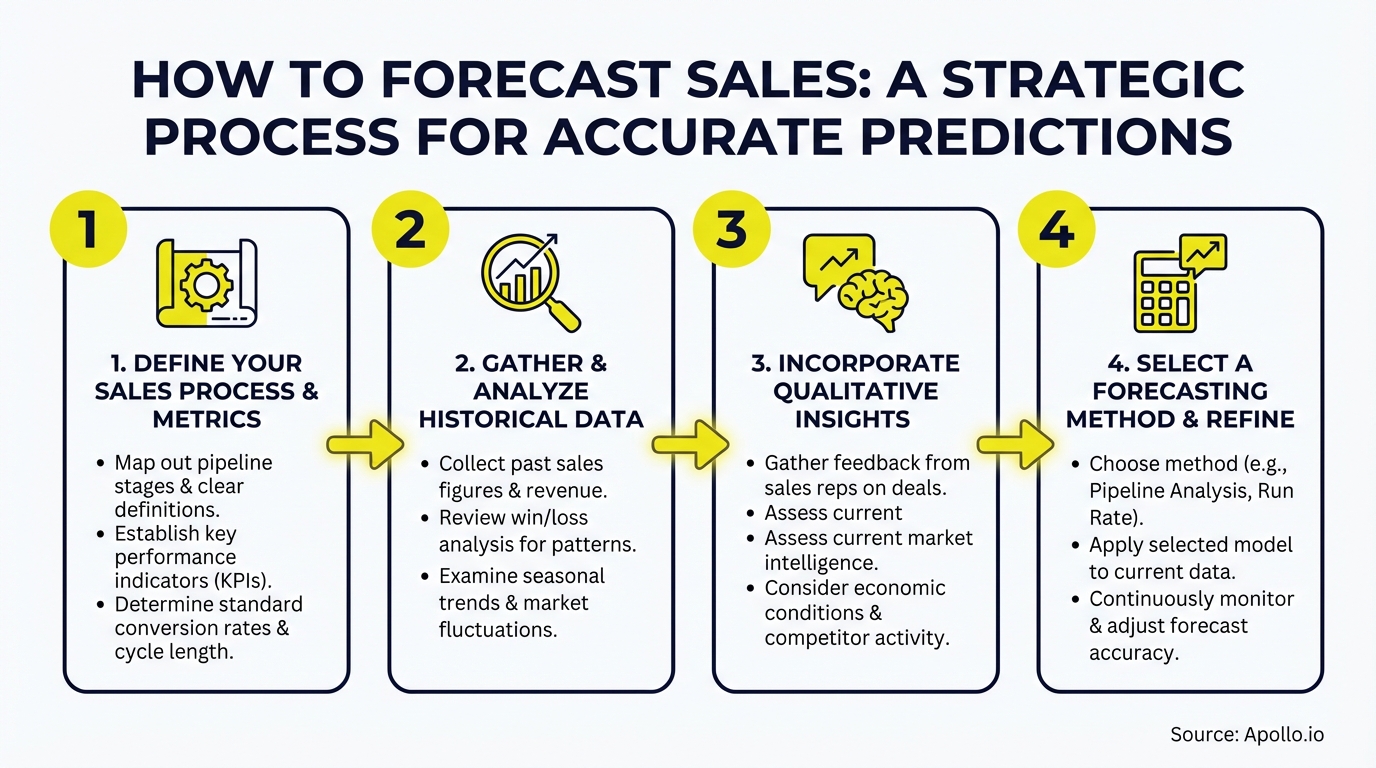
Sales forecasting in 2026 requires more than historical data and spreadsheets. It demands data quality, cross-functional governance, AI-enabled workflows, and segmentation by buyer archetype.
The teams winning with forecasts are those treating it as a strategic capability, not a compliance exercise.
Key implementation steps: establish data quality baselines, implement multi-signal triangulation, segment by buyer channel, deploy AI for anomaly detection, and create governance frameworks that Finance trusts. Start with one improvement area rather than attempting full transformation simultaneously.
For Revenue Operations teams building forecast processes from scratch, focus first on data capture automation and stage-based validation. Add AI-powered predictions and archetype segmentation as your data maturity increases.
Ready to build more accurate forecasts? Get Leads Now with Apollo's all-in-one platform combining data enrichment, pipeline management, and sales intelligence in one workspace.
Prove Apollo's ROI In Your First 30 Days
Budget approval stuck on unclear metrics? Apollo tracks every dollar impact—pipeline generated, meetings booked, deals closed. Built-In increased win rates 10% and ACV 10% with Apollo's measurable insights.
Start Free with Apollo →Don't miss these
Sales
Inbound vs Outbound Marketing: Which Strategy Wins?
Sales
What Is a Sales Funnel? The Non-Linear Revenue Framework for 2026
Sales
What Is a Go-to-Market Strategy? The 2026 GTM Playbook
See Apollo in action
We'd love to show how Apollo can help you sell better.
By submitting this form, you will receive information, tips, and promotions from Apollo. To learn more, see our Privacy Statement.
4.7/5 based on 9,690 reviews
