
How to Dynamically Include Relevant Case Studies and Testimonials
Your best case studies are probably arriving too late. Research from 6sense's 2025 B2B Buyer Experience Report found that the winning vendor appears on buyers' Day One shortlist 95% of the time, and the pre-contact favorite wins roughly four out of five deals. That means your most persuasive customer proof needs to surface before the demo request, matched to who is actually reading it.
Generic logo walls and static PDF case studies no longer move deals. Dynamic proof systems, which select and display the right customer story by industry, persona, buying stage, and objection, are becoming the new baseline for B2B GTM teams. This guide shows you how to build one. You can see how Apollo approaches this with its own real B2B sales success stories and results.

Research Less, Pipeline More With Apollo
Tired of burning hours verifying contact info that goes nowhere? Apollo surfaces accurate, ready-to-contact leads so your reps spend time selling — not searching. Join 600K+ companies building pipeline faster.
Start Free with Apollo →Key Takeaways
- Buyers finalize their shortlist before engaging sales, so proof must appear early and be matched to visitor context, not added as an afterthought.
- Case studies are table stakes. Relevance and placement are now the differentiators.
- A proof data model with consistent tagging by industry, role, company size, use case, and objection is the foundation of any dynamic system.
- AEs and SDRs need instant access to objection-matched proof, not just a shared Google Drive folder of PDFs.
- Structuring proof assets with clear metadata makes them retrievable by both human buyers and AI answer engines.
Why Does Dynamic Proof Outperform Static Case Studies?
Dynamic proof outperforms static case studies because relevance, not volume, drives buyer confidence. According to fryerhq.co.nz, 73% of B2B buyers consider case studies a key factor in purchasing decisions. But showing a manufacturing buyer a fintech case study, or showing an enterprise security team a startup story, erodes credibility rather than building it.
Research from Growleads shows that 80% of B2B buyers use case studies during their research, with 42% finding them valuable across both middle and late buying stages. The implication: proof must be present at multiple touchpoints, not just the proposal stage.
Buyers also use proof to answer specific questions, not just feel good about a vendor. The right testimonial addresses a concrete objection, validates a use case, or confirms an ROI assumption.
Generic praise does none of these things.
What Is a Proof Data Model and How Do You Build One?
A proof data model is a structured tagging taxonomy applied to every case study and testimonial you own, enabling rules-based or AI-driven selection. Without it, personalization is guesswork.
Tag every proof asset across these dimensions:
| Dimension | Example Values |
|---|---|
| Industry | SaaS, Manufacturing, Financial Services, Healthcare, Logistics |
| Company Size | Startup (1-50), SMB (51-500), Mid-Market (501-2,500), Enterprise (2,500+) |
| Buyer Persona / Role | SDR/BDR, AE, RevOps, VP Sales, CMO, Founder |
| Use Case | Outbound prospecting, pipeline acceleration, data enrichment, sales coaching |
| Objection Addressed | Price, implementation complexity, data quality, security/compliance, ROI proof |
| Buying Stage | Awareness, Consideration, Decision, Renewal |
| Outcome Type | Revenue increase, time saved, cost reduction, team efficiency, faster ramp |
Once every asset is tagged, you can build selection logic: "If visitor industry = Healthcare AND company size = Enterprise AND page = Pricing, show healthcare enterprise ROI case study." This is the core of a high-converting B2B marketing funnel that uses proof at the right moment.

How Do You Build a Dynamic Proof Decision Engine?
A dynamic proof decision engine selects and surfaces the most relevant case study or testimonial based on real-time visitor or account signals. The signals you use depend on your tech stack and data maturity.
Signal sources to connect:
- Firmographic data: Industry, company size, geography from IP or CRM enrichment
- Intent signals: Pages visited, content downloaded, topics researched (see how intent data powers smarter B2B sales)
- CRM stage: Prospect, active opportunity, late-stage, renewal
- Ad audience or UTM source: Campaign-specific landing pages show segment-matched proof
- Self-declared data: Form fields, chatbot answers, filter selections on your case study library
Sample decision logic:
- Visitor from financial services + viewed security page = show FinServ security/compliance case study
- SDR persona + pricing page = show testimonial addressing ROI and quota attainment
- Enterprise account in CRM + late stage = show buying-committee enablement story with implementation proof
Companies excelling at this level of personalization generate 40% more revenue than average players, according to omnibound.ai's 2026 B2B content marketing data.
Struggling to qualify and segment your prospects before proof even enters the picture? Use Apollo's 65+ filters to build precise prospect lists by industry, role, and company size before your proof engine ever fires.
Turn Funnel Guesswork Into Pipeline Wins
Quota missed because leads stall before they ever become opportunities? Apollo surfaces in-market buyers and tracks deal momentum so your forecast finally reflects reality. Join 600K+ companies closing with confidence.
Start Free with Apollo →What On-Page Proof Modules Work Best for B2B Websites?
On-page proof modules are discrete, reusable content blocks that display dynamically based on visitor context. Moving from a static case study page to modular proof blocks gives you flexibility across every surface.
High-impact module types:
- ROI card: Customer name, industry, specific outcome metric, one-sentence quote. Place on pricing pages and product pages.
- Peer-proof carousel: 3-5 rotating testimonials filtered by the visitor's detected industry. Place on homepages and solution pages.
- Objection-handling snippet: A short quote that directly addresses the most common objection for that page (e.g., "We were worried about implementation time, but we were live in two weeks."). Place near CTAs and pricing.
- RFP-ready proof block: Full case study summary with challenge, solution, measurable outcome, and integration detail. Place in digital sales rooms and proposal templates.
- Industry logo strip: Dynamic logo display showing only logos from the visitor's detected sector, not a random wall of brands.
Each module should be built as a self-contained content block with its own metadata so it can be pulled into email sequences, multi-channel sales sequences, chatbot flows, retargeting ads, and proposal decks without reformatting.
How Should AEs and SDRs Use Dynamic Proof in Live Deals?
AEs and SDRs should use proof as a real-time validation tool, not a post-meeting follow-up. A May 2026 Gartner survey found that 69% of B2B buyers want sales reps to validate AI-generated insights, which means reps who enter conversations armed with the right customer story for that specific account, objection, and stage will consistently outperform those relying on generic decks.
How AEs can deploy proof dynamically in deals:
- Before discovery: Pull the 1-2 case studies matching the prospect's industry and company size from your proof library
- During objection handling: Map common objections to specific testimonials (price objection = cost-reduction story; security objection = enterprise compliance story). See the full sales objection handling playbook for frameworks.
- For buying committee enablement: Send role-specific proof to each stakeholder. The CFO gets an ROI story. The IT lead gets an implementation and security story. The end-user champion gets a day-in-the-life efficiency story.
- At renewal: Share a case study from a similar company that expanded use, addressing the "Is this worth renewing?" question before it's asked.
For SDRs running high-volume outbound, proof snippets embedded in sequences increase reply rates by giving prospects a credible reason to engage. A one-line customer result relevant to the prospect's role beats a generic feature list every time.
Want to match the right proof to the right account automatically? Apollo's multi-channel sales engagement platform lets you embed dynamic proof snippets into personalized sequences at scale, so every touchpoint feels relevant without manual customization.
How Do You Structure Proof Assets for AI and Answer Engine Discovery?
Structuring proof assets for AI discovery means writing case studies and testimonials so that both human buyers and AI answer engines can extract and cite the right story. As Forrester noted in February 2026, third-party validation from successful customers is increasingly important for discoverability in answer engines, not just for direct buyer persuasion.
Structural requirements for AI-readable proof:
- Open every case study with a one-sentence declarative summary: "[Customer], a [industry] company with [size] employees, reduced [specific outcome] by [result] using [product]."
- Use named sections: Challenge, Solution, Results, Integration Details, Security/Compliance Notes
- Include measurable outcomes in the headline and first paragraph, not buried in the body
- Add FAQ-style sections that answer buyer questions directly: "How long did implementation take?" "What integrations are supported?"
- Apply schema markup (CustomerReview, CaseStudy entity patterns) to help search and AI tools extract structured data
- Avoid gating high-value proof behind forms; self-service buyers and AI crawlers both need ungated access
This structure also supports high-converting sales sheet templates that pull proof directly into printed or digital leave-behinds.
How Do You Build a Scalable Proof Library That Stays Current?
A scalable proof library is a tagged, searchable repository of modular proof assets that your marketing, sales, and RevOps teams can query by any dimension in your data model. According to Zixflow, 40% of B2B organizations are already using real-time reviews alongside case studies to build long-term rapport, which means your library needs live review feeds, not just annual PDF refreshes.
Operational steps to build and maintain it:
- Set a quarterly cadence for capturing new customer stories via short interview or survey
- Build a tagging checklist (using your proof data model dimensions) that every new asset must pass before publishing
- Connect your review platforms (G2, Capterra, Trustpilot) via API to pull live quotes into your proof library automatically
- Create a "proof request" intake form so AEs can flag gaps: "I need a case study for a 500-person logistics company with a security objection"
- Audit the library quarterly: retire outdated metrics, refresh quotes, and identify coverage gaps by industry or persona
RevOps leaders building this system should connect the proof library to the CRM so deal stage automatically triggers the right proof recommendation for the rep. This is the same principle that drives a strong revenue operations strategy: one source of truth, automatically surfaced at the right moment.

Start Turning Customer Proof Into a Revenue System
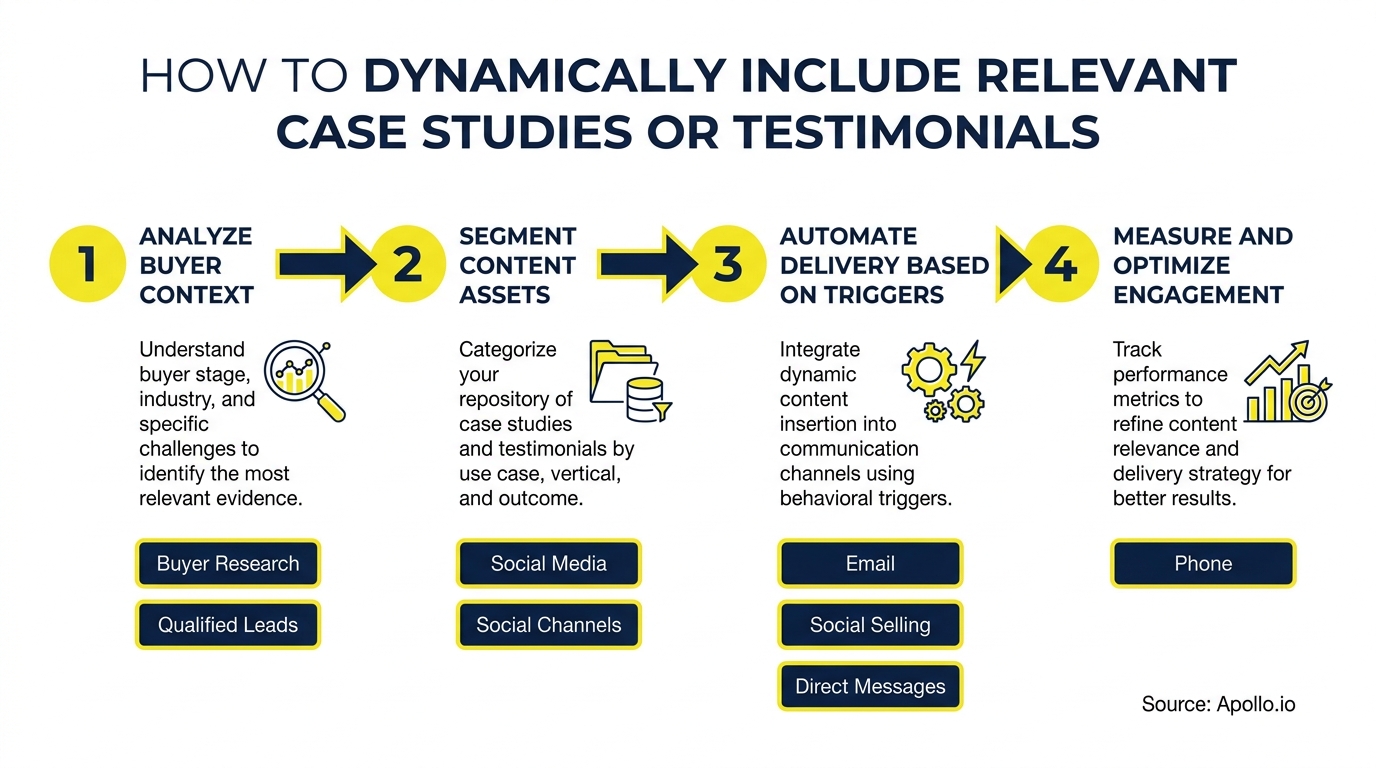
Dynamic proof is not a design project. It is a revenue system.
When you tag your assets, build selection logic, deploy modular on-page blocks, and equip your AEs and SDRs with objection-matched stories, customer proof stops being a marketing deliverable and starts driving pipeline and close rates.
The teams winning in 2026 are not the ones with the most case studies. They are the ones surfacing the most relevant story to the right buyer, at the right moment, across every channel.
Apollo helps B2B GTM teams from SDRs to enterprise revenue leaders consolidate prospecting, engagement, and data into one unified platform, so every outreach and sequence can carry the right proof at the right stage. Trusted by nearly 100K paying customers including Anthropic, Smartling, and Redis, Apollo gives your team the signal and automation to make every touchpoint count. Start a free trial and see how Apollo powers personalized, proof-backed outreach at scale.
Prove Pipeline ROI From Day One
ROI pressure killing your tool budget before it even starts? Apollo delivers measurable pipeline impact fast — with 35% more bookings via AI-powered messaging. Join 600K+ companies that justified the investment.
Start Free with Apollo →Don't miss these
Sales
Inbound vs Outbound Marketing: Which Strategy Wins?
Sales
What Is a Sales Funnel? The Non-Linear Revenue Framework for 2026
Sales
What Is a Go-to-Market Strategy? The 2026 GTM Playbook
See Apollo in action
We'd love to show how Apollo can help you sell better.
By submitting this form, you will receive information, tips, and promotions from Apollo. To learn more, see our Privacy Statement.
4.7/5 based on 9,690 reviews
