
How to Determine Which Communication Channel Works Best for a Specific Segment
Picking the wrong channel for a segment doesn't just waste budget — it actively signals to buyers that you don't understand them. In 2026, Gartner reportsthat 67% of B2B buyers prefer a rep-free experience, which means your channel decisions now need to start with a single question: does this segment want to buy with or without a sales rep? Getting that answer right — by segment, not by gut feel — is what separates teams that build pipeline from those that burn it. A strong marketing framework starts with this segmentation step.

Scale Pipeline Without the Manual Grind
Tired of your reps burning hours on research instead of selling? Apollo surfaces verified contacts and automates outreach so your team scales without adding headcount. Join 600K+ companies building predictable pipeline.
Start Free with Apollo →Key Takeaways
- Segment by rep-free readiness first, then match channels to that preference — not the other way around.
- Email remains the most preferred contact channel among B2B buyers, but effectiveness varies significantly by segment, deal size, and funnel stage.
- Channel decisions should output a sequence (e.g., website → video call → sales), not a single destination.
- Self-serve segments need risk-reduction content (ROI calculators, implementation guides) to prevent purchase regret.
- Measure channel fit with pipeline outcomes and incrementality tests — not open rates or impressions.
Why Does Segment-Aware Channel Selection Matter in 2026?
Segment-aware channel selection matters because buyers in different segments behave fundamentally differently, and a channel that converts one segment can repel another. B2B buyers now use an average of 10 interaction channels in a single buying journey, according to McKinsey's B2B Pulse research — up from five in 2016.
Treating all segments with the same channel mix means you're optimizing for the average buyer, who doesn't actually exist.
The practical implication: stop asking "which channel works?" and start asking "which channel works for this segment at this stage?" A high-intent renewal buyer needs a frictionless self-serve portal. A first-time enterprise evaluator with a seven-person buying committee needs video, peer validation, and a rep. These are not the same motion.
According to The Insight Collective, 83% of B2B buyers prefer email contact from sellers during the purchasing process — but that preference shifts based on deal complexity, seniority, and segment type. Context always wins over channel defaults.
How Do You Build a Segment-to-Channel Fit Framework?
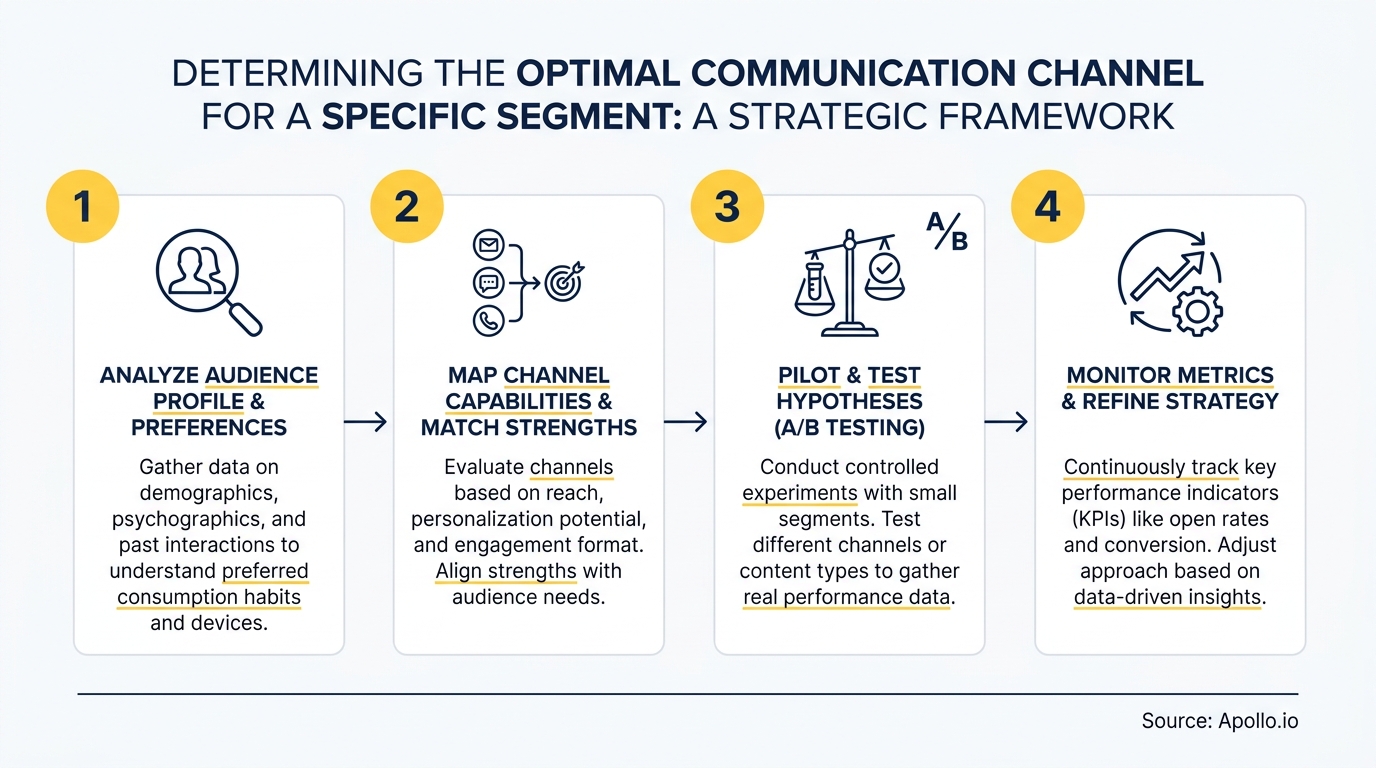
A Segment-to-Channel Fit framework maps each segment's characteristics to a prioritized channel sequence, not a single channel. Score each segment across four inputs before assigning channels.
| Input | Low Score Signal | High Score Signal |
|---|---|---|
| Rep-Free Readiness | First-time buyer, complex use case | Returning buyer, standardized SKU |
| Deal Complexity | Multi-stakeholder, custom pricing | Single buyer, fixed pricing |
| Segment Seniority | C-suite, low email tolerance | Practitioner, high email engagement |
| Funnel Stage | Awareness (needs discovery) | Decision (needs confirmation) |
High-scoring segments (rep-free ready, low complexity, practitioner-level) map to self-serve channels: website, chat, email sequences, and in-product flows. Low-scoring segments (rep-dependent, high complexity, executive buyers) map to assisted channels: phone, video conferencing, and in-person.
Most segments fall somewhere in between and need a hybrid sequence.
A Reddit user in the r/internalcomms community shared a firsthand perspectiveon exactly this kind of tiered logic: "Emergencies/business stoppages = all channels. Must know/actionable = weekly newsletter, Slack, push notification. Nice to know = intranet notification only." The same urgency-and-applicability logic applies directly to B2B segment-channel mapping.

What Channel Sequences Work Best by Segment Type?
The best channel sequences depend on where a segment sits on the rep-free readiness spectrum.
Below are three tested templates SDRs, AEs, and marketing teams can adapt immediately.
| Segment Type | Primary Channel | Sequence | Key Content Asset |
|---|---|---|---|
| High-intent returning buyer | Website / portal | Website → email confirmation → chat | Renewal comparison page |
| SMB practitioner (new) | Email → social proof → demo booking | ROI calculator | |
| Mid-market with buying committee | Phone + video | Phone → video demo → email follow-up | Implementation guide |
| Enterprise first-time evaluator | In-person / video | Social discovery → rep outreach → video → in-person | Security checklist + business case |
For SDRs running outbound:timing matters as much as channel choice. A Spring 2025 benchmark from memoryBlue, analyzing over 321,000 booked meetings, found that 85% of meetings were booked via phone — while email and professional social networks accounted for 8% and 7% respectively. Phone dominates for certain segments, but only when paired with the right timing and message.
Spending hours stitching together manual outreach across channels? Automate segment-specific sequences with Apollo's multi-channel sales engagement platform.
Turn Funnel Guesswork Into Closed Deals
Forecasts feeling like fiction because quality leads never materialize. Apollo surfaces verified, in-market prospects so your pipeline reflects reality. Nearly 100K paying customers stopped guessing and started closing.
Start Free with Apollo →How Do SDRs and AEs Calibrate Channel Choice by Segment?
SDRs should calibrate channel choice by testing one variable at a time per segment, not by copying a generic cadence. For outbound-heavy motions, start with the channel most native to the segment's daily workflow — phone for finance and operations personas, email for technical evaluators, professional social for marketing and product roles.
For AEs managing active opportunities, channel selection shifts to reducing friction and building consensus. Admix Global reports that 89% of B2B buyers are more likely to purchase from sales representatives who demonstrate a clear understanding of their business mission and objectives. Channel choice is a signal of that understanding: sending a 40-slide PDF to a time-pressed CFO signals you don't know them; sending a two-minute video summary does.
RevOps leaders can support both motions by building segment-level channel dashboards in the CRM. Track meetings booked, reply rates, and pipeline created by channel per segment — not just total volume. This turns channel selection from opinion into data. See how RevOps teams drive sales transformation with this kind of systematic approach.
How Do You Reduce Purchase Regret for Self-Serve Segments?
Self-serve segments carry a higher downstream risk: buyers who convert without rep guidance show measurably higher purchase regret rates. The antidote is building risk-reduction content directly into the self-serve channel experience.
Must-have content modules by stage:
- Pre-purchase: ROI calculator, feature comparison page, security/compliance FAQ, peer case studies
- At decision: Implementation timeline, onboarding checklist, integration compatibility guide
- Post-purchase: Quick-start video, milestone tracker, escalation path to live support
A Reddit commenter added in a Reddit discussion that their team filters all communications through a "70% applicability" test — only pushing broad channel messages when the content is relevant to at least 70% of the audience. For self-serve segments, apply the same logic: only surface content that directly addresses that segment's specific objection or uncertainty, not generic product information.
Not sure which contacts in your self-serve segments actually have verified emails and phone numbers? Enrich your segment lists with Apollo's 230M+ verified business contacts before you build the sequence.
How Do You Measure Channel Fit per Segment?
Measure channel fit per segment using pipeline outcomes, not engagement vanity metrics. Open rates and click-through rates measure attention; meetings booked, opportunities created, and deals won measure fit.
Core metrics to track by segment and channel:
- Conversion rate by channel: What percentage of touches in each channel produce a next step?
- Time-to-close by channel mix: Do segments that enter via phone close faster than email-only?
- Regret proxies: Churn rate, support escalations, and refund requests within 90 days of self-serve conversion
- Incremental pipeline: Use holdout tests to determine which channels add pipeline rather than just claiming it
Research from Join Valley shows digital channels accounted for 45% of B2B revenue in the US in 2023, up from 34% in 2021. This trajectory makes segment-level digital channel measurement a core competency, not a nice-to-have. Pair channel data with accurate sales forecasting to make the business case for channel investment by segment.
For B2B email specifically, Sopro reports that 73% of B2B buyers want vendors to contact them via email — making it a safe default channel for most segments, but still one that requires segment-specific subject lines, timing, and content to perform. See what email subject lines actually convert for B2B segments.

How Do You Put This Into Practice?
Determining the best communication channel for a specific segment comes down to three repeatable steps: score the segment on rep-free readiness and deal complexity, assign a channel sequence (not a single channel), and measure with pipeline outcomes. Avoid the trap of defaulting to the channel your team is most comfortable with — default to the channel your segment prefers.
For marketing leaders building a scalable B2B marketing tool stack, channel orchestration is only as good as the data underneath it. Clean, enriched, segment-level contact data is the foundation. Without it, even the best channel framework produces noise.
Apollo consolidates prospecting, multi-channel sequencing, and pipeline tracking in one workspace — so SDRs, AEs, and RevOps teams can run segment-specific channel experiments without managing five separate tools. As Cyera's team put it: "Having everything in one system was a game changer."
Try Apollo Free and start building segment-aware channel sequences backed by 230M+ verified contacts today.
Prove Pipeline ROI With Apollo
Budget approval stuck on unclear metrics? Apollo delivers measurable pipeline impact your leadership can see — fast. Leadium 3x'd annual revenue after making the switch. Start your free trial today.
Start Free with Apollo →Don't miss these
Sales
Inbound vs Outbound Marketing: Which Strategy Wins?
Sales
What Is a Sales Funnel? The Non-Linear Revenue Framework for 2026
Sales
What Is a Go-to-Market Strategy? The 2026 GTM Playbook
See Apollo in action
We'd love to show how Apollo can help you sell better.
By submitting this form, you will receive information, tips, and promotions from Apollo. To learn more, see our Privacy Statement.
4.7/5 based on 9,690 reviews
