
How to Customize Sales Strategies for Different Industry Verticals in 2026
Generic sales pitches are losing deals. According to Martal, 80% of buyers expect a personalized experience, and companies that tailor their outreach achieve 38% higher sales win rates. Yet most B2B teams still run the same playbook across every vertical they touch.
The shift happening in 2026 goes beyond messaging polish. Vertical customization now means building a full operating model: selecting the right verticals, mapping buyer journeys by industry, aligning sales and marketing, and deploying self-service enablement assets that convert without a rep in the room. This article gives you that model. For complementary tactics, see Sales Strategies That Close: 4 Rules Top B2B Sellers Swear By.

Let Apollo Find Your Next Buyer
Tired of burning hours verifying contact info before a single email goes out? Apollo surfaces accurate, ready-to-engage prospects so your team sells instead of searches. 600K+ companies have already made the switch.
Start Free with Apollo →Key Takeaways
- Vertical-specific outreach consistently outperforms generic messaging on win rates, making industry customization a revenue lever, not a nice-to-have.
- Choose verticals by scoring revenue potential, deal repeatability, and sales-cycle impact before building any playbook.
- Map buyer-journey assets to each funnel stage per vertical: awareness content, ROI calculators, risk checklists, and deployment timelines all serve different buying moments.
- Sales and marketing must co-own vertical strategy. Low cross-functional alignment is one of the most common and costly gaps in B2B GTM execution.
- SDRs and AEs executing vertical plays need consistent messaging across every channel, because today's buyers research independently before engaging a rep.
How Do You Choose Which Industry Verticals to Prioritize?
Prioritize verticals by scoring three factors: revenue potential, deal repeatability, and sales-cycle impact. Without a structured selection process, teams spread resources across too many industries and win in none of them.
Use this scorecard to rank candidate verticals:
| Scoring Factor | What to Measure | Weight |
|---|---|---|
| Revenue Potential | Total addressable accounts x average ACV in that vertical | 40% |
| Deal Repeatability | Win rate consistency, reference customer density, similar buyer profiles | 35% |
| Sales-Cycle Impact | Average days-to-close vs. company benchmark, number of stakeholders | 25% |
Research from MarketBridge shows that industry-specific targeting with single account ownership boosts Average Contract Values by 40% compared to hunter-farmer models. Score at least five candidate verticals before committing resources to any playbook build. RevOps leaders should own this scoring process and refresh it each quarter.
What Is a Vertical Sales Strategy Matrix?
A Vertical Sales Strategy Matrix maps your buyer-journey stages to the specific assets, channels, and proof points each vertical needs at each stage. It replaces ad hoc content requests with a systematic, repeatable framework.
| Buyer Stage | Asset Type | Vertical Example (Healthcare) | Vertical Example (FinServ) |
|---|---|---|---|
| Awareness | Thought leadership, industry benchmarks | HIPAA compliance cost report | AML regulatory change brief |
| Consideration | Case studies, comparison pages | EHR integration case study | SOC 2 audit readiness comparison |
| Decision | ROI calculator, deployment checklist | 90-day go-live timeline | Risk mitigation scorecard |
| Post-Sale | Expansion triggers, success metrics | Patient outcome KPI dashboard | Compliance audit pass rate tracker |
As noted in Elefante RevOps, modern B2B sales success hinges on deeply understanding industry-specific pain points and aligning products and GTM strategies accordingly. Build one matrix per priority vertical and review it quarterly with both sales and marketing input. For deeper pipeline thinking, explore sales performance management strategy.
Turn Funnel Gaps Into Pipeline Gold
Tired of watching marketing leads die before they reach your pipeline? Apollo surfaces high-intent prospects ready to engage — so your team stops chasing and starts closing. Nearly 100K paying customers can't be wrong.
Start Free with Apollo →How Should SDRs and AEs Execute Vertical Plays Differently?
SDRs and AEs each own different moments in the vertical buying journey and need role-specific execution guides within every vertical playbook.
SDRsshould lead with vertical-specific triggers: a regulatory change, a funding event, or a published industry benchmark. Their outreach sequences should reference the vertical pain point in the first line, not the product. For smarter prospecting by industry, SDRs need filtered contact lists segmented by vertical, job function, and company signal, not just company size.
AEs managing deals in complex verticals must prepare buying-group-specific talk tracks. A CFO in healthcare cares about reimbursement risk; an IT lead cares about EHR compatibility. For enterprise accounts, review Enterprise Sales: Mega Deals, Executive Access, Winning Strategies for proven multi-stakeholder approaches.
Need to find decision-makers inside your priority verticals fast? Search Apollo's 230M+ contacts with 65+ filters to build vertical-specific prospect lists in minutes.
What Buyer-Enablement Assets Make Vertical Selling Rep-Free?
Buyer-enablement assets let prospects self-qualify and self-educate within your vertical before a rep is involved. Gartner reported in 2025 that 61% of B2B buyers prefer a rep-free buying experience, and 69% see inconsistencies between supplier websites and sales reps.
Vertical-specific self-service assets close that gap.
Build these four assets for each priority vertical:
- ROI Calculator: Input fields mapped to vertical KPIs (e.g., cost-per-claim for healthcare, bps saved for FinServ).
- Risk Checklist: Industry-specific compliance, security, or operational risks your solution addresses.
- Deployment Timeline: A realistic go-live schedule referencing vertical-specific integration complexity.
- Escalation Triggers: Clear signals for when a prospect should book a call (e.g., "If you're managing 500+ endpoints, speak with our enterprise team").
Consistency across web, SDR outreach, and sales decks is non-negotiable. When a buyer researches independently and then talks to your SDR, the vertical proof points must match exactly.

How Do Sales and Marketing Align on Vertical Strategy?
Sales and marketing alignment on vertical strategy requires shared CRM fields, a joint enablement review cadence, and a structured win/loss feedback loop. Without this infrastructure, vertical content gets built once and never updated.
Use this alignment checklist:
- CRM Fields: Tag every contact and opportunity with vertical, sub-vertical, and buyer persona. RevOps owns this taxonomy.
- Enablement Review Cadence: Monthly 30-minute sync between sales enablement and content marketing to review asset usage and gaps by vertical.
- Win/Loss Feedback Loop: AEs log the top vertical objection from every closed-lost deal. Marketing uses it to update the corresponding buyer-enablement asset within 30 days.
- Shared KPIs: Both teams report on vertical pipeline contribution, not just MQLs or opportunities in isolation.
For RevOps leaders driving sales transformation, this alignment model is the operational backbone of any vertical GTM motion. Spending hours syncing data across disconnected tools? Apollo's unified platform connects prospecting, sequencing, and CRM in one workspace, so vertical plays run without the tool-switching tax.
How Does Omnichannel Execution Differ by Vertical?
Omnichannel execution differs by vertical because each industry has preferred channels, buying rhythms, and digital comfort levels. A one-channel approach will miss large portions of your buying group regardless of how good your messaging is.
Channel mix guidance by vertical:
- Healthcare and Life Sciences: In-person events and peer referrals carry high weight. Supplement with case study email sequences and compliance-specific landing pages.
- Financial Services: Executive briefings and regulatory webinars convert well. Digital self-serve works for mid-market; enterprise still prefers a rep for final-stage decisions.
- Technology: Digital-first. Buyers research independently via review sites, documentation, and community forums before engaging sales.
- Manufacturing: Longer cycles with procurement involvement. Prioritize ROI calculators, total-cost-of-ownership tools, and partner-channel plays.
Track channel performance per vertical inside your CRM. Sales analytics at the vertical level reveals which channels accelerate pipeline and which stall it, so you can reallocate budget with confidence.

Start Building Your Vertical Sales Playbook Today
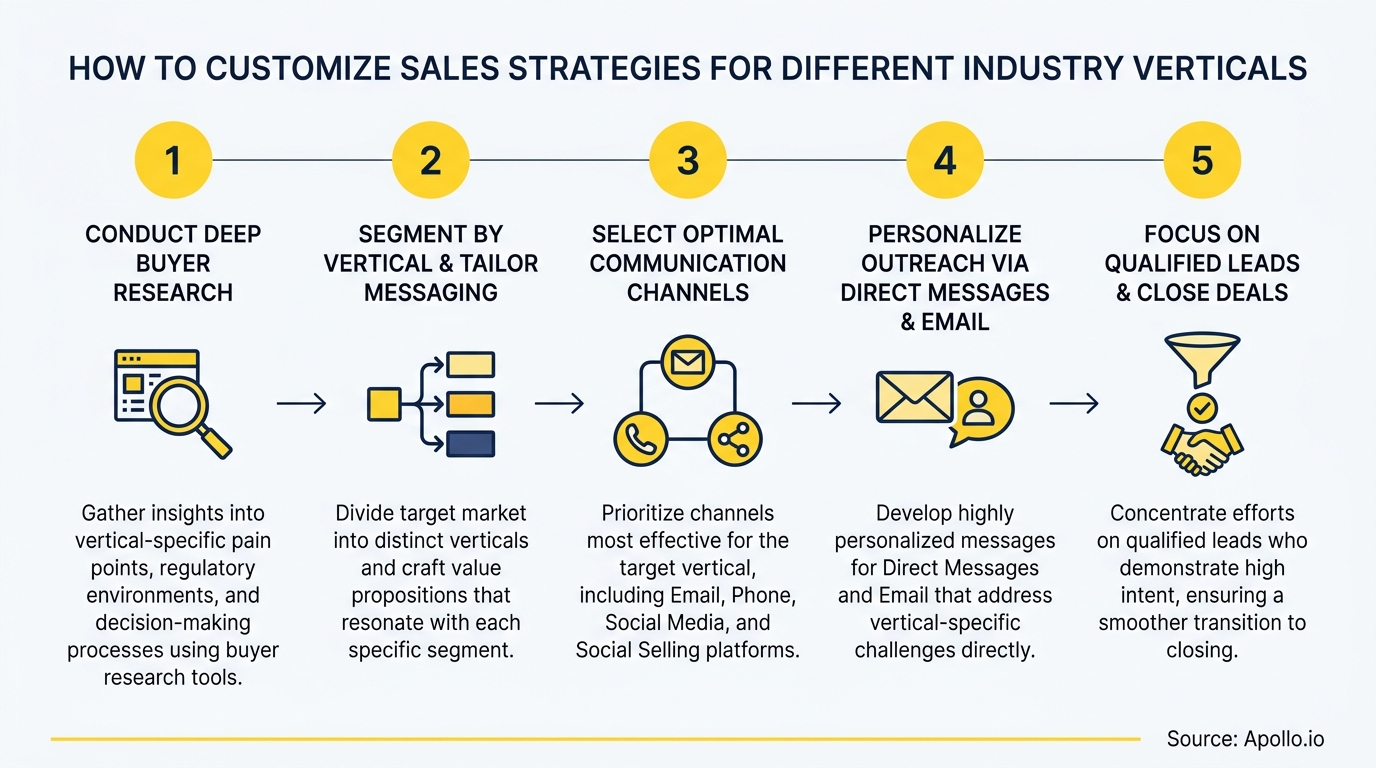
Customizing sales strategies for different industry verticals is a systematic process: score and select verticals, build a buyer-journey matrix, create rep-free enablement assets, align sales and marketing around shared data, and execute omnichannel plays tailored to each industry's buying behavior.
Teams that execute this model consistently outperform those running horizontal playbooks. The data, the buyer expectations, and the competitive pressure all point in the same direction: vertical fluency is now a core revenue driver, not a differentiator reserved for large companies.
Apollo gives B2B GTM teams the unified platform to find vertical-specific prospects, run industry-tailored sequences, and track pipeline by vertical without stitching together multiple tools. As Cyera put it: "Having everything in one system was a game changer." Start a free trial and build your first vertical playbook with Apollo.
Prove Pipeline ROI From Day One
ROI pressure killing your next budget approval? Apollo delivers measurable pipeline impact fast — so you walk into every review with real numbers. Leadium 3x'd their revenue. Your turn.
Start Free with Apollo →Don't miss these
Sales
Inbound vs Outbound Marketing: Which Strategy Wins?
Sales
What Is a Sales Funnel? The Non-Linear Revenue Framework for 2026
Sales
What Is a Go-to-Market Strategy? The 2026 GTM Playbook
See Apollo in action
We'd love to show how Apollo can help you sell better.
By submitting this form, you will receive information, tips, and promotions from Apollo. To learn more, see our Privacy Statement.
4.7/5 based on 9,690 reviews
