
How to Continuously Improve Your Sales Approach Using Platform Analytics
Most sales teams track metrics. Few actually change their behavior because of them. Sales analytics drives revenue growth only when it closes the loop between signal and action, and that gap is where most teams stall. This article gives you a practical, closed-loop framework to continuously improve your sales approach using platform analytics in 2026.

Let Apollo Find Your Next Buyer
Tired of burning hours verifying contact info that goes nowhere? Apollo surfaces accurate, ready-to-engage prospects so your team sells instead of searches. Nearly 100K paying customers have already made the switch.
Start Free with Apollo →Key Takeaways
- Dashboards don't improve sales — behavior changes do. Analytics only works when ownership, cadence, and action are explicitly assigned.
- By the time a deal appears at risk in your CRM, the warning signs often surfaced earlier in call transcripts, intent data, or content engagement.
- Message inconsistency is a hidden revenue leak: when your website, decks, and outreach contradict each other, buyers disengage before you even know they're evaluating.
- RevOps leaders who unify GTM data across channels get a clearer signal for where to improve seller behavior and buyer-stage messaging.
- Weekly analytics reviews with assigned owners outperform monthly reporting reviews in driving measurable seller behavior change.
What Is the Analytics-to-Action Loop and Why Does It Matter?
The analytics-to-action loop is a closed-loop operating system where platform signals trigger specific seller behavior changes on a defined cadence. Without it, analytics becomes reporting theater: numbers reviewed, nothing changed. According to research cited by Lead Forensics, Gartner predicts that by 2028, 60% of B2B sales work will be conducted through conversational AI interfaces, making structured analytics frameworks essential now.
The loop has four components:
- Signal sources: CRM stage data, call transcripts, email engagement, intent data, win/loss notes, and content consumption
- Owners: RevOps owns data integrity; sales managers own behavior response; reps own execution
- Cadence: Weekly analytics review (pipeline + activity), monthly message consistency audit, quarterly strategy adjustment
- Experiment backlog: A prioritized list of hypothesis-driven changes (e.g., "Change subject line for CFO persona based on low open rate")
Sales leaders who assign KPI ownership and review cadence before layering on more tooling see far better outcomes. The signal is only as useful as the decision it triggers.
How Do RevOps Leaders Use Platform Analytics to Drive Seller Improvement?
RevOps leaders use platform analytics to identify where pipeline stalls, which messages resonate, and which rep behaviors correlate with closed revenue. Research from Digital Commerce 360 found that B2B organizations utilizing RevOps were 1.4 times as likely to exceed their 2023 revenue goals by 10% or more.
For RevOps teams building a weekly analytics review, focus on these KPIs and the actions they should trigger:
| Signal | KPI to Track | Action Triggered |
|---|---|---|
| Email reply rate drops | Open rate, reply rate by sequence | Rewrite subject lines; A/B test persona-specific hooks |
| Stage 2-to-3 conversion falls | Pipeline velocity by rep | Review discovery call recordings; update talk track |
| Win rate declines vs. specific competitor | Win/loss by competitive tag | Update battle card; adjust objection handling playbook |
| High intent accounts not contacted | Intent signal-to-first-contact lag | Trigger immediate outreach sequence for target accounts |
Struggling to act on pipeline signals fast enough? Get complete pipeline visibility with Apollo's deal management and surface stalled deals before they cost you the quarter.
How Do SDRs and AEs Use Buyer-Stage Analytics to Improve Outreach?
SDRs and AEs improve outreach by mapping platform signals to buyer stage and adjusting message, channel, and timing accordingly. Intent data is the clearest pre-lead signal available, but most teams activate it too late.
Use this buyer-stage playbook to translate analytics into outreach actions:
- Anonymous/pre-shortlist stage: Monitor account-level intent and content consumption. SDRs should prioritize accounts showing topic spikes before inbound forms are submitted. First-contact timing is critical.
- Shortlist/day-one stage: Personalize outreach using the specific content a prospect engaged with. Reference their pain point explicitly. Generic sequences lose here.
- In-cycle stage: AEs managing active deals should use call transcript analytics to identify unresolved objections and buying-committee gaps. Address both proactively.
- Win/loss stage: Tag every closed deal with a reason. Review monthly. Loss patterns are your most actionable coaching input.
For Account Executives managing enterprise deals, mapping buying-committee signals to deal progression is the difference between a stalled deal and a closed one.
Turn Funnel Guesswork Into Pipeline Clarity
Pipeline forecasting a guessing game because marketing leads never convert? Apollo surfaces high-intent prospects that actually become opportunities. Nearly 100K paying customers stopped flying blind and started closing.
Start Free with Apollo →How Do You Audit Message Consistency Using Platform Analytics?
A message consistency audit compares what your website says, what your decks claim, and what your outreach delivers, then measures whether inconsistencies are causing buyer drop-off. Buyer trust erodes when channels contradict each other, and analytics can surface exactly where that happens.
Run this audit monthly:
- Website vs. outreach: Pull your highest-traffic landing pages. Compare the value claims there against your active email sequences. Mismatches signal a credibility gap.
- Deck vs. call recordings: Review whether reps are using the same proof points in calls that appear in your sales deck. Deviation often signals the deck is outdated or the rep has lost confidence in the message.
- Content engagement vs. outreach topic: If prospects engage heavily with a specific content piece, your outreach should reference that topic. Use engagement data to align your sequences.
Companies leveraging AI in their sales processes see measurable improvements in win rates and productivity, according to AI Bees, with AI-driven win rate increases of 15% and productivity gains of 14%. Message consistency, enforced through analytics review, is one of the fastest ways to realize those gains without adding headcount.
Spending hours manually cross-referencing outreach performance? Automate your sequences with Apollo's multi-channel engagement platform and track which messages drive replies, meetings, and revenue.

What Does a Practical Analytics Implementation Checklist Look Like?
A practical implementation checklist ensures your analytics infrastructure produces actionable signals rather than noisy reports. Sales efficiency gains from analytics depend on data quality and instrumentation being in place first.
Before your next weekly analytics review, verify these foundations:
- Data quality: CRM fields are consistently filled; contact and account data is current; duplicate records are resolved
- Instrumentation: Email, call, and meeting activity is auto-logged; sequences are tagged by persona and stage; intent signals are flowing into your CRM
- KPI ownership: Each metric has a named owner and a review date; no KPI is tracked without a corresponding action threshold
- Experiment backlog: At least three active A/B tests running at any time (subject lines, CTAs, call openers, sequence timing)
- Reporting-to-action workflow: Weekly review produces a written decision log, not just a slide deck
Deloitte Digital research in 2024 found that leading B2B sales organizations prioritize a robust RevOps function, according to Deloitte Digital. That function starts with clean data and ends with accountable action. Without both, your sales tech stack generates cost, not insight.
How Does Apollo Help Teams Build a Closed-Loop Analytics System?
Apollo consolidates prospecting, engagement, conversation intelligence, and pipeline analytics into one unified platform, replacing the fragmented stack that makes closed-loop analytics difficult. As Cyera noted after adopting Apollo, "Having everything in one system was a game changer." Predictable Revenue put it simply: "We reduced the complexity of three tools into one."
For GTM teams at every stage, from SDRs building pipeline to enterprise AEs closing multi-stakeholder deals, Apollo surfaces the signals that matter: email engagement by sequence, call outcomes by rep, intent spikes by account, and deal health across stages. Revenue operations teams use Apollo as the single source of truth that makes their weekly analytics reviews actionable, not aspirational.
Apollo's AI platform has seen 500% year-over-year growth, with teams using AI-powered messaging reporting a 35% increase in bookings. That result comes from closed-loop analytics: measure what works, systematize it, and improve every cycle.

How Do You Continuously Improve Your Sales Approach Using Platform Analytics in 2026?
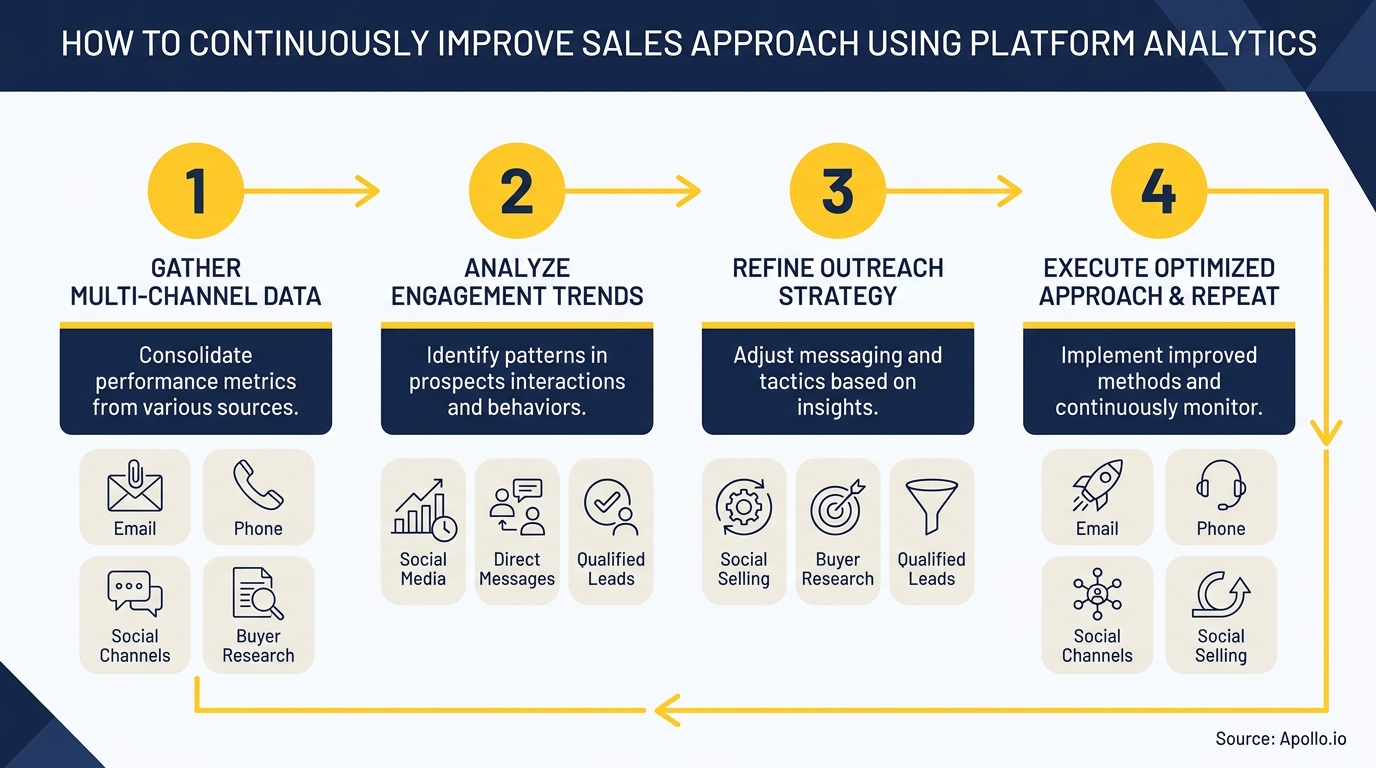
Continuously improving your sales approach using platform analytics requires four habits: a weekly signal review with named owners, a buyer-stage playbook that maps signals to actions, a monthly message consistency audit, and an active experiment backlog. Dashboards are the starting point, not the outcome.
The teams winning in 2026 are not the ones with the most data. They are the ones with the fastest loop from signal to seller behavior change.
Start with one KPI, assign one owner, run one experiment, and review in seven days. That cadence compounds.
Ready to build your closed-loop analytics system on a unified platform? Start Your Free Trial with Apollo and give your team one workspace for prospecting, engagement, conversation intelligence, and pipeline analytics.
Prove Pipeline ROI With Apollo
ROI pressure killing your tool budget? Apollo delivers measurable pipeline impact from day one. Leadium 3x'd annual revenue — see what Apollo does for your numbers.
Start Free with Apollo →Don't miss these
Sales
Inbound vs Outbound Marketing: Which Strategy Wins?
Sales
What Is a Sales Funnel? The Non-Linear Revenue Framework for 2026
Sales
What Is a Go-to-Market Strategy? The 2026 GTM Playbook
See Apollo in action
We'd love to show how Apollo can help you sell better.
By submitting this form, you will receive information, tips, and promotions from Apollo. To learn more, see our Privacy Statement.
4.7/5 based on 9,690 reviews
