
How to Build a Sales Pipeline That Converts in 2026
Building a sales pipeline in 2026 means designing for buyers who complete most of their journey before ever talking to a rep. According to Salesso, 70% of buyers complete their research before engaging with sales. Your pipeline must convert through content, data, and automation long before human touchpoints. This guide shows you exactly how to build a modern sales pipeline that meets buyers where they are and moves deals forward at every stage.

Apollo Cuts Research Time From Hours To Seconds
Tired of spending 4+ hours daily hunting for contact info? Apollo delivers 224M verified contacts with 96% email accuracy. Join 550K+ companies who stopped manual prospecting.
Start Free with Apollo →Key Takeaways
- Modern pipelines prioritize self-serve buyer experiences with stage-specific content and intent signals
- Sales cycles now median 84 days, requiring systematic nurture and multi-channel engagement
- CRM systems increase goal achievement likelihood nearly ninefold when properly implemented
- Lead-to-MQL conversion benchmarks at 22%, making qualification criteria critical to pipeline health
- All-in-one platforms consolidate prospecting, engagement, and deal management into unified workflows
What Is a Sales Pipeline?
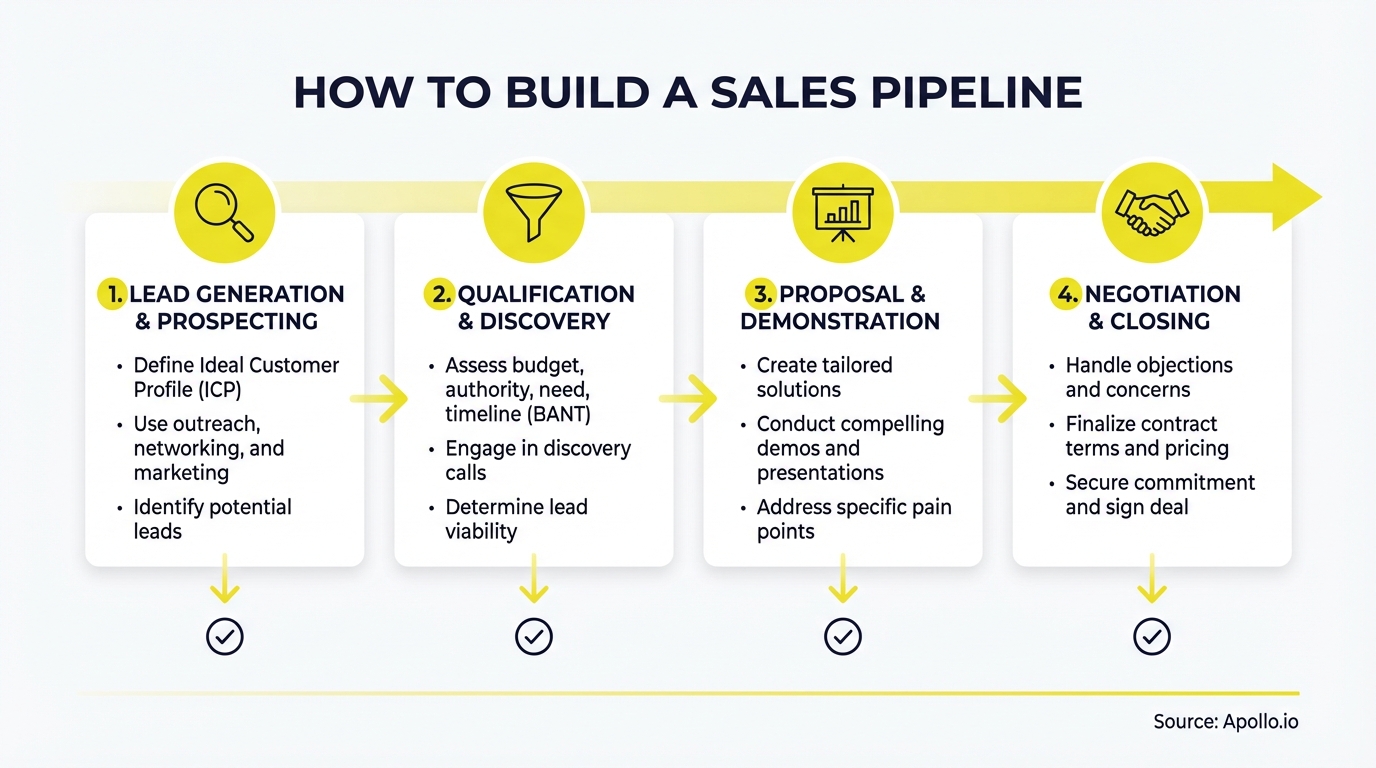
A sales pipeline is a visual representation of where prospects are in your buying process, from initial contact through closed deals. It maps each stage (prospecting, qualification, proposal, negotiation, close) with clear entry and exit criteria.
Unlike a sales funnel that shows volume at each stage, a pipeline tracks individual deals and their progression.
In 2026, effective pipelines operate as omnichannel systems. Research from Graph8 shows 80% of B2B sales interactions are digital, meaning your pipeline must track email, phone, web activity, and social engagement as unified buyer signals. Modern sales tech stacks integrate these channels into single workflows rather than forcing teams to toggle between disconnected tools.
Why Do SDRs and AEs Need a Structured Pipeline?
SDRs need pipeline structure to prioritize accounts showing genuine buying intent rather than chasing cold leads. Clear stage definitions tell SDRs when a prospect qualifies for handoff to AEs, preventing premature transfers that waste both teams' time.
For Account Executives, structured pipelines provide deal forecasting accuracy and reveal bottlenecks. According to SME Today, businesses utilizing a CRM are almost nine times more likely to exceed their sales goals. AEs managing deals in defined stages can identify stalled opportunities, apply appropriate interventions, and coach themselves on conversion patterns.
Sales Leaders benefit from pipeline visibility across their entire team. When every rep follows the same stage framework, leaders spot coaching opportunities, allocate resources to high-value deals, and forecast revenue with confidence.
How Do You Define Pipeline Stages That Convert?
Start by mapping your actual buyer journey, not an idealized version. Interview recent customers to understand their decision process, key questions at each phase, and what information moved them forward.
Define 5-7 stages with specific entry and exit criteria:
- Prospecting: Target fits ICP, contact info verified, initial outreach planned
- Qualification: Two-way conversation held, budget/authority/need/timeline confirmed
- Meeting Scheduled: Discovery call booked, stakeholders identified
- Proposal Sent: Custom solution presented, pricing shared, decision criteria documented
- Negotiation: Terms discussed, legal/procurement engaged, timeline agreed
- Closed Won/Lost: Contract signed or opportunity marked lost with reason
Research from Digital Bloom shows sales cycles typically range from 70-162 days depending on industry complexity, with a median of 84 days. Build realistic time expectations into each stage rather than rushing deals that need proper validation.
What Data and Tools Power Modern Pipeline Management?
Pipeline effectiveness depends on three data layers: contact intelligence, engagement tracking, and deal analytics. Contact data tells you who to reach and how.
Engagement data shows which accounts are active. Deal analytics reveal conversion patterns and forecast accuracy.
Struggling to find qualified leads? Search Apollo's 224M+ contacts with 65+ filters to build targeted prospect lists that match your ICP. The platform combines prospecting, engagement sequences, and deal management in one workspace, eliminating the need for separate tools at each pipeline stage.
Essential pipeline tools include:
- CRM for stage tracking and forecasting
- Sales engagement platform for multi-channel outreach
- Data enrichment to verify contact accuracy
- Analytics dashboards showing conversion rates by stage
- Revenue operations tools connecting marketing and sales data
According to Serpsculpt, the median B2B conversion rate across all industries is 2.9%. Teams using unified platforms report higher conversion by reducing data entry friction and maintaining consistent follow-up across channels.

How Do RevOps Leaders Optimize Pipeline Velocity?
RevOps leaders focus on three velocity levers: stage conversion rates, time-in-stage, and deal size. Start by establishing baseline metrics. Data from MarketJoy shows Lead to MQL conversion benchmarks at 20-25%, with their data indicating 22% as the midpoint.
Identify your conversion bottleneck (the stage with lowest pass-through rate). Common culprits include qualification criteria too loose (flooding pipeline with unqualified leads) or proposal stage delays (missing stakeholder buy-in).
Run win/loss analysis to understand why deals stall or die at specific stages.
Reduce time-in-stage through automation and enablement:
- Auto-assign leads based on territory/industry rules
- Trigger automated sequences when prospects hit engagement thresholds
- Provide stage-specific content (ROI calculators, case studies, implementation guides)
- Set activity minimums per stage (calls, emails, touchpoints required before advancing)
Can't track your deals effectively? Get complete pipeline visibility with Apollo's deal management to monitor stage progression, forecast accurately, and identify coaching opportunities across your team.
See Every Deal Stage In Real Time With Apollo
Pipeline forecasting a guessing game? Apollo gives you live deal visibility and buying signals so you can forecast with confidence. Built-In boosted win rates 10% with Apollo's intelligence.
Start Free with Apollo →What Content Assets Support Each Pipeline Stage?
Content must be stage-matched to buyer readiness. Early-stage prospects need educational resources that frame their problem.
Mid-stage buyers want proof and comparison. Late-stage decision-makers require risk mitigation and implementation clarity.
| Stage | Buyer Need | Content Assets |
|---|---|---|
| Prospecting | Awareness and relevance | Targeted outreach, industry insights, problem-focused content |
| Qualification | Solution fit validation | Product overviews, use case examples, ROI frameworks |
| Evaluation | Competitive differentiation | Comparison guides, customer proof points, demo recordings |
| Proposal | Business case building | ROI calculators, case studies, implementation timelines |
| Negotiation | Risk mitigation | Security documentation, SLAs, onboarding plans |
Create modular content that sales can mix and match. A single customer story should exist as a full case study, one-page summary, slide deck, and video testimonial.
This omnichannel approach meets buyers across their preferred research channels.

How Do You Measure Pipeline Health in 2026?
Pipeline health requires tracking leading and lagging indicators. Lagging metrics (closed revenue, win rate) tell you what happened.
Leading indicators (pipeline coverage, velocity, conversion rates) predict future performance.
Key metrics to monitor weekly:
- Pipeline Coverage: Total pipeline value divided by quota (aim for 3-4x coverage)
- Stage Conversion Rates: Percentage advancing from each stage to next
- Average Deal Size: Spot trends toward smaller or larger opportunities
- Sales Cycle Length: Days from first touch to close by stage
- Win Rate: Closed-won divided by total closed opportunities
Set stage-specific activity benchmarks. If your data shows successful deals average 8 touchpoints in qualification stage, flag deals with fewer than 5 as at-risk. Use sales analytics to identify patterns in won deals and replicate winning behaviors.
Pipeline reviews should happen at three cadences: daily for individual reps, weekly for team forecasting, and monthly for strategic planning. Daily reviews focus on next actions.
Weekly sessions validate forecast accuracy. Monthly reviews assess overall pipeline health and adjust targeting or messaging.
Start Building Your Revenue Engine Today
A well-built sales pipeline transforms unpredictable revenue into a systematic engine. By defining clear stages, equipping teams with the right tools, and tracking the metrics that matter, you create predictable growth.
The difference between top-performing sales organizations and the rest comes down to pipeline discipline.
Modern teams consolidate their tech stack into unified platforms rather than managing disconnected tools. As Census shared, "We cut our costs in half" by moving to an all-in-one system.
Predictable Revenue reported, "We reduced the complexity of three tools into one." When everything lives in one workspace, your team spends time selling instead of toggling between systems.
Ready to build a pipeline that actually converts? Start Free with Apollo to access 224M+ verified contacts, multi-channel sequences, and deal management in one platform. Join 550K+ companies already accelerating their revenue with Apollo.
Prove Apollo's ROI In Your First 30 Days
Budget approval stuck on unclear metrics? Apollo tracks every dollar spent to pipeline generated with built-in ROI dashboards. Built-In increased win rates 10% and ACV 10% with measurable Apollo impact.
Start Free with Apollo →Don't miss these
Sales
Inbound vs Outbound Marketing: Which Strategy Wins?
Sales
What Is a Sales Funnel? The Non-Linear Revenue Framework for 2026
Sales
What Is a Go-to-Market Strategy? The 2026 GTM Playbook
See Apollo in action
We'd love to show how Apollo can help you sell better.
By submitting this form, you will receive information, tips, and promotions from Apollo. To learn more, see our Privacy Statement.
4.7/5 based on 9,690 reviews
