
How to Become a Sales Manager in 2026
Breaking into sales management in 2026 requires more than hitting quota. The role has evolved from motivational cheerleader to data-driven coach who removes friction from your team's workflow. According to the U.S. Bureau of Labor Statistics, employment of sales managers is projected to grow 5% from 2024 to 2034, faster than the average for all occupations. With SalesOdyssey reporting that 81% of sales teams are investing in AI, aspiring managers must master technology adoption, coaching frameworks, and sales analytics to stand out.

Research Less, Close More With Apollo
Tired of your reps burning hours on manual lead research instead of selling? Apollo surfaces verified contacts instantly so your team spends time closing, not digging. Join 550K+ companies building pipeline faster.
Start Free with Apollo →Key Takeaways
- Sales managers in 2026 need data-driven decision-making skills and AI governance expertise, not just quota attainment
- Digital selling dominates: 80% of B2B interactions happen through digital channels, requiring new coaching approaches
- Promotion-ready managers demonstrate measurable coaching impact, process optimization, and cross-functional leadership
- The 90-day path to management involves building a portfolio of metrics: forecast accuracy, pipeline health, and rep ramp improvements
- Skills-based advancement is replacing tenure-based promotion in modern organizations
What Does A Sales Manager Do In 2026?
A sales manager in 2026 leads a team of sales reps by setting targets, coaching performance, and optimizing workflows that reclaim selling time. The role centers on removing obstacles that prevent reps from engaging buyers.
Sales managers own forecasting accuracy, pipeline health, team development, and cross-functional alignment with marketing and customer success.
According to BookYourData, 80% of B2B sales interactions between suppliers and buyers occur through digital channels. This shift means sales managers must coach digital deal execution, multi-threading strategies, and async stakeholder alignment rather than traditional field sales tactics. Managers also govern AI adoption, defining use cases and measurement frameworks as teams integrate conversation intelligence, automated outreach, and revenue operations platforms.
What Skills Do You Need To Become A Sales Manager?
Promotion-ready sales managers demonstrate three skill clusters: coaching excellence, operational leadership, and data fluency.
Coaching & Development:
- 1:1 coaching frameworks with behavior-change metrics
- Deal review methodology and qualification inspection
- Call and email coaching using conversation intelligence
- Onboarding design that reduces ramp time
Operational Excellence:
- CRM hygiene standards and data governance
- Process redesign to reclaim non-selling time
- Cross-functional collaboration with RevOps and enablement
- Tech stack consolidation and vendor management
Data-Driven Leadership:
- Forecast accuracy and pipeline inspection
- Leading indicators tracking (activity, conversion rates, velocity)
- Dashboard design and reporting cadences
- AI pilot design, governance, and ROI measurement
For aspiring managers, build a promotable portfolio by documenting coaching impact, process improvements, and measurable contributions to team performance. Skills-based advancement is replacing tenure-based promotion.
How Do You Transition From Sales Rep To Sales Manager?
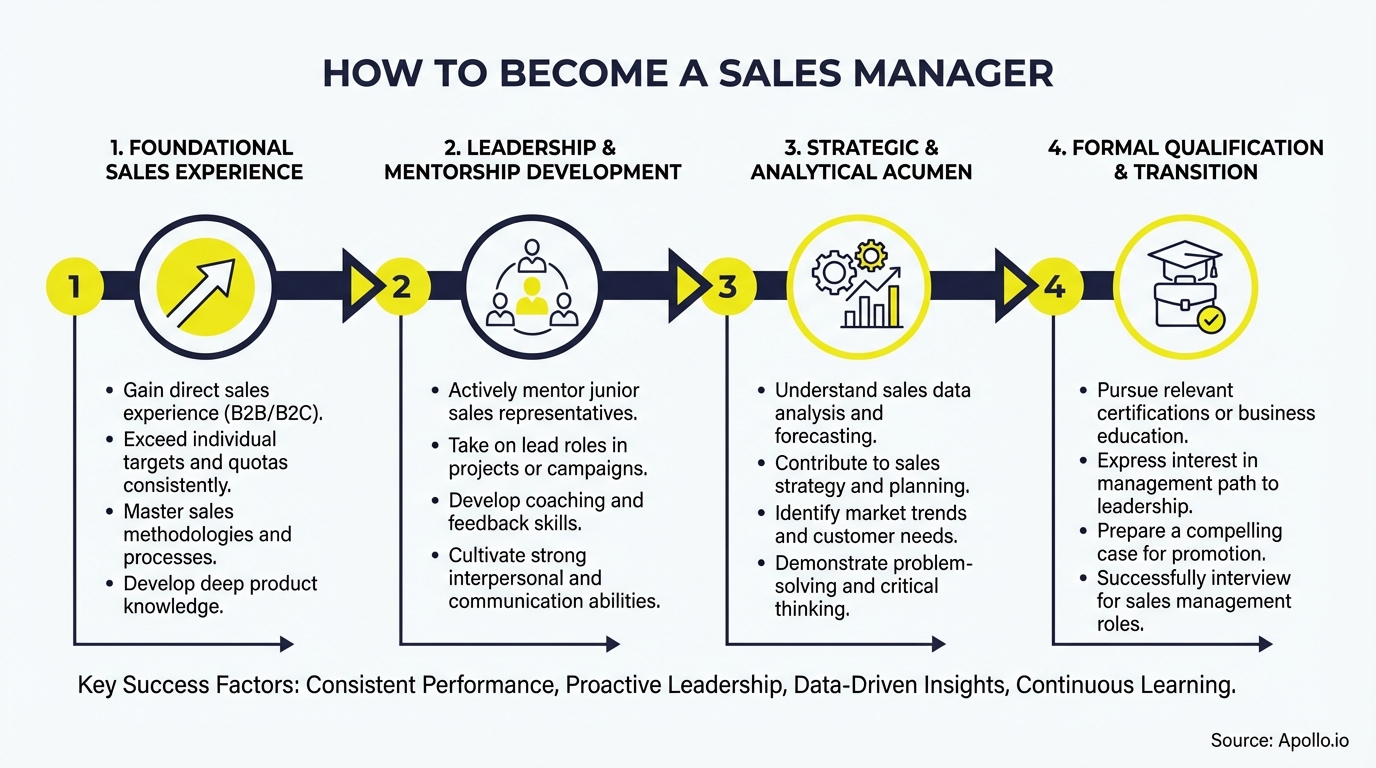
The transition from individual contributor to manager requires demonstrating leadership impact before receiving the title. Start by coaching peers informally, volunteering for onboarding responsibilities, and documenting process improvements that benefit the entire team.
90-Day Promotion Readiness Plan:
| Phase | Focus Area | Key Activities |
|---|---|---|
| Days 1-30 | Coaching Foundation | Shadow current managers, document 1:1 frameworks, coach 2-3 peers on specific deals, track behavior changes |
| Days 31-60 | Process & Data | Identify workflow friction points, propose CRM hygiene improvements, build team dashboards, analyze conversion rates |
| Days 61-90 | Strategic Impact | Lead cross-functional project, pilot AI tool, present promotion case with metrics (coaching ROI, process wins, forecast accuracy) |
Struggling to track pipeline health across your team? Get complete visibility with Apollo's deal management and forecasting tools.
Document your impact using measurable outcomes: percentage improvement in rep ramp time, increase in forecast accuracy, adoption rates for new processes, or coaching-driven quota attainment improvements. Promotion committees respond to evidence, not assertions.
Turn Funnel Gaps Into Qualified Pipeline
Tired of watching marketing leads stall before they ever reach your AEs? Apollo surfaces in-market buyers with precision targeting so your team engages prospects ready to convert. 550K+ companies trust Apollo to build pipeline that actually closes.
Start Free with Apollo →How Do Sales Managers Coach Their Teams Effectively?
Effective coaching in 2026 combines structured 1:1s, deal inspection, and skill development tied to measurable outcomes. Managers who coach weekly see teams achieve measurably higher quota attainment compared to those who coach monthly or less frequently.
Weekly Coaching Cadence:
- Pipeline Review: Inspect deal health, qualification rigor, next steps, and stakeholder mapping
- Activity Analysis: Review outreach quality, response rates, and conversion metrics
- Skill Development: Focus on one behavior per month (discovery questions, objection handling, demo delivery)
- Call/Email Review: Use conversation intelligence to identify coaching moments and replicate winning patterns
For Account Executives managing complex deals, managers should inspect mutual action plans, executive alignment strategies, and competitive positioning. For SDRs and BDRs, focus on messaging quality, personalization depth, and multi-channel sequencing. Research from Coalition Technologies shows B2B deals involve 62+ touchpoints over 6+ months, requiring managers to coach persistent, coordinated engagement strategies.
Modern coaching leverages AI tools for call transcription, automated note-taking, and coaching prompt generation, but managers must interpret insights and drive behavior change through consistent feedback loops.
What Tools Do Sales Managers Need In 2026?
Sales managers in 2026 need an integrated platform that consolidates prospecting, engagement, conversation intelligence, and pipeline management. Fragmented tech stacks create data silos, increase admin burden, and reduce coaching time.
Essential Sales Management Capabilities:
- Deal Management: Real-time pipeline visibility, forecast tracking, stage progression analysis
- Conversation Intelligence: Call recording, transcription, coaching moment identification, talk-time analysis
- Engagement Analytics: Email open rates, response rates, sequence performance, multi-channel effectiveness
- Data Quality: Automated enrichment, CRM hygiene monitoring, duplicate detection
- Activity Tracking: Rep productivity dashboards, leading indicator monitoring, goal tracking
Companies using consolidated sales platforms report measurable reductions in tool complexity. As one Predictable Revenue leader noted: "We reduced the complexity of three tools into one." Census reported: "We cut our costs in half." Cyera emphasized: "Having everything in one system was a game changer."
Tired of juggling disconnected sales tools? Apollo's all-in-one platform consolidates prospecting, engagement, and analytics in one workspace.

How Much Do Sales Managers Earn In 2026?
Sales manager compensation varies by geography, industry, company size, and individual performance. Base salaries typically range from $70,000 to $120,000, with on-target earnings (OTE) including commissions and bonuses reaching $120,000 to $200,000+ for high performers in tech and enterprise sales environments.
Salary Factors:
- Geography: Coastal tech hubs (San Francisco, New York, Seattle) offer higher compensation than mid-market cities
- Industry: SaaS and enterprise technology typically pay more than traditional industries
- Team Size: Managers overseeing larger teams or higher revenue quotas earn more
- Company Stage: Late-stage startups and public companies often provide higher base salaries than early-stage startups
According to Rachel A. Krug, up to 70% of B2B sales representatives missed their annual quota in 2024, meaning only 30% hit their target. This context makes sales management roles both more challenging and more valuable, as organizations seek leaders who can improve team performance through structured coaching and process optimization.
Beyond base compensation, evaluate equity grants, career development opportunities, internal mobility programs, and management training investments when considering sales management roles.
What Are The Biggest Challenges For New Sales Managers?
First-time sales managers face three primary challenges: shifting from individual contributor to coach, mastering forecast accuracy, and balancing administrative demands with coaching time.
Common Pitfalls:
- Hero Manager Syndrome: Jumping into deals instead of coaching reps to close independently
- Activity Obsession: Focusing on volume metrics rather than conversion quality and deal health
- Coaching Avoidance: Deprioritizing 1:1s when urgent issues arise, leading to performance gaps
- Data Paralysis: Building complex dashboards without actionable insights or behavior-change plans
- Tool Sprawl: Adding point solutions without integration strategy, creating admin burden for reps
To avoid these traps, establish non-negotiable coaching cadences, delegate operational tasks to RevOps or enablement partners, and focus on the critical few metrics that predict revenue outcomes. New managers should also seek mentorship from experienced leaders and invest in formal management training programs.
Organizations with strong learning cultures see measurably higher retention and internal mobility, making employer selection as important as role selection for aspiring managers.
How Do You Build Your Sales Management Career In 2026?
Building a sustainable sales management career requires continuous skill development, strategic network building, and adaptability to evolving buyer behaviors and technologies.
Career Development Priorities:
- Master emerging capabilities: AI governance, digital deal coaching, sales automation strategy
- Build cross-functional fluency: Partner closely with marketing, customer success, and product teams
- Document measurable impact: Maintain a portfolio of coaching outcomes, process improvements, and team performance metrics
- Pursue formal training: Sales leadership certifications, management development programs, executive coaching
- Expand your network: Join sales leadership communities, attend industry events, seek mentorship from senior leaders
According to Landbase, buyers spend only about 17% of their purchase time engaging with vendors, shifting manager focus toward coaching reps to maximize every interaction. This requires managers to stay current on buyer behavior trends, competitive positioning, and messaging effectiveness.
The most successful sales managers view their role as a platform for developing future leaders. By investing in team development, they create promotion opportunities for top performers while building their own reputation as talent developers who attract high performers to their teams.
Ready To Lead A High-Performing Sales Team?
Becoming a sales manager in 2026 requires demonstrating coaching excellence, operational leadership, and data-driven decision-making before receiving the title. Start building your promotion portfolio today by documenting coaching impact, optimizing team workflows, and mastering the tools that consolidate your sales tech stack.
The path from top rep to effective manager centers on removing friction from your team's workflow, governing AI adoption responsibly, and coaching digital deal execution in an environment where 80% of B2B interactions happen through digital channels. Focus on measurable outcomes, seek formal management training, and select employers with strong learning cultures and internal mobility programs.
Request a Demo to see how Apollo helps sales managers coach their teams, track pipeline health, and consolidate their sales tech stack into one unified platform.
Prove Pipeline ROI With Apollo
Budget approval stuck on unclear metrics? Apollo gives sales leaders quantifiable pipeline impact from day one. Leadium 3x'd their annual revenue — see your ROI before you commit.
Schedule a Demo →Don't miss these
Sales
Inbound vs Outbound Marketing: Which Strategy Wins?
Sales
What Is a Sales Funnel? The Non-Linear Revenue Framework for 2026
Sales
What Is a Go-to-Market Strategy? The 2026 GTM Playbook
See Apollo in action
We'd love to show how Apollo can help you sell better.
By submitting this form, you will receive information, tips, and promotions from Apollo. To learn more, see our Privacy Statement.
4.7/5 based on 9,690 reviews
