
How to Become a Sales Engineer in 2026: Transition Blueprint, Skills, and Career Path
Sales engineering sits at the intersection of deep technical knowledge and business persuasion, making it one of the most resilient and well-compensated roles in B2B sales. According to the U.S. Bureau of Labor Statistics, employment of sales engineers is projected to grow 5% from 2024 to 2034, faster than the average for all occupations, even as broader sales roles decline. If you're mapping your next career move, understanding how much a sales engineer makes and how to get there is a smart starting point.

Research Less, Close More With Apollo
Tired of your reps burning hours on manual lead research instead of selling? Apollo surfaces verified contacts instantly so your team spends time closing, not digging. Join 550K+ companies turning research time into revenue.
Start Free with Apollo →Key Takeaways
- Sales engineers combine technical expertise with consultative selling to support complex B2B deals across multiple stakeholders.
- A bachelor's degree in engineering or a technical field is the standard entry point, though business and communications degrees are increasingly common.
- AI fluency is now a core competency: 86% of presales leaders are actively integrating AI tools into their workflows.
- Building a portfolio of recorded demos, ROI models, and proof-of-concept artifacts is the fastest way to break in as a career switcher.
- The role pays well and is growing, with strong demand driven by rising buyer complexity and multi-stakeholder purchasing decisions.
What Does a Sales Engineer Do?
A sales engineer (SE) is a technical sales professional who bridges the gap between a product's capabilities and a buyer's specific business needs. They run product demos, architect solutions, answer deep technical questions, and build the business case that moves complex deals forward.
SEs work alongside Account Executives (AEs) and are especially critical in B2B software, hardware, manufacturing, and infrastructure sales.
The role goes well beyond running demos. Forrester's State of Business Buying 2024 found that 86% of B2B purchases stall during the buying process and buying groups average 13 people across 2+ departments. SEs are the ones who build evaluation plans, create stakeholder-specific narratives, and de-risk purchases for every persona in that group.
- Core responsibilities: Discovery calls, product demos, proof-of-concept (POC) execution, RFP/RFI responses, security reviews, ROI modeling
- Key collaborators: AEs, product managers, customer success, and technical architects
- Success metrics: Deal win rate, POC-to-close conversion, technical objection resolution, deal cycle length
What Education Do Sales Engineers Need?
According to GoConsensus, individuals typically need a bachelor's degree in engineering or a related technical field to become a sales engineer. However, the path is more flexible than it appears.
Data from College Raptor shows that 56% of sales engineers hold a bachelor's degree, 17% a master's degree, and 12% have some college education without a degree. Business, marketing, and communications backgrounds are also viable, especially when paired with hands-on technical experience.
| Degree Type | Relevance | Best For |
|---|---|---|
| Engineering (CS, EE, ME) | Very High | Software, hardware, infrastructure SE roles |
| Business / Marketing | High | SaaS, fintech, or product-led SE roles |
| Communications | Medium | Roles where stakeholder management is primary |
| No degree + technical certs | Growing | Career switchers with strong portfolios |
What Skills Do Sales Engineers Need in 2026?
Modern SEs need a blend of hard technical skills and consultative selling abilities. According to TealHQ, essential skills include deep technical proficiency and product knowledge, covering specifications, capabilities, and integration with other systems. Beyond that, SalesEngineer.direct notes that the ability to discuss APIs, SDKs, webhooks, and data workflows is critical, as integration capabilities are a major factor in B2B software purchasing decisions.
- Technical: Product architecture, API/integration knowledge, security fundamentals, data analysis
- Sales: Discovery questioning, objection handling, business case construction, ROI modeling
- Communication: Executive-level storytelling, whiteboarding, async demo creation
- AI fluency: Prompt-driven discovery summarization, demo personalization, requirements mapping
AI fluency deserves special attention. Vivun's State of PreSales 2024 report (surveying 500+ respondents) found 86% of sales engineering leaders are involved or very involved in integrating AI tools, with complex data analysis cited as the top use case.
Aspiring SEs who can demonstrate AI-assisted workflows have a clear hiring advantage.
Ready to build pipeline the smarter way? Automate your outreach sequences with Apollo's multi-channel sales engagement platform and spend more time on high-value technical conversations.

How Do AEs and SEs Work Together to Close Deals?
Account Executives own the commercial relationship; sales engineers own technical credibility. In most enterprise motions, the AE handles pricing, negotiation, and executive alignment, while the SE runs demos, POCs, and answers every technical question the buying group raises.
This partnership is especially important as deal complexity grows.
For AEs managing high-ticket sales, having a strong SE on the deal can be the difference between a stalled evaluation and a closed contract. SEs reduce risk for buyers by providing evaluation plans, security packets, and architecture diagrams that give every stakeholder confidence to move forward.
- AE sets meeting agenda and commercial context
- SE runs tailored demo and handles technical Q&A
- SE delivers POC or evaluation kit post-demo
- AE closes with pricing once technical validation is complete
Turn Weak Leads Into Real Pipeline
Tired of watching marketing leads die before they reach your pipeline? Apollo surfaces in-market buyers with verified contact data so your team stops guessing and starts closing. Join 550K+ companies building predictable revenue.
Start Free with Apollo →What Is the 12-Month Roadmap to Become a Sales Engineer?
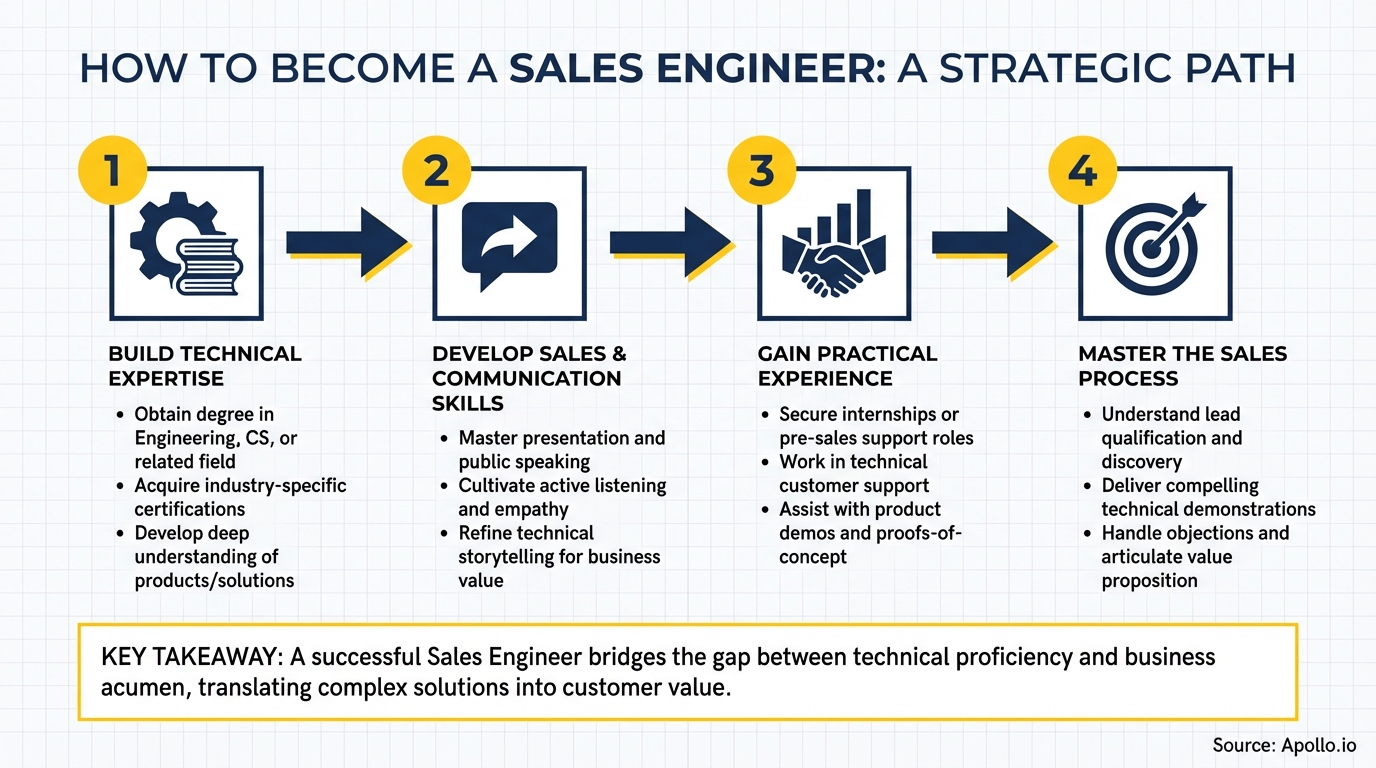
Career switchers and new graduates can follow a structured transition plan. The goal is to build demonstrable proof of work, not just credentials.
| Phase | Timeline | Actions |
|---|---|---|
| Foundation | Months 1-3 | Pick a domain (SaaS, security, data), get a relevant cert (AWS, Salesforce, etc.), learn discovery frameworks |
| Portfolio Build | Months 4-6 | Record a demo walkthrough, build a sample ROI model, write a case study for a past technical project |
| Network and Apply | Months 7-9 | Connect with SE communities, reach out to SE managers, apply to associate SE or solutions consultant roles |
| Interview Prep | Months 10-12 | Practice whiteboard demos, prepare objection responses, rehearse a 10-minute product walkthrough |
Credibility signals are shifting from years of experience to proof of work. Hiring managers increasingly use recorded demos, quantified case studies, and technical certifications to evaluate candidates, especially those making a career pivot. Understanding how to build a sales tech stack and articulate its components during an interview also signals operational readiness.
Looking to identify the right companies and decision-makers to target your SE job search? Search Apollo's 224M+ verified business contacts with 65+ filters to find SE hiring managers at companies that match your target domain.
How Does AI Change the Sales Engineer Role in 2026?
AI is no longer a bonus skill for SEs: it is becoming a baseline expectation. The most common applications in presales include discovery call summarization, requirements mapping, demo environment personalization, and technical forecasting.
SEs who can use AI tools to scale their output across more AEs and deals are more valuable to their organizations.
Operationally, AI helps SEs build buyer enablement artifacts faster.
Instead of writing a custom ROI model from scratch for every deal, an SE can use AI to generate a draft, then refine it with deal-specific inputs.
The same applies to security questionnaires, evaluation plans, and mutual action plan templates.
For a deeper look at how AI is reshaping sales workflows, see which AI sales tools actually close more deals.

How to Become a Sales Engineer: Start Here
Sales engineering is one of the few roles where technical depth and business acumen compound over time, creating a durable, high-earning career. The digital transformation market, which fuels high-tech B2B sales, was forecasted to expand from $469.8 billion in 2020 to $1,009.8 billion by 2025 globally, according to Springboard. That trajectory makes SE one of the most future-proof paths in technical sales.
Start by picking a domain, building a portfolio, and developing the AI-assisted workflows that modern presales teams run on. Use sales analytics to understand what good looks like in the roles you're targeting, and study how proven sales pitch techniques translate into demo best practices. The path is clear, the demand is real, and the compensation rewards those who invest in the right skills.
Get Leads Now:Start free with Apollo and build the pipeline that supports your SE career from day one.
Prove Pipeline ROI From Day One
Budget approval stuck on unclear metrics? Apollo delivers measurable pipeline impact fast — so you walk into every review with proof, not promises. Leadium 3x'd their revenue. Your turn.
Start Free with Apollo →Don't miss these
Sales
Inbound vs Outbound Marketing: Which Strategy Wins?
Sales
What Is a Sales Funnel? The Non-Linear Revenue Framework for 2026
Sales
What Is a Go-to-Market Strategy? The 2026 GTM Playbook
See Apollo in action
We'd love to show how Apollo can help you sell better.
By submitting this form, you will receive information, tips, and promotions from Apollo. To learn more, see our Privacy Statement.
4.7/5 based on 9,690 reviews
