
How to Adjust AI Models When Market Conditions Change: A 2026 Playbook
Your AI sales model is already stale. Buyers changed faster than your training data. According to G2's 2026 AI Search Insight Report, 93% of B2B software buyers say AI chatbots have fundamentally changed how they research software, and 51% now start their research with an AI chatbot rather than Google. If your lead scoring, intent, and pipeline models still weight traditional engagement signals, they are scoring a buyer journey that no longer exists. This playbook shows you how to detect market shifts early, choose the right adjustment type, and prove revenue lift. If you're also rethinking how to build a B2B marketing funnel that converts in 2026, model adaptability is the foundation everything else depends on.

Scale Your Team Without the Chaos
Tired of inconsistent prospecting across your growing team? Apollo standardizes your entire outreach process — verified contacts, automated sequences, one playbook for everyone. Join 600K+ companies building predictable pipeline.
Start Free with Apollo →Key Takeaways
- AI model adjustment is an ongoing operating discipline, not a one-time retraining event — most production models go unmonitored until performance collapses.
- Four distinct adjustment types exist: full retraining, recalibration, RAG refresh, and prompt update. Choosing the wrong one wastes time and can make drift worse.
- Sales organizations providing AI-enabled next best actions are significantly more likely to achieve commercial growth, but only when those models are kept current.
- Data quality is the primary bottleneck — clean, unified CRM and intent data matters more than which adjustment method you choose.
- RevOps leaders and sales managers should own a monthly model health review tied to pipeline and win-rate benchmarks, not just data-science metrics.
Why Do AI Models Drift When Market Conditions Change?
AI model drift happens when the real-world patterns a model was built on diverge from current reality. Markets shift through macro shocks, buyer-behavior changes, competitive disruption, and seasonal cycles — and any of these can silently erode model accuracy before anyone notices a revenue impact.
The performance decay can be rapid. A Reddit user shared a firsthand perspectiveon how quickly this happens: "I tried some [AI models], one e.g. to trade Gold spot. It needed a daily retraining, otherwise it went out of profitability within two days. Trained with the chart from yesterday, the win rate was between 60 and 80%. Train it and let it run... 80% at Monday, 30% at Friday." B2B sales cycles are longer, but the same decay logic applies to lead scores, churn predictions, and messaging models when buyer behavior shifts.
Research from InsightMark Research shows that 88% of organizations were using AI in at least one business function as of November 2025 — yet governance and monitoring have not kept pace with deployment speed.
What Are the Four AI Model Adjustment Types?
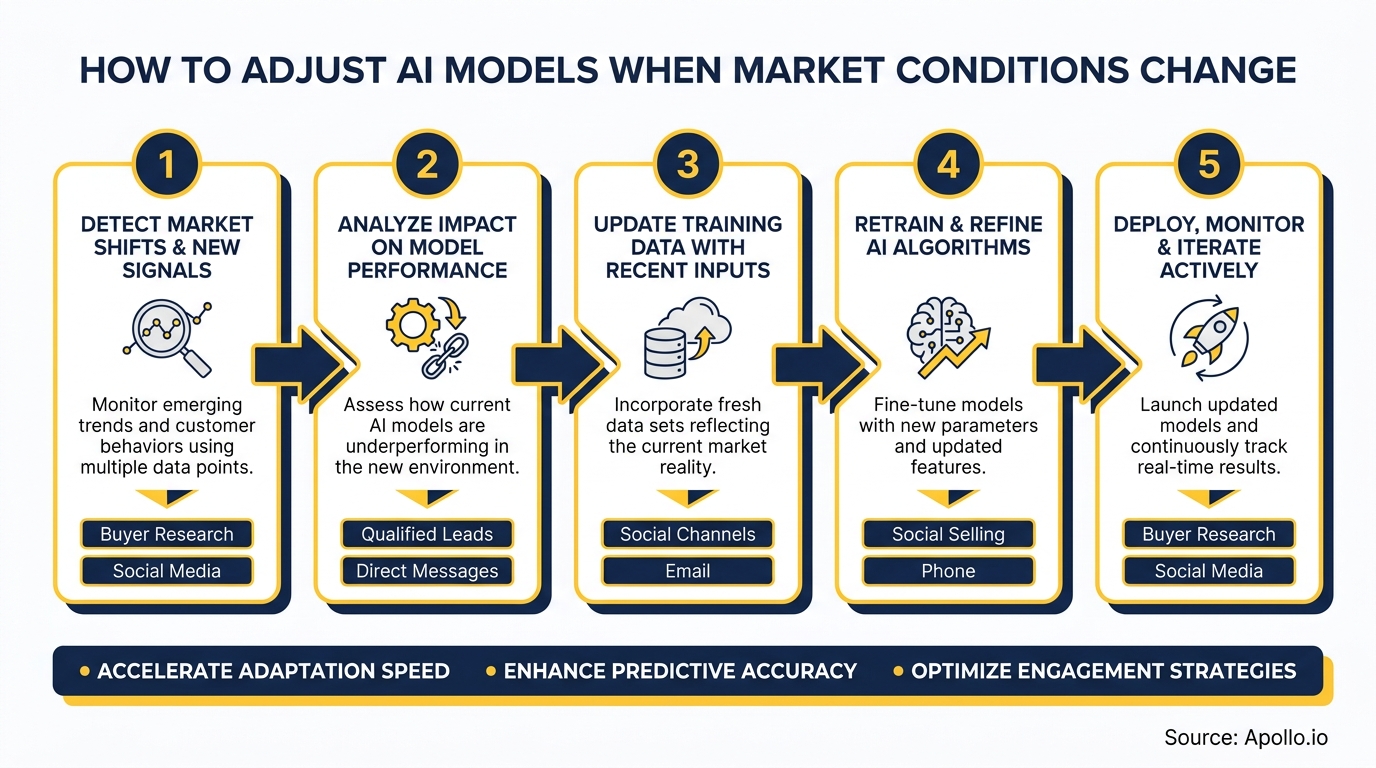
Adjusting an AI model when market conditions change requires choosing the right intervention level. Using a full retraining when a prompt update would suffice wastes resources.
Using only a prompt update when fundamental data distributions have shifted produces false confidence.
| Adjustment Type | When to Use | Effort | B2B Example |
|---|---|---|---|
| Full Retraining | Fundamental shift in buyer behavior, ICP, or market structure | High | New vertical expansion; major competitor enters your segment |
| Recalibration | Output scores have drifted but feature logic is still valid | Medium | Lead scores no longer correlate with pipeline conversion rates |
| RAG Refresh | Knowledge base is stale but model architecture is sound | Low–Medium | Pricing, product, or competitive content used in AI responses is outdated |
| Prompt Update | Tone, persona, or instruction context needs adjusting | Low | Messaging model is using terminology buyers no longer respond to |
| Rollback | Recent update degraded performance metrics | Low | New model version produces lower reply rates or more hallucinations |
A commenter added in a Reddit discussionon ML market prediction: "Consider regime shifts and only focus on the current decade... Calculate what a random classifier's expected precision would be based on the class distribution. This is your baseline comparison. Anything 2x this score means you are onto something." Setting a clear baseline before any adjustment is the only way to know whether the change worked.
How Do RevOps Leaders Build a Market-Signal Monitoring Plan?
RevOps leaders should monitor four signal categories that reliably precede meaningful model drift in B2B GTM contexts. Each signal maps to a specific adjustment trigger.
- Pipeline conversion rate changes: A drop in MQL-to-opportunity or opportunity-to-close rates signals that lead scoring weights need recalibration. Review monthly.
- Buyer-behavior shifts: Declining email reply rates, rising self-service signups, or new referral sources entering the attribution mix indicate that engagement-signal weights are stale. Review quarterly or after major product or pricing changes.
- Intent data pattern changes: If the keywords and topics your intent data signals are surfacing no longer match your winning deal profiles, your propensity model needs a RAG refresh or recalibration.
- External market events: Macro shocks, competitive price cuts, budget freezes, or major regulatory changes warrant an immediate model health review rather than waiting for a scheduled cycle.
According to a Bain & Company report cited by ProInsights360, while 90% of executives are implementing AI, 60% acknowledge their technology stacks are not ready, limiting meaningful returns. The gap is almost always data readiness, not model sophistication. Tying data sync practices to your model health review is a prerequisite, not an afterthought.
Struggling to keep your pipeline data fresh enough to support reliable AI signals? Apollo's pipeline tools give GTM teams a live, enriched view of every opportunity so your models are scoring reality, not last quarter's snapshot.

How Should Sales Leaders Implement Model Adjustments with Evaluation Gates?
Sales leaders should treat every model adjustment as a controlled experiment with pass/fail criteria before full deployment. The Gartner finding from May 2026 that sales organizations with AI-enabled next best actions are 2.6x more likely to achieve commercial growth only holds when those models are continuously tuned — not deployed once and forgotten.
Use this evaluation-gate checklist before promoting any adjusted model to production:
- Baseline benchmark set: Record current win rate, pipeline velocity, and reply rate before any change.
- Holdout test completed: Run the adjusted model on a subset of accounts or sequences for at least two to four weeks.
- Lift threshold defined: Agree in advance on the minimum improvement required to justify rollout (e.g., a measurable improvement in meeting booking rate or lead-to-pipeline conversion).
- Rollback trigger documented: Define the specific metric threshold that triggers an automatic rollback — before you go live.
- Stakeholder sign-off: RevOps, sales leadership, and the model owner must approve before full deployment.
For lead scoring models specifically, the evaluation window should align with your average sales cycle length so you're measuring actual pipeline outcomes, not just early engagement proxies.
Turn Weak Leads Into Pipeline That Closes
Pipeline forecasting a guessing game because your leads never convert? Apollo surfaces in-market buyers with verified contact data so your team reaches the right prospects at right moment. Nearly 100K paying customers trust Apollo to build predictable revenue.
Start Free with Apollo →How Do SDRs and AEs Know When Their AI Tools Need Adjustment?
SDRs and AEs are often the first to feel model drift, but the last to flag it formally. Giving frontline reps a simple set of signals to watch creates an early-warning layer that no automated monitoring system can fully replicate.
SDRs should flag for review when:
- Suggested messaging templates generate declining reply rates over two or more consecutive weeks
- Recommended prospects consistently turn out to be wrong-fit (wrong stage, wrong use case, wrong budget)
- Sequences built from AI-suggested cadences are underperforming manually built sequences
AEs should flag for review when:
- AI-recommended next best actions no longer match the objections they're hearing in discovery calls
- Deal health scores don't correlate with which deals actually close
- Competitive intelligence surfaced by AI tools is outdated relative to what buyers are actually saying
According to Cirrus Insight, early AI deployments have boosted win rates by over 30%, per Bain's 2025 analysis of enterprise sales productivity. That lift depends on models that reflect current buyer reality. Connecting rep feedback loops to your sales development workflow closes the gap between what the model predicts and what reps experience in the field.
Spending too much time manually researching prospects because your AI recommendations feel off? Apollo's AI sales automation keeps outreach aligned with live account signals so SDRs and AEs are always working with current context, not stale data.
How Do You Prove ROI After Adjusting an AI Model?
Proving ROI for a model adjustment requires connecting the technical change to a business outcome metric that revenue leaders care about. Most teams skip this step and lose budget approval for future improvements.
Use this three-column measurement template for every model change:
| Metric | Pre-Adjustment Baseline | Post-Adjustment Result |
|---|---|---|
| Lead-to-meeting conversion rate | Record before change | Measure after 30–60 days |
| Opportunity-to-close rate | Record before change | Measure after one full cycle |
| Average deal velocity (days) | Record before change | Measure after one full cycle |
| AI-suggested action adoption rate | Record before change | Measure weekly |
| Revenue attributed to AI-assisted deals | Record before change | Measure after one full cycle |
According to lead-spot.net's 2025 AI-Driven Demand Generation Benchmark Report, 75% of B2B marketing leaders are actively integrating generative AI into their workflows. The teams extracting measurable returns are the ones connecting AI outputs directly to revenue metrics rather than stopping at engagement proxies. Pair this measurement practice with solid marketing analytics to ensure you can attribute pipeline changes to specific model adjustments rather than seasonal variation.

How Should GTM Teams Stay Adaptive as Markets Keep Shifting in 2026?
Staying adaptive in 2026 means treating model adjustment as a recurring operating rhythm, not a crisis response. The teams seeing the strongest results are not necessarily using more sophisticated models.
They are running more frequent, smaller adjustments with clear evaluation gates and a unified data foundation.
Three habits separate adaptive GTM teams from reactive ones:
- Monthly model health reviews: RevOps owns a standing review of lead score accuracy, intent signal freshness, and messaging performance tied to pipeline outcomes.
- Scenario-based planning: Sales leadership runs quarterly "what-if" model refreshes for territory, segmentation, and pricing assumptions when market inputs shift — aligning with Salesforce's 2026 State of Sales finding that 91% of sales pros say AI benefits sales planning.
- Unified data before new models: Every adjustment starts with a data quality audit. The go-to-market strategy is only as good as the data feeding it.
AI model adjustment is not a data science problem. It is a revenue operations discipline that requires signal monitoring, clear decision criteria, evaluation gates, and business-outcome measurement.
The teams building this muscle in 2026 are the ones whose AI investments will compound rather than decay.
Apollo gives B2B GTM teams a unified platform for prospecting, engagement, and pipeline intelligence so your AI-driven workflows are always operating on verified, current data. "Having everything in one system was a game changer" — Cyera. Get Leads Now and put your GTM models on a foundation that adapts with your market.
Prove Pipeline ROI With Apollo
ROI pressure killing tool adoption before it starts? Apollo delivers measurable pipeline impact fast — so budget conversations become easy wins. Leadium 3x'd annual revenue. Your next renewal justifies itself.
Start Free with Apollo →Don't miss these
Sales
Inbound vs Outbound Marketing: Which Strategy Wins?
Sales
What Is a Sales Funnel? The Non-Linear Revenue Framework for 2026
Sales
What Is a Go-to-Market Strategy? The 2026 GTM Playbook
See Apollo in action
We'd love to show how Apollo can help you sell better.
By submitting this form, you will receive information, tips, and promotions from Apollo. To learn more, see our Privacy Statement.
4.7/5 based on 9,690 reviews
