
How Should You Handle Outdated or Obsolete Company Information in 2026?
Stale company data is not an editorial inconvenience. It is a direct revenue risk. Research from KeepSync shows individual organizations lose an average of $12.9 million to $15 million per year due to poor data quality, encompassing wasted marketing spend, lost sales opportunities, and operational inefficiencies. For B2B GTM teams relying on contact data enrichment and outbound sequences, the cost compounds fast.
The 2026 challenge is speed: AI-powered CRMs and sales agents now act on your data automatically. Wrong titles, outdated domains, and stale firmographics do not just slow reps down.
They mis-trigger routing, personalization, and sequencing at scale before a human ever notices.

Verified Contacts. Zero Wasted Hours.
Tired of burning hours verifying emails that bounce and chasing numbers that go nowhere? Apollo delivers 97% email accuracy so your team spends time selling, not searching. Start building pipeline that actually moves.
Start Free with Apollo →Key Takeaways
- Outdated company information carries measurable revenue costs that compound quickly when AI agents act on bad inputs.
- B2B contact data decays at rates between 22.5% and 70.3% annually, meaning a static database becomes unreliable within months.
- A tiered governance model (Tier 1: pricing/legal/security; Tier 2: product pages; Tier 3: blogs) gives teams clear refresh SLAs without overwhelming resources.
- RevOps leaders and SDRs both benefit from continuous enrichment over quarterly cleanup, keeping outreach accurate and deliverability intact.
- Adding "last reviewed" metadata and a source-of-truth registry prevents AI-generated content drift and protects buyer trust.
Why Does Outdated Company Information Cause So Much Damage?
Outdated company information damages pipeline because buyers now validate vendor claims earlier in their journey, and any mismatch triggers immediate disqualification. According to Landbase, B2B contact data decays at rates between 22.5% and 70.3% annually. A database that looked clean at the start of the year can be largely unreliable before Q3.
The decay hits multiple dimensions at once:
- Job changes:Zymplify reports that an estimated 10.9% of professionals change companies annually.
- Email addresses: 23-30% of email addresses become outdated annually, per CleanList.
- Firmographics: Company names, headcount, and industry classifications shift constantly through mergers, pivots, and rebrands.
- Pricing and product claims: Web content referencing old feature sets or discontinued pricing tiers erodes buyer trust at the exact moment they are self-educating.
For SDRs and AEs, bad data means personalized outreach lands as obviously generic. For RevOps leaders, it means automation sequences fire against the wrong segments entirely.
How Do You Build a Tiered Content Governance Model?
A tiered governance model assigns review cadences based on how quickly a content category changes and how damaging a stale version would be. This gives teams clear SLAs without treating every blog post like a compliance document.
| Tier | Content Type | Review Cadence | Owner |
|---|---|---|---|
| Tier 1 | Pricing pages, legal/compliance, security documentation | Monthly or on product change | Product + Legal |
| Tier 2 | Feature pages, case studies, sales decks | Quarterly | Marketing + Sales Enablement |
| Tier 3 | Blog posts, thought leadership, email templates | Bi-annually or on significant market shift | Content Team |
Each tier needs a named owner, a trigger condition (product launch, pricing change, regulation update), and a retirement rule for content that cannot be updated quickly enough to remain accurate. Pair this with a content inventory spreadsheet or CMS tag system so nothing goes unreviewed by default.
Teams using revenue operations frameworksapply the same tiering logic to CRM records: high-value accounts get enriched and validated more frequently than cold prospects in early nurture.
How Do RevOps Teams and SDRs Prevent Data Decay at the Source?
RevOps teams prevent data decay by replacing periodic cleanup cycles with continuous enrichment workflows that validate records in real time. Quarterly audits catch problems too late.
By the time a batch clean runs, SDRs have already sent sequences to bounced addresses and wrong-title contacts.
Practical steps for ongoing data hygiene:
- Enrich on record creation: Validate firmographics, email, and title at the moment a new contact enters the CRM, not weeks later.
- Set decay triggers: Flag records that have not been updated in 90 days for re-enrichment automatically.
- Monitor bounce rates: A rising hard-bounce rate is an early warning signal that your contact data is aging faster than your enrichment cadence.
- Audit account hierarchies: Acquisitions and rebrands break parent-child account structures. Review top accounts monthly.
Tired of chasing down accurate contact data before every campaign? Apollo's data enrichment keeps your records verified with 230M+ contacts and 97% email accuracy, so your team works from a clean foundation every day.
For SDRs, the practical payoff is immediate: accurate titles mean relevant openers, and valid emails mean sequences actually reach decision-makers. Learn more about keeping your outreach sharp with email personalization strategies that boost replies.
Turn Funnel Guesswork Into Real Pipeline
Pipeline forecasting a guessing game while leads stall before they ever reach your AEs? Apollo surfaces high-intent prospects and signals that move deals forward. 600K+ companies stopped guessing and started closing.
Start Free with Apollo →How Do You Handle Outdated Information in AI-Generated Content?
AI-generated content requires a source-of-truth registry to prevent claim drift, where AI outputs confidently repeat outdated pricing, feature descriptions, or market statistics that were accurate when the model was trained but are now stale.
Key QA controls for AI content:
- Claim registry: Maintain a living document listing every specific statistic, pricing point, or product capability referenced in published content, with its source URL and last-verified date.
- Source mapping: Every AI-assisted draft should cite sources inline. If a claim cannot be linked to a current, verifiable source, it gets cut or rewritten as qualitative language.
- Pre-publish checklist: Before any AI-assisted content goes live, a human editor cross-checks Tier 1 claims (pricing, features, compliance language) against current product documentation.
- Version tagging: Tag published content with the product version or pricing tier it describes, so future editors know when a refresh is needed.
This matters especially for sales tech stack content where tool capabilities and pricing shift frequently. An AI agent that routes based on a stale "industry" field or outdated "employee count" can mis-sequence an entire account list before anyone reviews the output.

What Trust Signals Reassure Buyers That Your Information Is Current?
Trust signals reassure buyers by making content freshness visible rather than assumed. Buyers in 2026 are self-educating earlier in the buying cycle and cross-checking vendor claims across multiple sources.
A page with no update date is a page buyers distrust.
Implement these trust signals on high-intent pages:
- "Last reviewed" date: Display a visible timestamp on pricing pages, feature documentation, and security overviews. Even a quarterly review date signals active maintenance.
- Inline citations: Link every specific statistic or benchmark to its original source. This is especially important for data claims in blog posts and sales enablement materials.
- Changelog or version history:For product documentation and pricing pages, a simple changelog ("Updated June 2026: Added Enterprise tier") removes ambiguity.
- "Information accurate as of" banners: For fast-moving content categories, a banner noting the review date and a contact for questions reduces buyer friction.
These signals also protect your team internally. When sales reps reference a page with a visible review date, they can confidently quote it in conversations without checking back with marketing first. For context on how data integrity connects to buyer confidence, see how Apollo approaches data protection.
How Should Sales and Marketing Teams Stay Aligned on Updated Messaging?
Sales and marketing teams stay aligned on updated messaging by establishing a formal internal communications protocol whenever Tier 1 content changes. The biggest source of stale claims in sales conversations is not a bad website.
It is a rep using a deck or talk track that marketing updated two months ago without notifying the field.
Alignment checklist for content updates:
- Send a Slack or email summary to all reps whenever pricing, feature, or compliance content changes.
- Archive old decks and email templates immediately when updates go live, so outdated versions cannot be pulled from shared drives.
- Run a monthly five-minute sync between content and sales enablement to surface any claims reps are hearing challenged by prospects.
- Use data sync practices to keep CRM field definitions consistent with current ICP criteria, so reps and marketers are targeting the same account profile.
Struggling to keep your pipeline working from accurate, current prospect data? Apollo's contact enrichment automatically keeps your CRM records fresh, so every rep sequences from verified, up-to-date information.
How Do You Fix Outdated Company Information and Keep It Clean Going Forward?
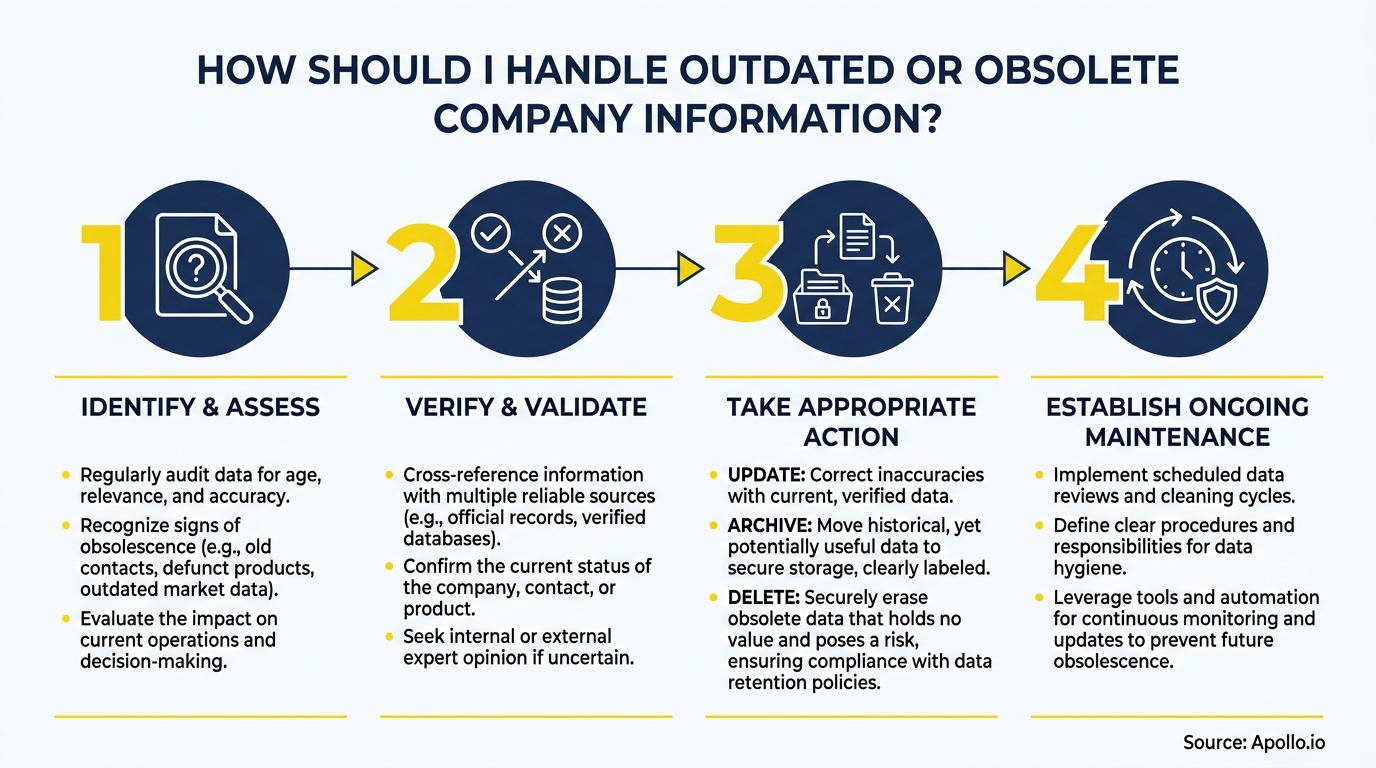
Fixing outdated company information requires a one-time audit followed by a permanent governance system. A single cleanup project without ongoing process just restarts the decay clock.
Step 1: Audit and triage. Pull a full content and data inventory. Flag every asset by tier, last-reviewed date, and owner. Prioritize Tier 1 assets for immediate review.
Step 2: Retire what cannot be updated. Content that references discontinued products, old pricing, or obsolete market conditions should be unpublished or redirected rather than left live with a disclaimer.
Stale pages hurt SEO and buyer confidence equally.
Step 3: Implement governance before publishing resumes. No new content should go live without an assigned owner, a review date, and a tier classification.
Build this into your CMS workflow or content brief template.
Step 4: Switch to continuous enrichment for CRM data. Quarterly cleanups cannot keep pace with the rate at which B2B records change. Always-on enrichment with automated re-validation triggers is the current standard for GTM teams serious about pipeline quality. Pair this with B2B email list building best practices to ensure new records enter clean from day one.
Teams that treat data governance as an operational function rather than a periodic project reduce wasted outreach, protect sender reputation, and give AI tools accurate inputs that produce reliable outputs. For broader context on building a scalable outbound engine, see how to use sales automation the right way.

Stop Letting Stale Data Drain Your Pipeline
Outdated company information is a solvable problem, but only with the right systems in place. Tiered governance, continuous enrichment, trust signals, and sales-marketing alignment together close the gap between what your team believes to be true and what buyers actually find when they check.
Apollo consolidates data enrichment, contact verification, and sales engagement into one unified platform, so RevOps leaders, SDRs, and AEs all work from the same accurate foundation. No patchwork of tools.
No data quality gaps between systems.
Schedule a Demo and see how Apollo keeps your company data current, your sequences accurate, and your pipeline moving.
Prove Pipeline ROI Before Q Ends
ROI pressure killing your next tool renewal? Apollo delivers measurable pipeline impact your leadership can see — fast. Leadium 3x'd their annual revenue. Your board wants proof. Apollo gives you the numbers.
Start Free with Apollo →Don't miss these
Sales
Inbound vs Outbound Marketing: Which Strategy Wins?
Sales
What Is a Sales Funnel? The Non-Linear Revenue Framework for 2026
Sales
What Is a Go-to-Market Strategy? The 2026 GTM Playbook
See Apollo in action
We'd love to show how Apollo can help you sell better.
By submitting this form, you will receive information, tips, and promotions from Apollo. To learn more, see our Privacy Statement.
4.7/5 based on 9,690 reviews
