
How Many Touchpoints Should an Outbound Sales Sequence Have?
Most outbound sequences fail not because of touch count, but because every touchpoint says the same thing: "Let's connect." In 2026, with 67% of B2B buyers preferring a rep-free experience, sequences that lead with value instead of asks consistently outperform those chasing a higher touch count. The real question isn't how many touchpoints to send — it's what each one is designed to accomplish.
Whether you're an SDR building your first cadence or a RevOps leader standardizing sequence templates across a team, this guide gives you a practical framework for designing outbound sequences that earn responses.
See how winning outbound sequences are built around purpose, not volume.

Research Less, Pipeline More With Apollo
Tired of burning hours on manual lead research while your pipeline stalls? Apollo surfaces verified contacts instantly so your team sells instead of searches. 600K+ companies have already made the switch.
Start Free with Apollo →Key Takeaways
- Most B2B deals require between 6 and 12 meaningful touchpoints — but high-ACV deals can require significantly more.
- Touch count alone doesn't drive quota attainment. Purpose, channel mix, and timing matter more.
- Buyers self-educate before engaging reps, so touchpoints should deliver useful assets, not just meeting requests.
- Signal-driven cadences — triggered by intent data and prospect behavior — consistently outperform fixed-step sequences.
- SDRs and AEs using multi-channel sequences book more meetings than those relying on a single channel.
How Many Touchpoints Should an Outbound Sales Sequence Have?
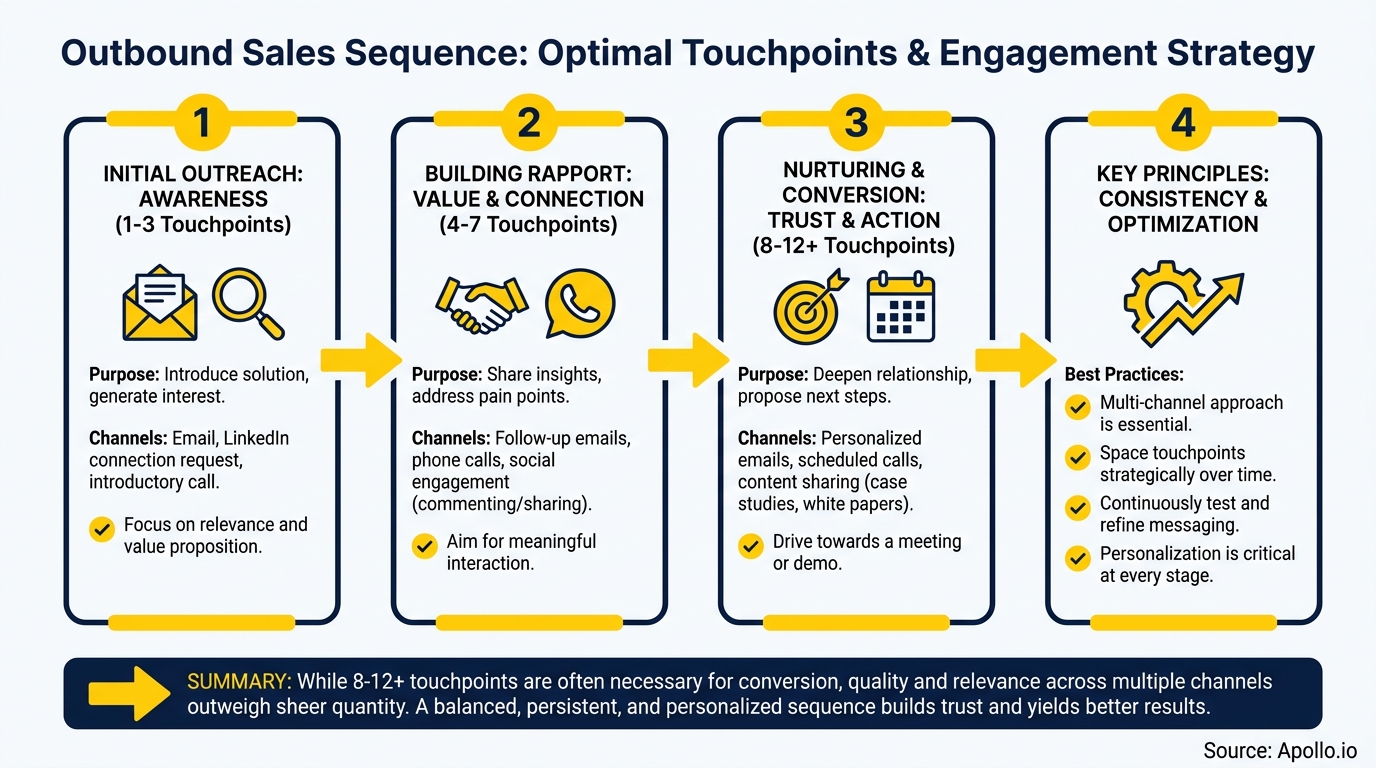
Most B2B outbound sequences should include 6 to 12 touchpoints spread across 2 to 4 weeks. Research from Abstrakt Marketing Group shows it takes 6 to 8 meaningful and strategic touchpoints to convert a lead into a customer, though this number rises for complex or high-ticket deals. Tendril reports that 8 to 12 contacts deliver the best results for effective outreach within a cadence.
The range isn't fixed — it shifts based on deal size, ICP, and channel mix. Here's a quick reference by scenario:
| Scenario | Recommended Touchpoints | Timeframe |
|---|---|---|
| SMB / transactional deal | 5–8 | 2–3 weeks |
| Mid-market / considered purchase | 8–12 | 3–4 weeks |
| Enterprise / complex deal | 12–20+ | 4–8 weeks |
| High-ACV ($100K+) | 40–417 (full journey) | Multi-month |
Data from HockeyStack shows that opportunities at or above $100,000 ACV can involve up to 417 touchpoints across the full customer journey — 1.5 times the average. For SDRs targeting enterprise accounts, this reinforces why persistence and multi-threading matter.
Why Does Touch Count Vary So Much?
Touch count varies because every buyer's journey, deal complexity, and channel preference is different. According to Email Tool Tester, the number of touchpoints before a sale can range from as few as 1 to as many as 50, depending on the prospect's buying stage and their existing relationship with the business.
Key variables that shift the number:
- Deal size: Higher ACV requires more education, more stakeholders, more touches.
- ICP familiarity: Warm inbound leads convert faster than cold outbound contacts.
- Channel mix: Multi-channel sequences naturally accumulate more touchpoints across email, phone, and social.
- Buyer awareness: Prospects already in-market need fewer educational touches before a conversation.
For outbound prospecting, sequences targeting cold contacts should plan for the higher end of the range — and build in value at each step rather than repeating the same ask.

What Is a Touch Purpose Framework and Why Does It Matter?
A touch purpose framework assigns a specific objective to each touchpoint in a sequence, moving away from volume-first thinking toward intentional, buyer-enabling outreach. Instead of sending 10 variations of "are you free for a call?", each touch delivers something distinct: a relevant insight, a proof asset, a direct question, or a break-up message.
Here's a sample 8-touch framework mapped to buyer stages:
| Touch # | Channel | Purpose | Asset / Action |
|---|---|---|---|
| 1 | Pattern interrupt | Personalized opening line + one insight | |
| 2 | Phone | Voice presence | Brief voicemail referencing email |
| 3 | Value delivery | Relevant benchmark, case study, or one-pager | |
| 4 | Social | Soft engagement | Comment on their content or share a resource |
| 5 | Proof + social validation | Customer story or ROI data point | |
| 6 | Phone | Direct ask | Connect call with a specific agenda |
| 7 | Objection preemption | Address the most common hesitation | |
| 8 | Break-up | Final message, permission to close the loop |
SDRs who map purpose to each touch report fewer wasted follow-ups and more qualified conversations.
For template examples, see the top 3 sales sequences used in Apollo.
Turn Funnel Guesswork Into Pipeline Confidence
Tired of watching quality leads stall before they ever reach your pipeline? Apollo surfaces verified, in-market buyers so your team works real opportunities — not dead ends. Nearly 100K paying customers stopped forecasting blind.
Start Free with Apollo →How Do SDRs Use Multi-Channel Sequences to Book More Meetings?
SDRs book more meetings by distributing touchpoints across email, phone, and social rather than relying on any single channel. Multi-channel outreach combining these channels boosts engagement results by over 287% compared to single-channel approaches, according to data from SalesO.
Channel-specific guidance for SDRs:
- Email: Over two-thirds of B2B buyers prefer email as their method of contact, per Sopro — make it your primary channel but not your only one.
- Phone: Use calls to reinforce email messaging, not duplicate it. Leave short, reference-based voicemails.
- Social: Engage authentically before pitching. Commenting on a prospect's post counts as a touch with zero friction.
- Video: Personalized video in outreach can increase email response rates and meeting book rates significantly compared to text-only sequences.
Spending hours switching between tools to manage multi-channel outreach? Automate your multi-channel sequences with Apollo's sales engagement platform and run email, phone, and social touches from one workspace.
How Should Signal-Driven Intent Data Change Your Cadence?
Signal-driven cadences adjust touch frequency and content based on real-time buyer behavior, replacing fixed-step sequences with dynamic responses to prospect intent. When a contact visits your pricing page, downloads a resource, or shows buying signals, that's the moment to accelerate — not wait for touch #7.
Practical ways to integrate signals into your sequence design:
- Trigger sequences on intent events rather than calendar-based intervals.
- Prioritize active accounts showing research behavior over cold contacts at the same stage.
- Shorten sequences for in-market buyers — they need fewer educational touches before a direct ask.
- Pause or branch sequences when a contact engages with a specific asset, routing them to a more relevant follow-up track.
Understanding how intent data works in B2B sales is foundational to building cadences that respond to buyer behavior instead of running on autopilot. RevOps leaders who operationalize intent signals reduce wasted outreach and improve sequence-to-meeting conversion rates.
What Are the Right Stop Rules for an Outbound Sequence?
Stop rules define when to exit a prospect from a sequence, either because they've responded, disengaged, or exhausted your touch limit. Without clear stop rules, sequences run indefinitely and damage sender reputation.
Recommended stop triggers:
- Prospect replies (positive or negative) — exit immediately and handle manually.
- Prospect books a meeting — remove from sequence, log in CRM.
- Prospect unsubscribes or asks to be removed — exit and suppress permanently.
- No engagement after full sequence — move to a low-frequency nurture track, not a repeat sequence.
- Bounced email or disconnected number — flag for data enrichment before re-engaging.
For sales automation to work cleanly, stop rules must be built into your sequence logic from the start. Recycling unengaged contacts back into the same sequence is a common SDR mistake that inflates touch counts without improving outcomes. See how to build winning sequences in Apollo with built-in automation and exit logic.
How Can SDRs and AEs Measure Sequence Effectiveness Beyond Touch Count?
Sequence effectiveness is best measured by pipeline impact and engagement quality, not the number of touches sent. Touch count is an input metric — it tells you activity, not outcomes.
KPIs that matter more than touch volume:
- Reply rate by touch number: Identify which steps generate responses and which fall flat.
- Meeting booked rate: Divide meetings booked by contacts enrolled in the sequence.
- Asset engagement: Track opens, clicks, and time spent on shared resources.
- Sequence-to-opportunity rate: How many enrolled contacts convert to pipeline?
- Time to first response: Faster responses indicate better targeting and messaging fit.
AEs managing active pipeline benefit from tracking time-to-decision alongside engagement data to identify where deals stall. Sales analytics tools that surface sequence performance by step, channel, and persona give RevOps teams the data needed to optimize cadences continuously.

Build Smarter Sequences in 2026
The right number of touchpoints for an outbound sales sequence sits between 6 and 12 for most B2B deals — but the number is secondary to the quality of each touch. In 2026, winning sequences deliver buyer enablement assets, respond to intent signals, and include clear stop rules.
Volume without purpose burns your pipeline and your sender reputation.
Ready to build sequences that actually convert? Grab the Apollo Outbound Sales Resource Kit for free templates and scripts, or explore how Apollo consolidates prospecting, sequencing, and analytics into one platform — no need to juggle separate tools. "Having everything in one system was a game changer" (Cyera).
Struggling to turn your sequence strategy into booked meetings? Automate your outbound cadences with Apollo's AI-powered sales automation and let intent signals do the prioritization for you. Start a free trial today.
Prove Pipeline ROI With Apollo
ROI pressure killing your tool budget? Apollo delivers measurable pipeline impact so you can walk into every budget review with hard numbers. Leadium 3x'd annual revenue — your team is next.
Start Free with Apollo →Don't miss these
Sales
Inbound vs Outbound Marketing: Which Strategy Wins?
Sales
What Is a Sales Funnel? The Non-Linear Revenue Framework for 2026
Sales
What Is a Go-to-Market Strategy? The 2026 GTM Playbook
See Apollo in action
We'd love to show how Apollo can help you sell better.
By submitting this form, you will receive information, tips, and promotions from Apollo. To learn more, see our Privacy Statement.
4.7/5 based on 9,690 reviews
