
How Many Leads Can You Find for a Niche Industry Using a Sales Platform?
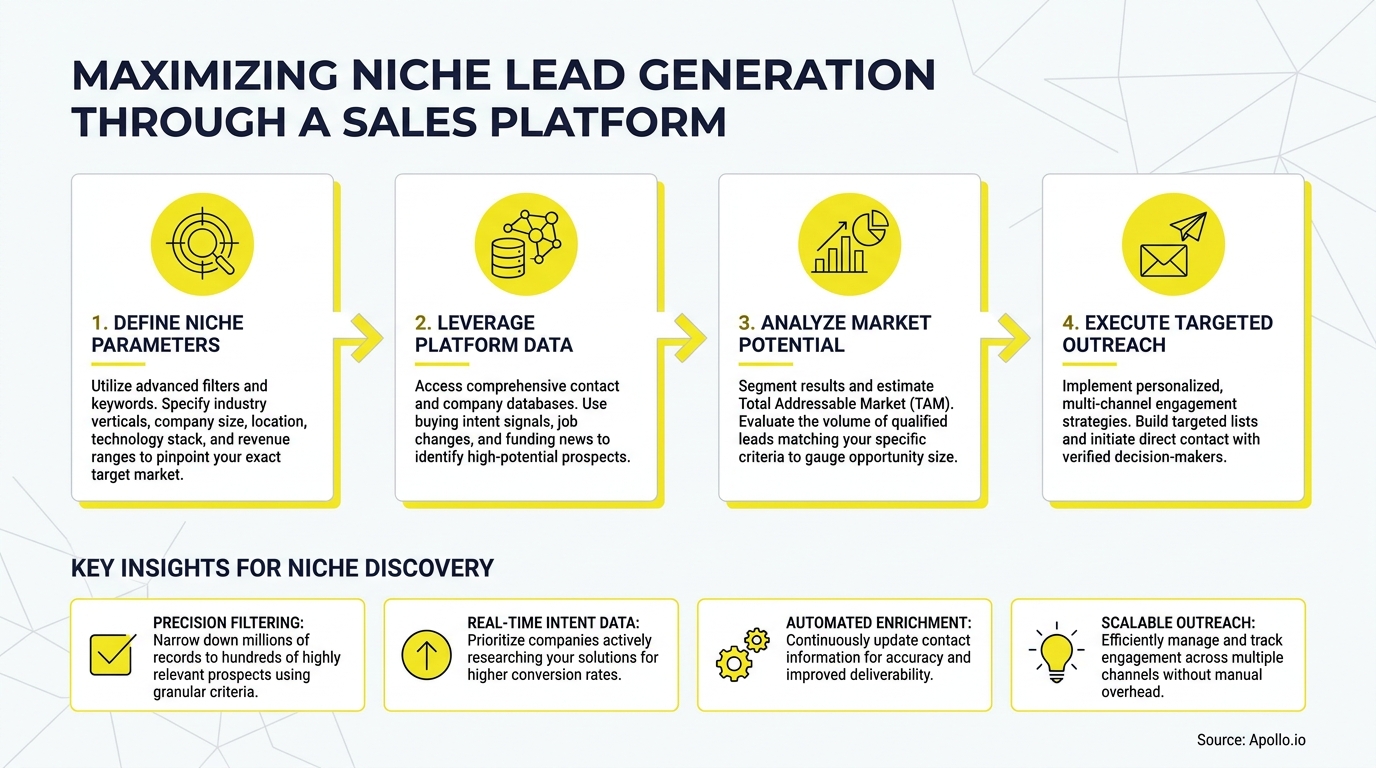
The honest answer: database size is a vanity metric. A platform with 230M+ contacts means nothing if your niche has 800 qualifying companies. What actually determines your niche lead yield is your total addressable universe, your ICP filter precision, and your data quality. This guide gives you a repeatable framework to forecast realistic lead volumes before you ever run a search. For a broader look at sales prospecting and how to find and close the right leads faster, the fundamentals apply at every scale.

Research Less, Pipeline More With Apollo
Tired of burning hours verifying contact info that goes nowhere? Apollo delivers 230M+ contacts with 97% email accuracy so your reps spend time selling, not searching. Start building pipeline today.
Start Free with Apollo →Key Takeaways
- Your niche lead ceiling is set by your TAM (total addressable market), not your platform's database size.
- Firm-level TAM and contact-level TAM are different numbers. Confusing them leads to pipeline gaps.
- Data quality metrics like verification rate and contact freshness cap your usable lead volume.
- Intent data and AI-driven prospecting can meaningfully expand discoverable leads inside a small niche.
- SDRs and RevOps teams working niche verticals get more pipeline from tighter ICP definitions than from larger exports.
What Is the Difference Between Firm-Level TAM and Contact-Level TAM?
Firm-level TAM counts the number of qualifying companies in your niche. Contact-level TAM multiplies that by the average number of reachable decision-makers per account.
These are two separate numbers, and conflating them is the most common forecasting mistake in niche B2B prospecting.
For example: if your niche has 1,200 qualifying establishments (firm-level TAM) and you target two buyer roles per account, your contact-level TAM is roughly 2,400 contacts. That is your ceiling before data quality adjustments. The U.S. Census Bureau's County Business Patterns dataset provides annual establishment counts by NAICS code, making it a reliable starting point for firm-level sizing before you open any platform.
How Do You Forecast Niche Lead Yield Step by Step?
A niche lead yield forecast starts with your firm-level TAM and applies three sequential discounts to arrive at a usable lead count.
| Step | Input | Typical Discount | Output |
|---|---|---|---|
| 1. Firm-level TAM | NAICS + geo + revenue/headcount filters | — | Total qualifying companies |
| 2. Platform coverage | % of TAM companies in database | Varies by niche (40–90%) | Reachable companies |
| 3. Contact-level expansion | Avg. target roles per account | — | Gross contact pool |
| 4. Data quality discount | Verification rate + freshness | 15–35% reduction | Verified, deliverable contacts |
| 5. Intent filter | In-market signal threshold | Surfaces 10–30% of pool | High-priority leads this week |
The result of step 4 is your true niche lead yield. Step 5 does not increase your total, but it prioritizes which contacts your SDRs should contact first, which matters when every bad record in a small list hurts deliverability and sender reputation.
Struggling to find qualified leads in a tight niche? Search Apollo's 230M+ contacts with 65+ filters to model your niche pool before committing to outreach.
What Does a Real Niche Lead Forecast Look Like?
Here is a worked example using a medtech quality compliance niche (NAICS 339112, U.S., companies with 50–500 employees, targeting Quality and Regulatory Affairs roles).
- Firm-level TAM: ~1,400 qualifying establishments (CBP estimate)
- Platform coverage: ~75% = 1,050 reachable companies
- Target roles per account: 2 (VP Quality, Regulatory Affairs Director) = 2,100 gross contacts
- Data quality discount (20%): ~1,680 verified, deliverable contacts
- Intent-filtered priority list: 250–400 contacts showing in-market signals at any given time
That 250–400 figure is your actionable weekly or monthly pipeline, not 2,100. This distinction matters for calculating return on sales accurately and avoiding false pipeline projections.
A sales professional shared a firsthand perspective on Redditthat captures this reality well: in niche life sciences, they generate 60–80 qualified leads per quarter, with each lead worth $1,000–$100,000 to the business and a CPL of $250–$350. Volume is low. Value per lead is high. That ratio should anchor your forecast expectations for any narrow vertical.
Turn Weak Funnels Into Pipeline Gold
Tired of watching marketing leads die before they ever reach sales? Apollo surfaces in-market buyers with precision targeting so every rep works a funnel that actually converts. 600K+ companies trust Apollo to fill the top.
Start Free with Apollo →Why Does Data Quality Cap Your Niche Lead Volume?
In a niche market, data quality has an outsized impact because your pool is small and every wasted contact reduces working pipeline. A Reddit commenter wrote in a discussion about niche lead sourcing that biotech and pharma databases suffer from high contact turnover at the researcher and director level, plus nonstandard titles that broad B2B databases miscategorize or miss entirely.
Three data quality metrics control your usable lead ceiling:
- Verification rate: What percentage of exported contacts have confirmed, deliverable emails
- Freshness: How recently the contact record was validated (role changes decay fast in niche verticals)
- Coverage depth: Does the platform hold the nonstandard titles common in your vertical, or only generic job functions
According to Dux-Soup's B2B Lead Generation Report, email is the most widely adopted lead generation channel, with 88% of businesses using it. In a niche where your list is small, a high bounce rate does not just waste credits. It damages sender reputation and reduces the effectiveness of every subsequent campaign.

How Can SDRs Use Intent Data to Expand a Small Niche Pipeline?
SDRs working small TAMs can expand their effective pipeline by surfacing in-market accounts within a fixed contact universe, rather than trying to grow the universe itself. Intent data functions as a lead multiplier: it does not add contacts, but it identifies which contacts are actively researching solutions right now.
For SDRs and BDRs, the practical workflow looks like this:
- Set intent topics aligned to your solution category (not just brand terms)
- Route accounts showing intent signals to sequences immediately
- Deprioritize the remaining pool and return to it on a 30–60 day cadence
- Use AI-driven lookalike discovery to identify adjacent personas not captured by strict title filters
Apollo's agentic prospecting, announced in March 2026, moves this process from manual filter-setting to AI-driven ICP discovery. The platform iteratively expands your niche definition to include adjacent functions and lookalike titles while maintaining deliverability safeguards. This is especially valuable when your initial title list is narrow. Learn more about how intent data powers smarter B2B sales and how to integrate it into your niche prospecting workflow.
Research from Semrush shows 69% of B2B professionals report sales is becoming more difficult. In niche markets, intent signals are one of the clearest ways to counteract that difficulty by ensuring your outreach reaches accounts when they are most likely to respond.
How Should RevOps Leaders Measure Niche Lead Program Performance?
RevOps leaders should measure niche lead programs against serviceable lead metrics, not raw export counts. The right baseline metrics are verified contacts generated per week, contact-to-reply rate, and pipeline sourced per verified lead. These connect directly to sales analytics and revenue growth reporting.
A useful measurement framework:
| Metric | Baseline Target | Why It Matters |
|---|---|---|
| Verified contacts / week | Set from yield forecast | Tracks list exhaustion rate vs. TAM |
| Contact-to-reply rate | Benchmark against vertical | Signals ICP fit and message relevance |
| Intent-sourced pipeline % | Track monthly | Measures intent data ROI in niche |
| Data decay rate | Monitor quarterly | Flags when re-enrichment is needed |
Data from Reach Marketing shows 91% of marketers rank lead generation as their top priority, which means budget and attention are available. RevOps teams that tie niche lead yield to revenue attribution will secure that budget more reliably than those reporting on raw list size. For teams consolidating tools to improve attribution clarity, Predictable Revenue reduced tech stack complexity by moving to a unified platform, making RevOps reporting significantly cleaner.
Spending too much time managing disconnected data sources for your niche campaigns? Enrich and verify your niche contacts in Apollo's unified platform to reduce decay and improve pipeline accuracy.

How Many Niche Leads Can You Realistically Find in 2026?
The realistic niche lead yield depends on four variables: your firm-level TAM, platform coverage of that TAM, the number of target roles per account, and your data quality discount. There is no universal number.
A narrow medtech quality niche might yield 1,500 verified contacts total. A broader professional services vertical might yield 40,000.
The framework above produces a defensible estimate for any vertical.
What has changed in 2026 is how you reach that ceiling faster. AI-driven prospecting expands beyond exact title matches to surface adjacent personas. Waterfall enrichment stacks increase coverage in niches where single-source databases fall short. Intent data prioritizes your fixed pool so SDRs contact the right accounts at the right time. Building a sales tech stack that scales around these capabilities is what separates teams that exhaust their niche in 90 days from teams that generate consistent pipeline from the same TAM all year.
Apollo consolidates prospecting, enrichment, engagement, and intent into one platform, eliminating the manual overhead of assembling a multi-tool waterfall stack. Trusted by nearly 100K paying customers across every vertical, it is built for GTM teams that need to do more with a defined universe of accounts.
Get Leads Now and run your niche lead forecast inside Apollo for free.
Prove Pipeline ROI Before Next QBR
ROI pressure killing your tool adoption? Apollo delivers measurable pipeline impact from day one — 35% increase in bookings with AI-powered messaging. Start your free trial and show leadership real numbers fast.
Start Your Free Trial →Don't miss these
Sales
Inbound vs Outbound Marketing: Which Strategy Wins?
Sales
What Is a Sales Funnel? The Non-Linear Revenue Framework for 2026
Sales
What Is a Go-to-Market Strategy? The 2026 GTM Playbook
See Apollo in action
We'd love to show how Apollo can help you sell better.
By submitting this form, you will receive information, tips, and promotions from Apollo. To learn more, see our Privacy Statement.
4.7/5 based on 9,690 reviews
