
How Many Follow-Up Messages Are Appropriate in a Sales Campaign
Most sales teams ask the wrong question. Instead of "how many follow-up messages are appropriate in a sales campaign," the better question is: what signal earned the next message? The answer shapes everything from sequence length to channel mix to reply rates. And with stricter email deliverability rules now enforced by both Google/Yahoo and Microsoft Outlook (effective May 2025), sending more follow-ups without a strategy can actively damage your pipeline instead of building it.
This guide gives you a data-backed framework for follow-up cadence, channel coverage, and persona-aware sequencing, whether you're an SDR managing cold outbound or an AE following up on a warm inbound lead. For teams looking to drive revenue through sales automation, the right cadence is foundational.

Research Less, Pipeline More With Apollo
Tired of burning hours verifying contacts that go nowhere? Apollo delivers 230M+ accurate business contacts so your reps spend time selling, not searching. Start building real pipeline today.
Start Free with Apollo →Key Takeaways
- Most B2B cadences perform best in the 4–8 touch range, spread across 17–21 days, with each follow-up delivering new value rather than repeating the original pitch.
- The first follow-up message consistently generates the largest lift in positive replies. Stacking 5+ emails without engagement signals sharply increases unsubscribe and spam-complaint risk.
- Multi-channel cadences (email + phone + social) outperform single-channel email sequences, and B2B buyers now use an average of 10 interaction channels during a purchase decision.
- For inbound leads, speed to first contact matters more than total follow-up count. Responding within 5 minutes dramatically outperforms waiting 10 minutes or more.
- Signal-based sequencing, where the next touch is triggered by prospect behavior rather than a fixed schedule, is the emerging standard for high-performing GTM teams.
How Many Follow-Up Messages Are Appropriate in a Sales Campaign?
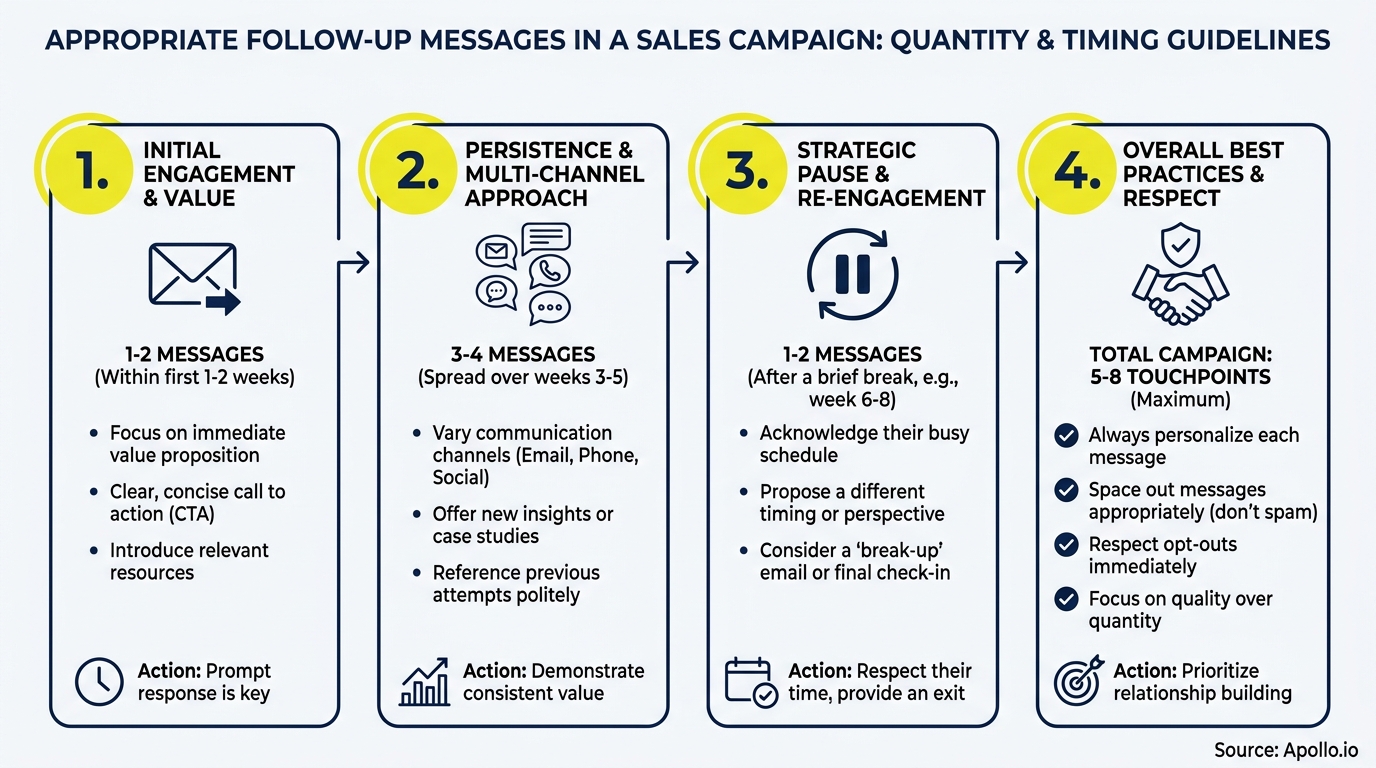
For most B2B sales campaigns, 3–6 follow-up messages (after the first outreach) is the practical sweet spot, with the total sequence spanning 8–12 touchpoints over 17–21 days. Research from Tendril confirms that a well-structured B2B cadence commonly spans this window with that touchpoint range. Shorter sequences leave pipeline on the table. Longer ones risk deliverability damage and diminishing returns.
The range isn't fixed. It shifts based on three variables:
- Lead source: Inbound leads warrant faster, shorter sequences. Cold outbound allows more persistence.
- ICP tightness: Narrow TAMs justify longer, more careful follow-up. Large TAMs can afford shorter sequences and higher volume.
- Channel mix: Multi-channel cadences distribute touches across email, phone, and social, reducing per-channel risk while increasing total contact attempts.
According to Martal, 92% of reps quit after four attempts or fewer, even though most B2B deals require more follow-up than that. The persistence gap is real, and it's where deals get lost.
What Does the Data Say About Follow-Up Reply Rates?
Follow-up messages do generate measurable lift, but the gains taper off after a few touches. A sales professional shared a firsthand perspective on Reddit that cold outbound typically yields 1–1.5% positive replies on the first touch, climbing to 2.5–4% positive replies after 3–4 follow-ups. That incremental lift is real, but it comes with a tradeoff: Belkins notes that going from 1 to 5+ emails can cut the reply rate by more than half. More volume does not always mean more pipeline.
The implication: follow-ups are worth sending, but each one needs to earn its place. A follow-up that re-states the original pitch without adding new insight is just noise.
Every message should introduce a new angle, a relevant proof point, or a clear opt-out offer.

How Should SDRs and BDRs Structure a Follow-Up Cadence?
SDRs and BDRs building outbound sequences should use a 4-touch email structure with phone and social layered in, not stacked email-on-email. A practitioner wrote on Redditthat the sweet spot for outreach campaigns is: initial email, then follow-ups at days 5, 12, and 21. Each message has a distinct job: the first references the original, the second introduces a new angle, and the third is a break-up email asking if the prospect wants to be removed.
Layer in phone and social touches between emails to hit the channel coverage that modern buyers expect. McKinsey's 2024 B2B Pulse Survey found that B2B buyers use an average of 10 interaction channels during a purchase decision, up from just 5 in 2016.
An email-only sequence covers a fraction of that surface area.
Spending hours building these sequences manually? Automate your multi-channel sequences with Apollo's sales engagement platform and run email, phone, and social outreach from a single workspace.
| Day | Touch Type | Purpose |
|---|---|---|
| Day 1 | Initial outreach, lead with value | |
| Day 3 | Phone / Voicemail | First call attempt |
| Day 5 | Email Follow-Up #1 | Reference original, new hook |
| Day 8 | Social Touch | Connection request or comment |
| Day 12 | Email Follow-Up #2 | Completely new angle or case proof |
| Day 15 | Phone / Voicemail | Second call attempt |
| Day 21 | Email Follow-Up #3 | Break-up email, clear opt-out CTA |
Turn Funnel Guesswork Into Real Pipeline
Pipeline forecasting a guessing game because marketing leads never convert? Apollo surfaces high-intent prospects so your reps work opportunities that actually close. Nearly 100K paying customers stopped guessing and started hitting quota.
Start Free with Apollo →How Does Inbound Follow-Up Differ from Cold Outbound?
Inbound and outbound follow-up require completely different strategies. For inbound leads, speed to first contact is the primary lever.
Responding within 5 minutes dramatically outperforms a 10-minute delay in terms of contact rate, according to HBR's Lead Response Management research. The sequence can be shorter because intent is already demonstrated, but the first response must be fast.
Inbound leads also benefit from multi-threading. 6sense's 2025 BDR Benchmark found that 90% of BDRs now practice multi-threading (up from 83% the prior year), with 53% reaching out to three additional personas inside the same account when following up an inbound lead. A single contact rarely controls the buying decision.
For high-ticket sales and enterprise deals, both speed and multi-threading are non-negotiable. The economic buyer, champion, and technical evaluator each need a tailored message, not a forwarded email chain.
What Role Does Signal-Based Sequencing Play in 2026?
Signal-based sequencing means the next touch is triggered by prospect behavior, not a fixed calendar date. A prospect who opens your email three times in two days, visits your pricing page, or changes jobs has demonstrated intent.
That signal earns the next message faster and with higher relevance. A prospect who shows no activity after touch 3 may not deserve touch 4.
This approach directly addresses the deliverability risk that comes with long email sequences. Following Google/Yahoo bulk-sender enforcement (2024) and Outlook's stricter requirements (May 2025), spam complaints and unsubscribes now carry heavier penalties for domain reputation. Fewer, higher-signal follow-ups protect your sending domain while concentrating outreach on prospects most likely to respond. Intent data is the fuel that makes signal-based sequencing work at scale.
Not sure which prospects are ready for the next touch? Apollo's AI sales automation triggers follow-ups based on engagement signals, so your team reaches out at exactly the right moment, not on a rigid schedule.
How Many Follow-Ups Are Appropriate by Campaign Type?
| Campaign Type | Recommended Touches | Cadence Window | Channel Mix |
|---|---|---|---|
| Cold Outbound (large TAM) | 4–6 touches | 14–21 days | Email + Phone + Social |
| Cold Outbound (tight ICP) | 6–10 touches | 21–30 days | Email + Phone + Social + Direct Mail |
| Inbound Lead Follow-Up | 3–5 touches | 7–14 days | Phone first, then Email + Social |
| Post-Demo or Trial | 4–6 touches | 10–21 days | Email + Phone (multi-threaded) |
| Re-engagement (cold list) | 2–3 touches | 7–10 days | Email only, clear opt-out |
Some teams push further. Salesgenie notes that some sources extend recommended follow-up persistence to 5–12 follow-ups, particularly for longer B2B sales cycles with multiple stakeholders. That range is defensible when each touch adds new value and the sequence spans multiple channels rather than stacking emails alone.
How Can RevOps Teams Measure Cadence Effectiveness?
RevOps leaders should track cadence performance at the touch level, not just the sequence level. Knowing that a 6-touch sequence produced a 3% reply rate tells you little.
Knowing that touch #3 drove 60% of those replies tells you where to concentrate. Track these metrics per touch:
- Open rate by touch number (email only)
- Positive reply rate by touch number
- Unsubscribe and spam complaint rate (flag if rising after touch 3)
- Contact rate by channel (phone connect rate vs. email reply rate)
- Meeting booked rate by sequence and touch
For teams using sales analytics to drive revenue growth, sequence-level reporting is table stakes. Touch-level analytics is where optimization actually happens. Pair this data with intent signals and you can build conditional sequences that exit prospects early when they show no engagement, protecting domain reputation while keeping the pipeline clean.

Conclusion: The Right Number of Follow-Ups Is the One That Earns a Reply
There is no universal answer to how many follow-up messages are appropriate in a sales campaign. But the evidence points clearly toward 4–8 total touches, spread across 17–21 days, using at least three channels, with each message adding new value.
SDRs, BDRs, and AEs who treat follow-up as a fixed checklist will keep leaving pipeline on the table. Teams that use signal-based triggers, multi-thread across personas, and respect deliverability limits will convert more of the prospects they already have.
Apollo brings prospecting, sequencing, intent signals, and analytics into one platform, so your team stops juggling tools and starts building pipeline. "Having everything in one system was a game changer" — Cyera. Ready to run smarter follow-up sequences across every channel? Start free with Apollo and see why nearly 100K paying customers trust it to power their outreach.
Prove Pipeline ROI Before Next Quarter
ROI pressure killing your tool budget? Apollo delivers measurable pipeline impact from day one — not months later. Leadium 3x'd their annual revenue. See your ROI fast.
Start Free with Apollo →Don't miss these
Sales
Inbound vs Outbound Marketing: Which Strategy Wins?
Sales
What Is a Sales Funnel? The Non-Linear Revenue Framework for 2026
Sales
What Is a Go-to-Market Strategy? The 2026 GTM Playbook
See Apollo in action
We'd love to show how Apollo can help you sell better.
By submitting this form, you will receive information, tips, and promotions from Apollo. To learn more, see our Privacy Statement.
4.7/5 based on 9,690 reviews
