
How Technographic Data Helps Sales Teams Target Better-Fit Prospects
Most sales teams still prospect by industry and company size alone. That approach misses a critical dimension: what technology a prospect already runs. Technographic data fills that gap, letting reps target accounts based on their actual tech stack rather than generic firmographic signals. Paired with strong contact data enrichment, it's one of the highest-leverage targeting upgrades a GTM team can make in 2026.

Research Less, Close More With Apollo
Tired of your reps burning hours on manual lead research instead of selling? Apollo delivers verified contacts instantly, so your team spends time closing—not digging. Join 600K+ companies building pipeline faster.
Start Free with Apollo →Key Takeaways
- Technographic data reveals what software prospects use, enabling stack-fit messaging that resonates far better than generic outreach.
- Companies using technographic data report significantly higher conversion rates compared to those using traditional demographic targeting alone.
- Combining technographics with intent data accelerates qualification and surfaces accounts that both fit your ICP and are actively researching solutions.
- SDRs and AEs can use technographic triggers to personalize outreach at scale, reducing wasted effort on poor-fit accounts.
- Apollo's unified platform consolidates technographic filtering, data enrichment, and multi-channel engagement in one workspace.
What Is Technographic Data and Why Does It Matter?
Technographic data is information about the technologies, software platforms, and digital tools a company uses. It includes CRM systems, marketing automation tools, cloud infrastructure, analytics platforms, security software, and ERP systems. Rather than just knowing a company's size or industry, technographic data tells you how that company operates technically.
This matters because product fit often depends on the existing stack. A prospect running Salesforce has different integration needs than one on HubSpot. A company using an outdated CRM is a different opportunity than one actively modernizing. According to iTechSeries, 75% of B2B customers expect personalized offerings based on their technology use. Without technographics, that personalization is impossible at scale.
For teams building a scalable sales tech stack, technographic filtering is increasingly a baseline requirement, not a nice-to-have.
How Does Technographic Data Help Sales Teams Target Better-Fit Prospects?
Technographic data helps sales teams target better-fit prospects by filtering out accounts whose stack signals poor integration fit, active competitive lock-in, or low adoption readiness before a rep invests any outreach time.
Here's how it improves targeting across the funnel:
- ICP sharpening: Layer tech stack criteria on top of firmographics to define your true ideal customer. If your product integrates with Slack and Salesforce, filter for accounts running both.
- Competitive displacement: Identify accounts using a competitor's product that is reaching end-of-life or recently had negative reviews, signaling openness to switching.
- Expansion signals: Spot accounts adding new tools in adjacent categories, indicating growth and budget movement.
- Integration readiness: Qualify accounts by ERP or procurement system compatibility before engaging your technical sales team.
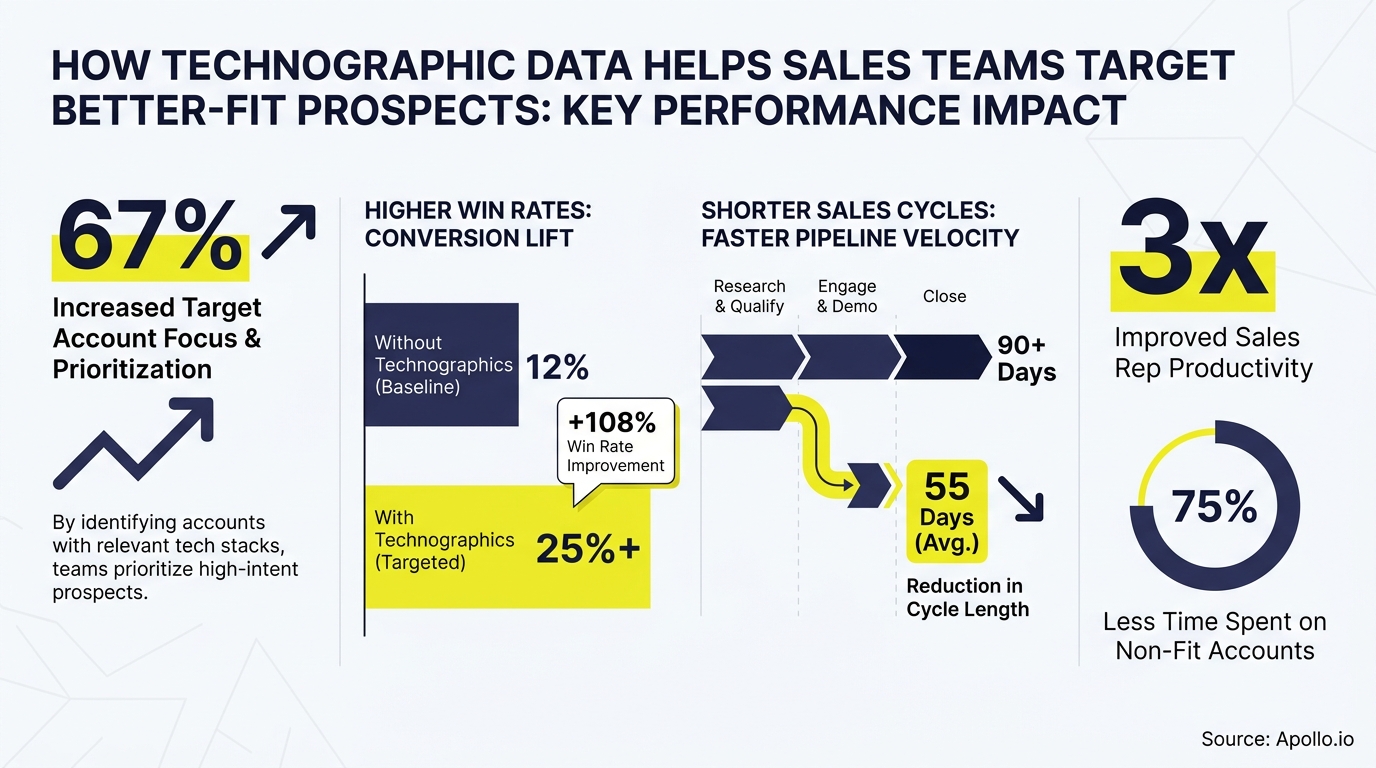
Research from Landbase shows businesses using technographic data report a 28% higher conversion rate in B2B sales campaigns compared to traditional targeting methods. That lift comes directly from eliminating poor-fit accounts before outreach begins.

How Do SDRs Use Technographic Data to Book More Meetings?
SDRs use technographic data to personalize cold outreach with specific, relevant context that generic templates cannot match.
Instead of leading with a generic value proposition, an SDR can open with a reference to the prospect's current stack and a concrete integration story.
Practical SDR applications include:
- Filtering prospects by installed CRM to tailor the integration pitch in the first line of an email sequence
- Prioritizing accounts running tools your product replaces, using stack data as a displacement trigger
- Routing accounts using enterprise security stacks to AEs with technical backgrounds for faster qualification
- Avoiding outreach to accounts locked into long-term competitive contracts identified through stack data
This precision directly addresses a major pipeline leak. A Gartner survey of 632 B2B buyers found 73% actively avoid suppliers who send irrelevant outreach.
Stack-aware messaging is one of the most direct levers to reduce that avoidance behavior and protect sender reputation.
Struggling to find qualified leads before building stack-aware sequences? Search Apollo's 230M+ contacts with 65+ filters including technographic criteria.
Turn Funnel Chaos Into Predictable Pipeline
Tired of forecasts built on guesswork while quality leads stall before they ever reach your AEs? Apollo surfaces in-market buyers and moves them through your funnel faster. Nearly 100K paying customers stopped guessing and started closing.
Schedule a Demo →How Does Combining Technographics with Intent Data Improve Funnel Performance?
Combining technographics with intent data creates a two-signal filter: technographics confirms stack fit, while intent data confirms active research behavior. Together, they identify accounts that both match your ICP and are in-market now.
According to SalesIntel, integrating technographic data with intent data allows businesses to identify companies that not only fit their ideal customer profile but also show buying intent, significantly enhancing lead scoring and prioritization.
| Signal Type | What It Tells You | Funnel Stage Best Used |
|---|---|---|
| Technographics | Current tech stack, integration fit, competitive install | ICP definition, list building |
| Intent Data | Active research topics, content consumption, buying signals | Prioritization, timing outreach |
| Combined Signal | Stack-fit accounts actively evaluating solutions | High-priority outreach, AE routing |
RevOps leaders building data enrichment strategies should treat this combination as the foundation of any lead scoring model. It removes the guesswork from prioritization and gives reps a defensible reason to reach out now.
What Are the Measurable Business Outcomes of Using Technographic Data?
The business case for technographic data is quantifiable. Organizations using it consistently report improvements across conversion, cycle length, and revenue efficiency.
Key benchmarks from external research:
- Companies leveraging technographic data are 2.5 times more likely to exceed their sales targets, according to SuperAGI.
- Congruence Market Insights reports organizations achieve up to 42% higher lead conversion rates compared to traditional demographic-based targeting.
- The global account intelligence platform market is projected to grow from $2.1 billion in 2024 to $4.8 billion by 2029, according to Bright Data, driven by demand for technographic insights.
For AEs managing pipeline, these outcomes translate to fewer wasted discovery calls, faster qualification, and stronger close rates on accounts that were properly filtered before outreach began. For revenue operations teams, it means cleaner lead scoring models and more predictable pipeline.
How Can Sales Teams Implement Technographic Targeting in 2026?
Implementing technographic targeting requires three things: access to reliable stack data, a filtering layer to apply it during prospecting, and a workflow that activates it in outreach sequences.
A practical implementation checklist:
- Step 1 — Define stack-fit criteria: List the tools your best customers run. Identify which tools signal readiness, which signal competitive risk, and which signal poor fit.
- Step 2 — Enrich your CRM: Use data enrichment tools to append technographic attributes to existing accounts and new leads.
- Step 3 — Build segmented lists: Create separate sequences for different stack profiles. Prospects on Salesforce get an integration story; prospects on legacy CRMs get a migration narrative.
- Step 4 — Layer intent signals: Prioritize within each stack segment by who is actively researching your category right now.
- Step 5 — Automate routing: Use technographic triggers to route accounts to the right rep, whether that's an SDR for outbound or a technical AE for complex stack environments.
Spending too much time manually building segmented lists? Automate stack-aware sequences with Apollo's multi-channel engagement platform.
How Does Apollo Help Sales Teams Activate Technographic Data?
Apollo consolidates technographic filtering, contact enrichment, and multi-channel outreach in a single platform, eliminating the need to stitch together separate tools for data, engagement, and analytics.
With Apollo, GTM teams can filter across 230M+ contacts and 30M+ companies using technographic criteria alongside 65+ other filters, then move directly into automated sequences without exporting to a separate engagement tool. As Cyera noted, "Having everything in one system was a game changer." That consolidation is the core value proposition: fewer tools, less data loss between systems, faster activation of signals like technographics.
RevOps leaders who previously managed separate data enrichment, prospecting, and engagement platforms find that Apollo's unified approach improves sales analytics accuracy because all activity data lives in one place. For SDRs and AEs, it means less context-switching and more time in front of prospects who actually fit.

Conclusion: Technographic Data Is a Targeting Multiplier
Technographic data transforms prospecting from a volume game into a precision exercise. It narrows the universe of potential accounts to those whose stack signals genuine fit, reduces irrelevant outreach, and gives reps a credible, specific reason to engage. Combined with intent data and a strong contact enrichment foundation, it becomes the most reliable input into any lead scoring or account prioritization model.
For B2B GTM teams under pressure to generate more pipeline with fewer resources, stack-aware targeting is not optional in 2026. It's the difference between a full calendar and a wasted quarter.
Ready to put technographic data to work? Try Apollo free and start filtering by tech stack, intent signals, and 65+ other criteria today.
Prove Pipeline ROI From Day One
Budget approval stuck on unclear metrics? Apollo surfaces measurable pipeline impact fast, so you walk into every renewal with hard numbers. Leadium 3x'd annual revenue — your CFO wants results like that.
Start Free with Apollo →Don't miss these
Sales
Inbound vs Outbound Marketing: Which Strategy Wins?
Sales
What Is a Sales Funnel? The Non-Linear Revenue Framework for 2026
Sales
What Is a Go-to-Market Strategy? The 2026 GTM Playbook
See Apollo in action
We'd love to show how Apollo can help you sell better.
By submitting this form, you will receive information, tips, and promotions from Apollo. To learn more, see our Privacy Statement.
4.7/5 based on 9,690 reviews
